



18%
of Gen Zers (and 10% of all Americans) have an ongoing personal friendship with an AI chatbot.

SpaceX joined the Nasdaq 100 and got nearly unanimous “buy” ratings — but still fell 12%
Crypto has lost half its value since October and most of its “cool” factor
First-time homebuyers hit a record low, while prices hit a record high

Who Decides What SpaceX Is Worth?
SpaceX officially joined the Nasdaq 100 last week. It qualified under new fast-track listing rules, which reduced the required trading history from at least three months to just 15 days and eliminated the minimum public float requirement. Prior to the rule change Nasdaq 100 stocks had to have a minimum float of 10%.
The stock also received a torrent of new ratings from Wall Street analysts. Of the 32 analysts covering SpaceX, only one published a “sell” rating — and it came from CFRA Research, an independent financial intelligence firm with no investment banking, asset management, or trading arms.
Financial analysts typically set price targets that estimate a stock’s future value and write notes to their clients explaining their reasoning. The price targets for SpaceX were notably optimistic.
Raymond James’ Brian Gesuale projected that SpaceX would be worth $800 per share over the next 12 to 18 months. SpaceX stock would have to increase more than 400% for that to happen, and its market capitalization would hit $10.5 trillion, equivalent to one-third of US GDP. That would make SpaceX worth more than the stock markets of the U.K., France, and Germany, combined.
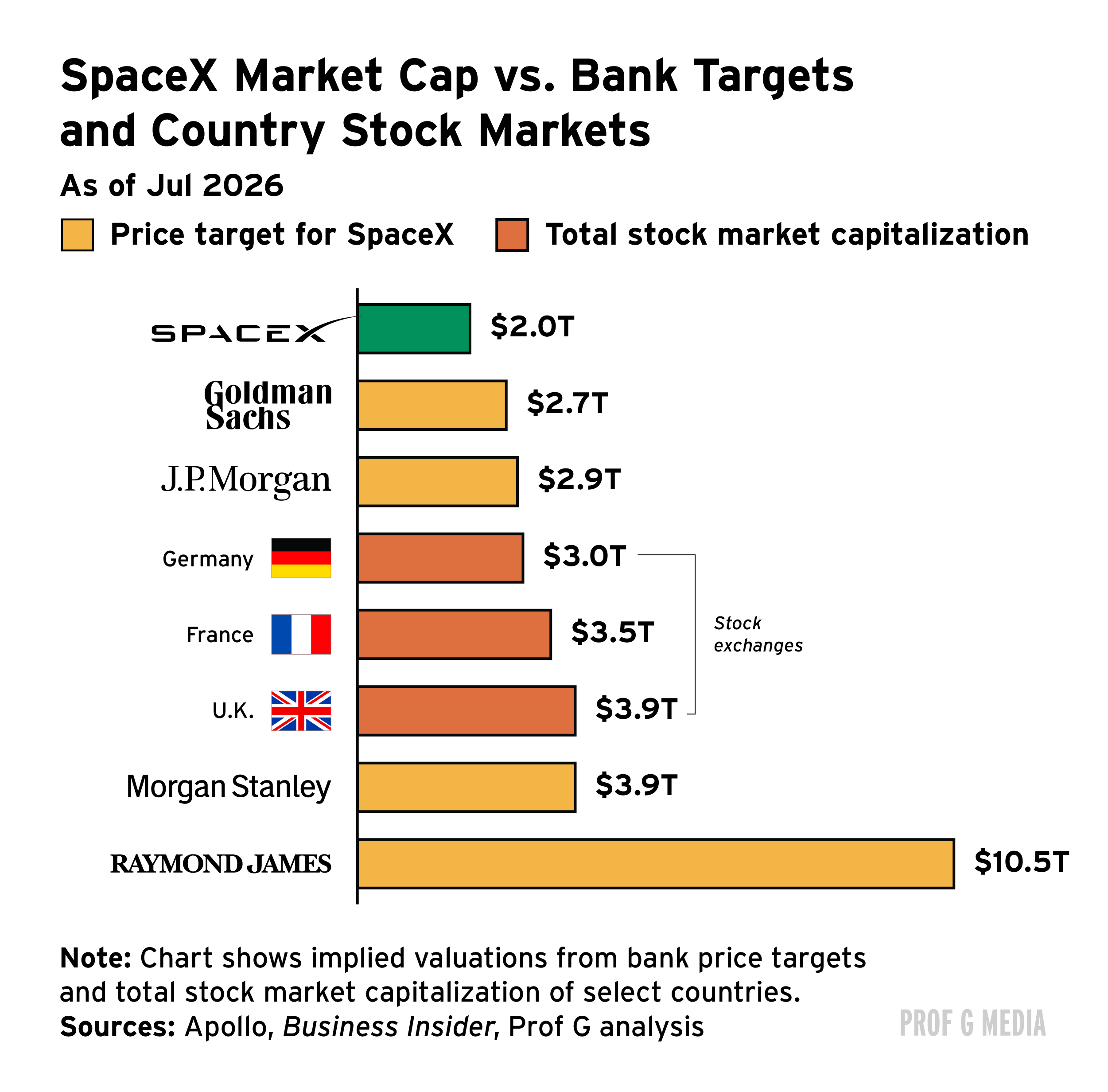
Research has found evidence that analysts bias stock recommendations upward, especially if the bank they work for is affiliated with the stock they are analyzing. This was particularly rampant during the dot-com bubble. One notable example: Just two months before Enron went under, 16 of the 17 sell-side analysts covering the stock rated it “buy” or “strong buy.” Many of them were from banks that did business with Enron.
Investor protections were put in place after the bubble burst, and it is now illegal for investment banking divisions to influence bank analysts. However, studies have shown that even after these reforms, affiliated analysts (i.e., those covering companies that also do business with their investment banking divisions) are still reluctant to issue pessimistic recommendations.
Optimism bias in the analyst community runs deep. Even controlling for accuracy, more-optimistic analysts are more likely to move up to top brokerages, and more optimistic analysts are more likely to be called on in company earnings calls.
Today, of all the 84 holdings in the Global X Artificial Intelligence & Technology ETF, only 2% of them have a net “sell” recommendation.
The analysts whose banks took SpaceX public were, on the whole, more optimistic than the group of unaffiliated analysts. One hundred percent of the affiliated analysts issued “buy” recommendations. Of the 17 analysts whose banks did not take SpaceX public, only 65% did.
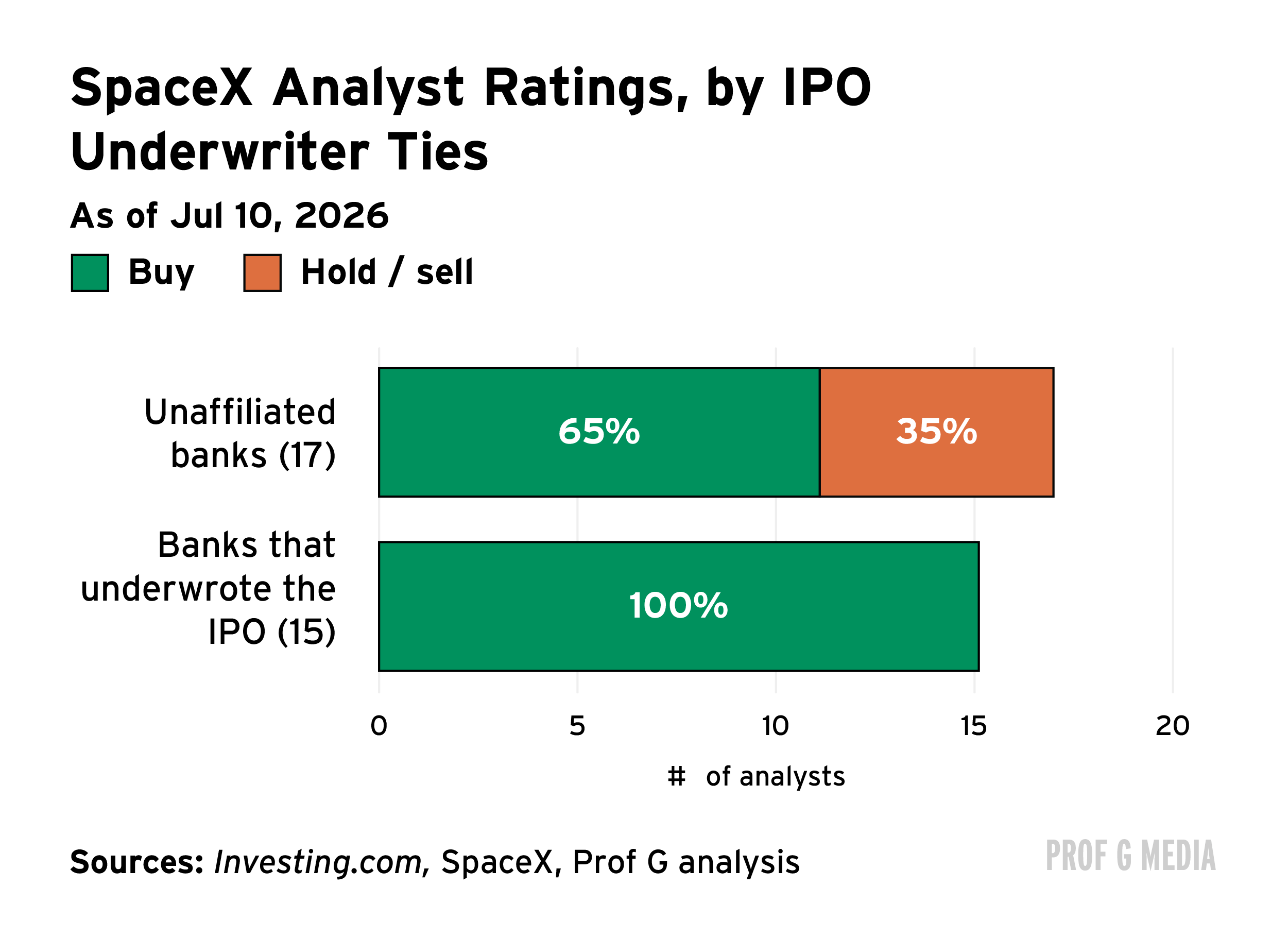
Despite the optimistic ratings, SpaceX shares fell 12% last week and are down 36% from their peak.

Morgan Stanley’s price target is $300 — that’s double where the stock is now. They also write that their bull case is $600 and their bear case is $75. They’re telling us: It could fall 50%, but it could also rise 300%. So they’re basically not telling us anything.
What we learned from the dot-com bubble is that there’s a structural conflict of interest embedded in equity research. If you assign a company a “sell” rating, then it’s unlikely that the company will be interested in working with you to underwrite their IPO, through which you would receive your 1%. So, Elon is naturally going to choose the investment banks that are nice to him.
The SEC tried to fight this with regulation in 2003 that aimed to separate the research arm of investment banks from the banking divisions responsible for getting those underwriting fees. Seven months ago, that rule was terminated by the SEC.
After that happened, former SEC Chair Arthur Levitt wrote an article in The Wall Street Journal titled “The SEC May Make Wall Street Analysts Corrupt Again.” He warned about the dangers of getting rid of this regulation.

I don’t think the analysts have as much power as they used to have. Back in the ’90s, these analysts were all over CNBC all day long. But it’s not the same today, because there are so many other sources of information.
To a certain extent, I view these targets as embarrassing. Wouldn’t it be embarrassing like in a couple years’ time, you’re at parties and people ask you, you’re the guy who said SpaceX at $300?
For those who aren’t familiar with these ratios, no company trades at 100x sales. It just doesn’t happen, and the companies that do trade at very high price-to-sales ratios are software companies where sales basically convert straight into profits — there aren’t a lot of fixed costs. In SpaceX’s case, it has massive costs: the rockets, the Nvidia GPUs, etc. It’s not just losing money, it’s losing a shocking amount of money.
And do you really want to pay 100x? You have to wait a hundred years to get your money back. It’s not really growing much either: It’s growth rate is close to 15%. SpaceX is presenting itself as an AI company, but it only has a 3.5% market share, so it’s really just hype.


The Great Brotation
The crypto market has now erased more than half of its value in the past eight months, and bitcoin ETFs have seen $8 billion in outflows in the past eight weeks. Meanwhile, AI has become the new frontier. It’s the technology people are most excited about, and it has captured the same sense of disruption and possibility that crypto once represented.
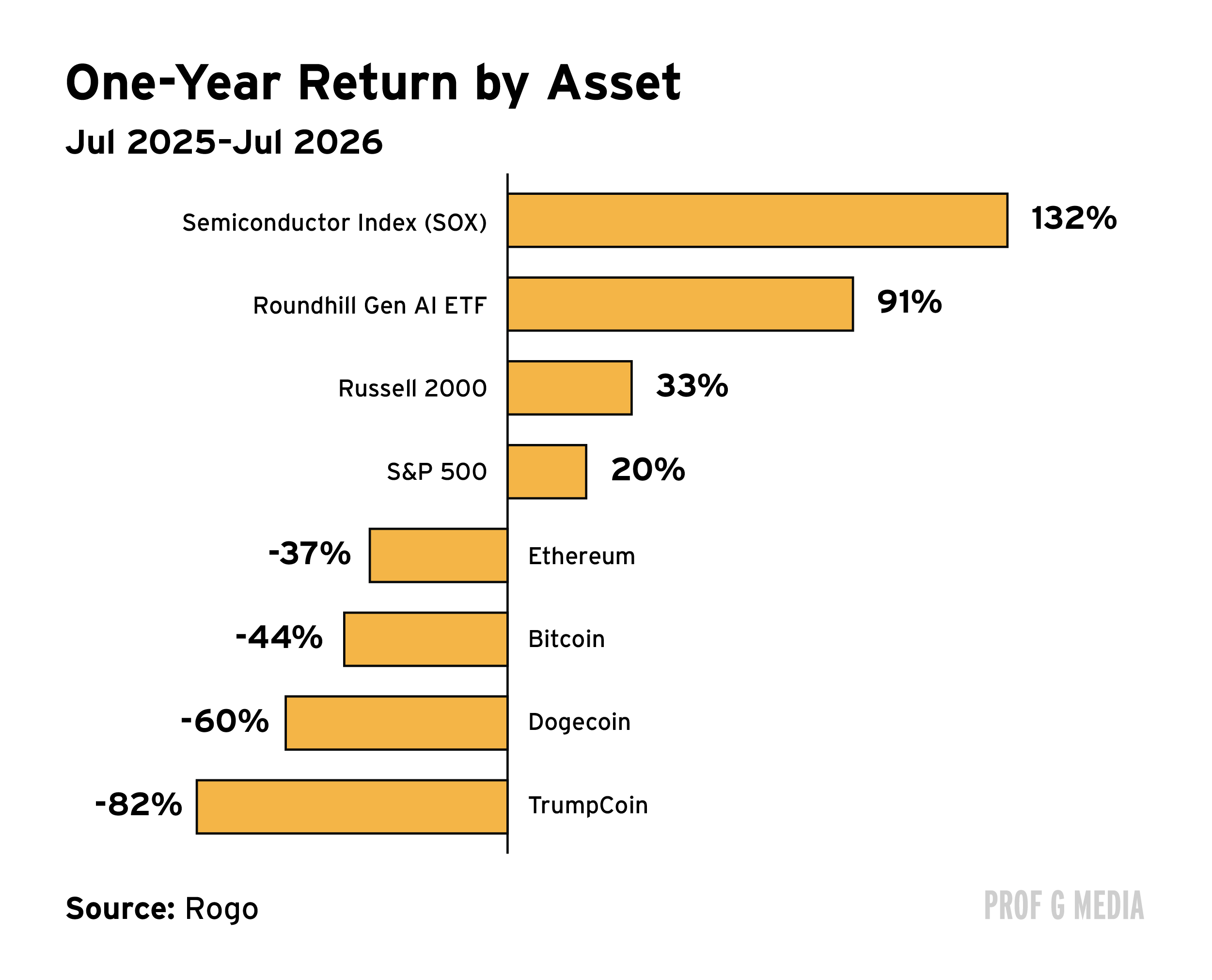
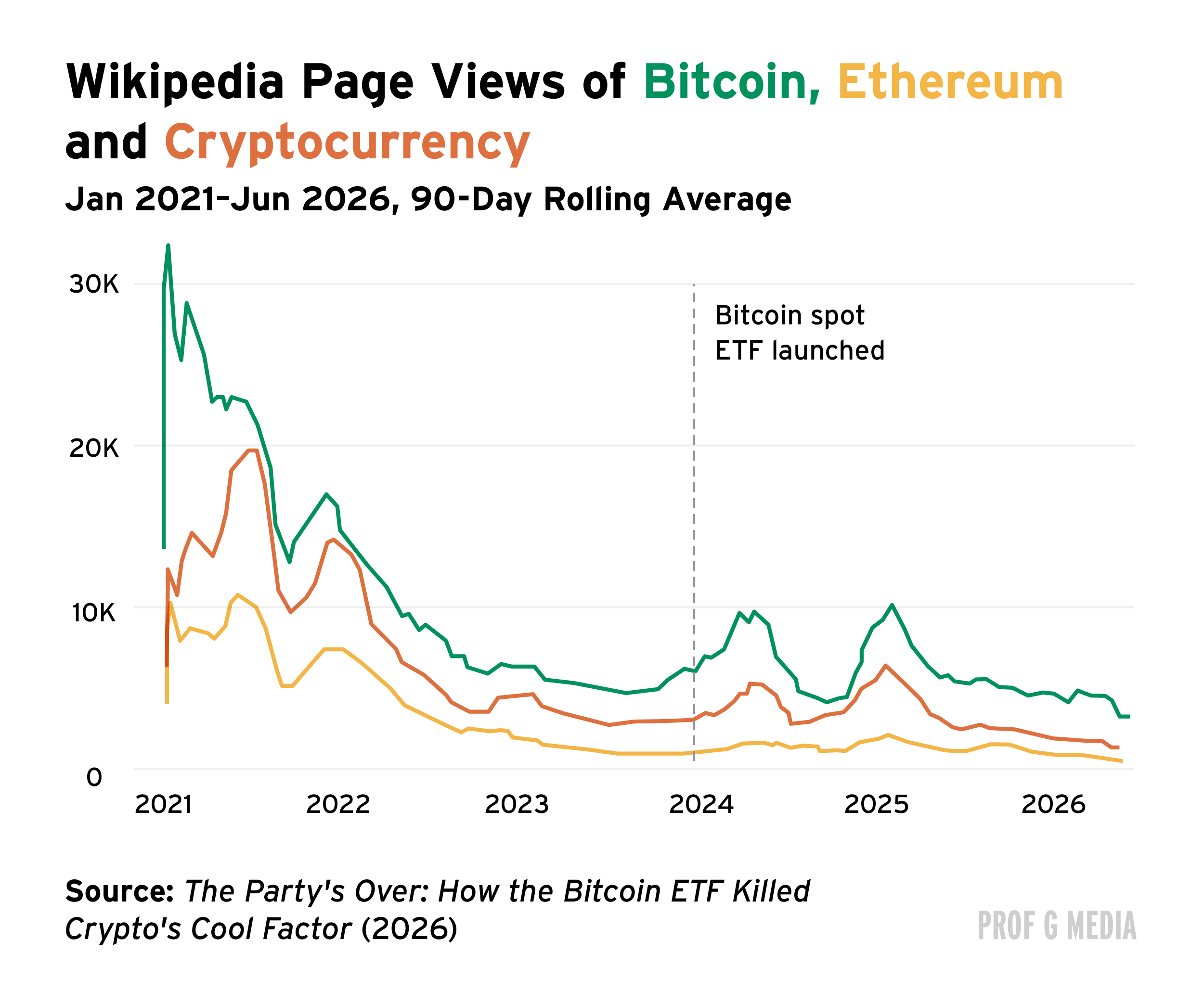
Crypto has lost its cool, and there’s academic work backing this up. A recent paper by David Krause, an associate professor of finance at Marquette University, pins the turning point on a specific date: January 2024, when the first bitcoin ETF launched. Krause’s thesis is that the moment Wall Street made crypto easy and mainstream, it stopped being cool.
As a proxy for public interest, he measured how often people Googled crypto terms and how often they visited the related Wikipedia pages. After the bitcoin ETF launched, he found that Google searches through June 2026 for dogecoin dropped 63%, searches for “cryptocurrency” dropped 47%, and Wikipedia visits to both pages fell 76% and 56%, respectively.

Crypto’s only selling point is that the line is going up and people want to buy it because they know someone who bought it for $1 and now it’s worth $60,000. So it’s really just a trend-based asset, something you talk about at parties.
But now, when you say you own bitcoin, you’re not really doing something exciting anymore. When the SEC chair is a crypto bro, and Commerce Secretary Howard Lutnick is a crypto bro, and all of Epstein Island was involved ... it’s no longer anti-establishment. The claims of use cases have evaporated as well.
If you want to be exciting, you’re probably telling people that you’re making bets on prediction markets.

Home Prices Aren’t Meant to Just Go Up
The U.S. housing market is showing new signs of strain. Last month, the median price of a home in the U.S. hit a record high at $408,838, and in April, the National Association of Realtors reported that the share of first-time homebuyers dropped to 21%, the lowest proportion since NAR began tracking the data in 1981.
This is part of a broader trend: Homeownership is increasingly out of reach for the average American. In fact, 75% of homes currently on the market are unaffordable for the typical household.
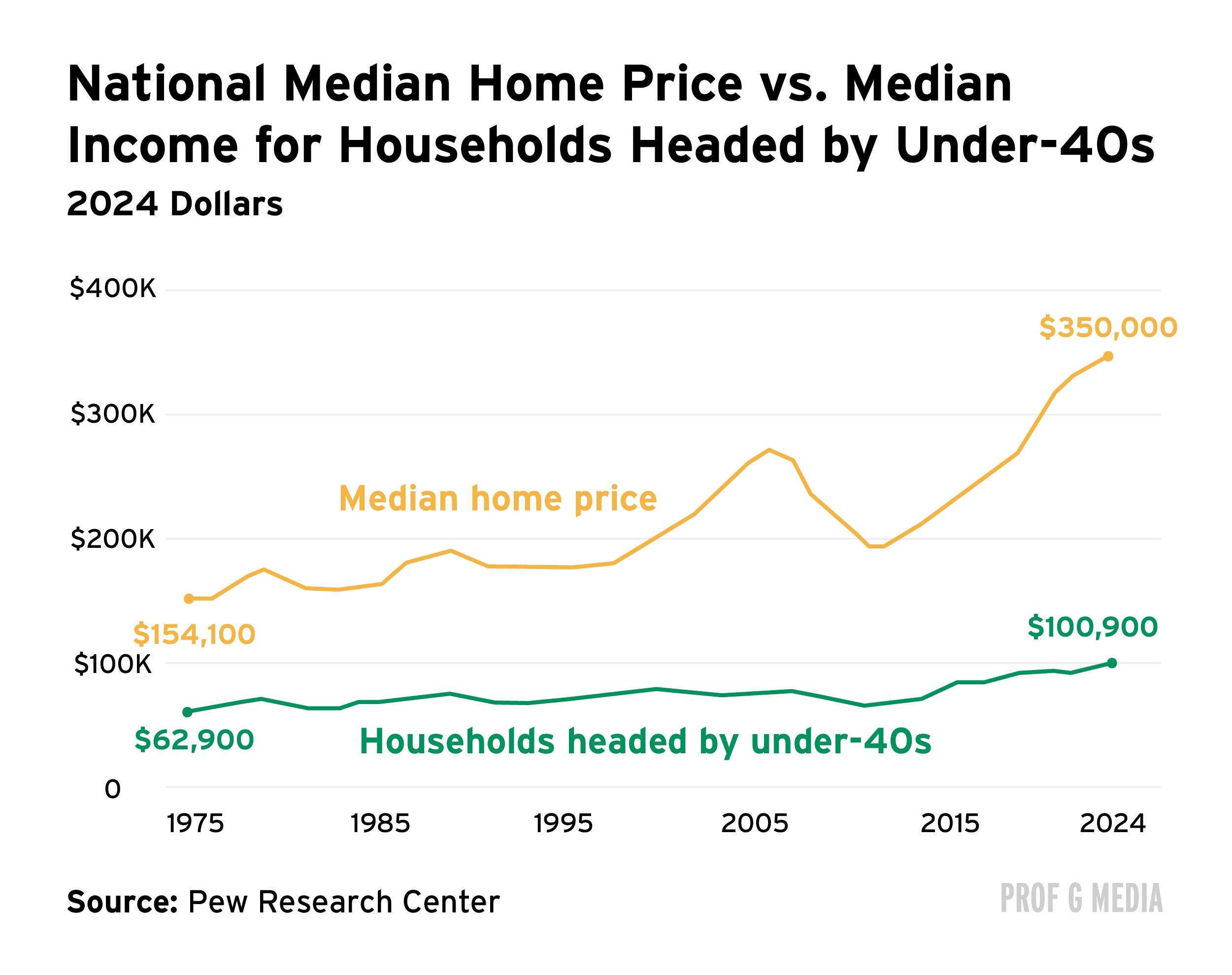
For young people, the housing market looks especially bleak. Between 2019 and 2024, the inflation-adjusted median home value rose 30%, while the inflation-adjusted median household income for those under 40 rose 9%.
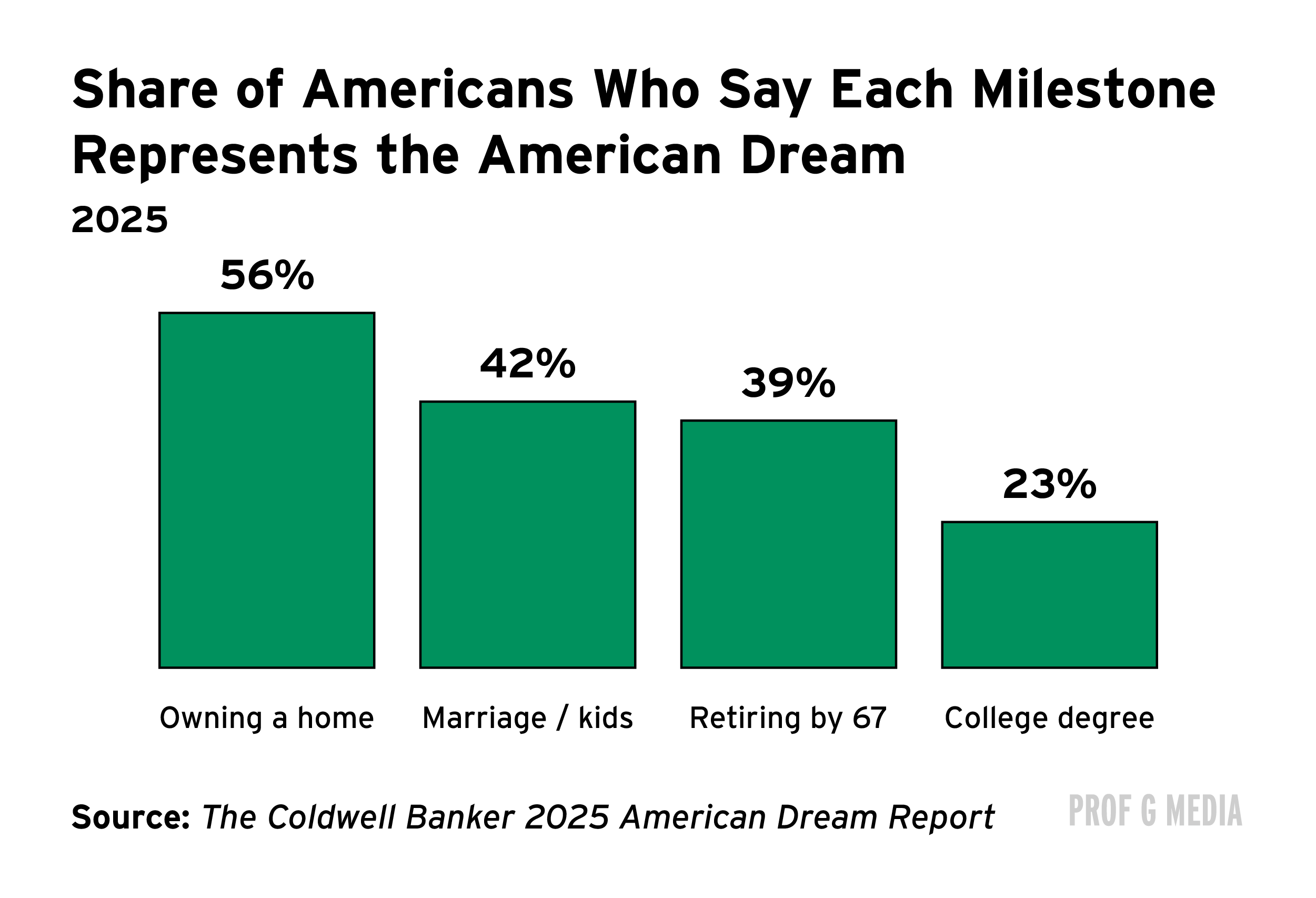
Americans still want to buy homes. Fifty-six percent of Americans say owning a home represents the American Dream, and nearly two-thirds of Americans who don’t currently own a house would like to buy one within the next five years. Unaffordability is making that goal harder — and putting off other life milestones. Nearly 1 in 5 aspiring homeowners are putting off marriage or having children until they own a home, and 17% are delaying career changes or getting a pet.
Homeownership is a hallmark of American culture, but it’s also seen as a savvy financial decision. Ninety-three percent of Americans believe that buying a home is “definitely” or “probably” a better investment than buying stocks. That’s not necessarily the case.
Moody’s compared two people earning $150,000 a year: a homeowner who bought a $500,000 house (20% down, 6.25% mortgage) and a renter paying $2,500 a month with 3% annual increases who invested the difference at a 10% return. After 30 years, assuming average annual rent and home appreciation increases, the renter came out ahead with a net worth of $2.8 million versus the owner’s $1.6 million. The analysis did not take taxes into account.

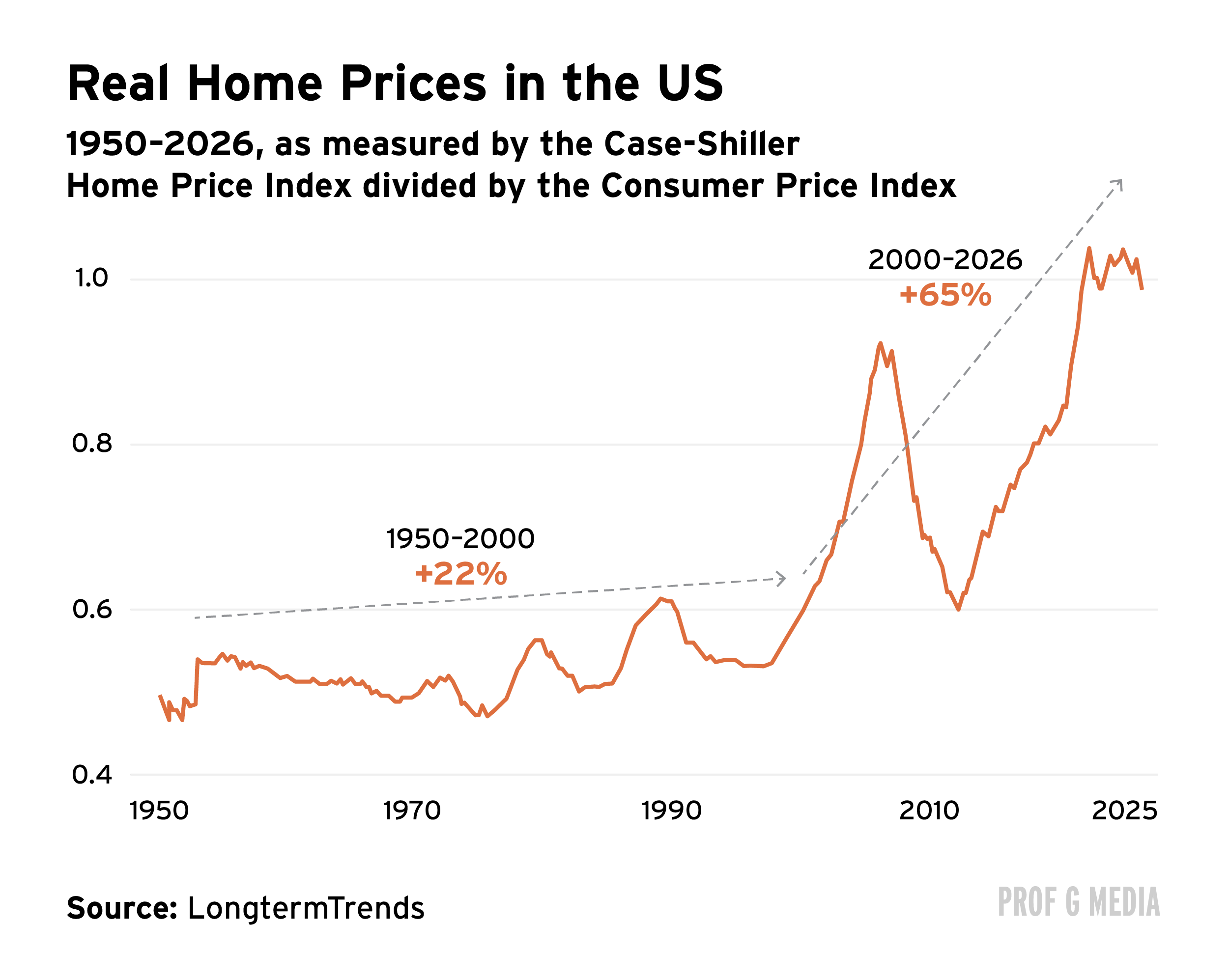
If you look at the long history of housing prices, there’s no reason to think they should go up. But it’s become an investment class. If you speak to your grandparents, they’ll never talk about the concept of real estate investing. They bought a home that they needed to live in.
So how did we get in this situation? Governments have incentivized people to buy homes, so they want prices to go up or at least stay steady. You see politicians saying, we want affordable housing for young people, but they don’t want to damage the home values of retirees who are relying on it, because young people don’t vote as much as older people. And, well, you get one or the other.
Also, if you’re buying an asset at an all-time high and it seems really unaffordable to a regular person like you, it might mean that that’s not a great investment.
I understand the emotional urge to own the place you live, but an emotional urge is different from an investment decision. If you look at the long-term return on housing versus the stock market, housing grossly underperforms the stock market.
This conversation has an interesting parallel to the crypto phenomenon: The incentive that was keeping the price of crypto up was because people just fundamentally believed that it would keep going up. I think there is the fundamental belief among Americans and current non-homeowners that the price will go up. And if you believe that, then there’s more incentive to go out and buy a home as opposed to investing in anything else.
The only reason you should assume that your house is going to be more valuable five years from now than it is today is: if you invest in renovation and make it nicer or if you believe that the specific locale that you have bought your house in is going to become a hot neighborhood and everyone’s going to want to live there.


We’re going to uncover that some very funky stuff has been happening with these price targets for SpaceX.

Young San Franciscans hate AI
Analysts’ stock recommendations are colored by their cultural biases
The deceptive rise of the short king
Good commentary on "Optimism bias in the analyst community" which is blatant and wide spread. Bottom line - do your OWN research and heed analyst commentary with a HUGE grain of salt - always!
“Lost its cool.” “Some very funky stuff.” Economics has more in common with literature than I realised. A surprising amount seems to come down to taste 👀😅