



TL;DR
For the first time, China had the upper hand at a US-China summit
At Cannes this year, China was impossible to ignore
China’s Upper Hand at the Beijing Summit
For the first time at a U.S. - China summit, China held the stronger position going in. The U.S. arrived with a long list of asks: rare earth access for weapons manufacturing and tech supply chains, Chinese cooperation on ending the Iran conflict, and market access for American companies. Trump called Xi a great leader, said it was an honor to be his friend, and declared the relationship would be better than ever. China did not reciprocate in kind.
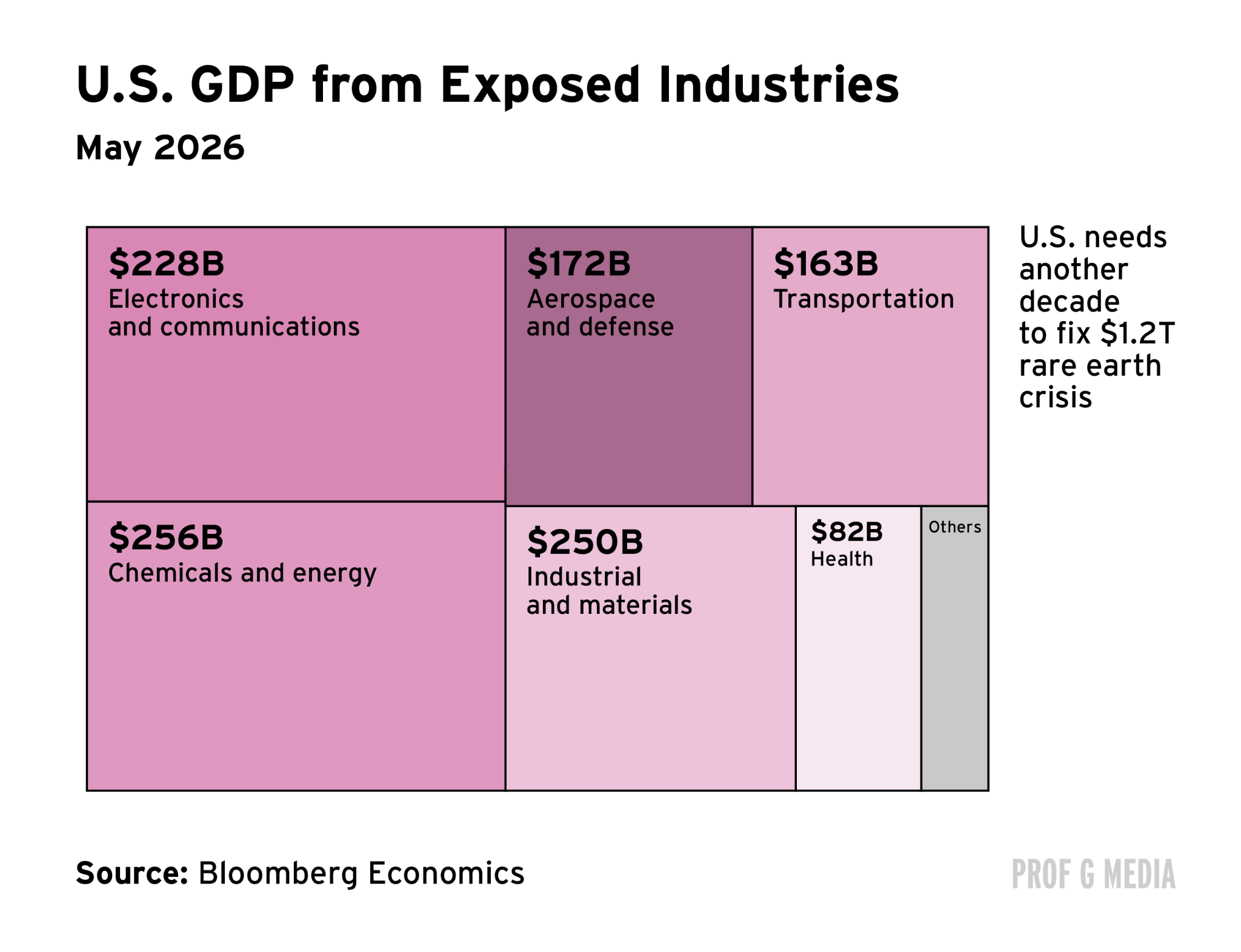
The summit’s most significant outcome was the formation of two new bodies — the U.S. - China Board of Trade and the U.S. China Board of Investment — alongside a joint commitment to what China calls a constructive relationship of strategic stability, a formal step away from adversarial posturing. Trump invited Xi to visit the U.S. in September; Xi accepted.
The two sides' official readouts told different stories. The U.S. announced China agreed to purchase 200 Boeing aircraft, renew licenses for around 400 American businesses, and buy at least $17 billion annually in agricultural products through 2028. Beijing acknowledged some of those commitments without citing figures, and focused instead on structural trade expansion and tariff reduction. The U.S. White House fact sheet led with rare earths. Beijing's readout did not mention them. There was no movement on chip export restrictions or tariff levels. On Iran, Washington noted that both sides agreed a resolution to the Strait of Hormuz conflict is in their shared interest. Beijing said nothing.
Trump traveled to Beijing with a delegation of 17 executives, among them Tim Cook, Larry Fink, David Solomon, Jane Fraser, and Kelly Ortberg. Two flew with him on Air Force One: Jensen Huang, who joined as a last-minute addition after boarding during a refueling stop in Alaska, and Elon Musk. Both had a lot riding on the trip:

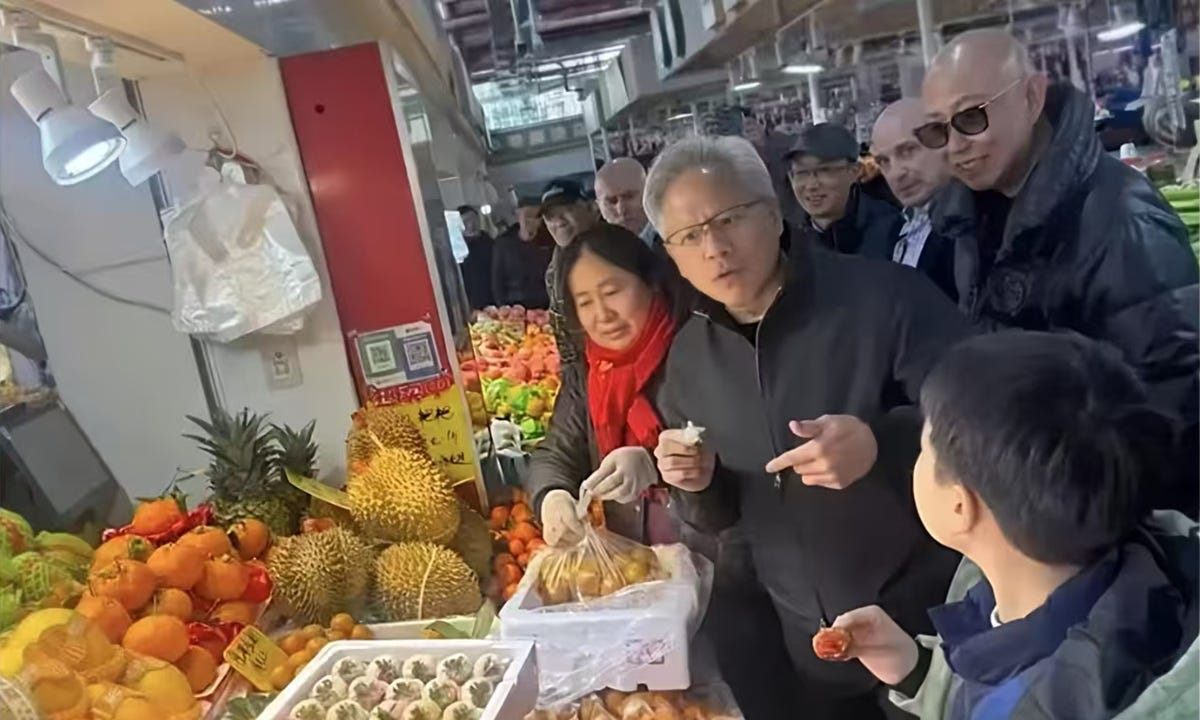
Jensen Huang — Drew the most attention. Nvidia’s CEO spent days in Beijing: eating bingfen, hand-pulled noodles, squid tentacles, and fermented soybean milk. None of that was incidental. Nvidia, whose market cap sits around $5 trillion, has seen its China market share fall to essentially zero under U.S. export bans. Ten Chinese companies have U.S. authorization to buy Nvidia’s H200 chips, but no shipments have moved. The bottleneck is Beijing.

Elon Musk — Was seeking regulatory clearance to expand Tesla's self-driving operations in China and looking to source around $2.9 billion in solar panel manufacturing equipment from Chinese suppliers.
The through line across all of the executives: China is not just a market to sell into. It is a supply chain, a regulator, and a strategic partner they cannot afford to lose.
Alice’s Take: Xi played the relationship skillfully. When he linked China's national rejuvenation with Make America Great Again at the state banquet, he was speaking directly to Trump — signaling that the two leaders are pulling toward the same thing. That's a deliberate revival of the G2 framing China has long wanted. The readout contrast tells you where the real priorities lie. Washington was focused on business: Boeing, agricultural exports, rare earths. Beijing was focused on structure: the two new boards, tariff reduction, expanded investment access for Chinese companies in the U.S. Those are longer-term asks. China got continuity, expanded strategic dialogue, and kept rare earths entirely off the table — which is the point. They're holding that card for Taiwan.
James’ Take: Two things stood out to me from the summit. First, for the first time in the history of these summits, the Chinese leader walked in with the upper hand. Second, the two countries are now formally working toward what China calls strategic stability, which means climbing down from constant adversarial posturing.
On Jensen Huang: the ball is no longer in America's court. China has been building around U.S. export restrictions through Huawei's Ascend clusters, and the compute need is only growing. Whether Beijing approves H200 imports is a political decision, not a technical one. On the broader CEO delegation: these executives aren't just trying to sell into China. They need continued access to Chinese inputs. China can manufacture high-quality goods cheaper and faster than anywhere else. That's not a supply chain you walk away from.
China is Arriving at Cannes - And It’s Not Just About Movies
Cannes is the world's most prestigious film festival, and this year China was impossible to ignore. Now in its fifth year at the festival, the China Pavilion featured film previews, cultural programming, and demonstrations of Chinese AI video technology. Gong Li, the actress who appeared in many of Zhang Yimou's defining films, opened the festival alongside Jane Fonda.
Chinese box office receipts have already surpassed $1.89 billion this year, driven in part by government initiatives converting film sets into tourist destinations — a program projected to generate around $26 billion in domestic revenue. A Chinese TV series, Pursuit of Jade, became the first Chinese show to reach the global top 10 for non-English content on Netflix. Meanwhile, Chinese AI video models are outperforming American competitors across multiple benchmarks. Short-form AI-generated video, distributed through Chinese TikTok equivalents, is expanding alongside the theatrical market. The head of Wing Sight, which produces AI-generated film content, estimated the Chinese AI film market at approximately $15 billion. The volume of video content on Chinese platforms gives domestic AI companies a training data advantage that Western platforms cannot currently match.
Alice’s Take: After COVID and a few years of Western indifference, Chinese cultural exports feel like they're returning to the enthusiasm of the early 2010s. What's different now is that Chinese creators and the government are actively projecting that richness outward — from traditional kung fu films to new animation to AI-generated content. Domestically, cinema is also benefiting from a cost-conscious moment. Going to the cinema is cheap relative to other entertainment, and the government has been actively promoting it. The AI angle is the bigger story though: China's edge in short-form video AI comes down to data. Douyin's user base generates content at a scale that Instagram can't match. That lead will compound.
James’ Prediction: Seeing Gong Li open Cannes alongside Jane Fonda was a genuine signal of how far China’s cultural footprint has extended. The vibrancy underneath that moment is real: box office already past $1.89 billion, Chinese video AI models outperforming American counterparts on key benchmarks, and the first Chinese show in Netflix’s global non-English top 10. We’re watching an inflection point.
James’ Prediction: Within five years, the highest-grossing actor in the world will be Chinese. China is already the second-largest film market globally, and when it becomes the largest, a Chinese actor at the top is the natural conclusion. This trend is already in motion.
Alice’s Prediction: Beijing will approve H200 imports within the coming months. Jensen Huang has built real goodwill with everyday Chinese people, and you can see it across social media. He knows how to play the game between the US and China, and he is one of the last figures who can genuinely benefit from both sides. Beijing simply does not have enough capacity through Huawei and SMIC to meet the compute demands AI will generate. The H200s get approved.