


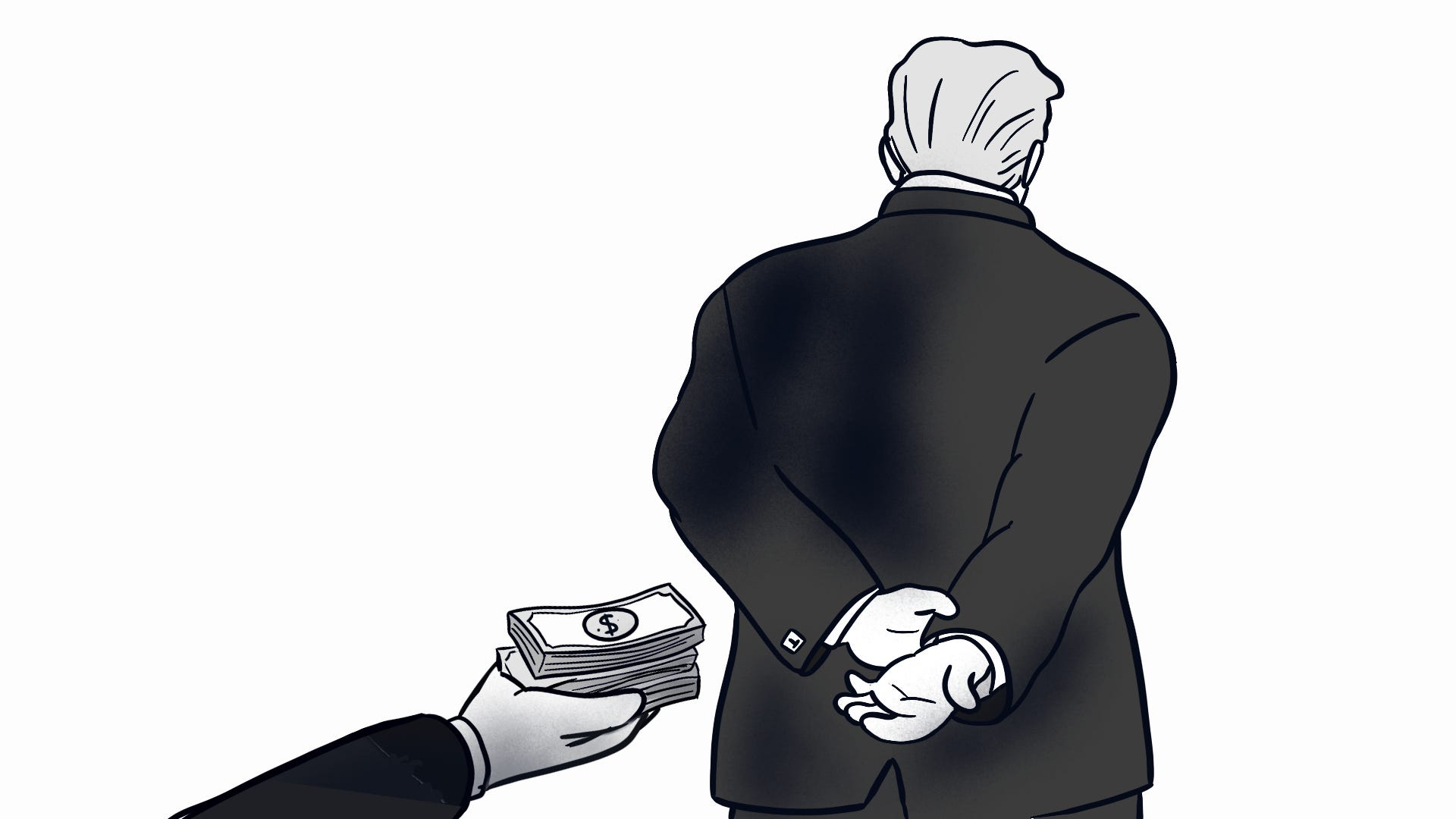
In Davos, Canadian Prime Minister Mark Carney had a warning for nations that have relied on the U.S.-led world order that provided (relative) peace and prosperity for eight decades. “If we’re not at the table,” he said, “we’re on the menu.” Heading home after last week’s summit with Chinese President Xi Jinping, President Trump made clear that whether Taiwan was at the table or on the menu was entirely his call. “I don’t talk about those things,” Trump said, referring to a private conversation in which Xi asked whether the U.S. would use military force to defend Taiwan. “There’s only one person that knows that — you know who it is? Me. I’m the only person.” But the question isn’t whether Trump will stand by the U.S. commitment to an independent Taiwan — breaking faith with our allies is a feature of his administration, not a bug — it’s how much he needs to be given to look the other way. A: Significantly less than Xi was previously prepared to pay.
Quid Pro Quo
The conventional wisdom was that China was preparing to invade Taiwan in the next few years, but that’s shifted. The most recent U.S. intelligence assessment, in March, concluded, “Chinese leaders do not currently plan to execute an invasion of Taiwan in 2027, nor do they have a fixed timeline for achieving unification.” Seeing Iran and Ukraine deploy asymmetric warfare against opponents with superior firepower may have given China’s hawks pause. Also, not a single member of the Chinese military has combat experience.
Meanwhile, the Tracking People’s Daily newsletter, analyzing 7,000 official Chinese statements since 2021, noted that Beijing had softened its rhetoric from Biden to Trump, despite the trade war. Biden was seen as a systemic threat who was determined to “encircle and suppress” China, according to Tracking People’s Daily, while Beijing views “Trump’s transactionalism [as] something [it] understands and can work with.” I believe Xi made a deal with Trump: Look the other way on Taiwan, and in exchange Beijing will purchase enough Trump meme coins to make him wealthier than the CEOs who accompanied him at the summit. One sign of a deal: Trump said he would withhold a $14 billion arms package from Taiwan, without receiving any concessions.
If Xi bribing Trump sounds implausible, consider the record. Trump has enriched himself and his family by $4 billion in his first year back in office. Citizens for Responsibility and Ethics in Washington, a corruption watchdog, flagged examples of Trump conflating personal business with U.S. interests in Brazil, Indonesia, Serbia, Syria, and Vietnam. Several months after Qatar gifted Trump a $400 million plane to replace Air Force One, Trump issued an executive order to provide Qatar a U.S. security guarantee with conditions similar to NATO’s Article 5. Probably just a coincidence. But wait … there’s more. Justin Sun dodged an SEC lawsuit alleging securities fraud after announcing he’d purchased $75 million worth of the Trump family’s World Liberty Financial coins. According to Bloomberg, 19 of the top 25 wallets that purchased Trump meme coins to secure a dinner date with the president were owned by foreign nationals. And for those with the means to erase their criminal record, Trump reportedly commands low-seven figures for a pardon.
But all of that is nothing compared to the shakedown he perpetrated on American taxpayers with a $10 billion lawsuit alleging the IRS had failed to keep private the tax returns Trump once promised to release. This week the DOJ announced a settlement in the form of a $1.776 billion fund to compensate Trump allies, including January 6 insurrectionists.
The Real Money
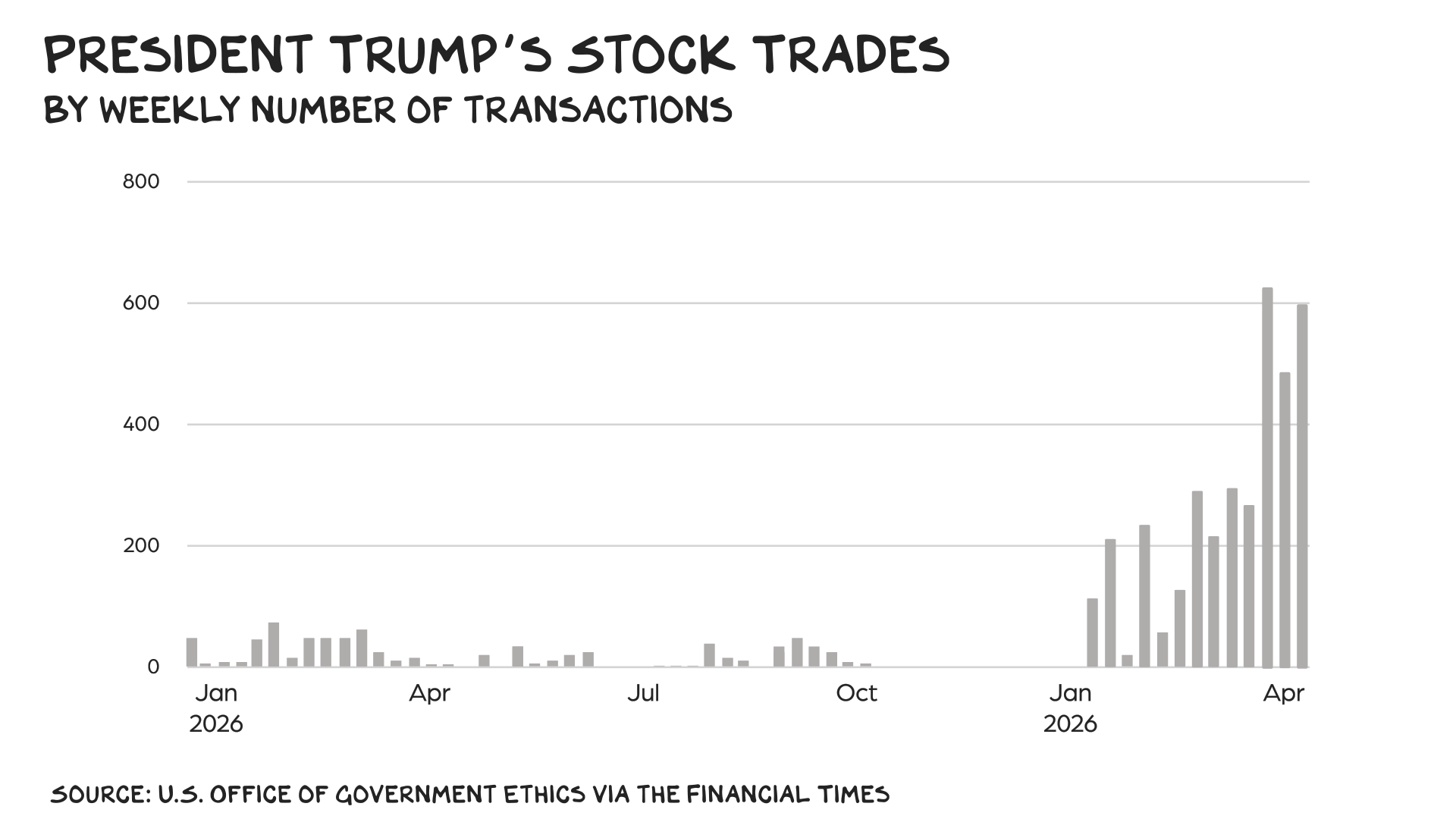
Of course, the real money is in market manipulation, from suspicious puts placed just before tariff announcements to oil bets made minutes before Trump announced a ceasefire with Iran. Trading on inside information is a bipartisan tradition, but Trump’s transgressions are orders of magnitude more brazen and profitable than anything we’ve seen. It took Nancy Pelosi four decades in Congress to amass $130 million in the stock market. Trump recently disclosed 3,700 stock trades from the first quarter of this year valued somewhere between $220 million and $750 million. We need investigations and prosecutions. However, the Supreme Court immunized the president, and he promised to grant preemptive pardons to everyone “within 200 feet of the Oval Office.” Besides, there isn’t anyone to bring the case, as Trump has gutted the DOJ, SEC, IRS and other agencies responsible for rooting out financial corruption.
Repatriation
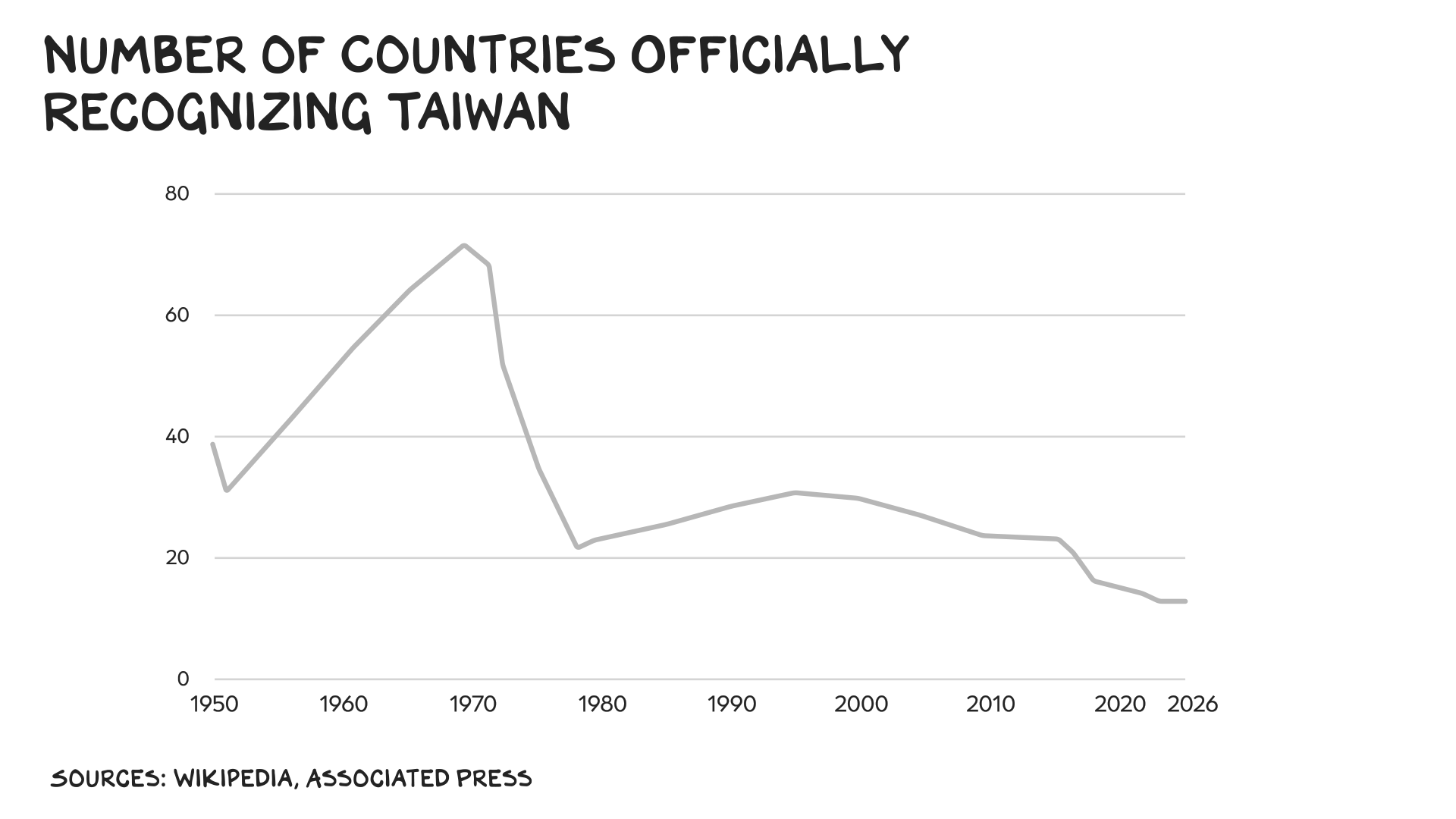
China doesn’t need to fire a shot to repatriate Taiwan. According to a Bloomberg analysis, a conflict over Taiwan would cost the world economy an estimated $10.6 trillion, roughly 10% of global GDP, in the first year alone. By comparison, the OECD predicts the Iran war will slow global GDP growth from 2.9% to 2.6% in 2026 and from 3.0% to 2.5% in 2027. Taiwan is the digital economy’s carotid artery, but, more important if you’re Xi, it has deep economic ties to China. An estimated 80% of Taiwan’s businesses are linked to China. Despite Taiwan’s recent efforts to disconnect from the mainland, China remains its second-largest trading partner, behind only the U.S., with exports accounting for 20% to 25% of GDP. Meanwhile, China has a history of deploying economic coercion. Between 2010 and 2022 the Mercator Institute for China Studies documented 123 instances of economic coercion from the PRC. It has also executed a multidecade campaign to isolate Taiwan in diplomatic terms, reducing the number of countries that officially recognize the island nation to 12. Add on cyberattacks, espionage, and disinformation, and Xi doesn’t need a D-Day-style assault. China’s “soft invasion” has already made inroads and will continue to advance until Taiwan capitulates.
Checkmate
Taiwan’s most valuable company, TSMC, controls 72% of the global foundry market, producing chips for AMD, Apple, Nvidia, and Qualcomm. The company also produces 90% of the world’s most advanced chips. Taiwan’s dominance isn’t an accident, but the result of a state policy to leverage chipmaking for national security purposes. In 2001, journalist Craig Addison coined the term “Silicon Shield” to describe how Taiwan’s chipmaking monopoly resulted in a de facto U.S. defense commitment, even though we dropped our recognition of Taiwan in 1979 in order to normalize relations with China. Two decades later, there’s a crack in the Silicon Shield. “The single biggest threat to the world economy, the single biggest point of single failure, is that 97% [sic] of the high-end chips are made in Taiwan,” Treasury Secretary Scott Bessent said in January at Davos. “If that island were blockaded [or] that capacity were destroyed, it would be an economic apocalypse.” Another way of putting that: If push comes to shove, the U.S. and the rest of the world would likely choose stability over Taiwan’s sovereignty.
Actually, we might not have a choice, considering how drones have disrupted warfare. China produced 2.5x the number of drones we produced in 2025, but as Noah Smith observed this week, “Drones use lithium-ion batteries and rare earth electric motors, both of which are almost entirely manufactured in China.” Currently, China controls 60% to 70% of rare earth mining and 90% of the global processing capacity. As Deng Xiaoping famously said in 1992, “The Middle East has oil, China has rare earths.” Adding chipmaking to its economic arsenal would give China unilateral power to tax the global economy, as well as leverage over other nations that far exceeds the $1 trillion it deployed to fund infrastructure projects around the world via its Belt and Road initiative.
Thucydides Trap
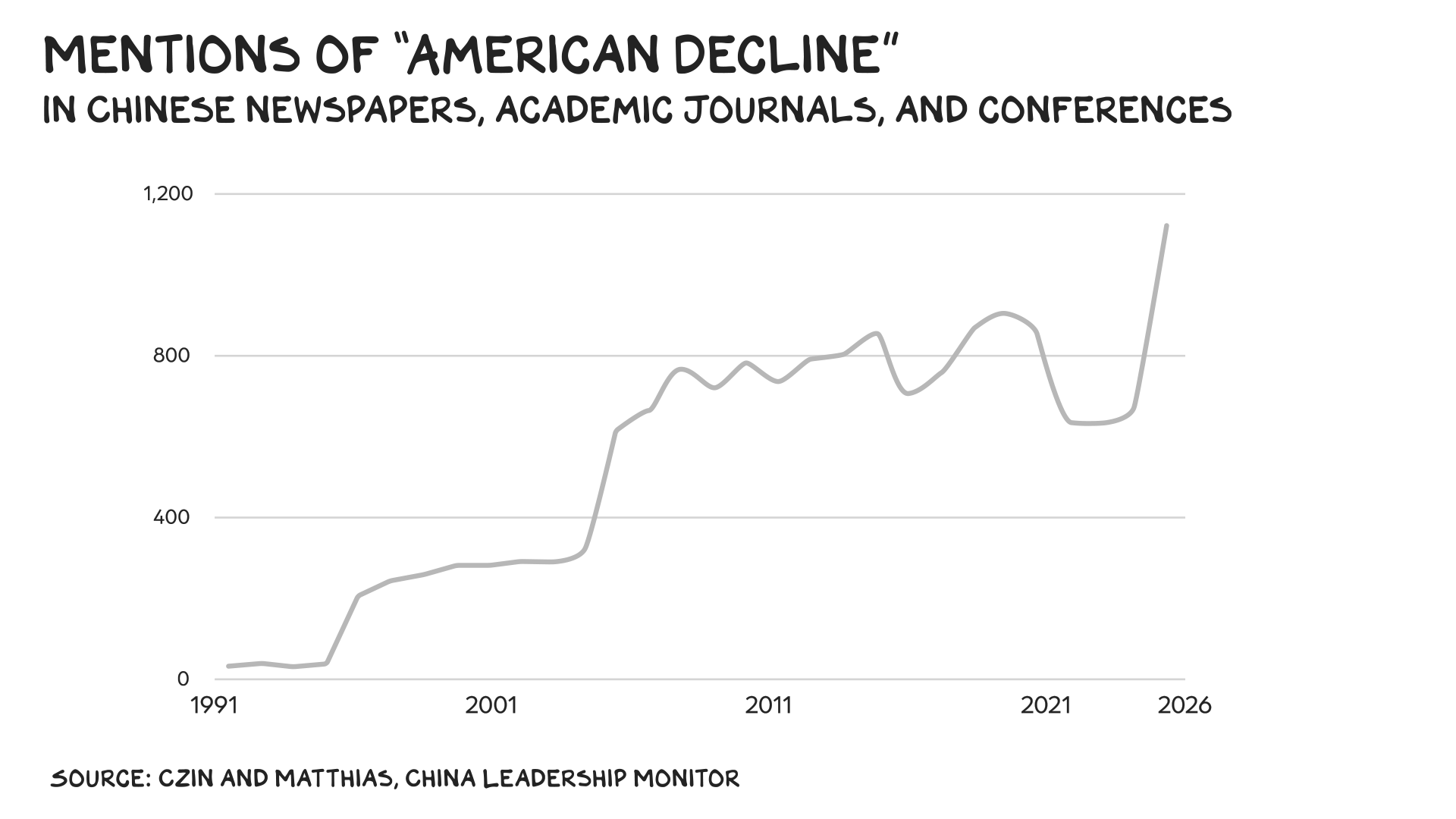
In his 2017 book, Destined for War, former U.S. Assistant Secretary of Defense Graham Allison wrote, “When a rising power threatens to displace a ruling power, alarm bells should sound: danger ahead. As a rapidly ascending China challenges America’s accustomed predominance, these two nations risk falling into a deadly trap first identified by the ancient Greek historian Thucydides.” At their summit, Xi asked Trump whether the two nations could avoid the Thucydides trap and “forge a new paradigm for major-power relations?” Trump registered the insult — the implication of U.S. decline — but blamed Biden and insisted that the U.S. is the “hottest nation anywhere in the world.”
Future historians will likely have trouble gauging Xi’s skill. On the one hand, he’s a serious statesman. On the other hand, his opposite number is Donald Trump. Regardless, the Chinese see blood in the water, even if American leadership won’t acknowledge we appear to be committing superpower suicide. In January, a Beijing think tank published a report called “Thank Trump,” which concluded that tariffs, attacks on allies, anti-immigration policies, and the president’s war against American institutions have strengthened China while weakening the U.S. Citing polarization, government dysfunction, and “Latin American-style instability,” the report’s authors labeled Trump an “accelerator of American political decay.” A decade ago, our priority was to manage the Thucydides trap such that we maintained our leadership of the rules-based world order, avoided conflict, and increased global prosperity. Today, we’re riding shotgun with a president who never met an American interest he didn’t seek to monetize. Superpowers don’t die when adversaries breach the gates. They die when the people inside start auctioning off the gates.
Memorial Day
I write often about what we’re losing by dismantling the rules-based order, less often about the cost of building it in the first place. It’s Memorial Day weekend in the U.S. — a holiday meant to honor those who died serving our country, though most Americans observe it by barbecuing, drinking, and shopping. Pulling down the U.S.-led order robs our children of their future, but it also demeans the memory of American sons and daughters who gave what Lincoln called the last full measure of devotion. Shame on Trump. Shame on his enablers. And shame on us if we fail to pull the country off of Trump’s auction block.
Life is so rich,

P.S.
My Prof G Markets co-host Ed Elson was live on Substack this week sharing “The New Normal,” his presentation about the forces shaping the global economy. Ed’s talk is available exclusively to Prof G + members for one week and one week only. Say no to FOMO by saying yes to a Prof G + membership. Upgrade here.
I have, for a long time, enjoyed Professor Galloway’s perspective. Always a good blend of humor, data and salient points to remember. I would love to see some articles in the future that are not so tied to Trump. Articles from years past, like the one on choosing a college (certificate, education, and experience) were so enjoyable. Hoping future writings can get away from the drama and obsession with the current administration. Articles on this administration, the flaws and peculiarities are a dime a dozen and not that edifying. I look forward to future creativity.
Everyone should watch this documentary on Taiwan.
Whether you're left, right, or somewhere in between, one thing is clear: we've spent 30+ years watching bloated, ineffective politicians grow government, explode deficits, and squeeze the productive middle class while delivering increasingly mediocre results.
And while Scott Galloway loves to focus on Trump, he seems remarkably blind to decades of institutional failure. That's easy to do when you're worth well over $100 million. For those of us actually paying the bills, California has become a masterclass in how not to govern: soaring budgets, endless bureaucracy, crumbling infrastructure, and taxpayers constantly asked for more.
Taiwan is one of the most important geopolitical stories of our generation. Watch it. The stakes are far bigger than partisan talking points.
https://www.pbs.org/video/invisible-nation-extended-cut-62kcrv/