



TL;DR
Diplomacy vs. Reality in Washington-Beijing Relations
Why U.S. Banks Are Scooping Up Chinese Currency
‘Pretend-to-Work’ Shows a Different Side of Economy
Positive Mood Music or Deepening US-China Division?
As Donald Trump and Xi Jinping prepare for a high-stakes summit in Beijing in mid-May, the AI battle between the U.S. and China is intensifying.
In the latest twist, China has blocked Meta’s $2 billion acquisition of AI startup Manus after calling the deal a “conspiratorial” attempt to leak sensitive technology to the U.S. The decision, following a move to restrict tech companies including ByteDance from taking American capital without approval, is expected to have a chilling effect on cross-border transactions.
The U.S. is carrying out its own crackdown, accusing China of stealing AI intellectual property on an industrial scale. The White House described a coordinated campaign to “systematically extract capabilities” from American AI models and exploit the country’s innovation. The U.S., meanwhile, has charged individuals with trying to transfer computer servers containing AI chips made by Nvidia to China, and lawmakers have called for a probe into potential data security vulnerabilities posed by Chinese AI startups, including DeepSeek.
While the governments clash over AI, startups in both countries are racing to tap its potential. DeepSeek released a preview of its long-awaited follow-up model after stoking fears last year that it had matched U.S. AI leaders at a fraction of the cost.
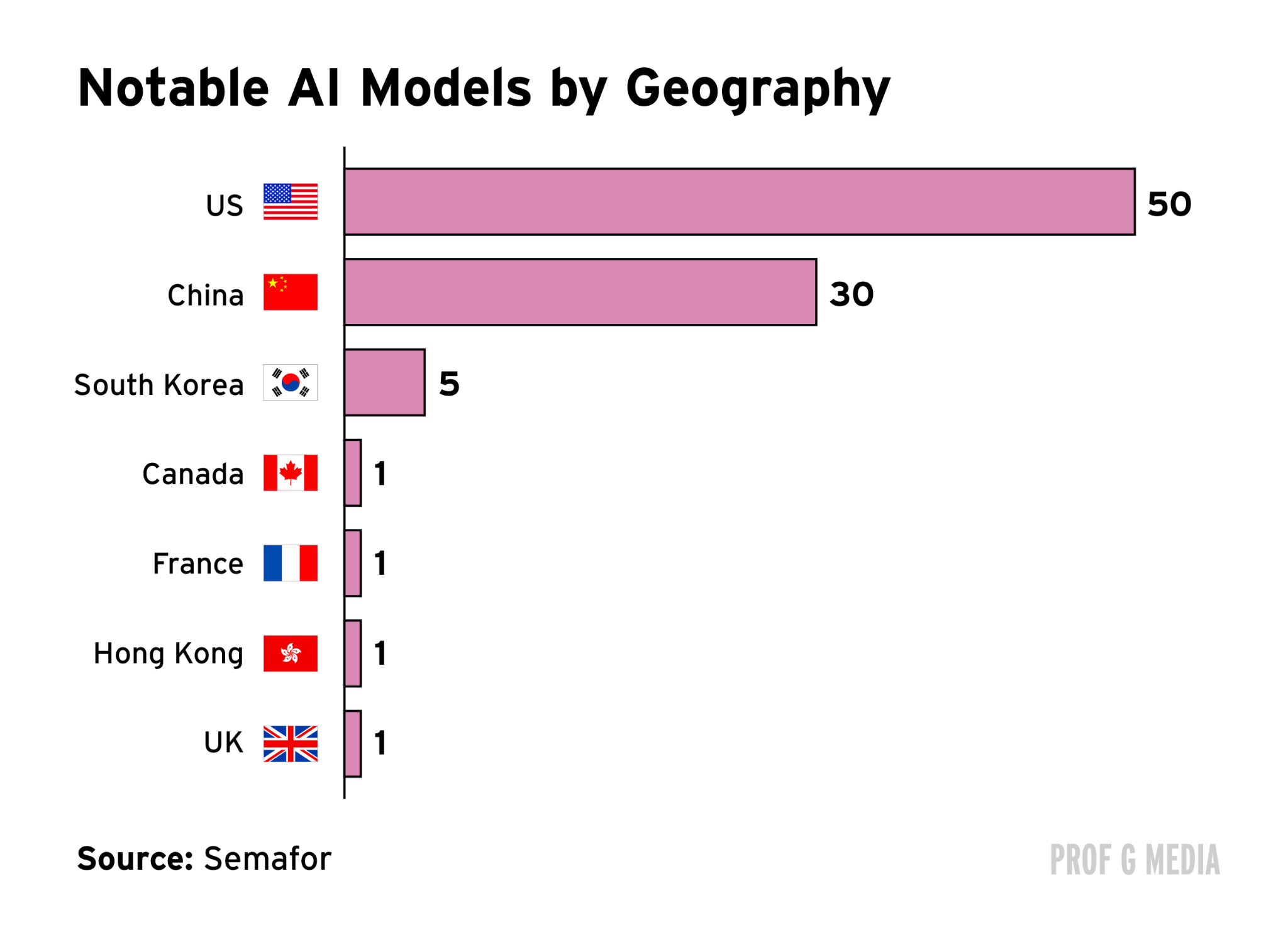
Alice’s Take: The two sides aren’t going to back down over AI. OpenAI and Anthropic are no doubt applying even more pressure on Washington to combat distillation efforts — or training smaller models using the output of larger ones in the U.S. — concerned not only about national security but also losing their lead in the AI race. This comes amid the broader backdrop of export restrictions, tougher regulation, and U.S. worries about China’s growing influence in the global pharma and biotech sectors.
In visiting China over the past few weeks, the consternation over the AI conflict was palpable, with the use of AI in military applications also on China’s agenda.
Still, I’ve also seen optimism in China over the government’s relationship with the U.S. There could actually be four U.S.-China meetings over the course of the year, not just one in May. The summit in Beijing is expected to pave the way for a Xi trip to America in the second half of the year, and officials could also meet at the APEC and G20 meetings. The mood music is positive. On the American side, Trump is in summit mode, eager to make a deal with China. Trump’s desire for a big win is going to outweigh everything else.
James’ Take: The first chapter of the U.S.-China AI rivalry began in 2022, when OpenAI released ChatGPT. Three years later, the shock waves triggered by DeepSeek’s model marked another important moment. But the statements we’ve seen from Beijing and Washington in recent days show that a Cold War curtain is coming down and the contest is entering a strained new phase. China is tightening its control of its industry, while U.S. law enforcement agencies seem to be limbering up to take on China on the AI front.
The U.S. has said foreign entities, including China, are evading detection by relying on tens of thousands of proxy accounts. China has slammed this as a baseless allegation. We don’t know who is right. What we do know is that the tension is rising. The diplomacy we see is at odds with the reality playing out in the shadows. Leaders of the two countries will play nice in front of the cameras. But the true trajectory of the relationship continues to worsen.
China’s Low Interest Rates Draw US Banks Such as Goldman
While the U.S. government worries about China exploiting American AI innovation and stealing intellectual property, its banks, led by Goldman Sachs, are borrowing record amounts of China’s currency, the renminbi. Why? It’s cheaper. Low interest rates are attracting more foreigners to China’s offshore debt markets. Total borrowing in so-called dim sum bonds — issued mainly in Hong Kong — has hit about $44 billion this year, more than twice the amount at this point in 2025. China more widely is pushing to expand the amount of mainland Chinese capital that can be invested in bonds in Hong Kong and internationalize its currency.
Alice’s Take: From an economic perspective, this makes sense given the lower borrowing costs for foreign investors and the inflation risks elsewhere in the world, especially the U.S. Also, for investors who are worried about America’s fiscal and political trajectory, China may represent a more stable place to invest. Moody’s this week revised China’s credit outlook to stable from negative, a sign of confidence in the economy in the face of challenges.
The role of the Chinese currency in global trade and FX reserves is also in the spotlight amid concerns about an unwinding of the carry trade in the yen — borrowing in the low-yielding Japanese currency to fund purchases of higher-yielding foreign assets.
That said, this isn’t going to displace the dominance of the U.S. dollar, derived largely from its share of foreign exchange reserves and loans. It’s a long game, and China remains far behind.
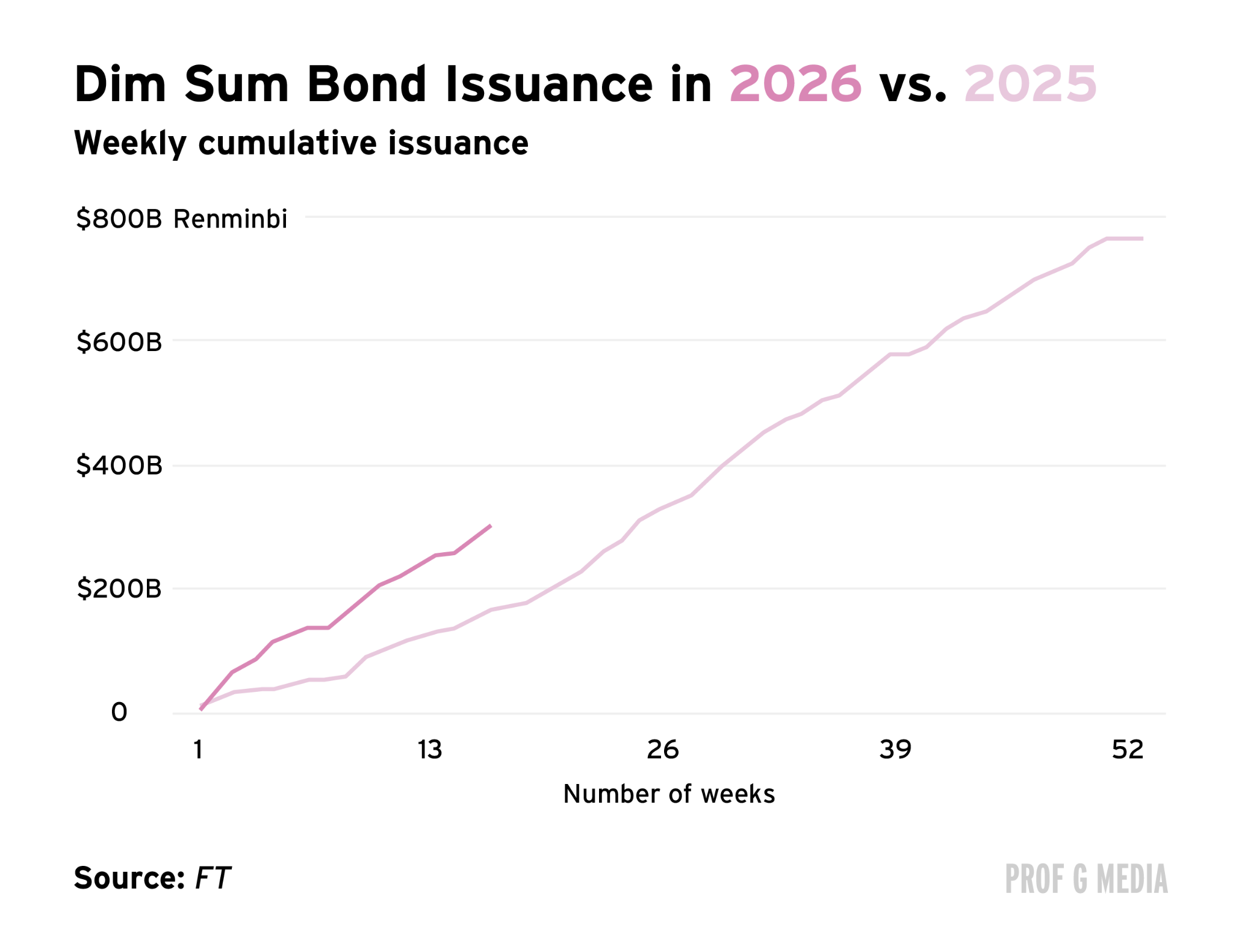
James’ Take: When you have Goldman Sachs, the symbol of American capitalism, issuing Chinese debt in the middle of the U.S.-led war against Iran, this is significant. What it suggests, however, isn’t so clear.
This isn’t a sign of a decline in the U.S. dollar. U.S. financial markets are unbelievably strong. It’s simple: The coupon on Goldman’s 10-year dim sum bond is 3%. If it had issued the same bond in America it would have to pay about 5% to 5.7%. However, there may be more to it. China likes to see the offshore renminbi bond market getting bigger and deeper. And this is probably a nod to Beijing — a way to show cooperation with China at a time when the government is trying to boost its status in the world.
The dim sum bond market is growing in importance but remains tiny compared with the U.S. bond market. The bottom line: The renminbi is becoming more of an international currency, but it’s still very far from the threat to the dollar’s dominance in the global economy.
China’s Absurd ‘Pretend-to-Work’ Industry Signals Deeper Problems
Rather than just sitting at home, some young and unemployed adults in China are paying as much as $7 a day to go into an office, meet with “colleagues,” and “pretend to work.” This new industry that’s expanding across the country sounds absurd, but it’s a sign of deeper problems: a challenging job market and a culture that stigmatizes unemployment.
At the top, China projects economic strength. Beneath the surface, many young Chinese people are struggling, unable to find the same opportunities that were offered to their parents.
Alice’s Take: I can’t help but think of WeWork back in the day. It was debatable how many people were actually working. Digging into this “pretend-to-work” story, it appears many of the people heading into these bogus offices are actually freelancers, influencers, and content creators. To be fair, they’re working, just not in traditional roles.
The good news is that the digital, AI-first economy is creating new opportunities. The bad news is that other types of work are drying up, forcing young people to seek out alternatives. Universities have faced calls to extend degrees and keep students on campus a little longer. But Gen Z is struggling, and unemployment in this demographic may only get worse. Another 12.7 million graduates are set to enter the job market this summer.
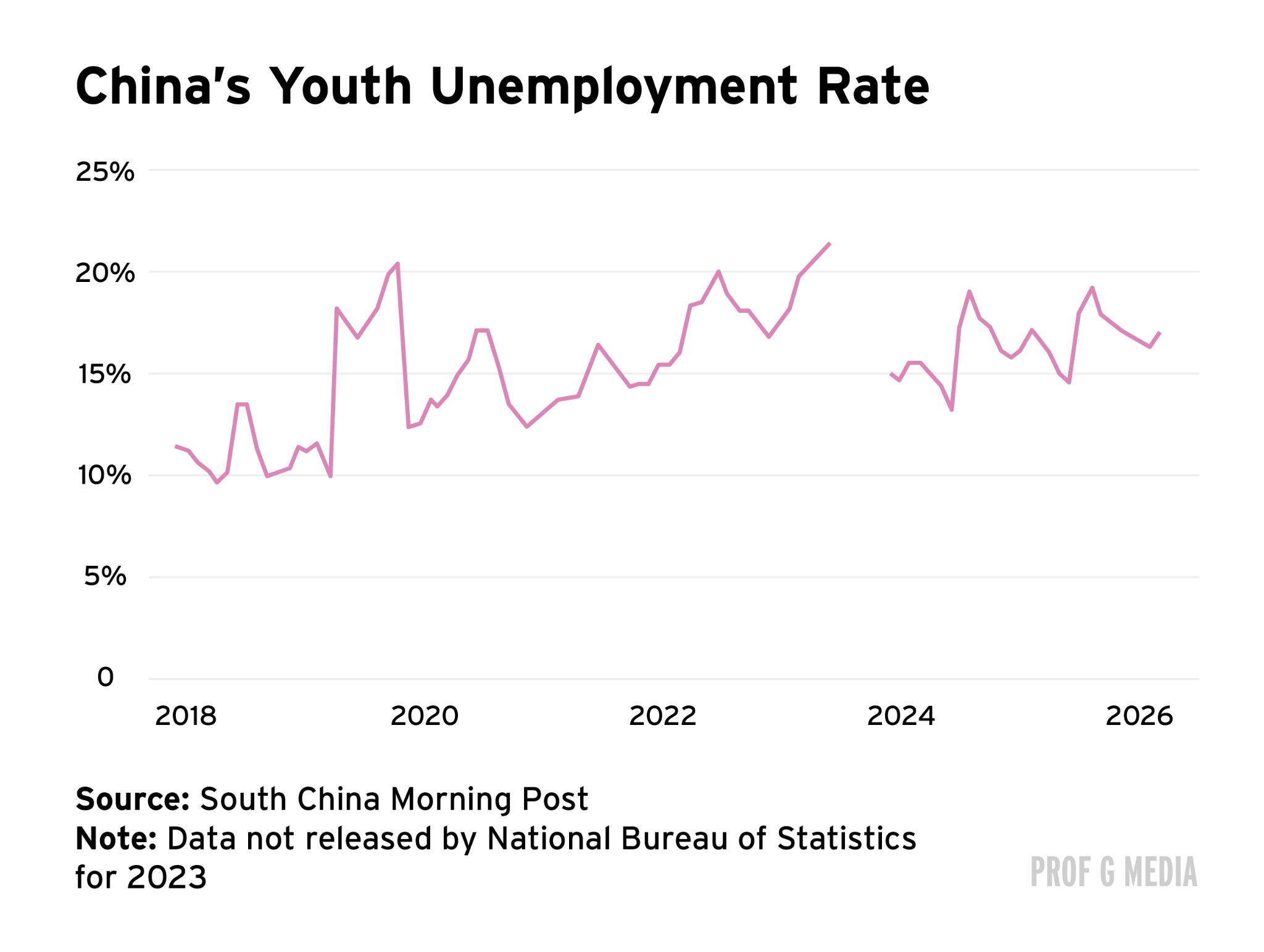
James’ Take: This reminds me of the time I spent in Japan in the early 1990s. Salarymen who lost their jobs would get up every morning, slip into a suit and tie — and then head into the local library, ashamed and unwilling to admit their lack of employment to their families. What’s different in China is that there’s less shame and more humor. In one case, a door marked “Chairman’s Office” opened onto a fire escape.
Still, many young people aren’t laughing. Among 16-to-24-year-olds, the jobless rate rose to 16.9% in March from 16.1% in February. Based on the conversations I’ve had in China, I wouldn’t be surprised to see it climb even higher.
Alice and James’s Weekly Predictions:
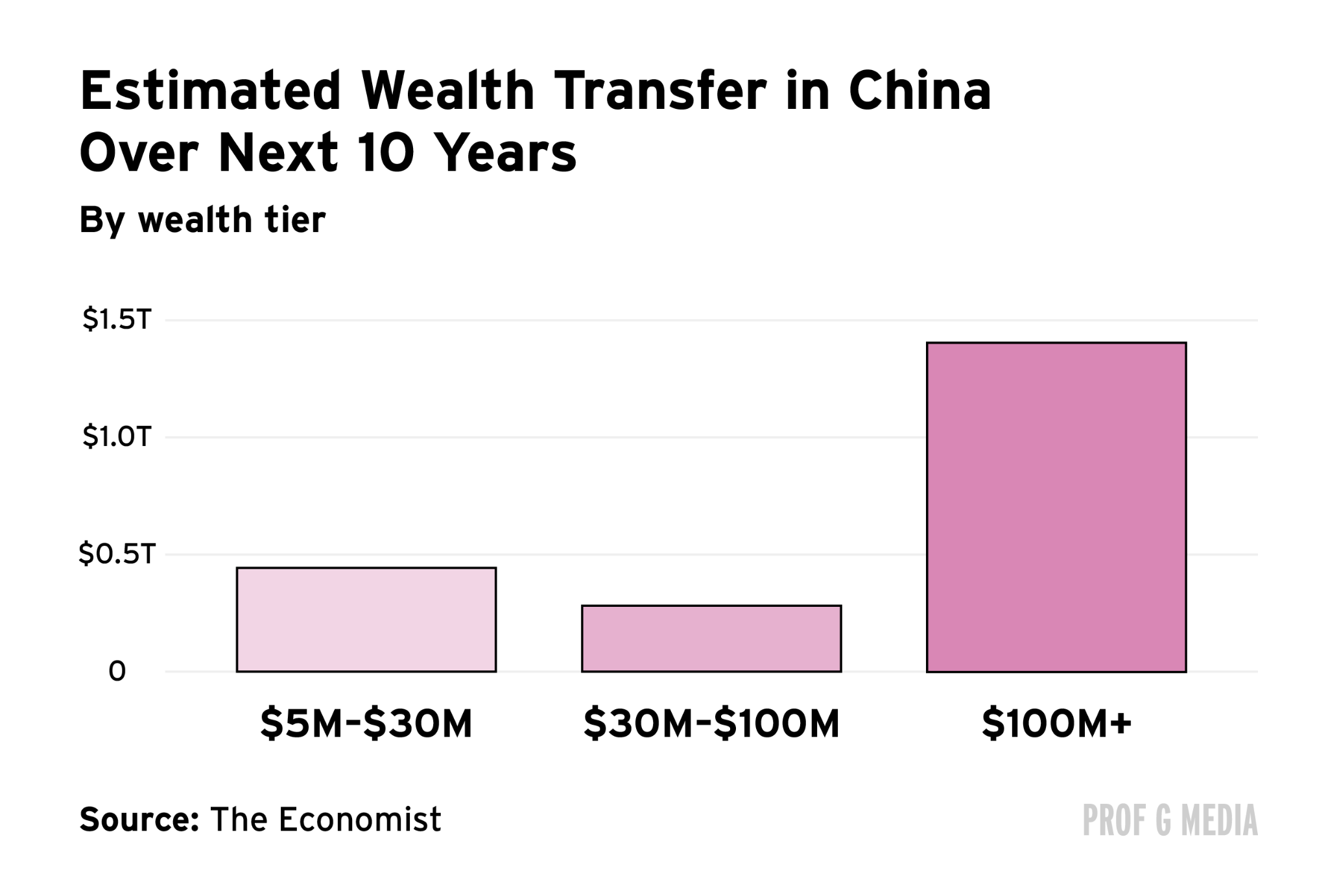
Alice’s Prediction: China is confronting the largest transfer of wealth in its history — at least $2 trillion will flow to the next generation over the coming decade, according to The Economist. Following China’s economic transformation and the relaxation of its one-child policy more than a decade ago, many people across this increasingly rich and rapidly aging population are set to inherit large estates. The upshot: We’re going to see some form of tax legislation over the next couple of years as the central and local governments hunger for more fiscal revenue.
James’ Prediction: I’ll return to dim sum bonds. Goldman Sachs has become the biggest foreign issuer of the bonds and the second-largest overall, after the Bank of China, while Portugal earlier this month emerged as the first euro-area country to tap the offshore renminbi bond market as it seeks to diversify funding sources. I see another milestone: By the end of 2030, this market will surge by more than fivefold to Rmb10 trillion from around Rmb1.8 trillion. This pales in comparison with the size of the U.S. bond market, but it’s growing quickly.
AI competition is indeed entering a new Cold War phase. But it will not simply split into two completely isolated blocs. It is more likely to form a layered structure: at the top, frontier models and advanced chips will become highly securitized; in the middle, open-source models, enterprise applications, and industry tools will still retain partial flows; at the bottom, developer ecosystems and hardware adaptation will move toward a multi-track coexistence.
Alice and James’ article correctly sees that AI competition is entering a Cold War-like stage. It also recognizes that U.S. AI policy is not driven purely by national security logic, but also by the corporate moat-building interests of Anthropic and OpenAI. It understands why DeepSeek’s low-cost model has shaken the U.S. market, and it points to a real tension: Trump may seek broader deals with China on trade, finance, market access, or macroeconomic issues, but AI, chips, model capabilities, biotechnology, and dual-use technologies will find it increasingly difficult to return to ordinary commercial logic.
But the article still largely remains at the level of “the U.S. and China are trying to prevent technology leakage to each other.” The deeper shift is that global AI is moving away from an open, transnational, Silicon Valley-centered technology ecosystem toward a partitioned structure shaped by national security, compute boundaries, model-capability controls, capital screening, and domestic industrial systems.
The U.S. is trying to prevent China from acquiring frontier capabilities. China, in turn, is beginning to prevent its own AI assets from being absorbed by American capital and platforms. China’s reported blocking of Meta’s acquisition of Manus, the U.S. crackdown on model distillation, and DeepSeek’s disruption of the American AI narrative are all different sides of the same structural change: AI is no longer just a global technology market. It is becoming one of the core infrastructures of 21st-century great-power competition.
This is the central argument of my recent post, “The Great Partition of Global AI.” China has demonstrated another path for AI diffusion: lower cost, stronger engineering optimization, faster industrial deployment, and large-scale applications better suited to non-Western markets. If America’s advantage lies in frontier models and advanced compute, China’s advantage may lie in low-cost diffusion, industry embedding, open-source ecosystems, domestic compute adaptation, and dense application scenarios. That is the foundation on which China may remain competitive even after the global AI system becomes increasingly partitioned.