


Einstein defined the 20th century with the revelation that mass is a form of energy. Today’s theoretical physics posits something more fundamental: Mass and energy are all information. The 21st century will be defined by the recognition that the most powerful form of energy is the manipulation of information: compute. The companies that control compute will be the most dominant businesses in history.
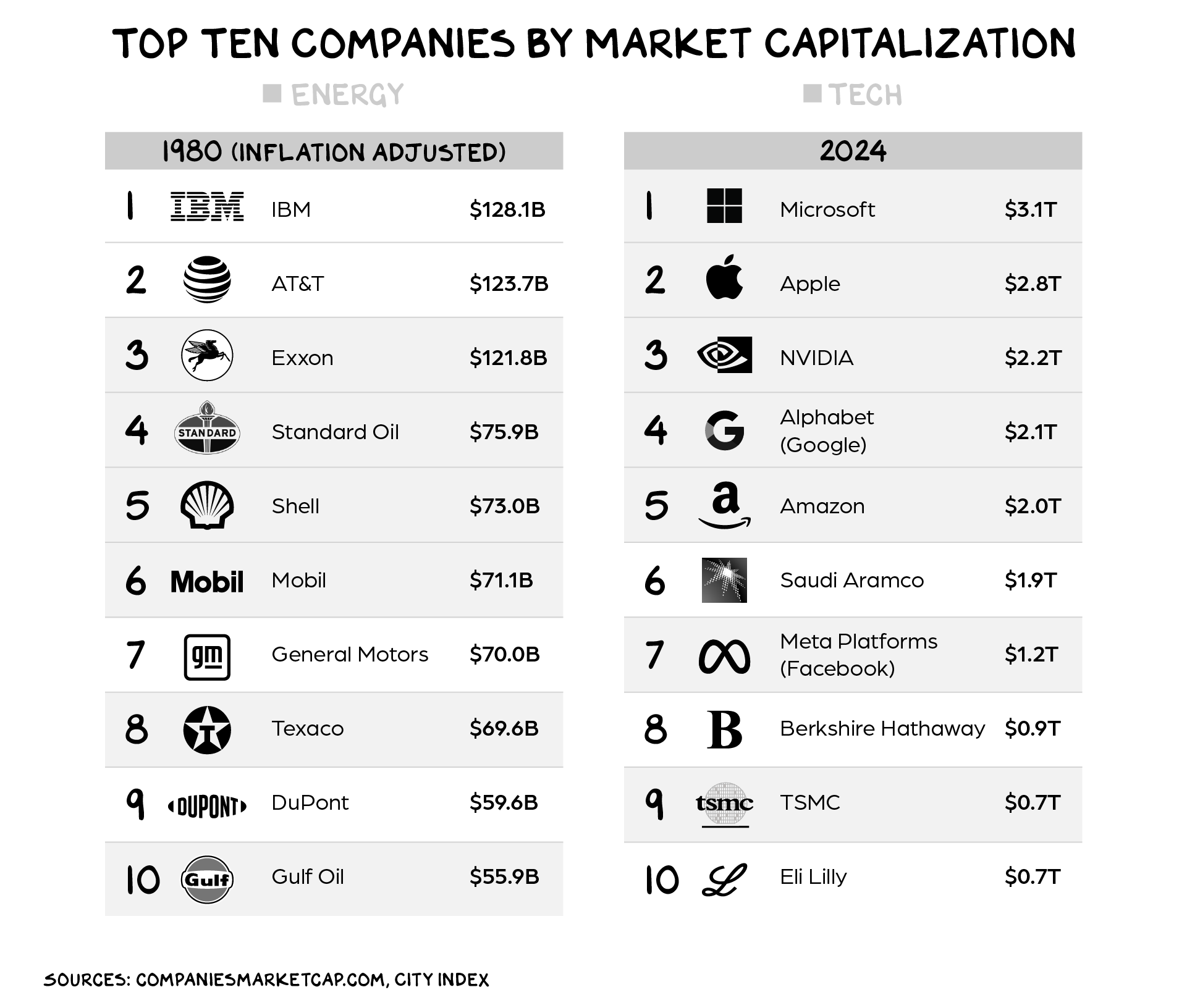
Energy has been the tail that wags every dog from the beginning of economies. Yet the narrative in the equity markets now is that Big Oil has passed the reins to Big Tech. It’s a practical observation: The majority of the most valuable firms in 1980 and 2024 were/are in energy and tech, respectively. However, the construction of acres of data centers and the energy investments needed to power them reflect a deeper convergence. AI is accelerating Big Tech’s transformation from an industry that sells computers to an industry that sells compute. And in a knowledge economy, compute is energy.
Power Up
Ten thousand years ago, energy was the only industry. The world ran on thew (muscle power), and food was the energy source. Settled agriculture in the fertile Middle East created surpluses, and economics emerged as the science of trading that surplus — exchanging energy. We then unlocked the energy in organic matter (wood, coal, oil), machines supplanted muscles, and the energy business became the business of powering machines. Oil’s unrivaled source material for machine power has created wealthy nations out of deserts. Big Tech companies may dominate the league tables of market capitalization, but energy remains the revenue king. Six of the 10 largest firms by revenue are energy companies, and the industry generates more revenue than any other. However … tech looks more similar to energy each year.
CapEx = Moats = Profits
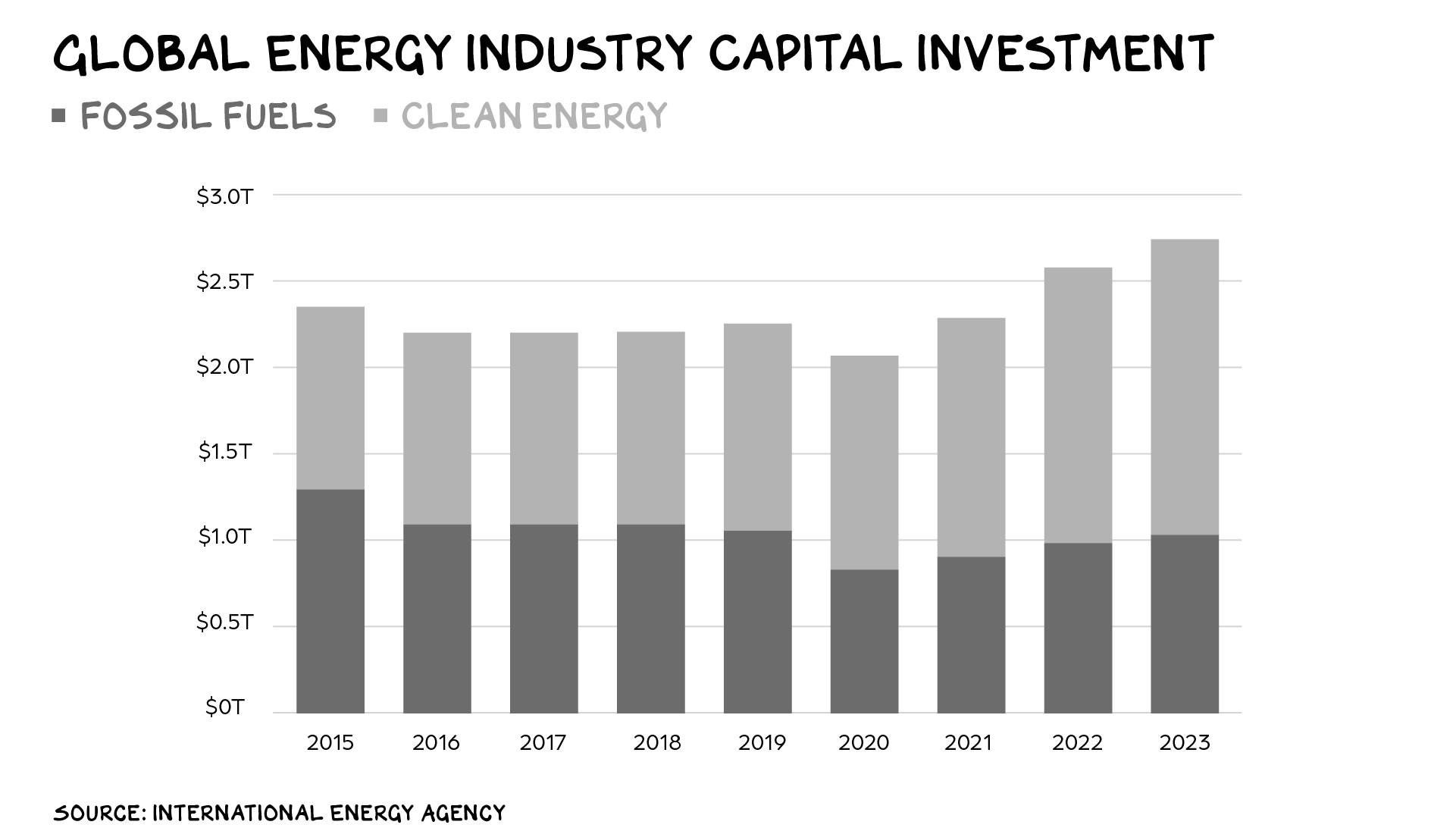
The energy business requires massive capital expenditures, allocated on data and faith, offering unrivaled payoffs for those who wager correctly. If the whaling industry is the origin story of venture capital, energy is the original gangster of CapEx. Investment across all energy sources will total $2.8 trillion in 2024. Fossil fuel companies, responsible for $1 trillion of that CapEx, generate $4 trillion in revenue. ExxonMobil spent $23 billion on CapEx in 2023, and made $36 billion in profit. The investments are chunky: The UK’s newest nuclear plant, under construction in Somerset, is projected to cost $57 billion. Planning the 20th century energy’s mega-projects required the development of a new science of forecasting, Shell’s famous “scenario planning” process. Side note: Scenario planning is not predicting the future, but determining which decisions will register the best outcome(s) across several possible futures.
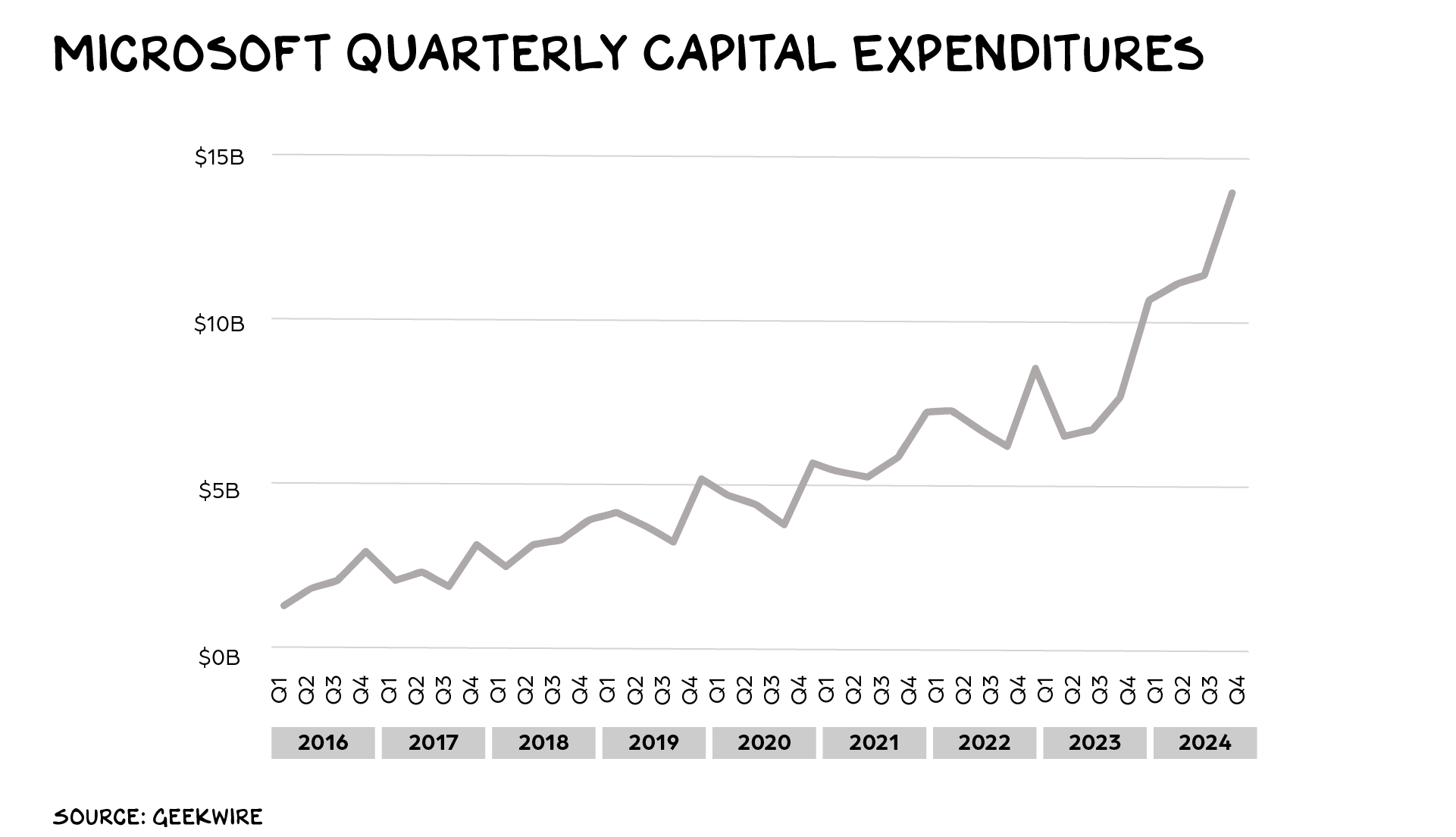
Now Big Tech is flexing its own thew. In 2024, the tech giants will spend the GDP of Finland ($300 billion, give or take), mainly on data centers — the modern equivalent of oilfield development. Alphabet spent $12 billion in the last quarter alone, up 90% year over year, Microsoft spent $14 billion, up 79%, and Amazon $14 billion. Tech does not match global energy investment yet, but individually, Alphabet, Amazon, Meta, and Microsoft will spend more in CapEx this year than ExxonMobil, Chevron, or Saudi Aramco. Meta operates 18 data centers that cover the same area as 19 Disneylands. The Core in Las Vegas, one of the world’s largest data centers, has its own hype video. (About 1 minute in, it gets … impressive.)
Big Tech’s profits are also historic, and growing. Last week, Alphabet added $200 billion in market cap (to reach $2 trillion) after beating profit estimates by 25%, and Apple also added $200 billion after an earnings beat and announcing a $110 billion share buyback. Both generated more net income than ExxonMobil in 2023, as did Microsoft.
More, I Want More
Energy companies can justify these investments because our imagination for uses of energy is limitless. The iron law of big(ger) energy: The more we generate, the more we use. There’s no such thing as too much energy. Energy is the antithesis of GLP-1 drugs. With energy, the more we consume, the hungrier we get.
Energy = Prosperity
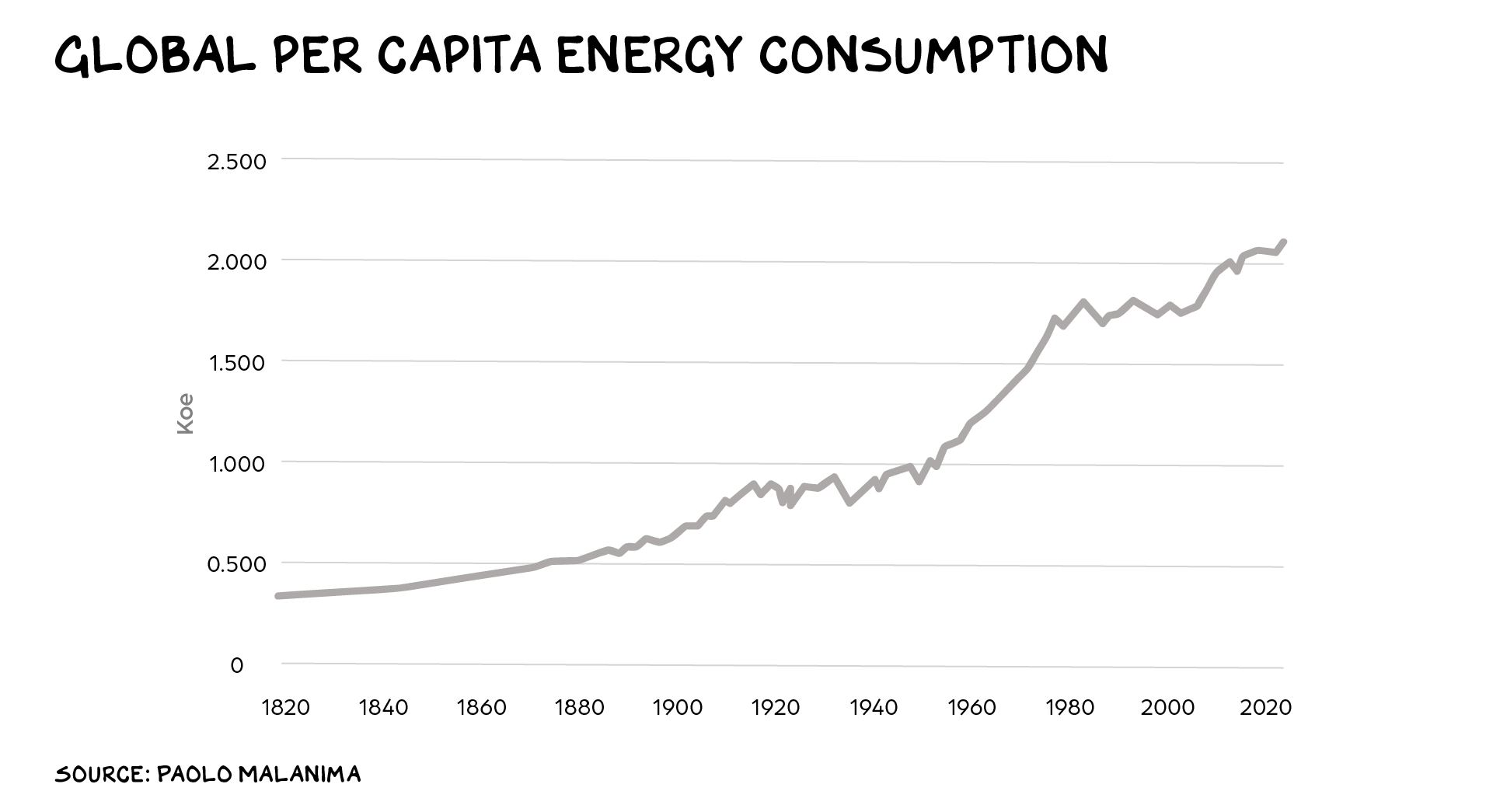
Wealth and energy consumption are correlated. It’s not just power for profligate lifestyles, but productive power: light, cooking and storing food, communications networks, building, transport. Academic estimates of optimal per capita energy consumption only trend up. No number of energy-efficient microwaves and double-paned windows can counter the consumption of billions moving into the middle class: Global energy consumption is projected to increase 44% by 2050.
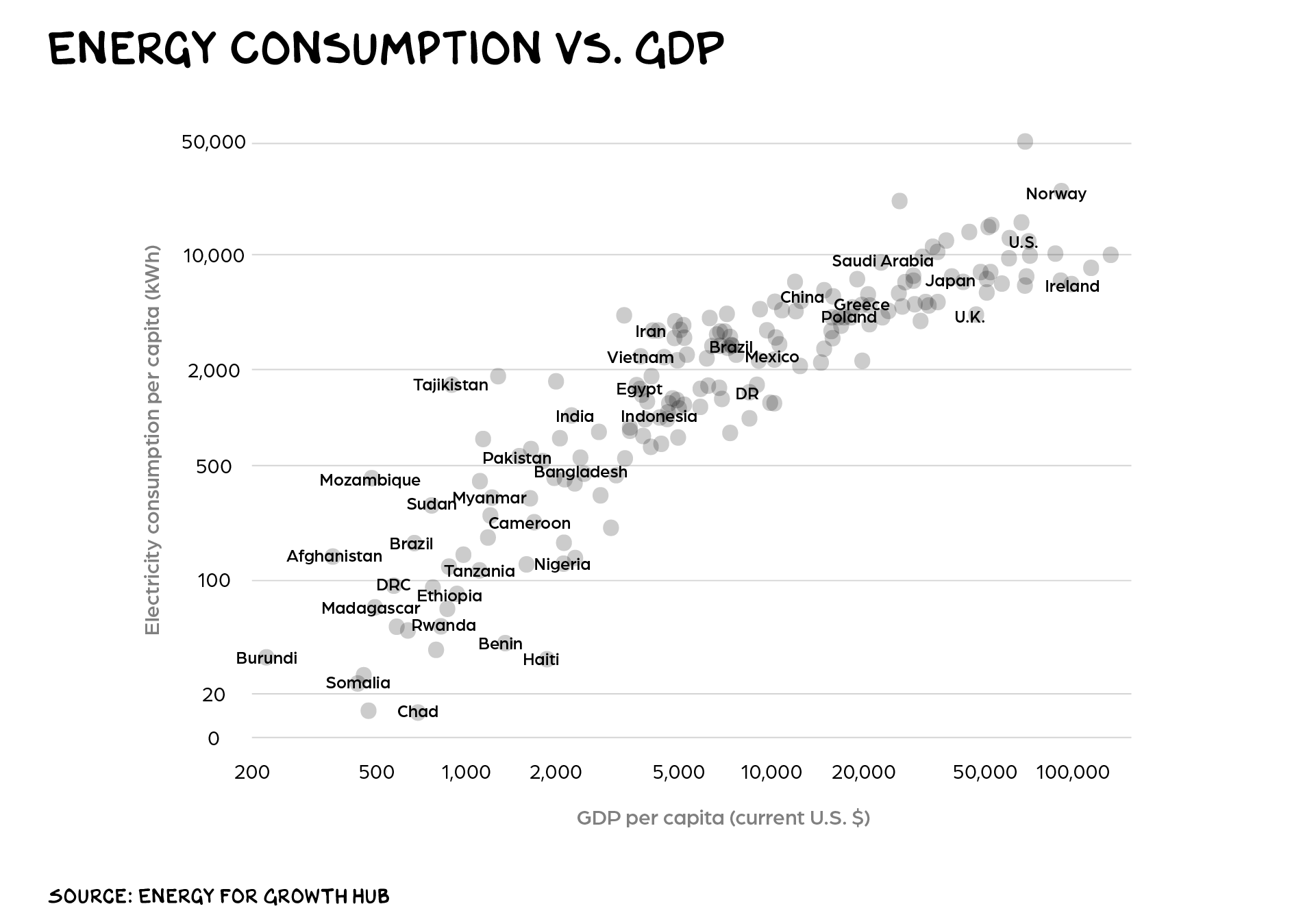
Tech’s appetite is also insatiable. Tech’s Iron Rule is Moore’s Law: Processing power doubles every two years. Nitpicking about the technical details aside, the principle has held true since 1965. “How will we use this power?” Queried nobody, ever. Intel, a client of my first firm, Prophet, impressed on us its singular strategic vision. They invested massive CapEx in fabrication plants for chips they hadn’t invented for applications they hadn’t imagined. In sum, “If we build it, they will come.” Nobody needed a faster chip until Apple showed the world a graphical user interface, until Netscape browsed the Web, until God (Google) began responding to any prayer/query with millions of answers, or until a new god (ChatGPT) responded to your prayer with a single answer. Intel stumbled with the transition to mobile, but the paradigm hasn’t changed. There’s no such thing as too much compute.
The New New Energy
Big Tech isn’t just similar to the energy business, it is the new energy business. AI’s growing power requirements make this concrete. AI compute requirements are doubling every 100 days, dramatically countervailing the gains in efficiency that every AI evangelist boasts about after vomiting that it will save/destroy humanity. Training the trillion-plus-parameter models being stewed in a medium-size city (San Francisco) requires the energy consumption of a small country. One ChatGPT request requires 10 times the energy of a Google search. In five years, the incremental energy demand of AI will be equivalent to 40 million homes — more than California, Texas, Florida, and New York combined. Data centers make up 3% of total U.S. power demand, but that’s projected to triple by 2030. BTW, 2030 is the same distance into the future as the finale of Game of Thrones is in the past (2019).
To feed their data centers, tech companies are investing billions in energy production and storage. The WSJ reports Big Tech execs descended on this year’s annual oil and gas conference, hunting for energy. Bill Gates was the featured speaker. Amazon, the largest corporate buyer of renewable energy, has over 500 projects operating or in development. Announcements of new data centers are accompanied by commitments to develop new wind and solar farms to provide the power.
Compute = Energy2
The convergence of tech and energy reflects tech’s transition from selling computing tools to selling compute itself. We don’t buy DVD players and discs, we stream. We don’t buy maps, we get directions. We don’t purchase film, we capture images. Apple, the most profitable product company in history, depends on services for growth. Amazon, the Apple of retail, is a data center business that offers retail.
AI pushes this trend to everything and everyone. Search, the most profitable business in history, will be replaced by Answers. Spreadsheets and browsers will be replaced by agents. “Apps” and “programs” will be mutable, evolving code organisms raised by other agents. According to energy conference keynote speaker Bill Gates: “Agents will affect how we use software as well as how it’s written. …. They’ll replace word processors, spreadsheets, and other productivity apps. Businesses that are separate today — search advertising, social networking with advertising, shopping, productivity software — will become one business.” Sam Altman believes that compute will be “the currency of the future,” the world’s most precious commodity.
In the 21st century, humanity has added a new page to physics, a new form of energy: compute. Just as our bodies convert the chemical energy of food into heat and mechanical energy, as solar panels convert the sun’s electromagnetic energy into electricity, data centers convert electrical energy to compute, and it powers the digital economy. As with other forms of energy, compute is created by the largest companies in the world, who have staggering capital to build moats the width of the Amazon (the river). As with other forms of energy, its consumption is inextricably linked with prosperity and growth. Compute defies economic gravity — increased supply speedballs demand. The future of energy isn’t renewable, but computable.
No Free Lunch
The passing of the torch from energy to tech felt good for a hot minute, because energy has gotten too in touch with its dark side. Energy firms invented the term “externality”: carbon, corruption, and capitalism as a Sith Lord. In contrast, tech felt better. Mark, Sheryl, Larry, Sergei, and Jeff were just too cute, too likable to be that evil … they even told us they would do no evil. Jeff’s laughter, Sheryl leaning in, Mark hunting with a bow and arrow:
Just. Fucking. Adorable.
But then kids started harming themselves, misinformation proliferated, and our discourse became coarse. Wait … the tech lords are not better than the titans of Big Oil, they’re worse. Actually, they’re neither — they are the same.
Any arbitrage of one substance to another for economic gain creates emissions. Plants to beef: methane. Fossil fuels to motion: carbon. Attention to advertising: rage. To believe the great arbitrage of compute won’t create extraordinary externalities is to believe that Zuckerberg/Sandberg/Brin/Bezos would prioritize the well-being of the commonwealth over their wealth. If we could go back 100 years to the beginning of the fossil fuel era, or 20 years to the start of social, what would we do differently?
Many argue that Big Tech is capitalism collapsing under its own weight. A jockey who’s lost control of a thoroughbred. Regulating compute is similar to a 5-foot, 110-pound jockey mounting a Tyrannosaurus Rex. We know it will be ungainly. The bigger question is, will it be violent?
Life is so rich,

P.S. Watch my TED talk on how the U.S. is destroying young people’s futures. In the past seven days, 7.5 million people (the population of Arizona) have watched the rant.
P.P.S. Get on the waitlist for Section’s AI for Business Mini-MBA. It’s free, and you’ll get a discount when the program opens enrollment.