



In the midst of the chaos of Trump’s second term it’s hard to imagine that there’s much planning going on. Just in the last few weeks, we’ve seen whiplash at the Strait of Hormuz. Noem and Bondi, fired. Another prosecutor purge at the DOJ. Refusal to fund the TSA.
But the truth is that this is chaos by design. The reality is that everything is going to plan. Methodically so.
Truth be told, we hadn’t thought much about Project 2025 until recently, when Hungarian voters fired Viktor Orbán after a 16-year run. After all, it was his own roadmap for undermining democracy that inspired Project 2025, the Heritage Foundation’s radical manifesto to “deconstruct” government and send America back to the dark ages.
We thought Orbán’s ouster was a good reminder to check in on just how much the Trump administration has looked to Project 2025 for its assault on the institutions and services we rely on.
Remember, President Trump ran a mile away from Project 2025 when it became a liability for him on the campaign trail, saying he hadn’t seen it, had no idea who was in charge of it, and “had nothing to do with it.” Well, according to the Center for Progressive Reform, Trump has made progress on at least 53% of Project 2025’s domestic agenda, or a total of 283 of its 532 recommended actions.
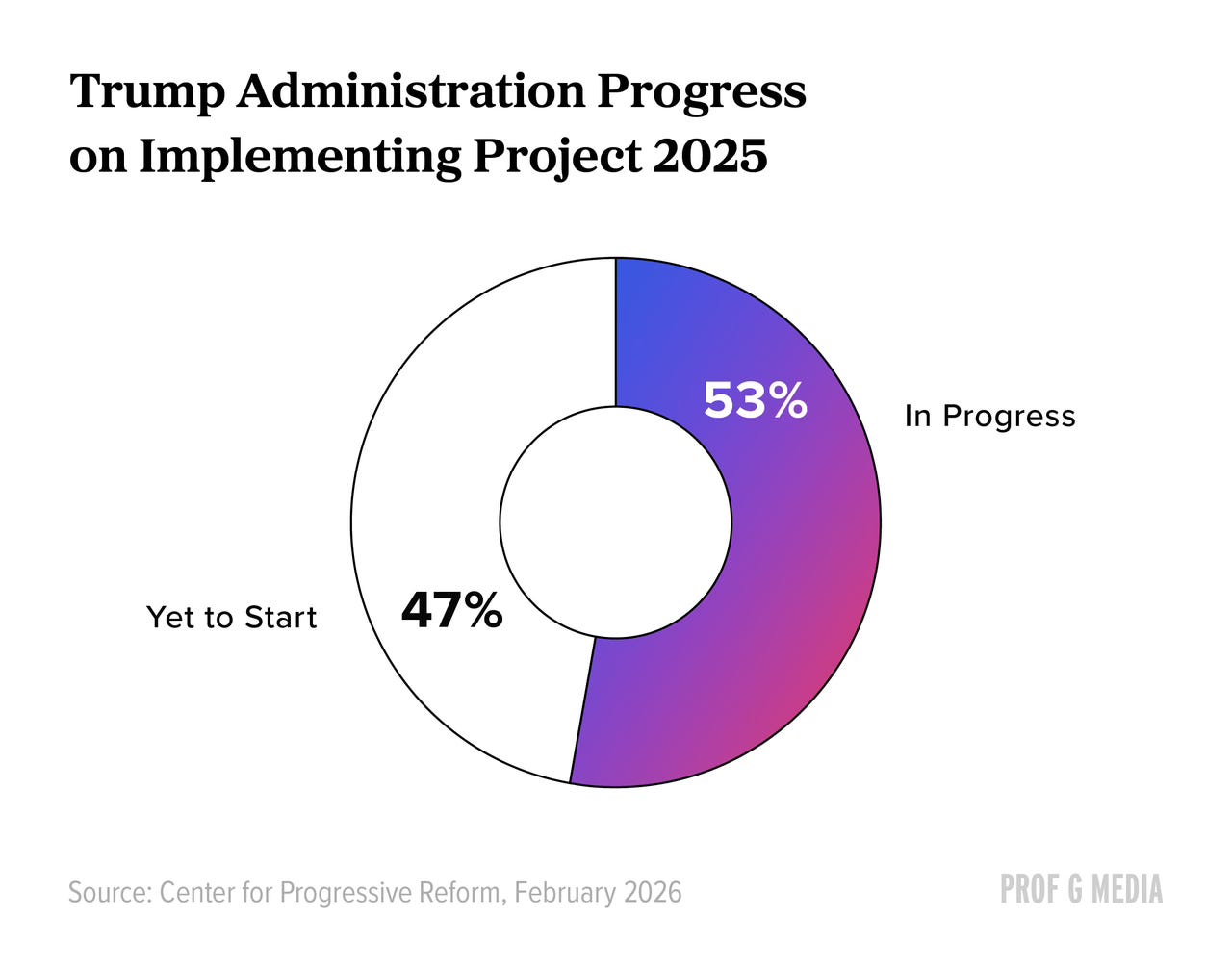
On everything from workers’ rights, to public education, independent law enforcement, and beyond, the second Trump administration has been heavily inspired by the ideas in that playbook, and that’s putting it lightly.
Justice
Trump’s attacks on justice are well-documented, but they didn’t happen in a vacuum. He got his worst ideas from Project 2025.
The ‘original sin’ lies in page 27 of the document, which rightly spells out that “traditionally, both the White House Counsel and the Attorney General have issued a memo requiring all contact between the two institutions to occur only between the Office of White House Counsel and the Attorney General or Deputy Attorney.”
The document doesn’t say why that’s a tradition, so let’s be clear: it protects the Department of Justice from the influence of the president. If White House staffers had on-demand access to prosecutors or investigators, they could easily pressure the DOJ to go easy on friends, and go after enemies.
On the next page, the Project 2025 authors go on to say that the next administration should “reexamine” that policy and consider whether it’s “appropriate” for more communication to take place. That would, as the Brennan Center has argued, politicize the DOJ and erode its independence.
We don’t know whether the White House or the Attorney General have issued an independence memo. We do know that Trump has sought to break down barriers between the White House and the DOJ.
In February last year, former Attorney General Pam Bondi issued a memo saying that DOJ personnel must “faithfully implement” Trump’s agenda, and established a Weaponization Working Group, providing quarterly reports back to the White House with progress of that review.
During her tenure, the administration reportedly fired more than 230 career lawyers, agents, and investigators “because of their work on cases they were assigned or past criticism of Trump, or seemingly no reason.”
In January, DNI Tulsi Gabbard was seen at an FBI raid of a Fulton County election facility, an extraordinary sign that there was potential political involvement in a federal law enforcement action.
And all of this still wasn’t enough. Trump fired Bondi and replaced her with Todd Blanche, reportedly because Trump was frustrated that she hadn’t been aggressive enough against his enemies. Her replacement, Todd Blanche, quickly told the media that Trump not only has the “right” but the “duty” to influence investigations.
Unions
When JD Vance spoke at the RNC in 2024, he had a clear message to the working class. “We need a leader,” he said, “who’s not in the pocket of big business, but answers to the working man, union and nonunion alike.”
Project 2025 had other ideas on unions, and so has the administration that Vance now serves in.
Let’s start with public sector workers. There are about 3 million of them in the US, including emergency workers, scientists, and VA doctors and nurses. Project 2025 called for Congress to consider whether any public-sector unions were “appropriate.” Before it did, Trump signed an executive order banning unions across 40 federal agencies, representing nearly two-thirds of that workforce.
Project 2025 recommended banning the union “card check,” a tool workers use to show that a majority of employees in a given workplace support unionization. Trump signed an executive order in March to stop a government agency, the Federal Mediation and Conciliation Service, from facilitating card checks.
Trump is going a step further in trying to dismantle that agency altogether, attempting to shut it down by firing almost all its employees in 2025 (a move that was stopped by lawsuits and federal court injunctions).
Education
Project 2025 famously called for abolishing the Department of Education, a recommendation that Trump took just two months into this presidency. The administration wants you to think that in doing so, they just fired a bunch of bureaucrats. That’s not true.
First, the department administered $900 million in research grants every year. As EdWeek reported when DOGE first slashed that funding, that research funded items including:
A tool that helps educators sift through dense curriculum research
Surveys on school crime
Long-term studies examining outcomes for high schoolers after graduation
…and countless other projects that stem from Education’s research arm, the Institute of Education Sciences.
The manifesto also told Trump to end occupation-based student loan forgiveness, a targeted program that forgave the student loan balances for people who dedicated more than a decade of their careers to public service in fields like teaching, nursing, law enforcement, or emergency response. The administration did so in November last year.
By calling for the elimination of the Department of Education, Project 2025 also wanted to end its Office of Civil Rights, a department that focused on providing equal access to education and responding to discrimination complaints. As the National Education Association pointed out just weeks ago, the department has fired 90% of that office’s staff just in its first year.
Abortion
Reproductive rights have been more of a mixed bag. Trump has, to his credit, maintained access to mifepristone, despite the fact that Project 2025 called for the FDA to “reverse its approval” of abortion drugs.
But this administration is still chipping away at women’s reproductive freedom in exactly the ways that Project 2025 laid out. The Guttmacher Institute has been tracking those policy changes, which include:
Prohibiting Planned Parenthood from receiving Medicaid reimbursement for any care it provides
Retracting guidance issued by the Biden administration that allows states to use Medicaid waivers to support patients traveling out of state for reproductive health care
Rescinding all clinical policy directives within the Veterans Health Administration (VA) that support access to abortion services
Each change means fewer women – even in states where abortions are legal – having access to potentially life-saving medical treatment.
Climate
Finally, on the environment, Trump and Project 2025 have largely been in lockstep.
Taken together, Project 2025’s goals amounted to a near total rollback not just of America’s commitments to the Paris Climate Agreement, but of hundreds of pollution and other environmental regulations.
Pre-election estimates predicted that these reversals would create billions of tonnes of extra carbon pollution, but also the loss of nearly two million jobs by 2030, thanks to reduced clean energy investment and a winding down of domestic renewable and electric car manufacturing.
We don’t know the impact of Trump’s post-election actions yet, but there have been many: withdrawal from Paris, repeals of pollution and environmental standards laws, an axe to climate research funding, and an EPA that has let go of many of its oversight functions.