



Next Friday, May 15 at 10 a.m. ET, Alice and James will by joined by Kevin Xu, author and founder of Interconnected, a bilingual newsletter exploring the intersections of tech, business, money, geopolitics, and U.S.-China relations.
Want early (unedited) access? We’re livestreaming the conversation on Substack, only for Prof G+ subscribers. Register here.
TL;DR
Beijing’s space ambitions have more to do than space
China’s billionaires are about to face their first wealth tax
If robots can fold dim sum, no job is safe
China’s Space Program Is About Controlling Earth
In the past five years, China has landed a rover on Mars, completed a space station, and collected samples from the far side of the moon. In 2025 alone, it executed more than 90 orbital launches, a new national record. It has developed a giant robotic arm capable of servicing satellites in orbit, a space telescope with a wider field of view than the Hubble, and reusable rockets to compete with SpaceX. It’s even building rockets designed to launch from water-based platforms.
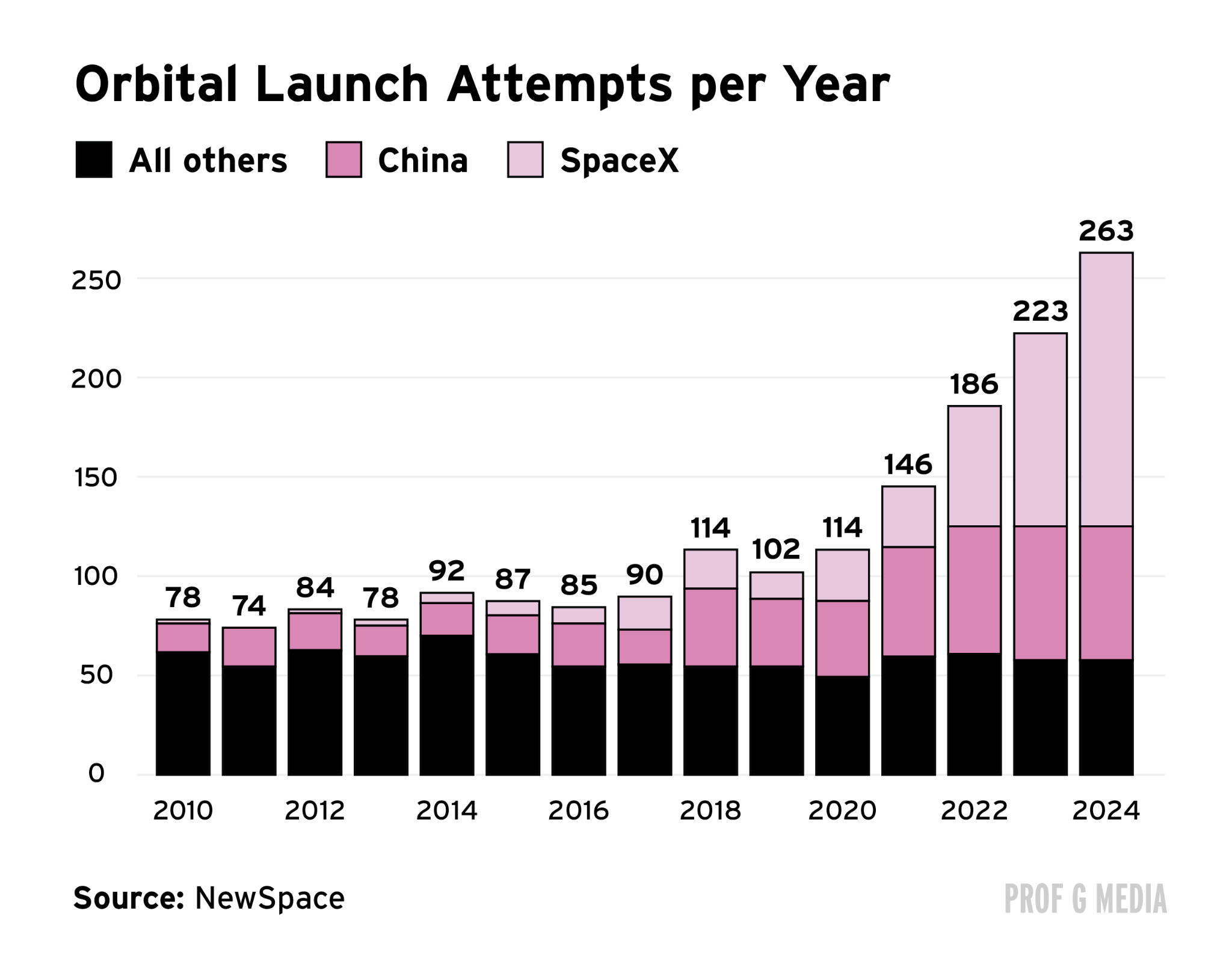
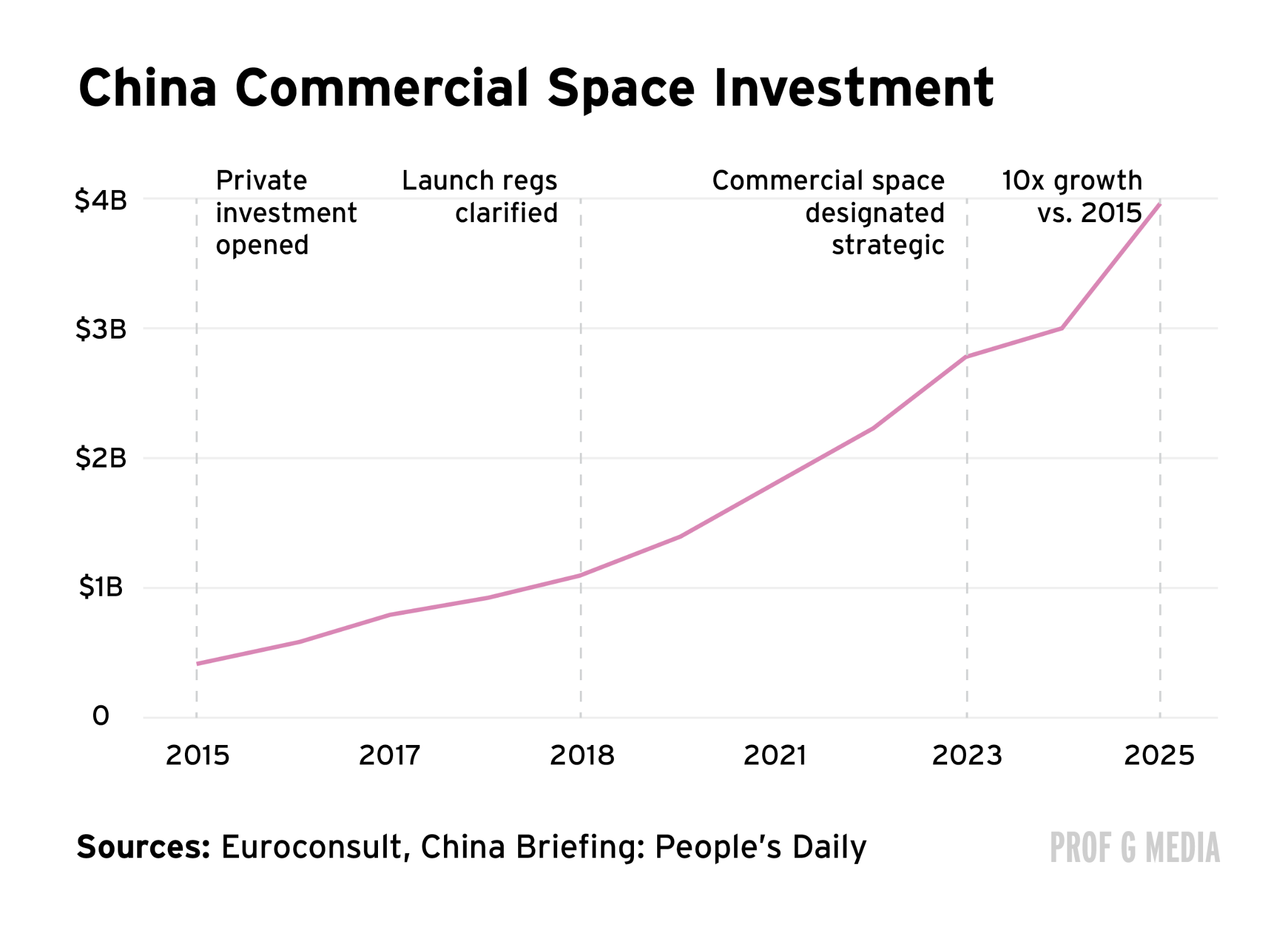
The commercial space economy is worth roughly $613 billion, with the United States holding about 55% of that market. China sits at around 8% but is growing quickly. Chinese commercial space investment reached approximately $4 billion in 2025, up from $340 million a decade ago.
China has emerged as a formidable competitor in space, and its ambitions are only accelerating.
James’ Take: The key to understanding China's space program is to ignore space entirely. It's a strategy for dominating Earth. A textbook written for PLA officers, not for public consumption, states that the ability to control Earth by controlling space represents a powerful military incentive, and that the development of space warfare capabilities has become a focal point of the arms race.
The Shijian 21 satellite shows exactly what this looks like in practice. It's a Chinese satellite equipped with a grappling arm that maneuvered alongside a defunct Chinese satellite more than 36,000 kilometers above Earth and hurled it into a graveyard orbit. The U.S. military took note immediately: if that arm can do it to a defunct Chinese satellite, it can do it to one of America's roughly 80 spy satellites currently monitoring Chinese territory. In 2023, the Office of the Director of National Intelligence formally warned that China had developed the ability to operate space-based weapons capable of degrading U.S. capabilities in orbit.
Alice’s Take: China’s current space investment is still a fraction of the U.S. total, but the trajectory is what matters. China’s space investment has grown tenfold in a decade, with explicit backing from the five-year plan and language at the March Lianghui designating China as a space superpower.
What’s also notable is that this ecosystem is increasingly public-private. A private company appears to be supplying the on-orbit robotic arm technology to the Chinese government, not unlike what we see with SpaceX in the U.S.
Space was embedded in China’s Belt and Road strategy as far back as 2013. What we’re watching now isn’t a sudden sprint; it’s the culmination of a long-run plan. And with the SpaceX IPO expected to be the largest in history, this will become a political flashpoint between Washington and Beijing, not just a technology competition.
The $2 Trillion Inheritance Problem
For the first time in its modern history, China is confronting a massive generational wealth transfer, and almost none of it will be taxed. Chinese citizens with fortunes above $5 million are expected to pass down roughly $2.1 trillion over the next decade. China has no inheritance tax. It has no meaningful property tax. Its fiscal revenues as a share of GDP are among the lowest in the world, at roughly 15%, against an OECD average of around 34%.
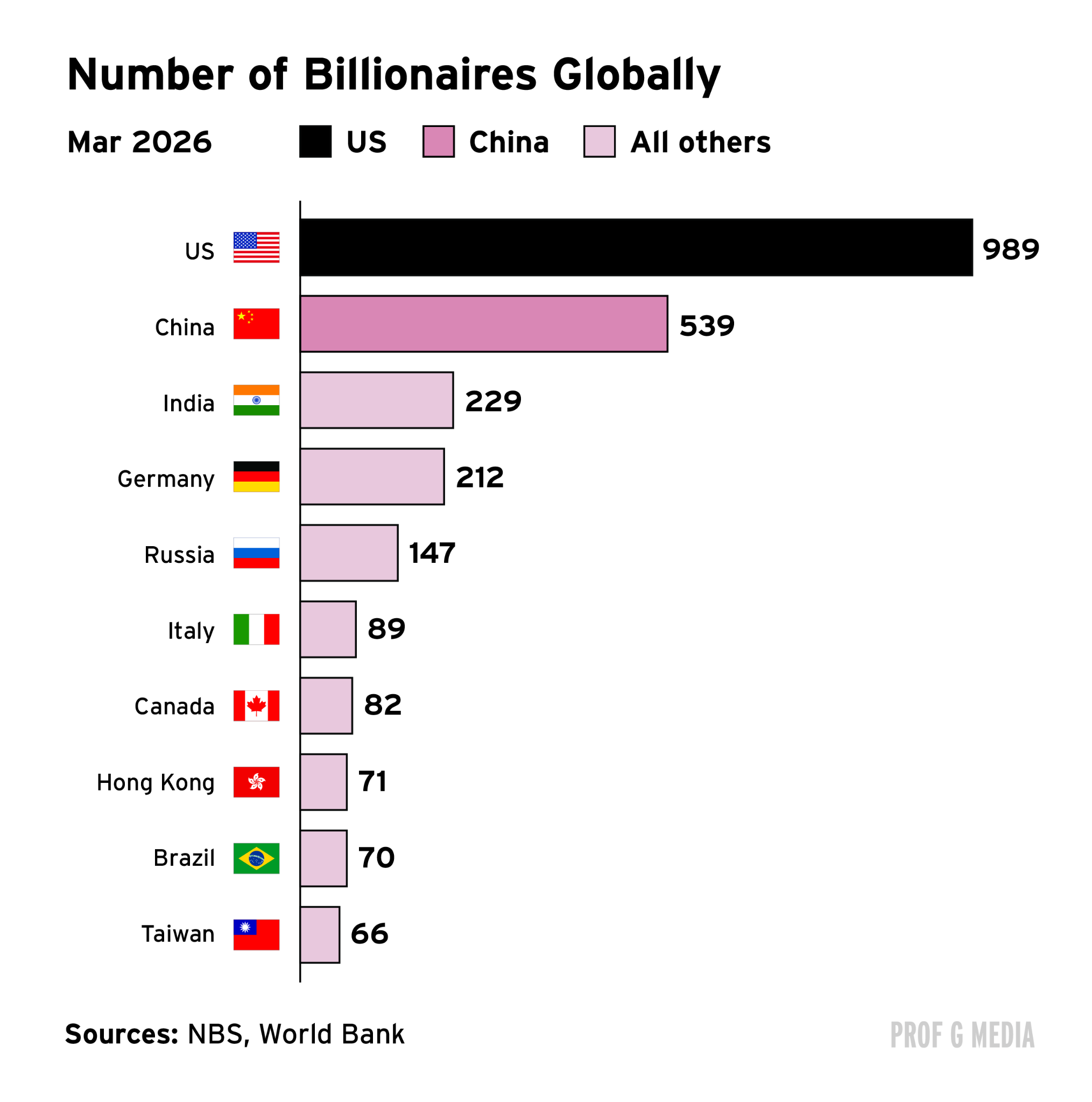
Land sales, historically a critical revenue source for local governments, fell 15% last year. The broader fiscal deficit is approaching 10% of GDP, a historic high. China has 539 billionaires according to Forbes, with a combined net worth of approximately $2.2 trillion, equivalent to the entire Australian economy.
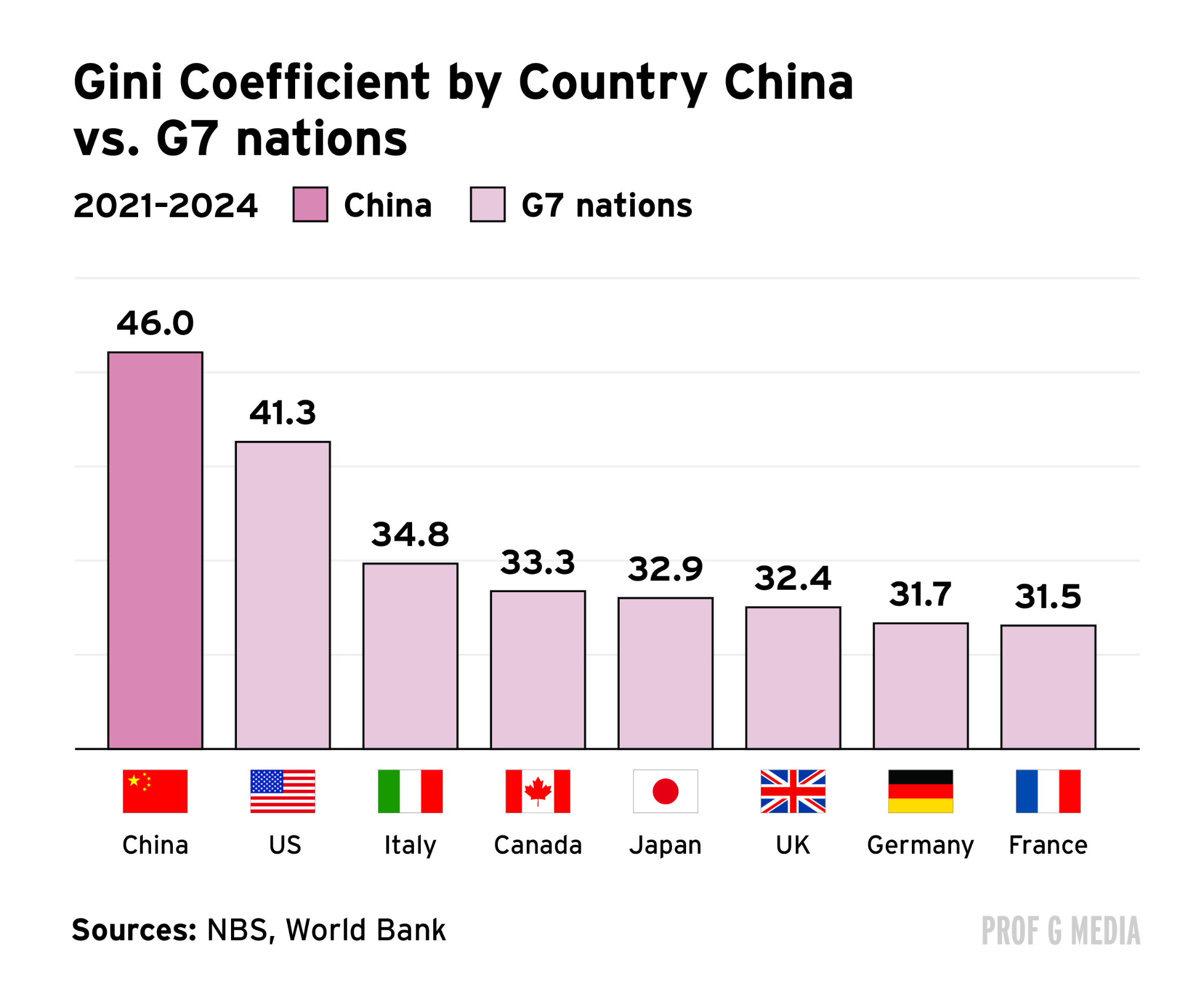
China’s Gini coefficient, the standard measure of income inequality, exceeded 0.46 as of 2021, by the Chinese government’s own account. That puts it above the 0.4 threshold associated with high inequality, above the U.S., and well above Germany, France, and Canada, which all sit in the low 30s. A country still governed by a party that calls itself communist is, by its own data, more unequal than most of the capitalist world.
Alice’s Take: This is all coming to a head because the alternatives are running out. Land sales are down, corporate tax revenues are under pressure, and the government doesn’t want to touch export tax rebates because it can’t afford to hurt Chinese manufacturers. Inheritance tax is low-hanging fiscal fruit. My prediction is they’ll pilot it in specific cities first, then figure out how to split revenues between the central and local governments, where local governments will probably lose again.
The one-child policy has concentrated family wealth into single children who know they will inherit everything. That feeds directly into the Tang Ping movement, the notion that lying flat is rational when you’re going to inherit your parents’ apartment and savings regardless. The whole situation is very ironic. The Communist Party governing one of the world’s most unequal societies, now scrambling to find a wealth tax before the fiscal situation forces its hand.
James’ Take: The deeper puzzle here is why China waited this long. The orthodox economic answer is that China wanted to build a winner-take-a-lot culture as a feature not a bug. But there’s something stranger going on. China has avoided both a property tax and an inheritance tax for decades despite running a system that theoretically prizes redistribution. My suspicion is there’s a political explanation we can’t fully see from the outside: factional interests, property developers with connections, local governments protecting their land-sale revenues. Whatever the reason, the pressure is real and hard to ignore.
Dim Sum Robots and the Coming Labor Shock
Starting May 1 in Guangzhou, teahouses are required to disclose whether their dim sum is handmade or produced by machine. In Hangzhou and Beijing, courts have separately ruled in the past two years that companies cannot fire workers simply because of AI — citing China’s labor contract law and ruling that AI-driven displacement does not constitute the kind of “major change in objective circumstances” that justifies termination. That legal category was designed for natural disasters. Now it’s being tested against algorithms.
This is happening against the backdrop of a rapid expansion of robotics across China. Robots are running half-marathons faster than world record holders. They are dexterous enough to fold dim sum to exact specifications. At an exhibition center in southern Beijing, robots have been designed not as general-purpose machines but as specialists: surgery robots, pharmacy robots, soccer robots, painting robots.
James’ Take: I came back from China genuinely worried. Not just about China’s trajectory but also about ours. China is moving into automated manufacturing faster than any other country, and the people I spoke to who weren’t in the AI or robotics industry were concerned. The government is trying to respond; it’s proposing a World Artificial Intelligence Cooperation Organization and passing regulations trying to slow the job shock, but I don’t think it can hold back the tide. When a technology can do something more efficiently than a human, that is what tends to happen. The dim sum disclosure rule is a small signal. The real question is what happens when this scales to every factory floor in China and then to ours.
Alice’s Take: I take a slightly different view on regulation. China has moved fast and retroactively on crackdowns before: the 2021 tech crackdown, the ed-tech crackdown, and I think unemployment from AI will be political enough to force Beijing’s hand. The government can’t afford a mass employment crisis. When stories start piling up about job losses at scale, the central government will likely step in with mandatory thresholds for how many workers can be displaced before companies need approval. More importantly, EVs peaked at around 1,000 manufacturers before consolidating below 100. Robotics could see 100,000 makers. But these won’t be general-purpose machines, they’ll be finely tuned for specific tasks. A robot for folding dim sum. A robot for painting cars. That wave is coming. And unlike EVs, which you can tariff at the border, robots built inside your own factories are much harder to stop.
China Decode Weekly Predictions:
James’ Prediction: FIFA will have to accept whatever lowball offer China is putting on the table for World Cup broadcast rights. China accounted for 49.8% of total visual hours worldwide during the 2022 World Cup. With the tournament weeks away, FIFA has no leverage. China does.
Alice’s Prediction: My prediction is that after a series of Trump-Xi meetings, including a Xi visit to the U.S. before year-end, Beijing will push for some kind of landmark green tech deal on American soil. A BYD-Ford joint venture, or something equivalent. Chinese manufacturers want to bypass tariffs, Washington wants an announcement, and both sides have incentive to point to something concrete. Whether it actually happens depends entirely on where the broader U.S.-China relationship stands by then.
The United States has SpaceX. China is building a space-industrial wolf pack.
Prof G is right to frame China’s space program as something larger than space exploration. The real issue is not whether China can reach space. The real issue is how China is turning space into part of its national industrial system.
Space is about Earth: communications, remote sensing, navigation, military awareness, commercial infrastructure, and geopolitical reach. But the deeper question is organizational. The United States has SpaceX as the central symbol of commercial space. China does not yet have one dominant SpaceX-style company. What it is building instead is something more distributed.
This is why I described China’s commercial space sector as entering a wolf-pack phase. CAS Space, LandSpace, Space Pioneer, Orienspace and other companies are moving along different rocket designs, propulsion pathways, launch systems, satellite applications, and local industrial clusters. The point is not that one Chinese company will immediately become SpaceX. The point is that China is creating a competitive space-industrial ecosystem.
That difference matters. A lion can be faster and more spectacular. A wolf pack can be more distributed, redundant, adaptive, and harder to stop. China’s space challenge should therefore be understood not only as a military or technological story, but as another example of China’s system-level industrial mobilization.
This is exactly the argument I made in my earlier piece on China’s commercial space wolf-pack phase
I’m confused. How is a Communist country more income unequal and lower taxed than the US? How is a Communist country projected to shed more jobs to robots than any other country in the world?
Do we need to ship Mamdani and AOC to Beijing to square them away first? 😳