



TL;DR
China Shut Out of the Biggest IPO in History
Will China Ever Produce a Trillionaire?
China Is Getting Ahead of the AI Jobs Crisis. America Isn’t.
China Found a Backdoor Solution to Being Shut Out of SpaceX
SpaceX raised $86 billion in its IPO last week, surpassing its initial target of $75 billion, in the largest public offering in history. The IPO was priced at $135 per share, and the stock climbed more than 30% in its first days of trading. However, Chinese and Hong Kong investors were excluded from participating over apparent concerns about U.S. restrictions on exports of critical technology. Chinese investors have even been using crypto tokens and stablecoins to simulate exposure to SpaceX and other hot U.S. IPOs, circumventing Beijing’s capital controls in the process, with some offerings heavily oversubscribed despite significant legal and financial risks.
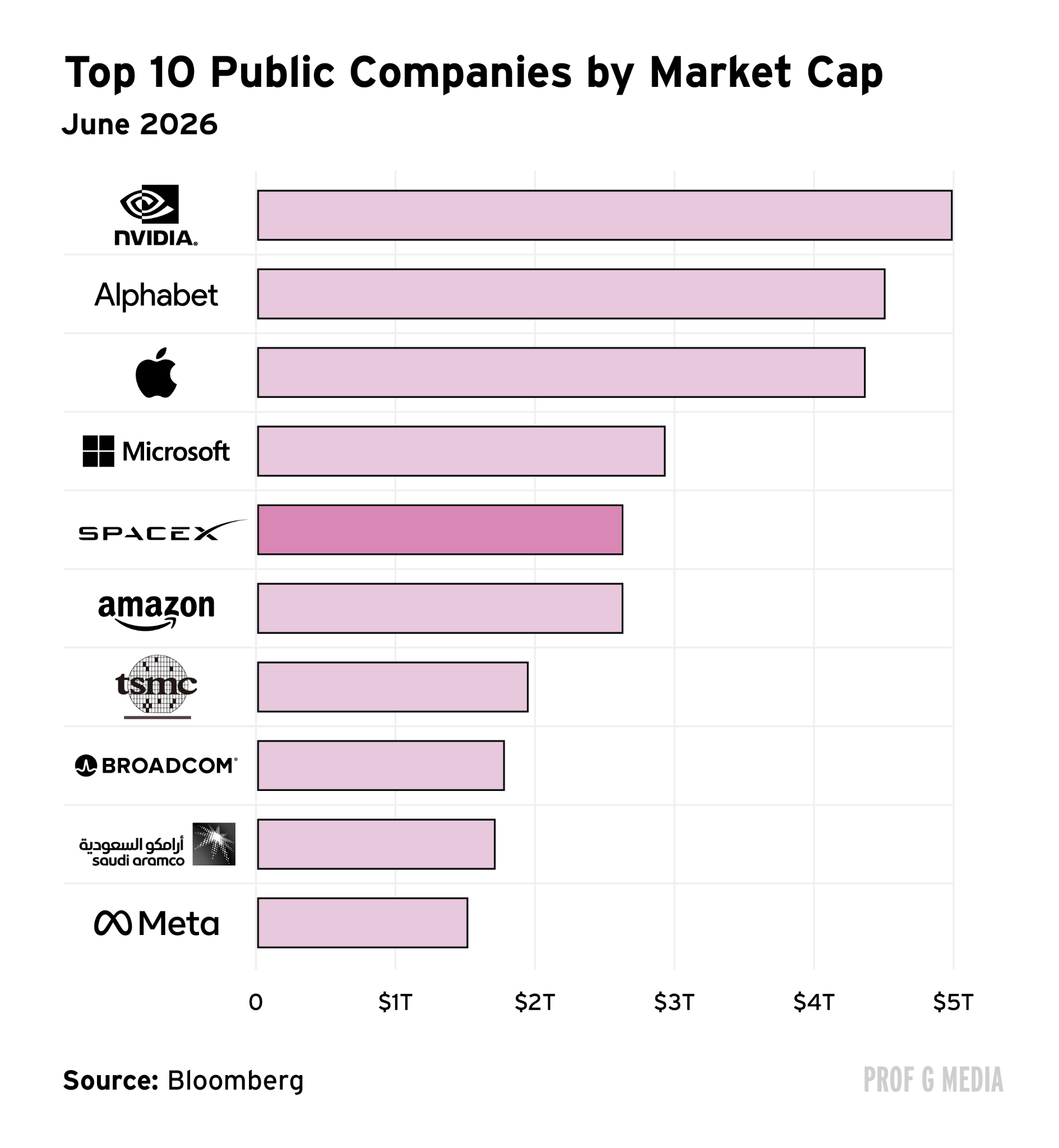
The exclusion is part of a broader pattern of financial decoupling. China’s securities regulator, the CSRC, has been cracking down on offshore brokerages facilitating cross-border securities transactions, moving against firms, including Tiger Brokers and Futu Holdings. At the same time, the Pentagon updated its Chinese military companies list to include Alibaba, BYD, and Baidu — corporate giants that are now barred from Pentagon contracts and face heightened reputational risk with American partners.
Alice’s Take: The SpaceX exclusion isn’t purely Washington’s doing. Beijing is also pushing to keep the mainland capital at home. The CSRC crackdown on cross-border brokerages signals that Chinese regulators don’t want to see domestic money flowing into U.S. tech listings. The trend is clear: Going forward, far less Chinese capital will be parked in U.S.-listed companies, both Chinese ADRs and American stocks. Instead, that money is being redirected toward a bumper crop of domestic tech IPOs. Unitree, China’s largest humanoid robotics company, has begun its listing process. CXMT and YMTC, two major semiconductor firms, are also in the pipeline, alongside an estimated 50 robotics companies at various stages of applying to list. The capital war is as much a part of the tech war as chips or models.
As for the Pentagon list: It’s more tactical than strategic. It’s designed to keep corporate America spooked about China. I was just in LA speaking to Hollywood executives who privately told me they’re in awe of what ByteDance is doing in video AI — specifically Seedance — calling it beyond anything else available globally. Their legal teams won’t let them touch it. The shadow of these designations is larger than the list itself.
Ed’s Take: My assumption when I saw the headline was that Washington had moved to block Chinese investors from the SpaceX IPO. But Alice is right that both sides are pulling away simultaneously. China is tightening capital controls, limiting foreign currency conversions, and actively incentivizing domestic investment. The U.S. is signaling, through the Pentagon list and other measures, that Chinese companies are unwelcome in sensitive sectors. Both parties are trying to break up with each other. The question is who gets to claim they left first.
The Pentagon list is performance art as much as policy. You can make an argument that if your view is “China equals bad,” then every Chinese company should be on it — they all operate under significant CCP oversight. Whether this is substantive policy or a signal to the market is the real question. Right now, it looks like both.
Will China Ever Have a Trillionaire?
SpaceX’s IPO made Elon Musk worth more than a trillion dollars, equivalent to 3.2% of U.S. GDP, more than twice the relative wealth of John D. Rockefeller at his peak. The richest person in China, ByteDance co-founder Zhang Yiming, is worth a reported $93 billion. The gap raises a structural question: Could China ever produce a trillionaire, and would the CCP allow it?
ByteDance, last valued at around $600 billion in private markets, generated an estimated $186 billion in revenue in 2025. If it were valued on the same multiple as Meta, the company would be worth closer to $1.6 trillion. Instead, it trades at a steep discount, in part because of what investors call the “China tax” — the persistent risk that regulatory action could disrupt any company, at any time, for any reason. Jack Ma’s Ant Group IPO, which was set to raise $35 billion in 2020, was pulled the night before it was supposed to launch after Ma made remarks that displeased regulators. Ma subsequently disappeared from public life for years.
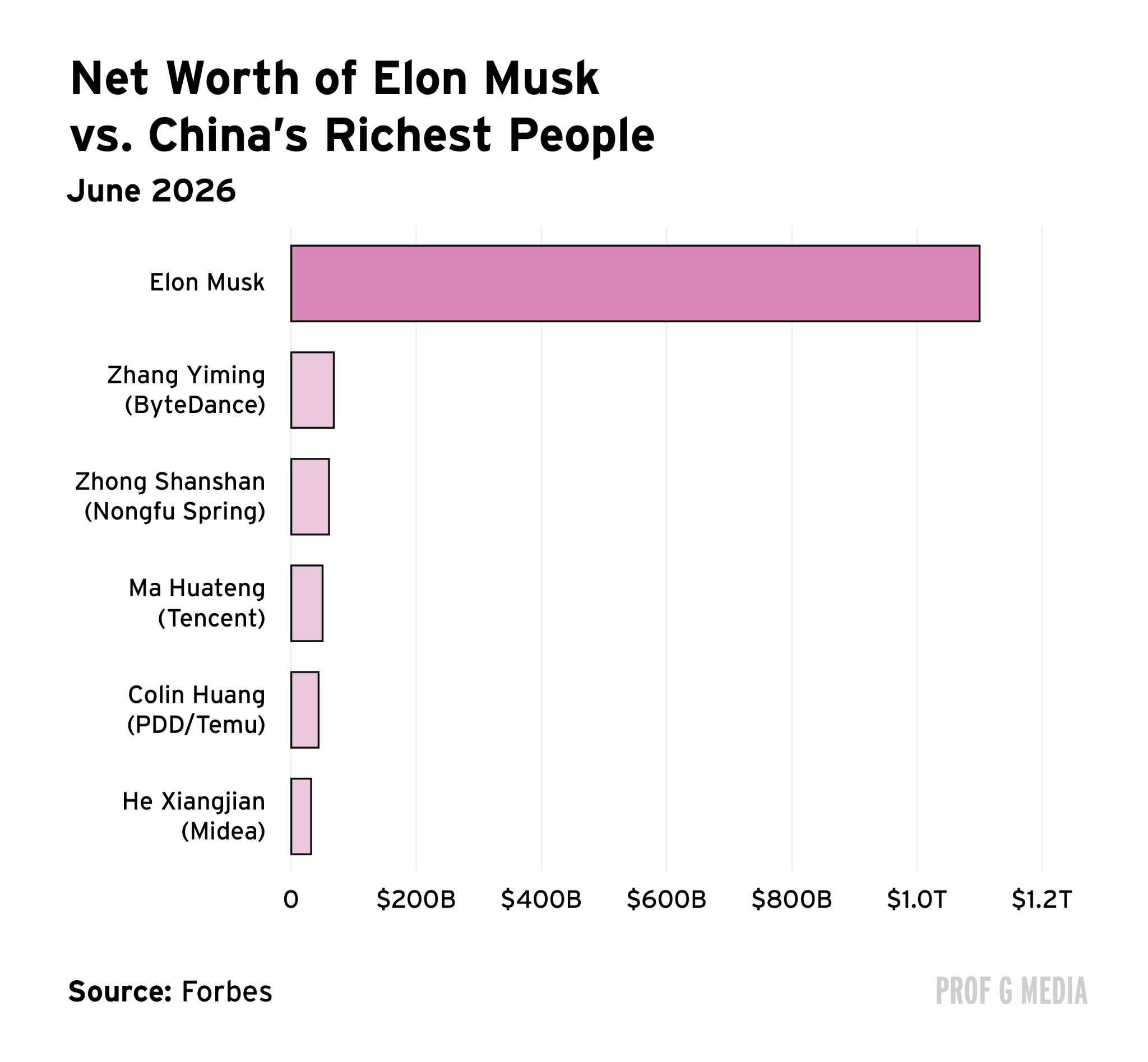
Alice’s Take: I don’t think we’ll see a Chinese trillionaire in our lifetime. ByteDance won’t IPO within the decade; they don’t need the cash, and listing would invite more regulatory scrutiny both at home and globally. Beyond that, Chinese IPO sizes are structurally smaller than their U.S. equivalents, and valuations of comparable companies are orders of magnitude lower. There’s also a political ceiling. When you accumulate enough wealth to become politically inconvenient — as Ma did — the government moves. The CCP has to walk a tightrope: Private companies hire the vast majority of China’s workforce and drive the innovation and exports that the government depends on. So billionaires are tolerated. But a trillionaire, in a country whose mandate is common prosperity, becomes a different problem entirely. My suspicion is that if anyone in China got close, they would find obstacles appearing in their path.
Ed’s Take: The numbers make the point clearly. Elon Musk is now richer than some countries. That level of wealth concentration is not something the Chinese system is built to produce or absorb. Xi Jinping is caught between the logic of the Mao era (which would have found any of this obscene) and the practical reality that the private sector is essential to China’s economic and technological ambitions. The CCP has co-opted its billionaires as instruments of national strategy. But there’s a threshold beyond which they become threats to it. China hasn’t built the kind of public markets that would allow wealth to compound at that scale, and I think that’s partly by design.
China is Getting Ahead of the AI Crisis. America Isn’t
China’s GDP grew 5% in the first quarter of 2026, but warning signs in the labor market are mounting. Youth unemployment for 16- to 24-year-olds held at 16.9% in March. The 25-to-29 cohort hit a record high of 7.7%. Nearly half of China’s urban labor force has shifted into flexible gig work — delivery drivers, ride-hailing, logistics — the categories most exposed to automation by autonomous vehicles, drones, and humanoid robots.
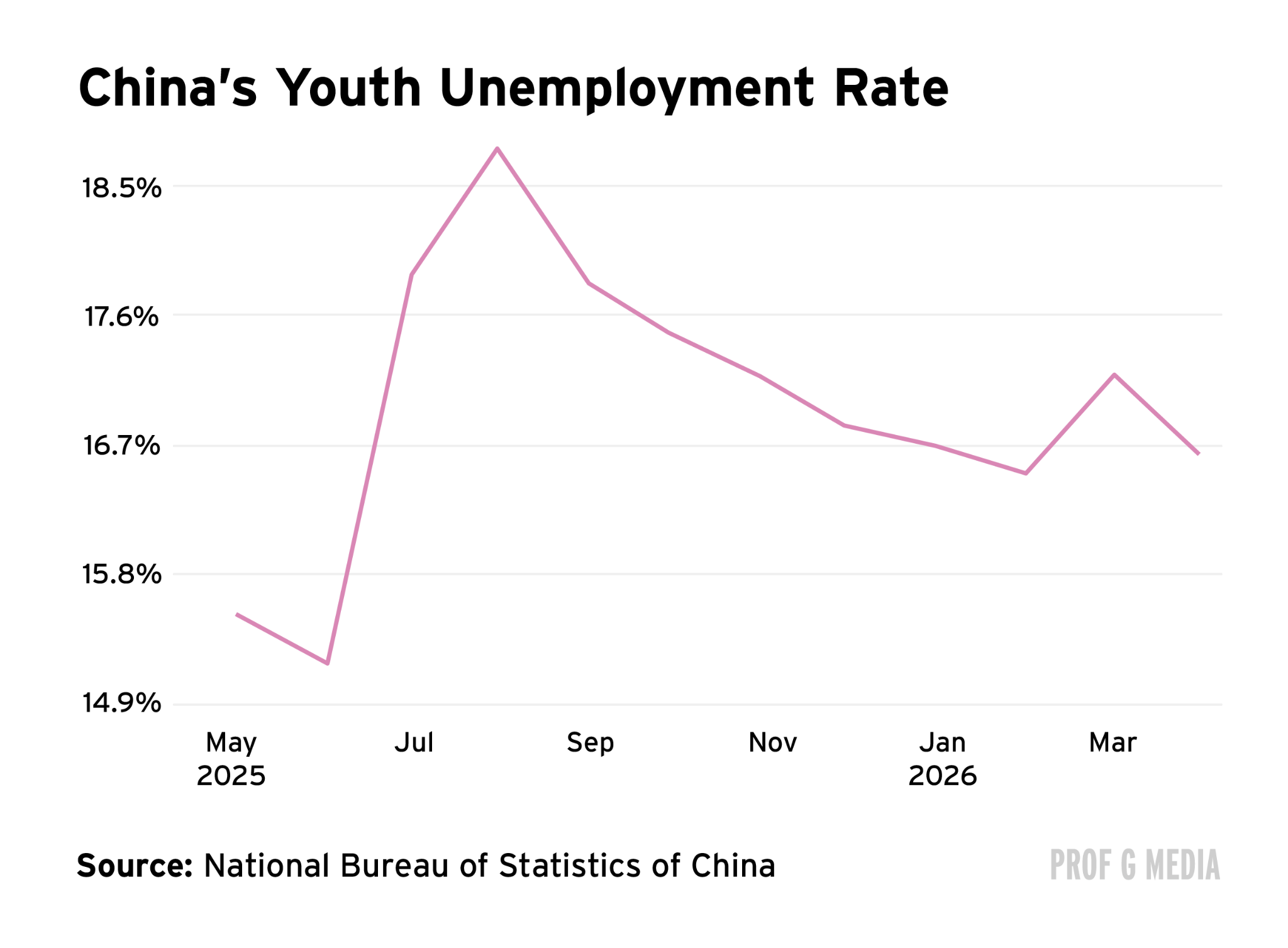
Researchers from Peking University, Nanjing University, and other institutions estimate that AI could displace up to 278 million Chinese workers by 2049, roughly 1 in 3 employees in China today. Job postings for college graduates fell 22% in the first half of 2025 compared with the prior year. In Wuhan, taxi drivers have already staged protests against Baidu’s rollout of robotaxis.
However, the Chinese government is responding. China’s Workers’ Daily, the official newspaper of the state-backed national trade union, recently ran a series of articles identifying three core labor threats from AI: digital cloning, where companies require employees to train AI avatars of themselves; AI being used as a pretext for unlawful termination, which Chinese courts have already ruled against; and algorithmic oversight systems that blur working hours, cut pay, and make it nearly impossible for workers to build a legal case in their own defense.
In the U.S., the picture is different. Around 1 in 5 job cuts this year has been attributed to AI — approximately 50,000 roles, with layoffs from Pinterest, Amazon, and Block among the most prominent. A recent KPMG and University of Melbourne survey found that only around 40% of Americans said they were excited about AI, compared with nearly 90% in China. The White House has taken a hands-off approach to AI labor regulation, and an executive order has moved explicitly to prevent states from passing their own rules.
The divergence matters for the AI race itself. U.S. data center construction is being slowed by political opposition; tens of billions of dollars in projects were blocked in 2025 alone, with 19 considering restrictions. That opposition is being driven, at least in part, by the sense that AI is benefiting the wealthy while displacing workers. China is attempting to get ahead of that dynamic. Whether it succeeds is an open question, but the contrast with Washington’s current posture is stark.
Alice’s Take: It’s a tale of two scenarios. China’s government detected the wave coming and is trying to get ahead of it. The narrative has shifted from AI as an economic panacea to digital inclusivity and inclusive growth. Those are catchwords for avoiding an AI apocalypse in the labor market. China is particularly exposed because so much of its workforce is in the gig economy: delivery drivers, ride-hailing, the jobs that disappear fastest when autonomous vehicles and humanoid robots arrive. I point to the 1990s as a reference. When SOEs went bankrupt and hundreds of millions of jobs were lost, Premier Zhu Rongji created what effectively amounted to subsidies to cushion the blow for displaced workers. That led to the next wave of growth as China rode the WTO and the export engine into the 2000s. I believe the government will move similarly here, possibly through taxes on AI and robotics companies, to try to soften the impact on workers who will be left behind.
Ed’s Take: The irony is that China’s approach to regulation may actually help it win the AI race. The White House said for years that any regulation on AI was a form of stifling innovation. Then they got into a scuffle with Anthropic, and suddenly regulation was on the table. The double standard is obvious. But the deeper point is this: The less effort you put into regulating AI, the more people fear it, and the more they move to block it. Tens of billions of dollars in U.S. data center projects were stopped in 2025 by political pushback. Nineteen states are considering restrictions on data center construction. That opposition comes from a vacuum of policy. China is filling that vacuum. It has a history of bending the economy to protect workers when the pressure gets high enough, and that may ultimately create more public trust in the technology, more adoption, and more infrastructure build-out. I don’t glorify the CCP. But on the specific question of regulating AI in the public interest, the White House could learn something.
☕️ I’m bookmarking this! I can’t make it totally compute, but maybe I haven’t had enough coffee. China has become a winner in 2026.