



Join China Decode hosts Alice Han and James Kynge and their guest, Kevin Xu of Interconnected Capital, this morning at 10 a.m. ET for a live debrief on the high-stakes summit. This Substack live is free to all Prof G Media subscribers, so if you’re reading this, you’re invited. Join the conversation here.
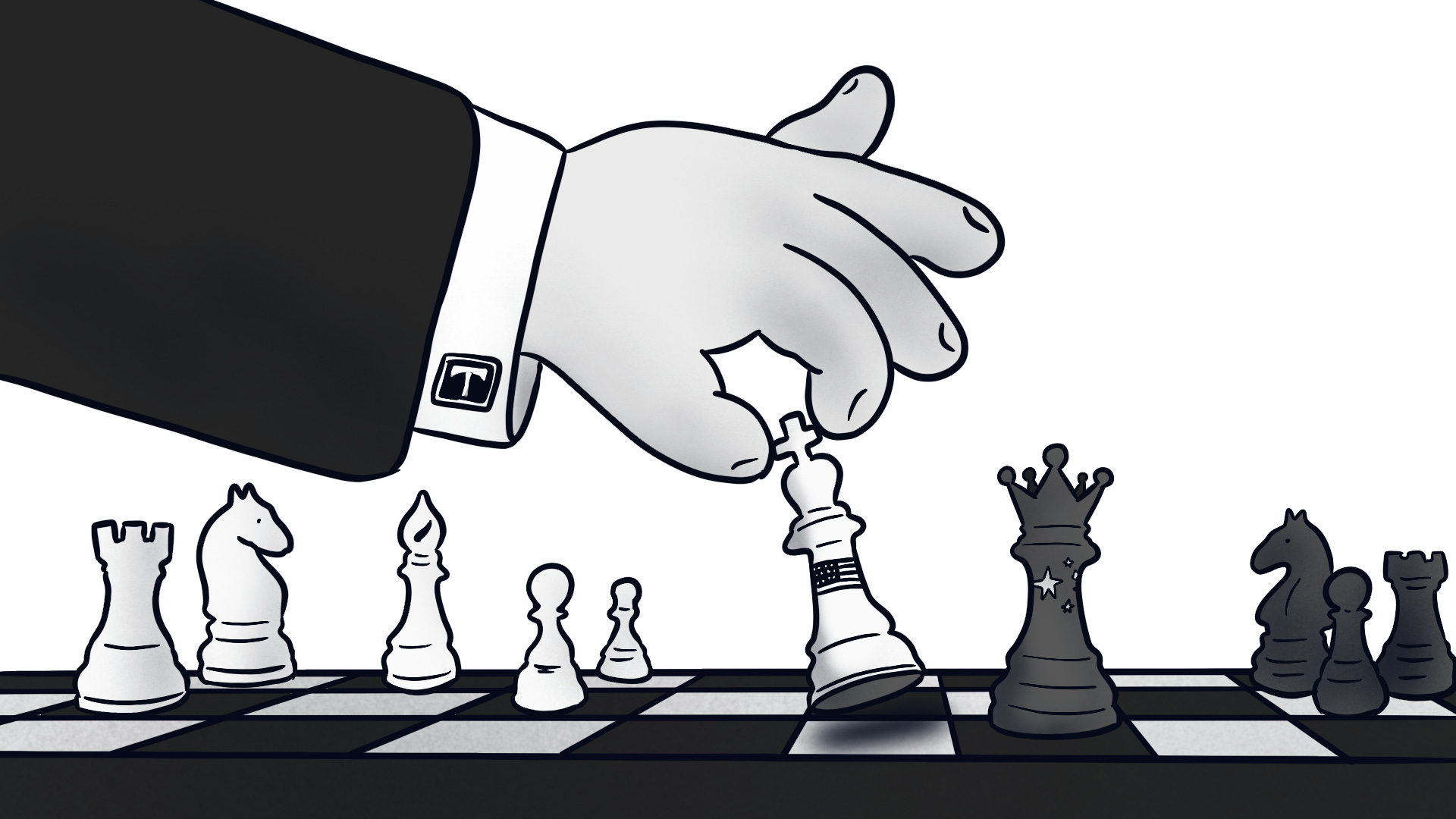
One of Trump’s many weaknesses is believing he’s playing three-dimensional chess when he’s eating the pieces. Things are different now. In 2017, Trump visited a China still playing catch-up, calling itself a “developing country,” needing America more than America needed it. That country no longer exists. China’s GDP is 54% larger. Its navy — 370 battle force ships to America’s 296 — is now the world’s largest. China added 78 warships between 2015 and 2023; the U.S. added 20. A single Chinese shipbuilder last year produced more tonnage than the entire U.S. shipbuilding industry has delivered since World War II. Meanwhile, DeepSeek shredded the assumption that chip controls could contain China’s AI ambitions. And Xi, who in 2017 was merely consolidating power, has since abolished term limits and purged his own generals. The man across the table isn’t asking for market access, he dominates many key markets. For example, in renewables, China produces 70% to 80% of the world’s EVs, solar panels, and batteries. Xi has built an AI ecosystem closing in fast on the frontier of artificial general intelligence and processes 90% of the world’s rare earth minerals. Trump is not negotiating from the same position he was in 2017. And neither is Xi.
For more context, here’s an excerpt from the most recent companion newsletter for China Decode:
The Super Bowl for U.S.-China Watchers Is Over — Questions Remain
Alice’s Take: This is the Super Bowl for followers of China-U.S. relations. There was a lot of analysis on the road leading up to the event, with commentary about who has the upper hand going into overdrive this week. I see the playing field as roughly even. My take on China’s priorities, having just spent a month in the country, boils down to three crucial issues. One is tariffs. China will want a modest reduction in the effective tariff rate. Secondly, they will likely push for more clarity on export controls. And the last point centers around the “Board of Investment” strategy. China is pressing for companies such as BYD and CATL to be able to set up plants in the U.S., either wholly owned or through joint ventures.
But there’s a second tier of issues important to China. Those include a resolution to the conflict in the Middle East — even though China would prefer to remain in the background — and, of course, Taiwan. Finally, there could be an attempt to connect North Korea and Washington, which could lead to a conversation between Trump and “Rocket Man” Kim Jong Un.
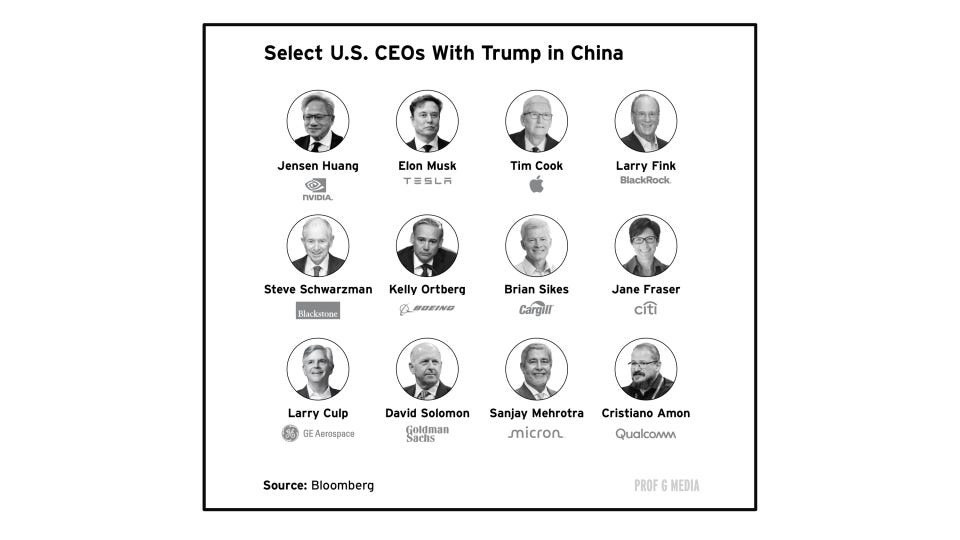
On the U.S. side, Trump needs a win. Behind him in Beijing is an entourage of American CEOs, including a surprise last-minute addition to the list: Nvidia’s Jensen Huang. Among names such as Tim Cook and Elon Musk are Boeing’s Kelly Ortberg and Cargill’s Brian Sikes. The White House has signaled it would like to see more agriculture and aviation purchases. You can also expect discussion about reducing the trade deficit, although the stats show bilateral trade volume in 2025 dropped by the most since 1979, the year when the U.S. and China officially established diplomatic relations. The U.S. share of Chinese exports to the world has fallen sharply since Trump last visited China in 2017. The conversation, meanwhile, is shifting more to dual-use technologies, which have both civilian and military applications.
James’s Take: I’d argue that this is the first U.S.-China summit in history where the Chinese leader sits down with the stronger hand. I’ll also go back to the 1970s. When Richard Nixon visited China in 1972, U.S. GDP was roughly 11 times China’s. When Trump headed to China in 2017, the U.S. was unambiguously the more powerful of the two. In nominal terms, the U.S. economy remains larger. But adjusted for purchasing power parity, China has eclipsed the U.S. In manufacturing, China accounts for roughly a third of global output, compared with about a sixth for the U.S. And when the Liberation Day tariffs hit 145%, China’s threat to restrict critical mineral exports was enough to bring those tariffs down to around 47%. That episode showed who blinks first. Today, Trump’s hand is relatively weaker, and Xi’s is relatively stronger.
Both sides see each other as an implacable adversary, and suspicion runs deep. But the rhetoric in public will be positive. The U.S. and China need each other. Each side seeks stability. The U.S. realizes China can play a critical role in resolving the conflict in Iran and unblocking the Strait of Hormuz. China is focusing on Taiwan. What Xi wants exactly remains unclear, but he will push for something more concrete. China is playing for big stakes.
Scott’s Take
History doesn’t repeat, it rhymes. Nixon went to China in 1972 from a position of strength, and it changed the world. Trump went to China in 2026 needing a win, trailing an entourage of American executives auditioning for access to 1.4 billion consumers. The world is changing again — just not in the direction we expected. And here’s the tell: The U.S. brought its CEOs. China brought its demands. When you need the other side’s market more than they need yours, you’re not negotiating — you’re applying.
Life is so rich,

P.S. For those in the back, the China Decode team is doing a live debrief of the summit on Substack this morning at 10 a.m. ET. Join the conversation here. And if you can’t make it, the recording will be available immediately following.
Agreed! As Napoleon once said, “never interfere with your adversary, when they’re in the process of destroying themselves.
The Straight of Hormuz appears to be our Suez Canal Crisis—when the Brits and Israel failed to take the Suez Canal—The British Empire signed its own death certificate—for the US, the date: TBD!
We may have been a declining superpower, but Trump is an accelerant of the worst order, and history will not be kind!…:)
Nixon sold out the American middle class in 1972, thinking China would "modernize" away from communism. The USA still doesn't understand China and is actively destroying itself to help billionaires.