


One of my New Year’s resolutions is to write more, so I’m doing something unheard of: I’m starting a Substack. Each week I’ll share my thoughts on markets, business, technology, and life. (What I do everyday on the podcast.) The only difference is the format — plus, we’ll discuss things in a little more detail here.
If you enjoy the post, subscribe here to receive my new weekly newsletter (out every Tuesday)
Before we dive in, a quick thank you. This past year has been incredible. We did our first live show on the big stage at SXSW, we won a Webby, I went on TV for the first time, and I also made the prison list. The most significant milestone, however, was taking Prof G Markets daily. This was a big deal for me as I went from co-hosting with Scott to hosting on my own. I was quite anxious in the beginning, but thanks to you the show has been an enormous success. So thank you for watching and supporting — we have great things planned for 2026.
OK, enough with the mushy stuff and onto the post.
Company of the Year
This week I’m discussing my pick for 2025’s “Company of the Year.” Disclaimer: This award is not given to the “best” company, or the most profitable. Rather, it goes to the company that best captures our current moment, that summarizes “our time.” To give you a sense, here are the runners-up: Third place: Nvidia. Second place: OpenAI. It’s a vibes-based award. (AI had a big year.) Got it? And the award goes to: OnlyFans.
Yes, OnlyFans. For as much impact as AI may (or may not) have had last year, there is no company in the world that better capitalized on the specific conditions that defined our world in 2025. Specifically: a chronic case of loneliness, a chronic case of sexlessness, and a more terminally online society than ever before. These trends have been building for a while, but they came to a head in 2025. And this, as I’ll explain, is why OnlyFans had such a phenomenal year. But first, a quick refresher on what OnlyFans actually is.
Something New
For the uninitiated, OnlyFans is essentially Substack for porn. “Creators” (young women) post “content” (porn), which their “community” (young men) can access for a monthly fee.
Some say this is nothing new: Porn’s been around for a long time, so who cares? However there’s one feature that makes OnlyFans very different, and that is the chat function. For an additional fee, users can send messages and “chat” with their favorite creators privately. This is in fact the most important piece of the business: Private chat fees make up 70% of OnlyFans’ total revenue. In this way, OnlyFans isn’t just monetizing porn — it’s also monetizing loneliness. It’s offering a sense of personal companionship that regular porn doesn’t provide.
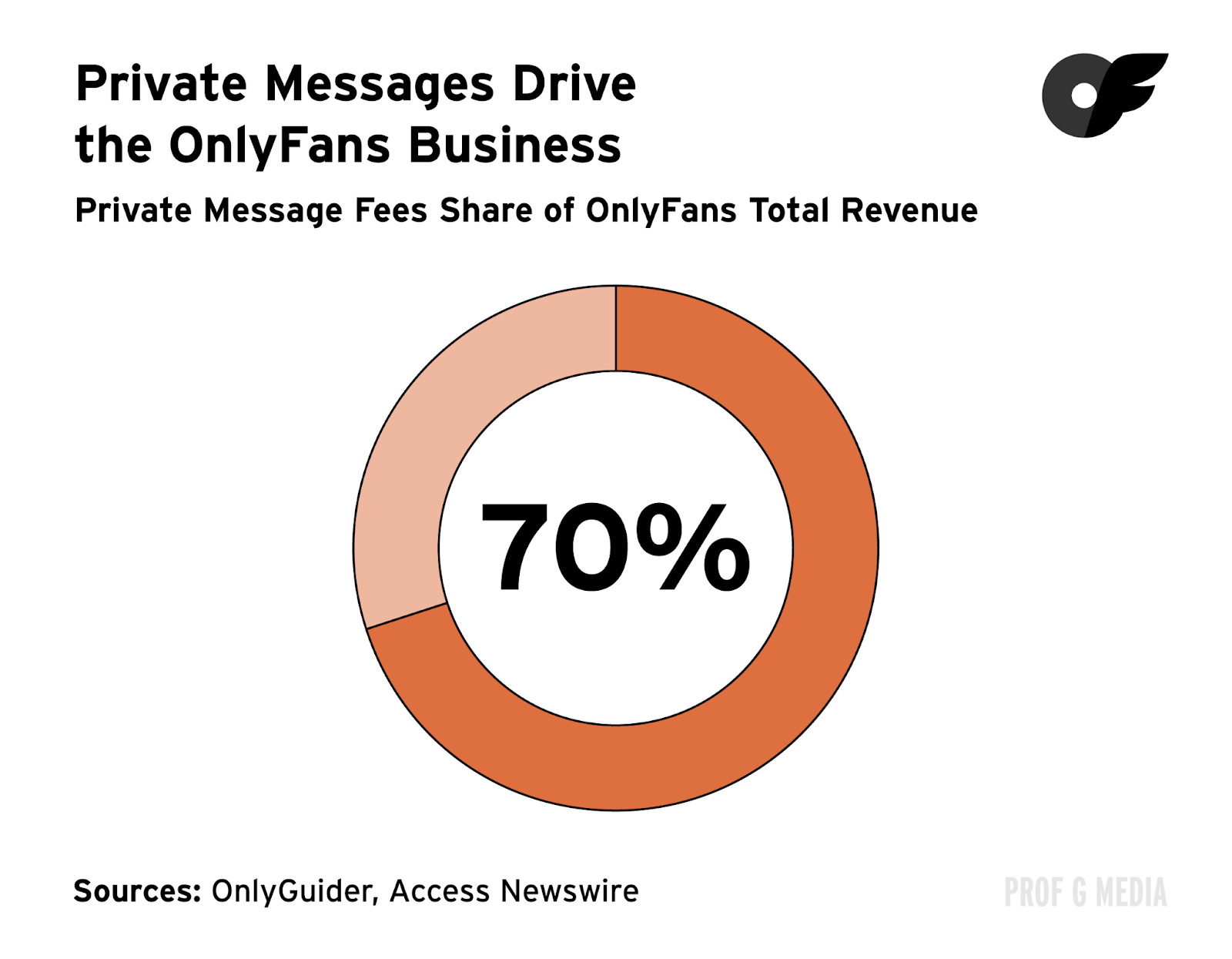
Some would argue this, too, is nothing new. Phone sex operators, for example, are similar, and they existed long before the internet. But this is where scale comes in. To understand how unique OnlyFans is, you must understand how big it is. To give you a sense:
378 million: That’s how many people use OnlyFans. That’s more than the population of the United States.
$7.2 billion: That’s how much money was spent on OnlyFans in 2025. That’s more than the GDP of Andorra.
$43 million: That’s how much money the top OnlyFans creator makes per year. That’s more than what top NBA players make, including last year’s MVP, Shai Gilgeous-Alexander.
Few adult platforms — let alone platforms — have achieved this level of success. In fact, OnlyFans is now one of the most revenue-efficient companies in the world, generating ten times more revenue per employee than Nvidia. We’ve seen many big-name brands in the adult industry like Playboy, Hustler, Pornhub, but nothing like this.
Beyond being a new type of business, I further posit that OnlyFans could not exist at any time other than now. This is what makes it Company of the Year. The pretext to its dominance is an environment so deeply and disturbingly specific to 2025.
A Really Big TAM
One of the most important forces in business is TAM, or total addressable market: how large the customer base is. If you’re a company that sells chocolate bars, it helps if a lot of people want chocolate bars. Similarly, if you’re a company that monetizes loneliness, it helps to have a lot of lonely people out there.
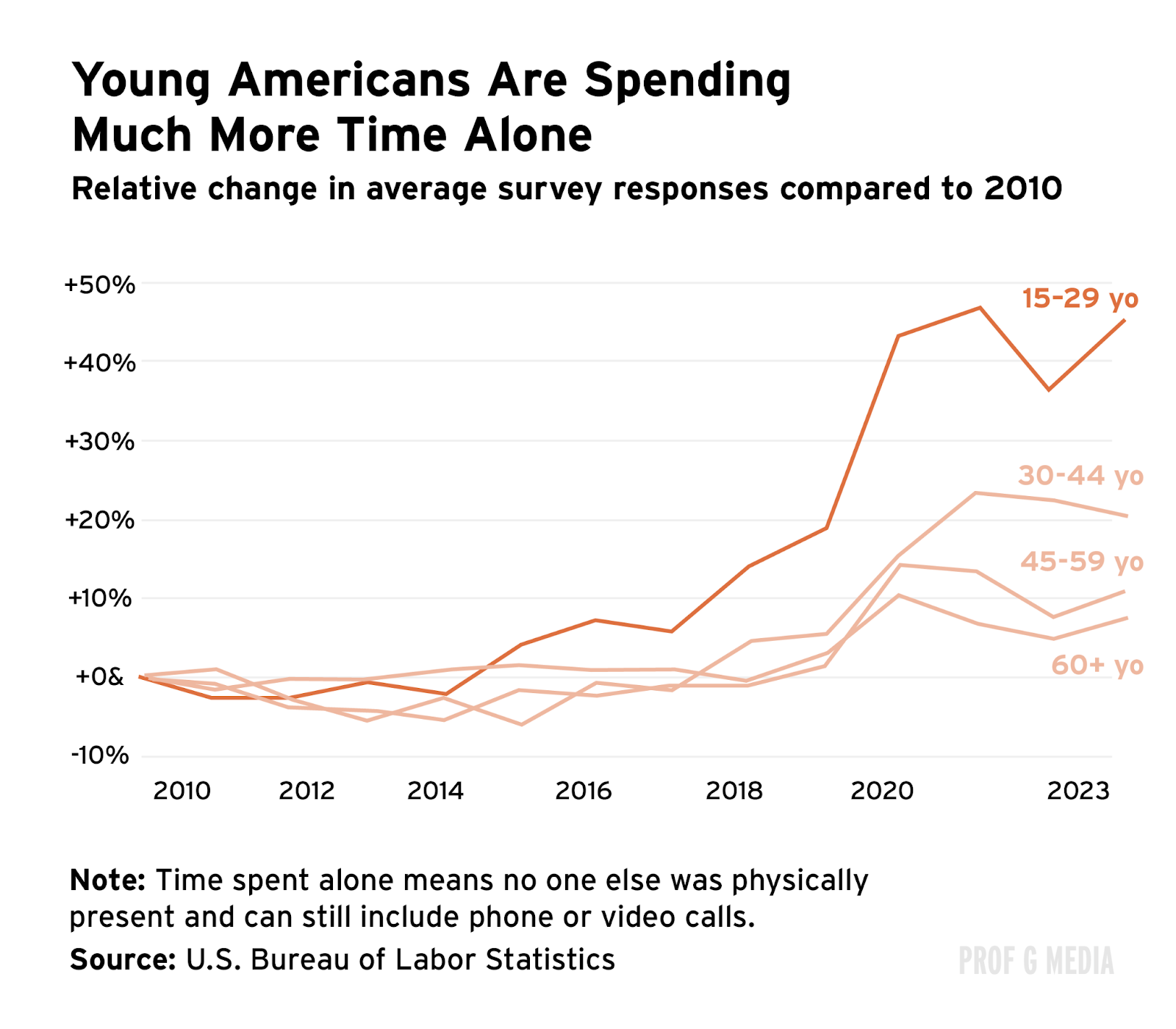
Many years ago, lonely people existed but weren’t nearly as frequent. In 1990, 3% of Americans reported having no close friends whatsoever. Since then, that number has quadrupled. Now, 12% of Americans say they have zero friends. This problem is particularly pronounced among young people, who are now spending nearly 50% more time alone than the average young person did just 15 years ago. In other words, OnlyFans’ TAM has very recently gotten very massive. And due to the youngness of this market, it’s only getting bigger.
The other key ingredient for OnlyFans is sex, or lack thereof. To put it bluntly, OnlyFans’ target customers are probably not getting much action, and fortunately for the company, there are now lots of these people.
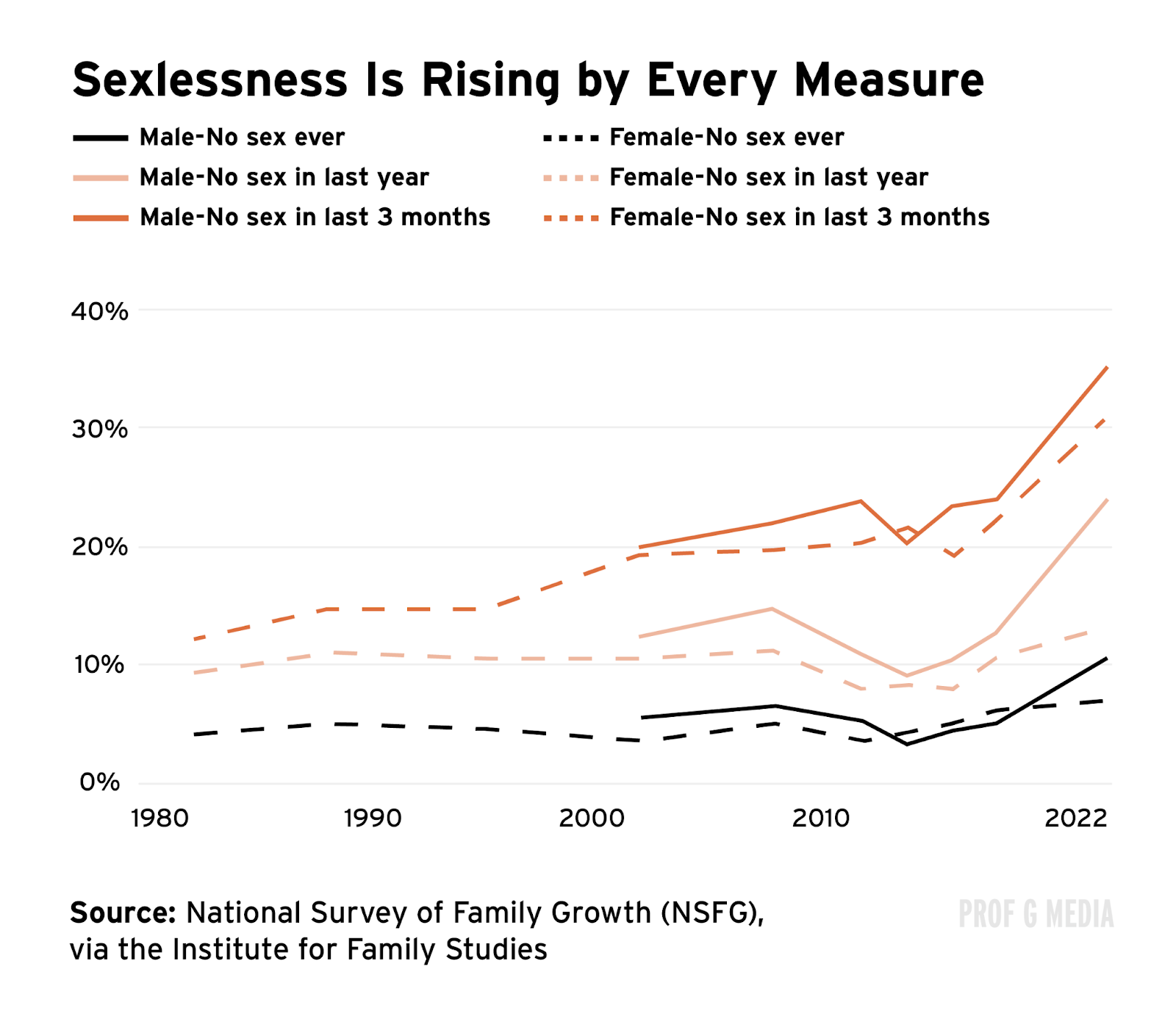
What we have here is a business uniquely positioned for success in a lonely and sexless world. I’ve thought before that OnlyFans might be a blip, a brief moment in internet history. As these trends accelerate, however, it becomes more obvious that OnlyFans is here to stay. It not only represents our current moment but defines it — a viscerally candid reflection of our new parasocial age.
OnlyFans FY 2025
In 2025, the OnlyFans business jumped to lightspeed. People spent more than $7 billion, 70% of that being chat revenue. The business has gotten so big that many OnlyFans creators are now outsourcing their chat operations to third parties as they cannot handle the volume of messages they’re receiving themselves. This has created an entire ecosystem of “chatting agencies” and contractors, many of them based out of India or Pakistan. The depressing irony is that the guy spending thousands of dollars to chat with a young woman isn’t even chatting with a young woman. He’s likely speaking with another guy in Islamabad.
We can also break down the numbers by country, where we find the United States is the number one spender, shelling out $2.6 billion in 2025. In other words, Americans now spend more on OnlyFans than they spend on socks or toothpaste.
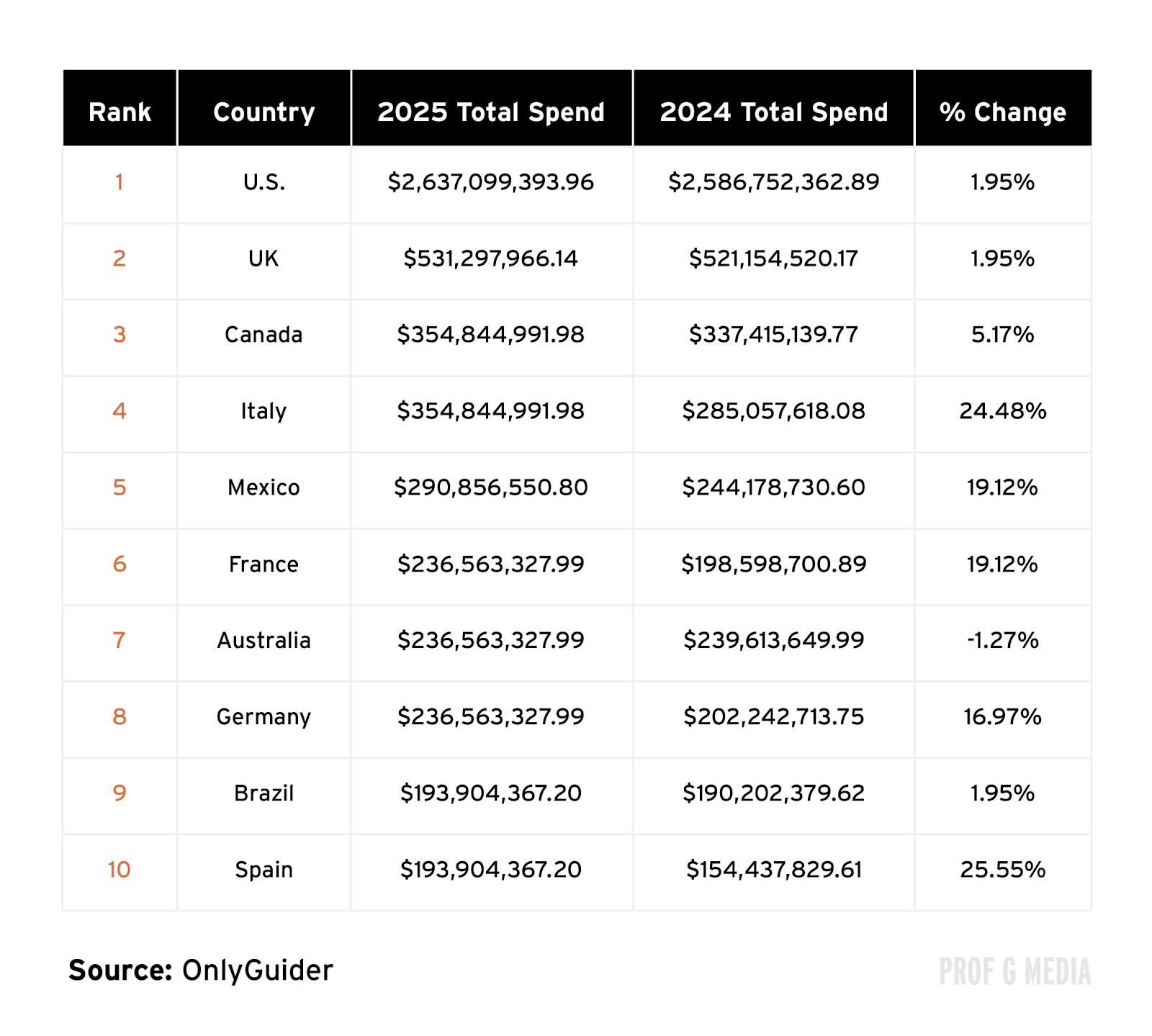
I discussed these numbers on the podcast, and received some backlash that I should have shown per capita spending instead. My response: No I shouldn’t have. My point isn’t that America is more or less addicted than another nation. My point is that everyone is addicted, including America. The sheer scale of the spending helps to demonstrate this point. I am nevertheless happy to oblige and have included the population-adjusted data below. On a per capita basis America drops to seventh-most spendiest, with the Finns rising to number-one. More proof that this is a problem everywhere.
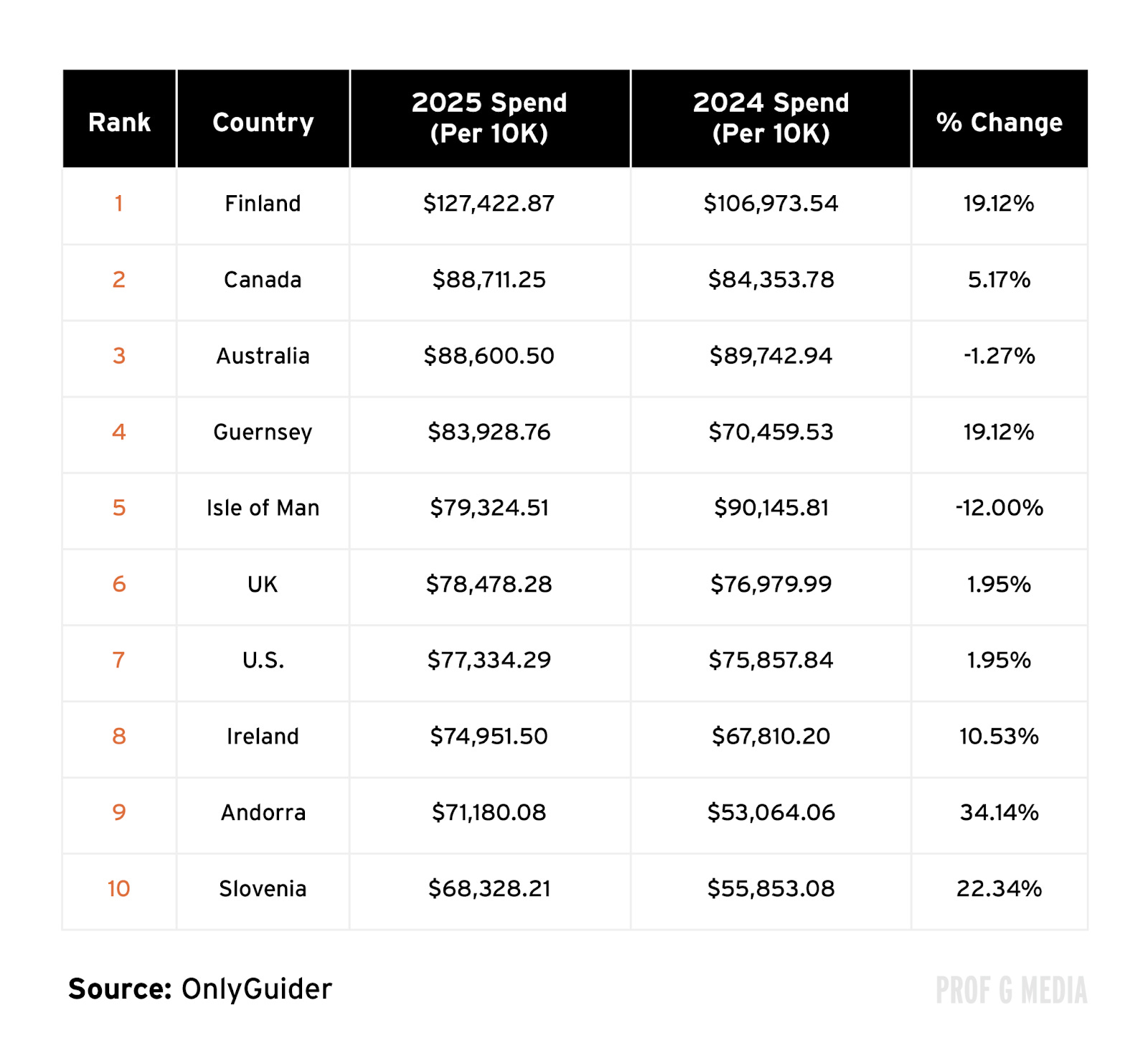
These trends will only accelerate in 2026. Aside from a promising social media ban in Australia, we’ve seen little evidence that governments are taking the loneliness crisis seriously. Apathy towards the problem is particularly pronounced in the U.S., where tech companies are repeatedly let off the hook for brazenly monopolistic behavior, and where subjecting young people to chronic depressive and addictive behaviors has thus far gone unpunished. The more amenable the conditions, the more these businesses thrive. OnlyFans is one of these businesses, and this year’s forecast is bright and sunny.
Why Pay At All
The most curious thing about OnlyFans is that people pay at all. If porn is already available across the internet for free, why don’t men just use that? Again, the key to OnlyFans is the chat feature. Unlike PornHub, which provides the illusion of sex, OnlyFans provides the illusion of companionship. It makes men think they are engaging in a real relationship with a real person.
For people who have relationships, that might seem a silly thing to pay for. But that’s the point: More and more people don’t. As such, intimate relationships are now becoming something of a luxury — a luxury worth spending $7.2 billion on.
If that depresses you, it’s supposed to. There’s nothing uplifting or positive about OnlyFans. Some would argue the platform “empowers creators.” But keep in mind the top 0.1% of creators capture 76% of the total revenue, so only a tiny handful of people (including the owner) are getting rich. Meanwhile the downsides (addiction, isolation, and loneliness) are too large to ignore. Like many great businesses, OnlyFans is very bad for society. Let no amount of PR distract you from this truth.
What To Do
The question becomes what do we do about it. I am writing this from the cabin of a New York-bound flight from Japan, and we are about to land. I therefore don’t have time to answer this question, but my quick-and-dirty solution would be age-gating. We’ve already seen its political popularity (see above: Australia), and it’s likely that nipping these screen-induced behaviors in the bud will result in better outcomes long-term. Again, quick and dirty.
Going forward in 2026, a major goal of this Substack will be to answer the loneliness question more thoroughly. Loneliness continues to be one of the most powerful forces in our world today. It is fundamentally transforming business, culture, politics, and markets in ways we could not have imagined. For the past couple of years, I’ve tried to spread awareness of the issue, but we are now entering the solutions-phase of the cycle. It’s now time we fix it.
So here’s to 2026, and solutions. I should hope that a year from now my “Company of the Year” will look very different. We’ll see. But for now, the seat-belt sign is on, and I need to buckle up.
See you next week,
Ed