


Every American entrepreneur takes the same risk I’ve taken nine times: They build something — worst case, it fails. In other countries, the worst case might be criminal prosecution or violence to seize the business. The gap in outcomes represents America’s advantage.
In Donald Trump’s second term, America’s advantage shrinks with each corrupt act. A jet gifted by Qatar, refurbished at government expense, that Trump considers a parting gift for his presidential library. Dozens of vanity projects at a cost of $1.8 billion to the taxpayers, including a golden ballroom where the East Wing once stood and the Arc de Trump, a monument to … himself. A slush fund for J6 rioters, dead for now but likely to return. An endless Oval Office parade of CEOs bearing gifts, including one who literally brought a gold bar.
Inclusive vs. Extractive
“I believe in America,” is the opening line of The Godfather. The speaker is an undertaker named Bonasera. After the courts fail to punish two boys who assaulted his daughter, Bonasera turns to Don Corleone, who delivers justice in exchange for a favor. It’s a chilling scene that captures the moment a man stops believing in the rule of law and starts believing in gangsterism. When nations make the same choice, their economies stagnate, according to economists Daron Acemoglu and James Robinson, who shared the 2024 Nobel Prize with Simon Johnson. In their 2012 book, Why Nations Fail, Acemoglu and Robinson wrote, “countries differ in their economic success because of their different institutions, the rules influencing how the economy works, and the incentives that motivate people.” Inclusive systems, they argue, protect property, enforce contracts, and allow everyone to compete. Extractive systems funnel wealth to the politically powerful. The former produces a middle class, Silicon Valley, and the world’s deepest capital markets; the latter produces megayachts, capital flight, and failed states. In a 1995 study of 67 countries, IMF economist Paolo Mauro found that a modest improvement in a country’s corruption score raised investment by 2.9% of GDP, increasing annual growth by as much as 1.3 percentage points. Compounded over a generation, you get Singapore. Let corruption fester, you get … Russia.
Russia has been running the extractive experiment for decades. In the lawless 1990s, owning a business required submitting to the right protection racket — difficult to decipher, as the line between gangsters and state officials was drawn in pencil. Owners who guessed wrong lost their companies (and sometimes their lives). Russians called these shakedowns reiderstvo, a bastardization of the Wall Street corporate raider concept, minus the tender offer. Reiderstvo has measurable costs. In a 2016 paper, researchers at the World Bank and Moscow’s Higher School of Economics surveyed nearly 2,000 Russian manufacturers and found that firms in regions with heavy raiding were a third less likely to make capital investments than those in regions with low levels of raiding. Under Putin, reiderstvo became state policy with the 2003 dismantling of Yukos, then the largest oil company in Russia. From that point forward, one Russia analyst wrote in 2025, “The message was unmistakable: Property rights existed at the pleasure of the Kremlin.”
Kill All the Lawyers
“The first thing we do is, let’s kill all the lawyers,” is uttered by the villainous right-hand man to Jack Cade, who’s leading a rebellion against the king in Shakespeare’s Henry VI, Part II. The line has multiple meanings (see Shakespeare), but as Supreme Court Justice John Paul Stevens wrote in a 1985 opinion, “Shakespeare insightfully realized that disposing of lawyers is a step in the direction of a totalitarian form of government.” Trump grasps this intuitively, no Shakespeare required.
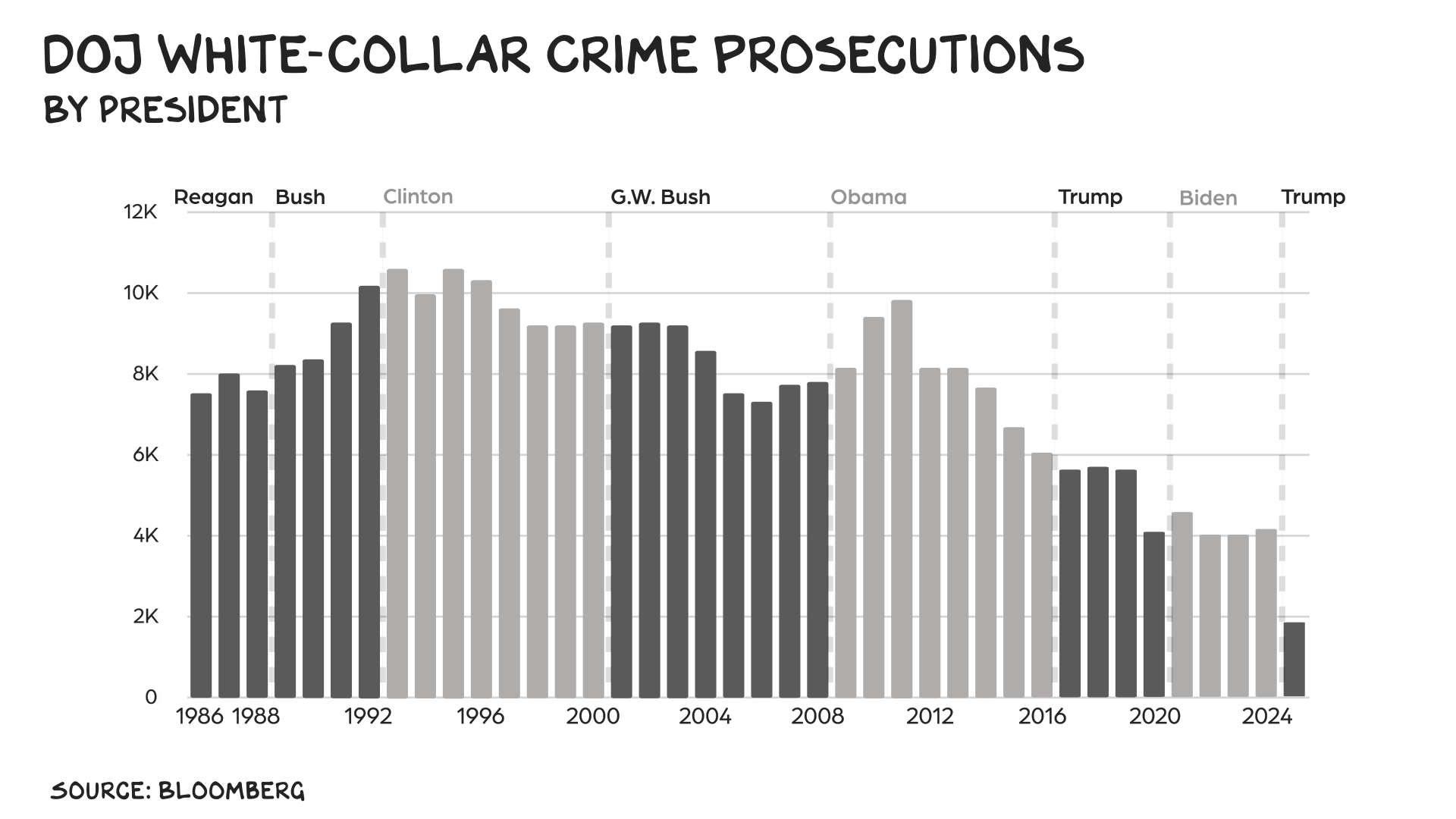
In his second term, Trump has fired or pushed out half the lawyers working at the Justice Department. At the SEC, the agency tasked with enforcing laws that are foundational to the world’s deepest capital markets, 1 in 6 employees has been nudged to the exit. More important for wrongdoers with the right connections, the SEC has brought only five enforcement actions all year, down from 80 two years ago. Meanwhile, Trump bought shares in Oracle while brokering a reiderstvo-style deal for the company to acquire TikTok. He purchased Nvidia shares, then cleared the way for it to sell chips to China, despite national security concerns. And while dangling his regulatory blessing for a sale of WBD to either Netflix or Paramount, Trump bought shares in all three companies.
At the Commodity Futures Trading Commission, an obscure federal regulator that has jurisdiction over crypto, Trump has reduced staffing by 22%, causing enforcement actions to fall to 80% of the annual average over the past decade. Good timing, as Trump went on to earn $1.4 billion from his meme coin and crypto empire last year, despite previously calling crypto a scam. Last week a lawsuit against World Liberty Financial accused Trump of defrauding shareholders and violating constitutional restrictions on accepting foreign money.
Finally, Trump has gutted the IRS, reducing total headcount by 25%, while slashing the unit that audits high-net-worth individuals by nearly 40%. Spoiler alert: Audit rates have hit a historic low. Not that Trump is personally worried — he secured immunity from audits. If you’re a white-collar criminal, this is your golden age.
Swamped
Comedian Eddie Izzard once joked that humans are incapable of comprehending crimes at scale. “If somebody kills someone, you go to prison,” he said. “Someone who’s killed 100,000 people, we’re almost going, ‘Well done. You killed 100,000? You must get up very early in the morning.’” Trump is an early riser.
Journalist Isaac Saul, founder of the nonpartisan news site Tangle, attempted to document the scale of Trump’s corruption. In a post from May and a follow-up this month, he identified nearly 100 instances of alleged corruption, self-dealing, and conflicts of interest. Examples include bribes for regulatory favors, pay-to-play pardons, crypto schemes, trading on inside information in the equities and prediction markets, an insider trading subscription service run through Truth Social, foreign governments pouring money into Trump family ventures ahead of favorable U.S. policy decisions, and the president’s children taking stakes in companies awarded federal contracts. Exact numbers are buried in lagging disclosures and opaque books, but a New York Times investigation estimates the president made $2.2 billion his first year back in office.
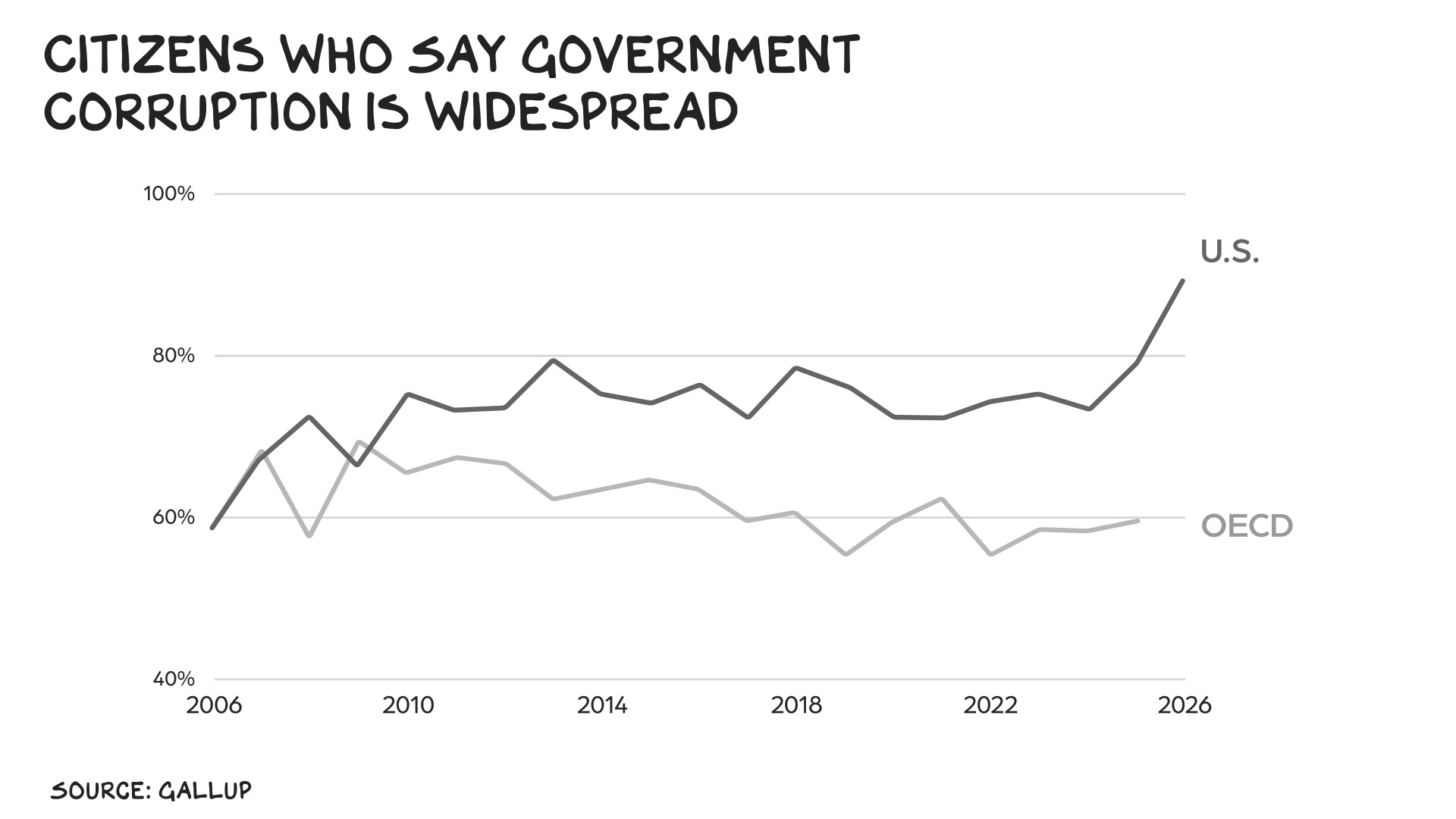
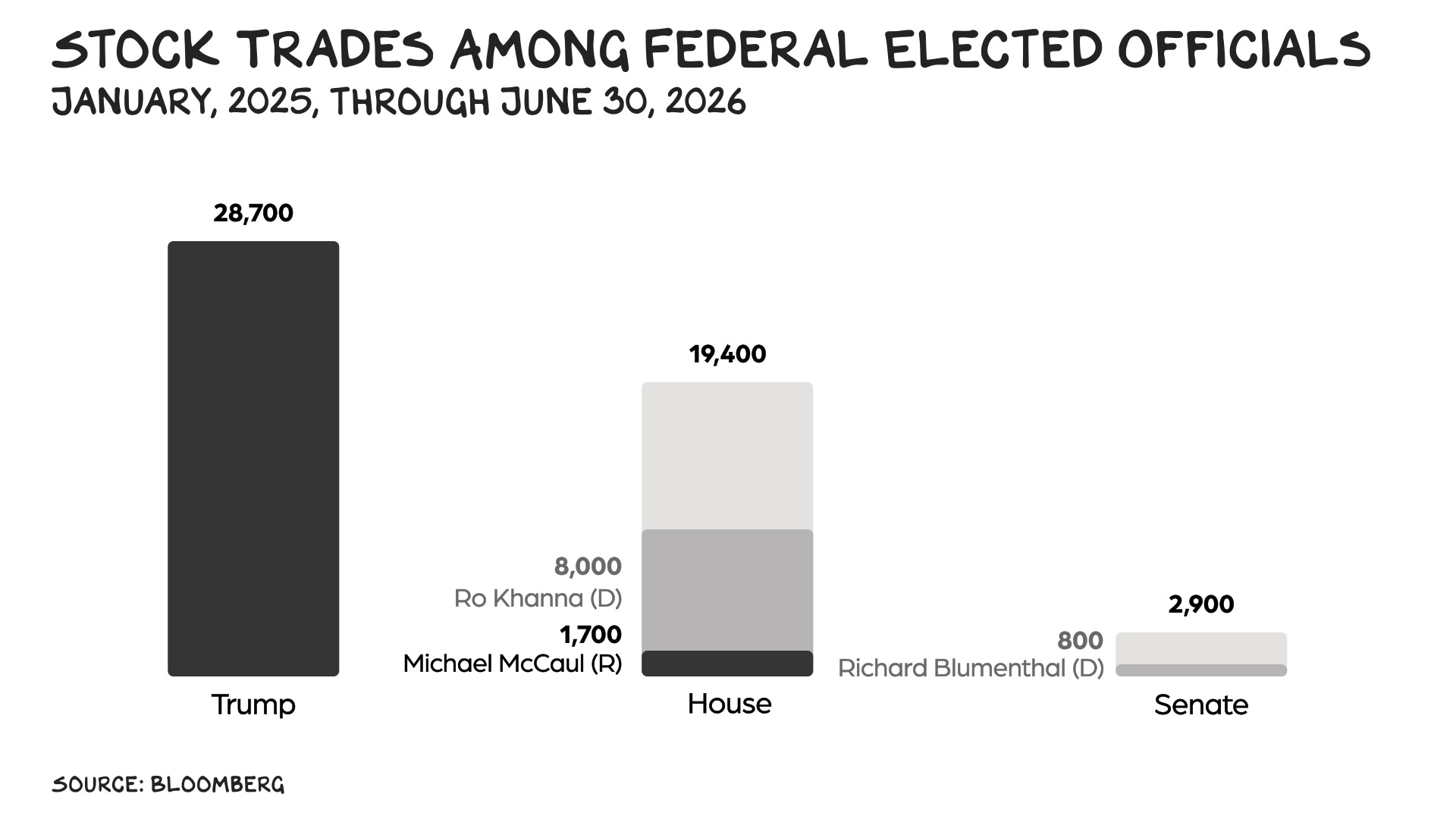
A decade ago, Trump campaigned on a promise to “drain the swamp.” The charge resonated, because corruption, self-dealing, and conflicts of interest are bipartisan, fueling the sentiment that the greatest gains accrue to the most powerful. A National Bureau of Economic Research working paper that analyzed lawmakers’ stock trades found that congressional leaders outperformed rank-and-file lawmakers in investment gains by as much as 47 percentage points. Former House Speaker Nancy Pelosi, who’s long been criticized for opposing a ban on congressional stock trading, registered a 166x increase in her stock portfolio from 1987 to 2024. But compared to Trump, Pelosi’s an amateur. Since 2014, she’s made 213 stock trades. In a single day shortly before pausing his Liberation Day tariffs, he made 327 trades. Trump isn’t draining the swamp. He’s swamping our ability to keep up with his crimes.
Betrayal
Power corrupts. But Robert Caro, who spent five decades studying power as he chronicled Lyndon Johnson’s rise and fall, came to believe something else, too: “Power always reveals.” Give someone enough of it, and you find out what they wanted all along and what they’re willing to do to get more of it. Of all Trump’s corruption, two acts reveal the most about his motives.
In presiding over the forced sale of TikTok’s U.S. business — at an estimated 94% discount — Trump, along with the buyers, betrayed the free market. On the front end, he abused his power, forcing a sale on his terms. On the back end, he divided up the spoils with his political allies. Similar to the lesson Russian investors learned when Putin dismantled Yukos, American investors now know the president, not the markets, dictates valuations, deal terms, and who can buy what.
Trump’s betrayal of Ukraine, and by extension the West, cuts even deeper. Less than a month after signing the bipartisan Lindsey Graham Sanctioning Russia and Iran Act, Trump waived sanctions on Russia, cutting a deal to buy diesel. Later he effectively ratified Elon Musk’s decision to restrict Ukrainian access to Starlink and Starshield. Put simply, we’re financing Russia’s war and sabotaging Ukraine’s defenses. But wait … there’s more. ‘By helping Russia — which gives Iran intelligence, technology, and diplomatic backing — we’re indirectly helping our enemies in Tehran. As Tom Nichols, retired professor at the U.S. Naval War College explained, Trump either believes he has Putin “on a shorter leash” re Iran, or he “just doesn’t care” that U.S. tax dollars are funding the Iranian weapons killing American troops. There’s a word for that: traitor. What does Trump gain in exchange for selling out America and our allies? A: We don’t know. But every autocrat sees the signal: American foreign policy is for sale.
Winning back Congress won’t fix this mess overnight, but subpoenas and investigations can unearth corruption and ultimately arm a reconstituted DOJ with the evidence it will need to achieve a reckoning. When I sold L2, the process was boring — there were rules we all played by and an absence of fear that bad political actors would insert themselves into the process. That’s what a country looks like when the rules apply to everyone. On November 3, let’s make America boring again.
Life is so rich,

P.S. Reckonings begin with voting. For information on how to cast your ballot, go here.
P.P.S. Frustrated by the corruption? Me, too. I spoke with historian Heather Cox Richardson about turning voter anger into political change. Prof G+ paid subscribers can catch us here.
Very true. And the angle on rules is crucial.
My take though, is that there is not only corruption at play, but also something deeper: a real ideology at the core of some tech entrepreneurs and their political counterparts. With 3 pillars:
- Democracy is outdated.
- Laws that protect the public are tyranny.
- Whole groups of people are enemies.
None of these ideas is new. Each was tried before in history, and each was pushed back. But today they are proposed again to a very wide audience with a lot of force.
So it falls on all of us to say the emperor has no clothes: plainly, in public, every time is needed (and thank you for doing that).
I recently reflected on this. Would love thoughts.
https://thinkuphill.substack.com/p/the-tech-moguls-playbook-democracy