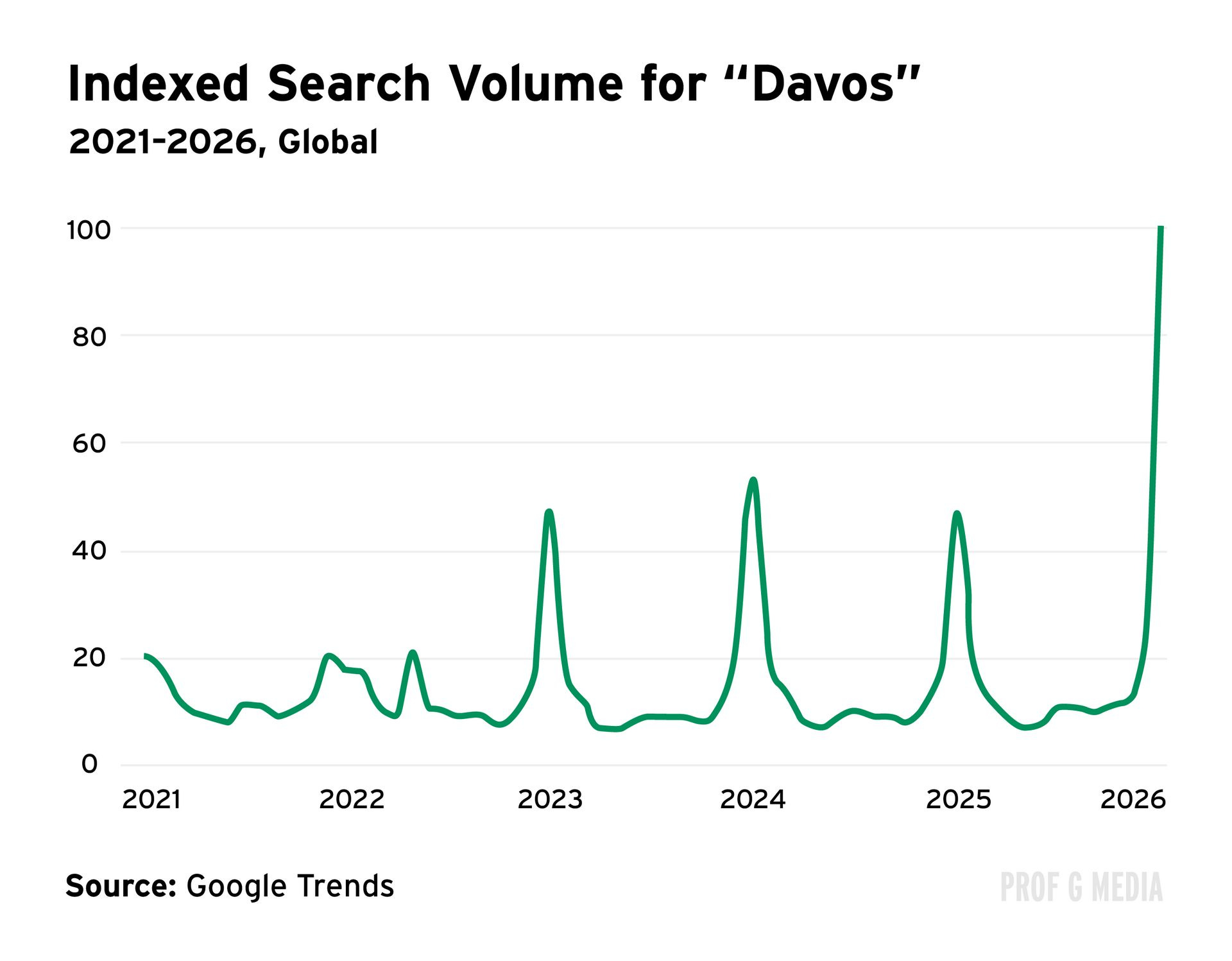
The World Economic Forum (WEF) convened in Davos last week. It forced a reckoning of geopolitical alliances, moved markets, and generated a fair share of gossip.
President Trump made a splash by referring to Greenland as Iceland four times in his address to the forum, and later for TACO-ing on his threats of using force and punitive tariffs to acquire the Danish territory.
Commerce Secretary Howard Lutnick did his part to provoke American allies by declaring in a speech: “With President Trump, capitalism has a new sheriff in town.” He was reportedly booed, and Christine Lagarde, the president of the European Central Bank, walked out of the room.
U.S. markets fell and Treasury yields rose on Tuesday on fears that Trump’s erraticism would bring the “Sell America” trade back.
A Danish pension fund, AkademikerPension, made headlines for announcing it would sell $100 million of Treasurys (the fund denied the move was motivated by politics).
The media got spooked — unnecessarily. AkademikerPension’s sale is about 1,000 times smaller than the holdings of the 20th-largest Treasury owner (Israel).
But, like Trump, the “Sell America” investors mostly chickened out; the S&P 500 closed slightly up, and the 10-year Treasury ended the week where it started.
The undisputed winner of Davos was Mark Carney, Canada’s prime minister. He delivered a moving speech about the end of American hegemony and the need for new alliances: “The middle powers must act together because if we’re not at the table, we’re on the menu.” The address was met with the third standing ovation in WEF history (the other two being Nelson Mandela and Ukrainian President Volodymyr Zelenskyy).

I was at Davos in 1999. What’s the difference between then and now?
In 1999, it was all about the internet, and President Clinton gave a speech about cooperation, competition, and consumerism. Now it’s about AI, and the president gave a speech about chaos and coercion and corruption. The tone and the vibe of 1999 was more optimistic. Now everyone’s sort of like, I hope it doesn’t get worse.
Another observation from this year: Europe remains fragmented; it lacks a unified voice. Who speaks for the EU? Macron with his aviators? Lagarde? Perhaps it should be Carney. Without coordination, these nations can’t command the space they should occupy. In aggregate, they’d be the world’s second-largest economy. Instead they’re a collection of midtier economies.
The main difference between Europe and the U.S. is our capital markets. The CEO of Anthropic was at Davos and said they’re closing on a new funding round at a $350 billion valuation. There are only two companies in Europe worth at least $350 billion, LVMH and ASML, and they’ve been around for nearly 40 years. Anthropic was founded only five years ago. Europe has amazing entrepreneurs and IP, but it doesn’t have the heft of the U.S. capital markets.

We continue to send our allies into our adversaries’ arms, pitting the rest of the world against America. Canada and China just struck a new trade deal. The U.K. is preparing a new deal with China. The EU and India are finalizing what Ursula von der Leyen calls “the mother of all deals.” The EU announced a deal with South America’s Mercosur. Deals are happening — just not with us.

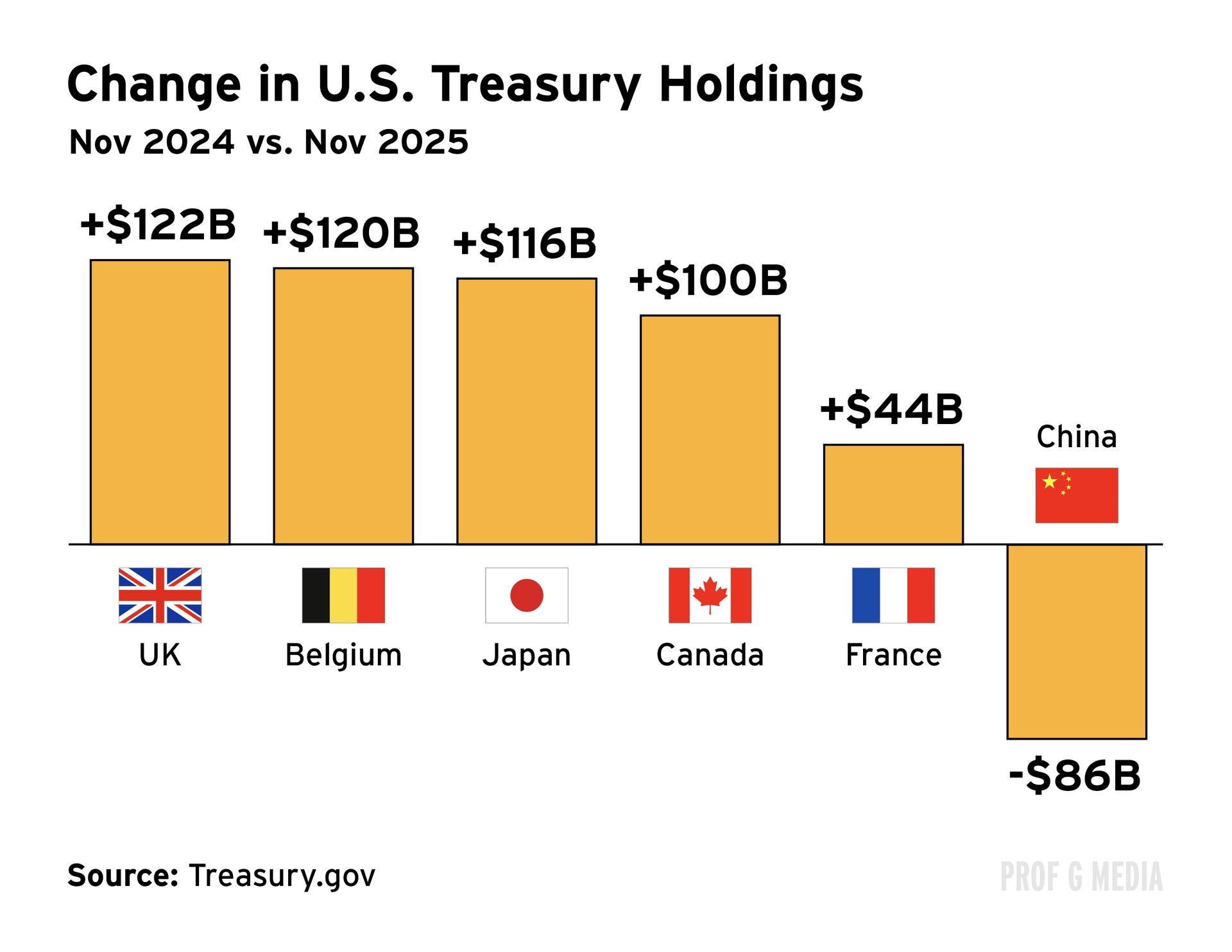
We’ve been hearing about the Sell America trade for months, and so far the opposite has happened. Foreign holdings of U.S. Treasurys hit record highs in November 2025. The only country that has continued to actually sell American debt is China, and they started doing that in 2017.
Macron has been praised for referring to Trump as a bully, and Mark Carney said that the world is “in the midst of a rupture, not a transition” — but you wouldn’t know from their countries’ actions. Over the past year, Canada and France have increased their holdings of U.S. Treasurys by $100 billion and $44 billion, respectively.
It’s also just not realistic that Europe will “dump” its holdings of U.S. assets. Most stocks and bonds are held by private pension funds, insurers, and asset managers in Europe—not governments—meaning they can’t just be ordered to sell.