



54%
of Americans say Jensen Huang’s affair has definitely or probably compromised U.S. national security. Just 17% say it hasn’t.

Nvidia beat earnings and raised guidance, but its stock has been cut in half.
Anthropic raised $119.5 billion in the biggest IPO ever, then fell back near its $83 IPO price on day two.
U.S. tech stocks just had their worst week since Covid-19.

Nvidia’s Board Shuts Out Jensen Huang as the Stock’s Rout Continues
Nvidia’s leadership drama continued last week. Just six hours before the company’s earnings call on Tuesday — and less than a week since Jensen Huang’s ousting — the former CEO issued a statement. He said that many people had called for his return, and that he would be “honored” to come back as CEO if the board wanted him. They didn’t. On the call, Nvidia’s new chairman said the board “does not intend to reinstate” Huang.
Then, on Friday, Reuters reported that the SEC is investigating potential accounting issues at Nvidia. The stock fell 13% and has now lost almost half its value — or nearly $3 trillion in market capitalization — since its Oct. 6 high.
The company’s core business is still strong. Nvidia’s revenue and earnings from last quarter beat Wall Street expectations for the 16th consecutive quarter. Net income rose 105%, to $65 billion, and revenue rose 103% from a year earlier to $116 billion. That makes 14 straight quarters of revenue growth above 50%. When the streak began in mid-2023, Nvidia’s quarterly revenue was $13.5 billion. No other company worth more than $500 billion in recent history has grown so fast, for so long.
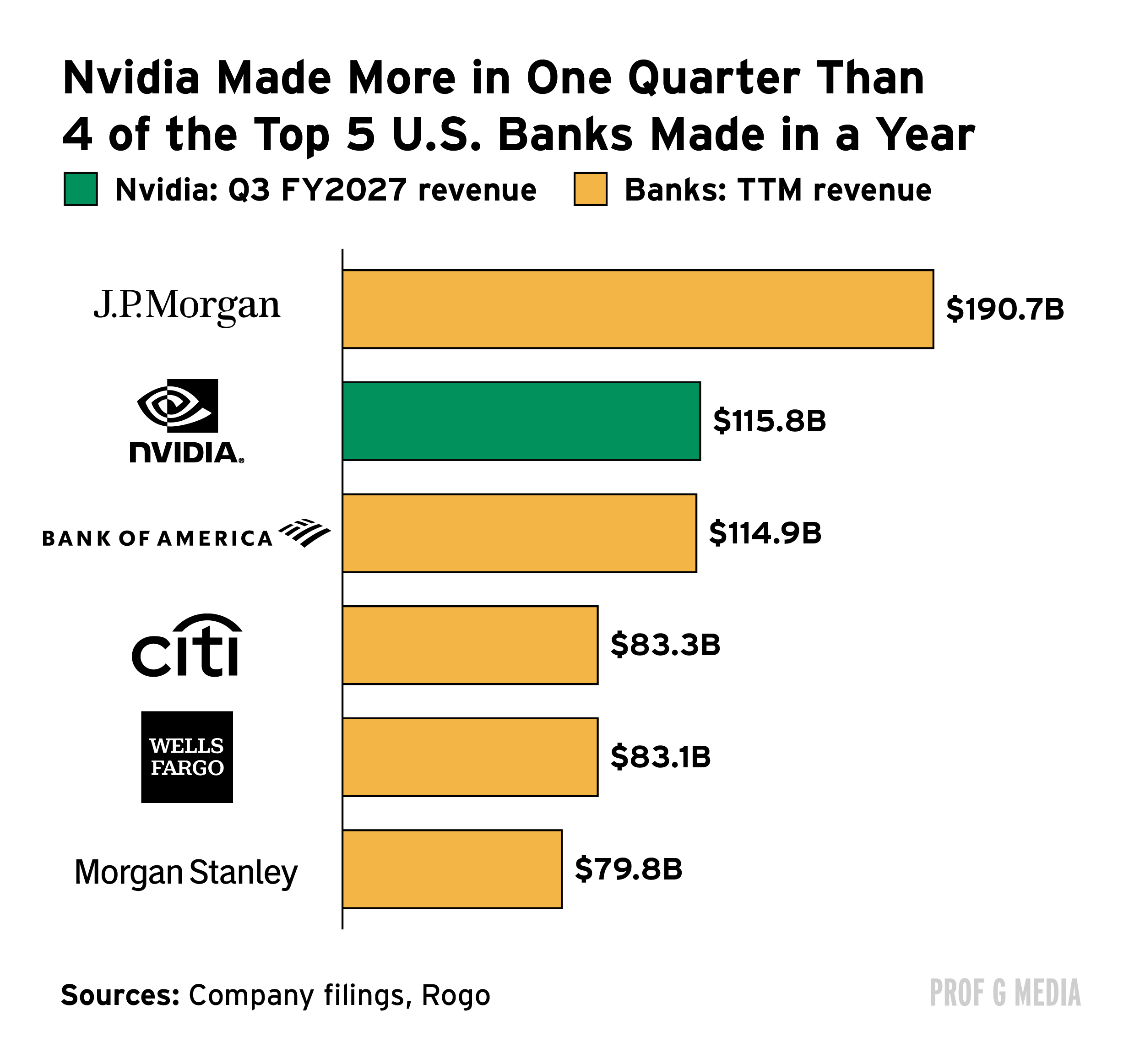
Nvidia increased fourth quarter revenue guidance to $130 billion, a forecast that assumes no data center compute revenue from China, and raised fiscal 2028 revenue guidance to 75% growth, citing strong demand and data center readiness.
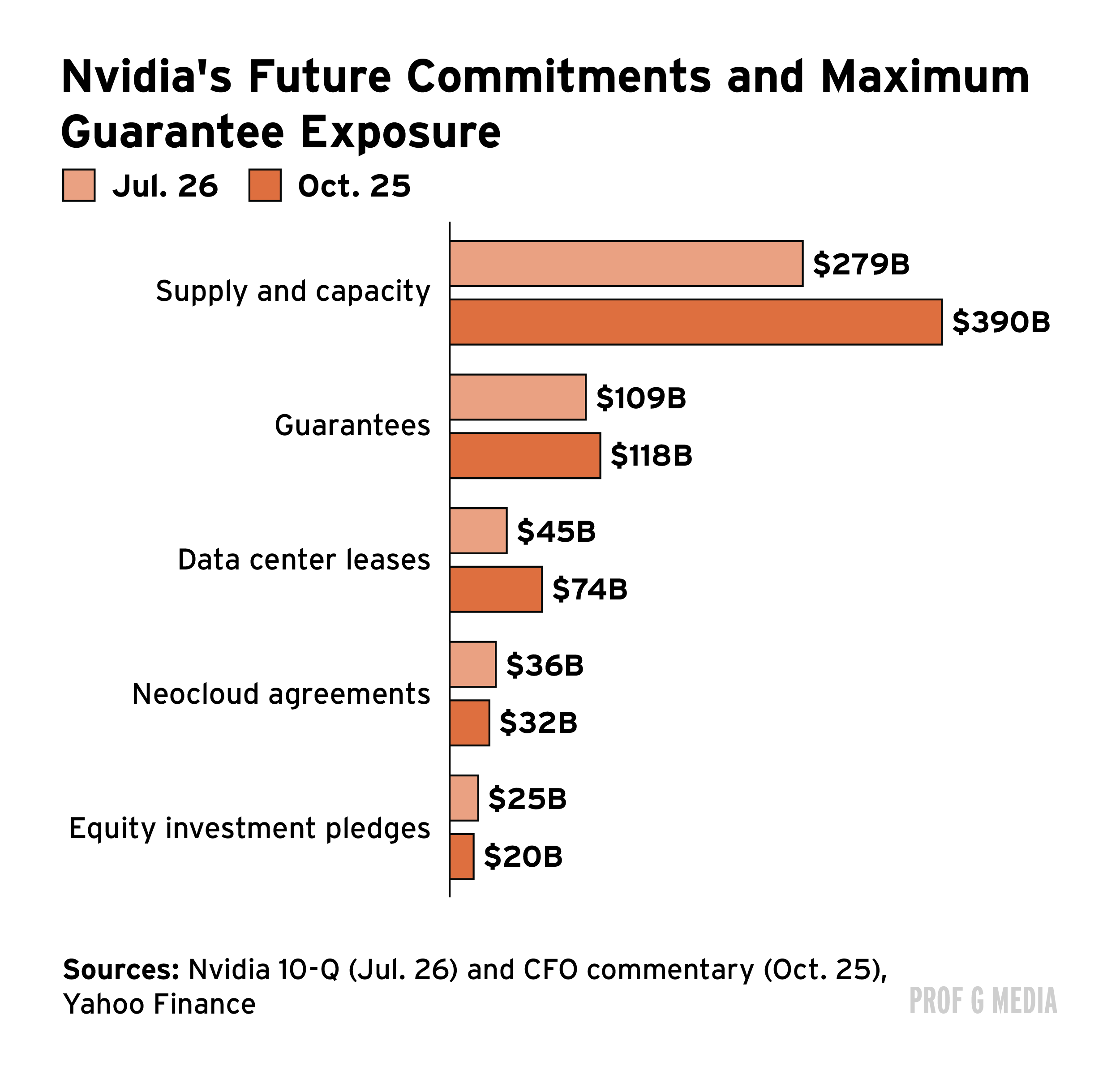
But some parts of the business will change under Nvidia’s new leadership. Most notably, Colette Kress, the company’s CFO and interim CEO, told investors that Nvidia would be more “disciplined and selective” in its investments in the AI ecosystem. As CEO, Huang turned Nvidia into one of the main financiers of the AI boom. From equity investments in AI startups, to data center lease guarantees, to promises to buy unused computing capacity from neoclouds, Nvidia has nearly $250 billion in future commitments — not including $390 billion in orders with its own suppliers, mostly for memory.
It has also been aggressive in buying other companies’ stock. Nvidia spent $58 billion on other companies’ stock in the nine months ending Oct. 25, approximately 12x the nearly $5 billion it spent in the same period last year, and almost as much as the $61 billion Nvidia spent buying back its own shares.
Investors have been worried that Nvidia’s circular deals and financing agreements have artificially propped up demand in the AI ecosystem and doubly exposed it to a potential downturn. Ironically, so far, it seems that Nvidia, not the neoclouds or nascent AI startups, is the problematic one.

There’s a lot of hair on the Nvidia ball right now.

Anthropic’s Record IPO Gave Back Most of Its Gains in Two Days
Anthropic officially made history with the biggest IPO of all time. The AI company began trading on Thursday under the ticker ANT. It opened at $111.50 per share, 34% above its $83 IPO price, which briefly pushed its value past $2 trillion. It closed up 17% at a $1.8 trillion market cap, making it the seventh-most valuable U.S. company, behind Apple, Microsoft, Nvidia, Alphabet, Amazon, and SpaceX.
The gains didn’t last. On Friday, Anthropic fell more than 14%, but recovered to close down 8.5% on the day. The drop came as the banks that ran the deal exercised the “greenshoe” option to buy 147 million additional shares from Anthropic at the IPO price.
Including a $26 billion private placement from investors such as Nvidia, Google, and AMD, Anthropic and its co-founders raised $119.5 billion in total.
On paper, demand was overwhelming. The offering was reportedly 7x oversubscribed, meaning banks had orders for roughly $500 billion of stock — that’s about as much as all U.S. IPOs raised over the past six years combined.
Shares were so hot that more than half of the institutional investors bidding for shares got none. For context, close to a third of institutional investors who wanted SpaceX shares came away empty-handed.
Like SpaceX, Anthropic kept supply tight. It sold just 7% of the company, more than the 5% SpaceX sold but well below the typical 15% to 20%. Going public with a small float makes first-day pops more likely. According to Jay Ritter of the University of Florida, companies that sold 10% or less of their shares rose 32% on average in their first day of trading, while firms that sold more than 40% rose 7.6%.
Anthropic also set aside an unusually large slice for retail investors: around 15% of the offering, compared with the typical 5% to 7%.
But retail interest was weaker for Anthropic than it was for SpaceX. U.S. Google search interest in “Anthropic IPO” ran at about one-third of the level for “SpaceX IPO” at the same point in its offering, according to Google Trends. Retail investors traded a record $772 million of Anthropic stock on its first day, according to Vanda Research, but they sold almost as much as they bought. Net retail buying came to $60 million, about half of SpaceX’s $118 million.
They may have been distracted. Searches for “Anthropic IPO” trailed searches for “GTA VI”, the long-awaited video game that came out the same day.
At its $2 trillion peak, Anthropic traded at about 57x its last 12 months of sales. That’s in line with Palantir (51x) and SpaceX (59x), and far above Amazon (3x) and Alphabet (7x).
Whether the debut made you money depended on when you bought. Investors who got an allocation, meaning they bought at the $83 IPO price, were up 17% by Thursday’s close. Early investors who bought in private funding rounds did even better. Everyone else had to buy on the open market, where the stock opened at $111.50. By Friday’s close, they were down 20%.
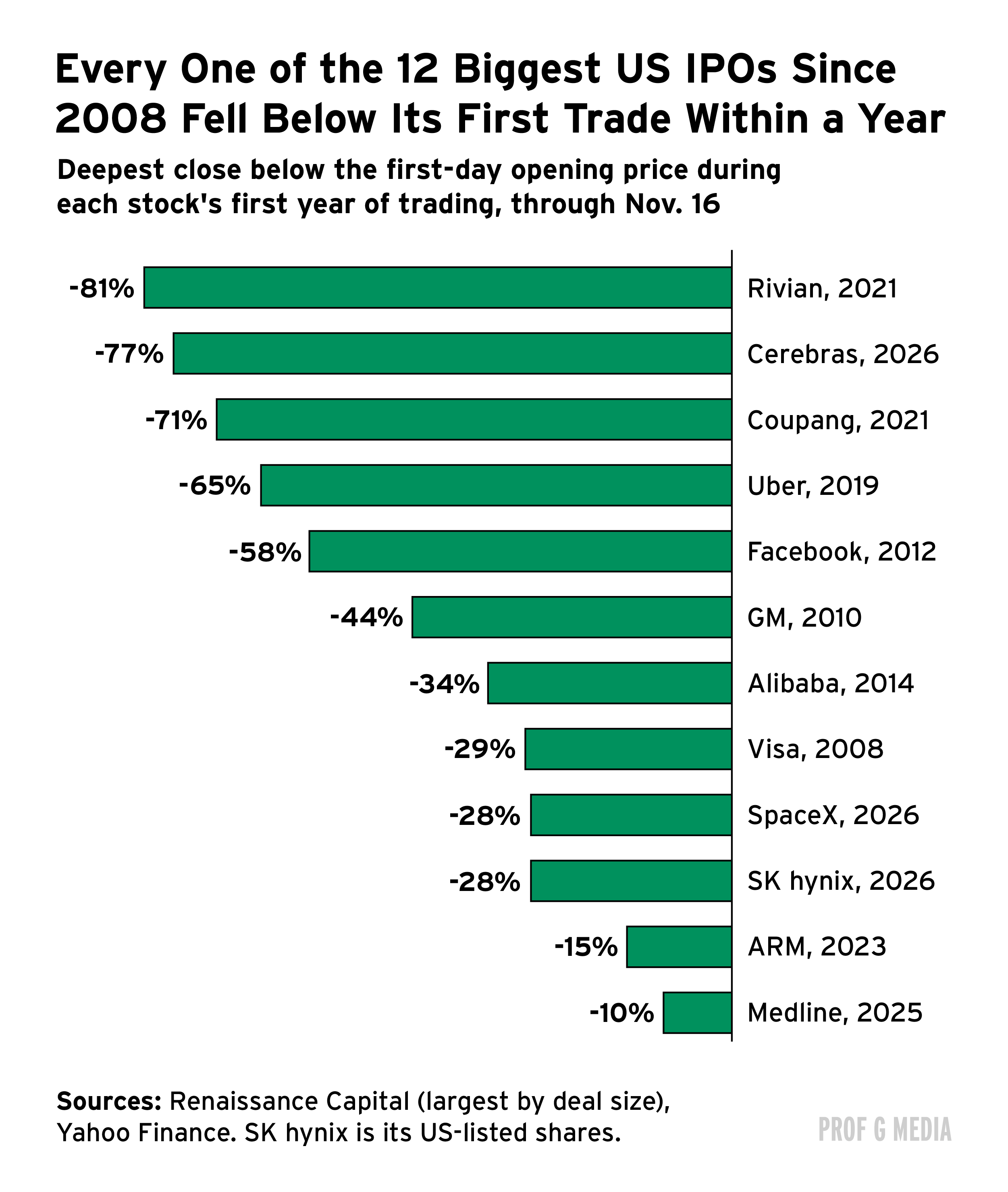
That’s a familiar pattern. All 12 of the biggest U.S. IPOs since 2008 fell below their first trade within a year, according to Yahoo Finance.
This year’s big listings have followed suit: SpaceX is 5% below its IPO price; SK hynix’s U.S.-listed shares, 30%; and Cerebras, 55%.
Anthropic was founded less than six years ago. If it had been founded in Europe, it would be worth more than twice as much as ASML, Europe’s most valuable tech company, which has been around for more than 40 years.

This is the first pure-play AI stock to go public, which is a really big deal. But this IPO, like most IPOs, has been highly engineered. The banker’s job is to price it so the stock pops on day one. Anthropic closed its first day up 17%, which is about what we were expecting.
What I was really interested in was the float, the percentage of shares actually trading. The average IPO floats around 15% to 20%. This one is around 7%. Anthropic has artificially restricted the supply, so the price has been insulated.
So I’m not putting too much stock in what the price is today, or next week, or the week after. What I really want to know is where it trades once the shares unlock. According to the lockup schedule, by February, around 20% of the shares will be trading on the public markets. By the end of May, that number will be around 75%.
That’s when Anthropic will be subject to true price discovery.
In partnership with

Financial clarity for your small business

Successfully running a small business means staying on top of every cost, all day long. But to do that, you need something more powerful than a spreadsheet. Xero is a small business accounting and financial management platform that makes managing business finances easier from day one. Accounting, payments, payroll and analytics are available in one connected platform. Reports, visual dashboards, forecasts and AI insights help owners better understand cash flow and make smarter decisions.

The AI Sell-Off Pushes Stocks Into a Correction
The AI bubble has officially popped, and the stock market is now in a correction. The S&P and Dow are both 12% below their highs, small caps are down 16%, and the Nasdaq is down 18% — approaching bear-market territory. On Friday, the Nasdaq 100 fell nearly 6% and posted its worst week since March 2020.
The U.S. stock market has now shed nearly $9 trillion in market value since its October high. In other words, nearly six months of gains have been wiped out in six weeks.
Chip stocks had their worst week since 2001. The Philadelphia Semiconductor Index fell about 17% for the week. The sell-off has spread beyond Nvidia. AMD now faces its own China questions after short seller Hunterbrook alleged that new versions of its firmware have continued to appear in products from IEIT Systems, a blacklisted Chinese server maker. AMD disputes the claims.
Many of the biggest AI stocks are now far below their peaks: Intel, Oracle, and CoreWeave are down 64%, 71%, and 79% respectively.
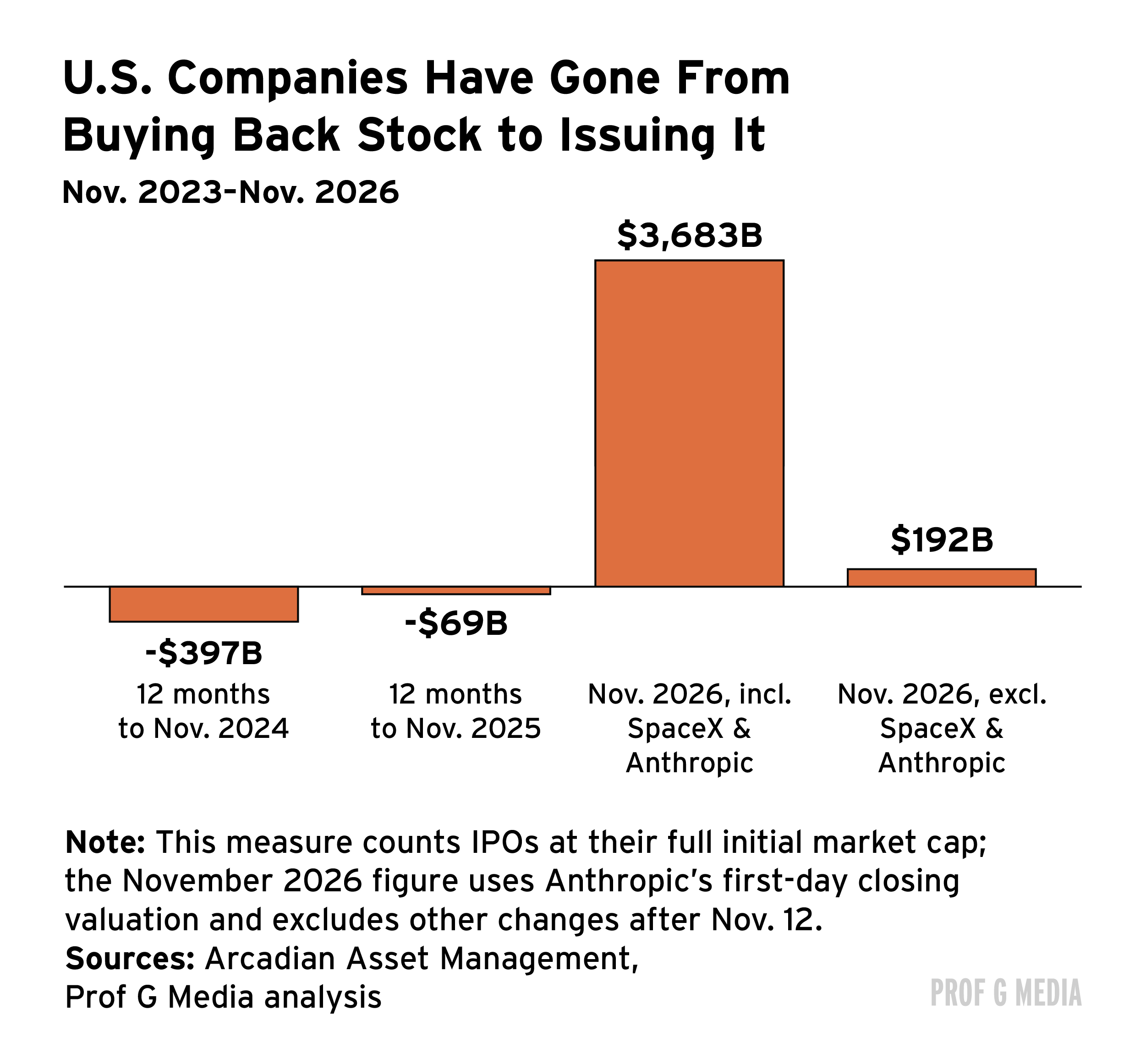
What sent the market into correction territory? A shift in supply and demand forces could be to blame. In 2024 and 2025, U.S. companies bought back more stock than they issued. In the 12 months to November 2024, for example, they bought back a net $397 billion of their own stock, according to Owen Lamont of Acadian Asset Management.
That pattern has since reversed. U.S. companies aren’t absorbing stock anymore; they’re selling it. Over the past 12 months, they’ve issued a net $3.7 trillion. That’s a more than $4 trillion swing from companies supporting demand for equities to competing for investors’ dollars.
Heavy issuance has historically come before weak stock market returns. There are a couple of clear examples. The 1999 IPO boom was followed by a 49% drop in the S&P 500 from 2000 to 2002. The record IPO year of 2021 was followed by a 19% fall in 2022.
This isn’t the end of the world. We’ve been expecting a correction for a while. But we’ve also said that whatever comes won’t look nearly as bad as 2000 or 2008. There are two reasons.
The biggest winner of this correction is Anthropic. It got out just in time. It raised $120 billion last week, right before the sell-off started. A few days later and that money might not have been there. The CFO looks like a genius.
The biggest loser is OpenAI.

One or more of the neoclouds will default in 2027.

How much more air can come out of the AI trade?
Companies are selling less of themselves when they go public
The International Butler Academy costs $14,000 to attend