


in partnership with

I’ve been spending a lot of time in Los Angeles lately, and I don’t recognize my hometown. LA remains a platform for conspicuous consumption, but even inside the luxury bubble, it’s obvious that the social contract has been breached. Dostoevsky famously observed that prisoners were a good barometer for the degree of civilization in a society. In America, it’s the homeless. The problem is nationwide, but it’s most visible on the West Coast. Seven of the top 10 metro areas with the greatest proportion of unsheltered homeless people are in California. Over the past decade, Angelenos have voted to raise taxes on themselves four times to house homeless people. It hasn’t worked. A project begun with compassion for society’s most vulnerable is failing and creating fissures where unity is needed.
Abandoned
Homelessness is frequently seen as the product of three overlapping crises: mental illness, drug addiction, and unaffordability. Our collective failure to address these problems opens the door for extremists to weaponize them. “The leftist view is we’re not spending enough money, that we’ve criminalized poverty,” the journalist Anand Giridharadas, author of Man in the Mirror, told me. “The right-wing view is that the government is incompetent or doesn’t care.” Both sides have a point, but both dodge the more difficult issue of a society whose members have stopped caring about one another. To Giridharadas, homelessness is the most visible symptom of a citizenry that’s lost faith in itself to solve big problems. “So many of our failing systems contribute to the sense that people feel abandoned, that systems don’t see or hear them and are condescending towards them, that nobody is coming to save them.”
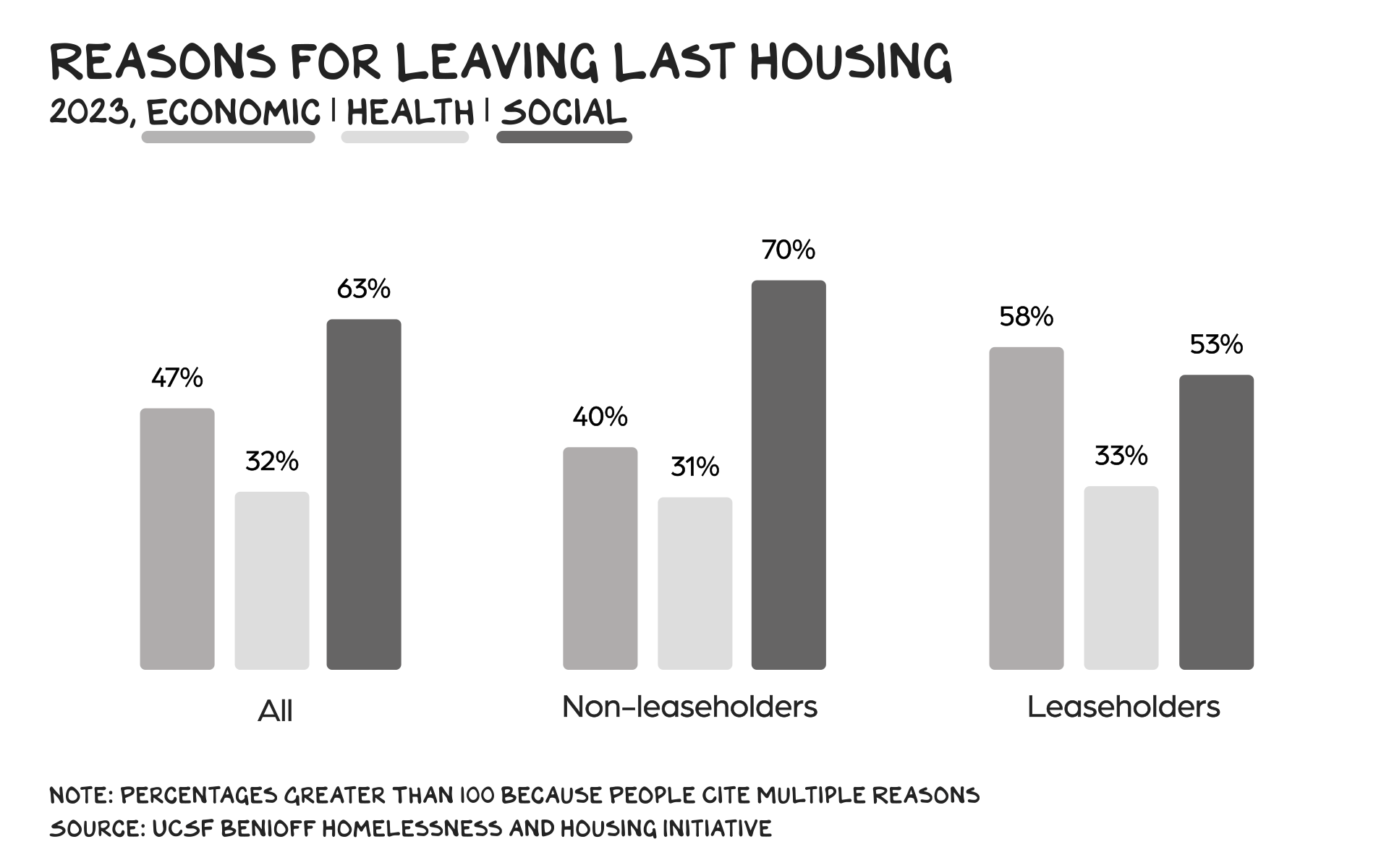
Researchers at UC San Francisco, in a comprehensive study of homelessness published in 2023 that shed light on the roles unaffordability, mental illness, and addiction play, also identified a common denominator: 90% of homeless people are single adults, i.e., they don’t have friends or family they can ask for help. Moreover, 63% of homeless people surveyed cited social issues — conflict with others, not wanting to be a burden, violence or abuse, etc. — as their reason for leaving their last housing situation. Among all Americans, 38% say they’re estranged from a family member. At the top of the homelessness funnel is a kid who graduates from high school, works a remote job, doesn’t have any family, and isn’t investing in relationships. As Giridharadas explained, “being needed, being part of things, having someone wonder where you are” is essential. The absence of those connections is at the root of what’s going wrong for so many Americans. “I think our ancestors would’ve intuitively understood that, but it’s something modern Americans miss.”
Survival of the Friendliest
Almost immediately after they were born, a nurse placed each of my sons on their mother’s chest. That moment is singular. A new sentient being, expelled into an alien world, alone and distraught. And then — physically reunited with his mother — silence, comfort, love. The skin-to-skin contact catalyzes a chemical reaction in mother and child, releasing oxytocin, a hormone strongly associated with love and bonding.
That primal understanding of belonging is foundational for humans. I often say greatness is in the agency of others, but in fact, nearly everything we do — good, bad, and ugly — is in the agency of others, as we’re social animals. Humans successfully colonized the planet not because we were the strongest or most aggressive apes, but because we were the most cooperative. That’s our superpower. In their book Survival of the Friendliest, Duke professor of evolutionary anthropology, psychology, and neuroscience Brian Hare and his wife, science journalist Vanessa Woods, argue that early humans selected for prosociality — shunning bullies, rewarding cooperators, and expanding their circle of empathy. “Survival of the fittest, which is what everyone has in mind as evolution and natural selection, has done the most harm of any folk theory that has penetrated society,” Hare told the Washington Post. “People think of it as strong alpha males who deserve to win. That’s not what Darwin suggested, or what has been demonstrated. The most successful strategy in life is friendliness and cooperation, and we see it again and again.”
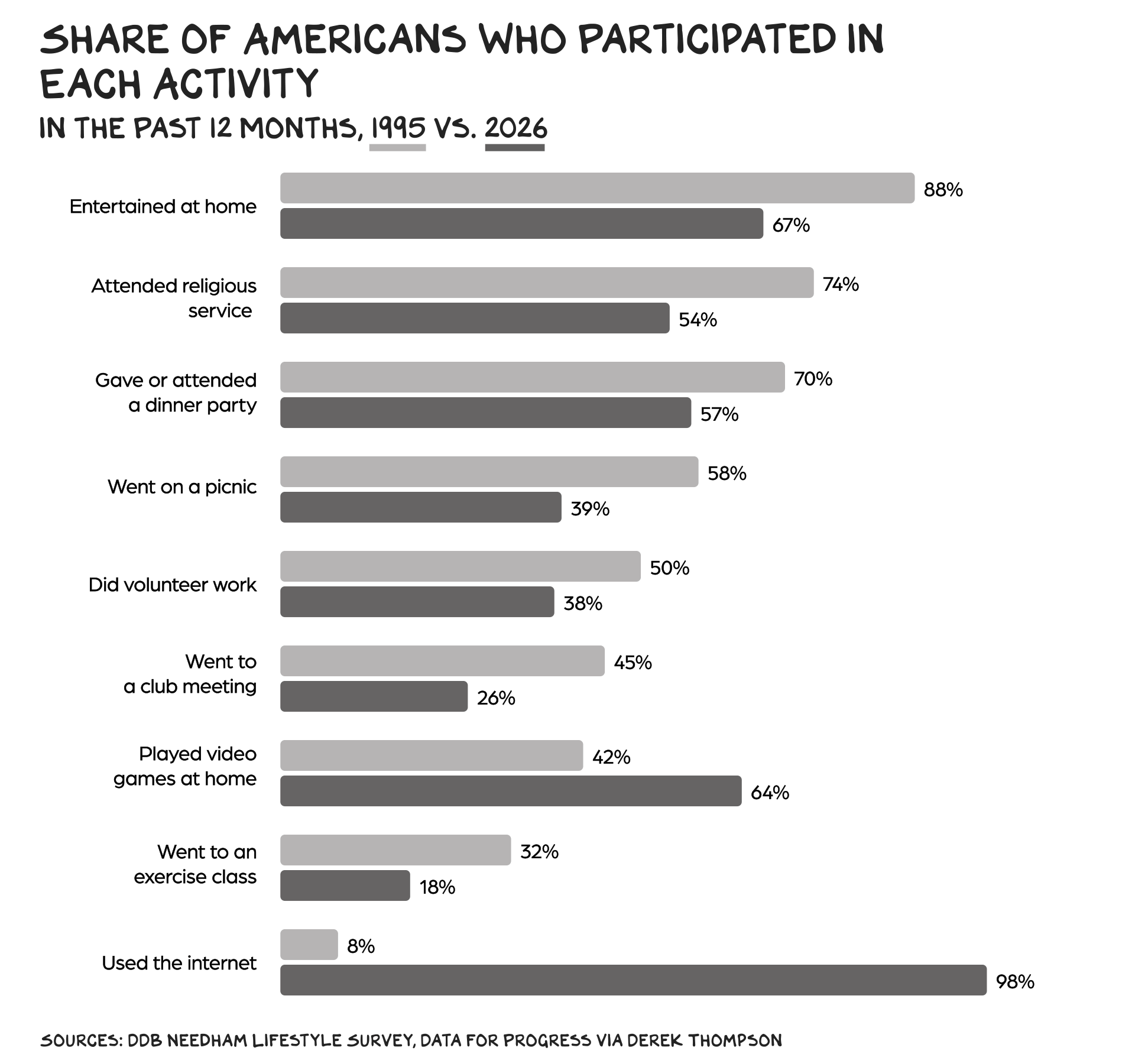
The best thing you can do for your career is establish relationships. One study found that the lonelier a child was at 12, the more likely they were to be out of work and out of school at 18, with each step up on the study’s 0–6 loneliness scale raising the odds by 28%. The same holds true for health. People with strong perceptions of community belonging are 2.6x more likely to report good physical health and 3.2x more likely to report good mental health, compared to those with weak perceptions of belonging. Another study found that social isolation increases the risk of premature mortality by 29%. There’s a reason the ancient Greeks considered exile a fate worse than death. For modern humans, however, exile is a self-induced state brought to you by Instagram, DoorDash, Netflix, and, increasingly, AI companions. We aren’t amusing ourselves to death, as Neil Postman famously argued, but isolating ourselves into distrust, despair, and discord.
Building Connections
I often write about the forces atomizing society. A K-shaped economy where the bottom 90% are nutrition for the top 10%. Social media companies that promise to connect us, but instead produce outrage and shame. A war on the young throttling a generation’s capacity to form relationships, start families, and contribute to the communities that are supposed to anchor our society. The list goes on.
At the same time, there are paths to renewing the American dream. A grown-up tax code that invests in the future, ameliorates wealth inequality, provides fiscal sanity, and disfavors incumbents. Healthcare that costs half as much and delivers 2x better outcomes. Accountability for social media companies. An education plan to invest in unremarkable children. Mandatory national service to build social cohesion and demonstrate to young people that America sees them as worthy of investment.
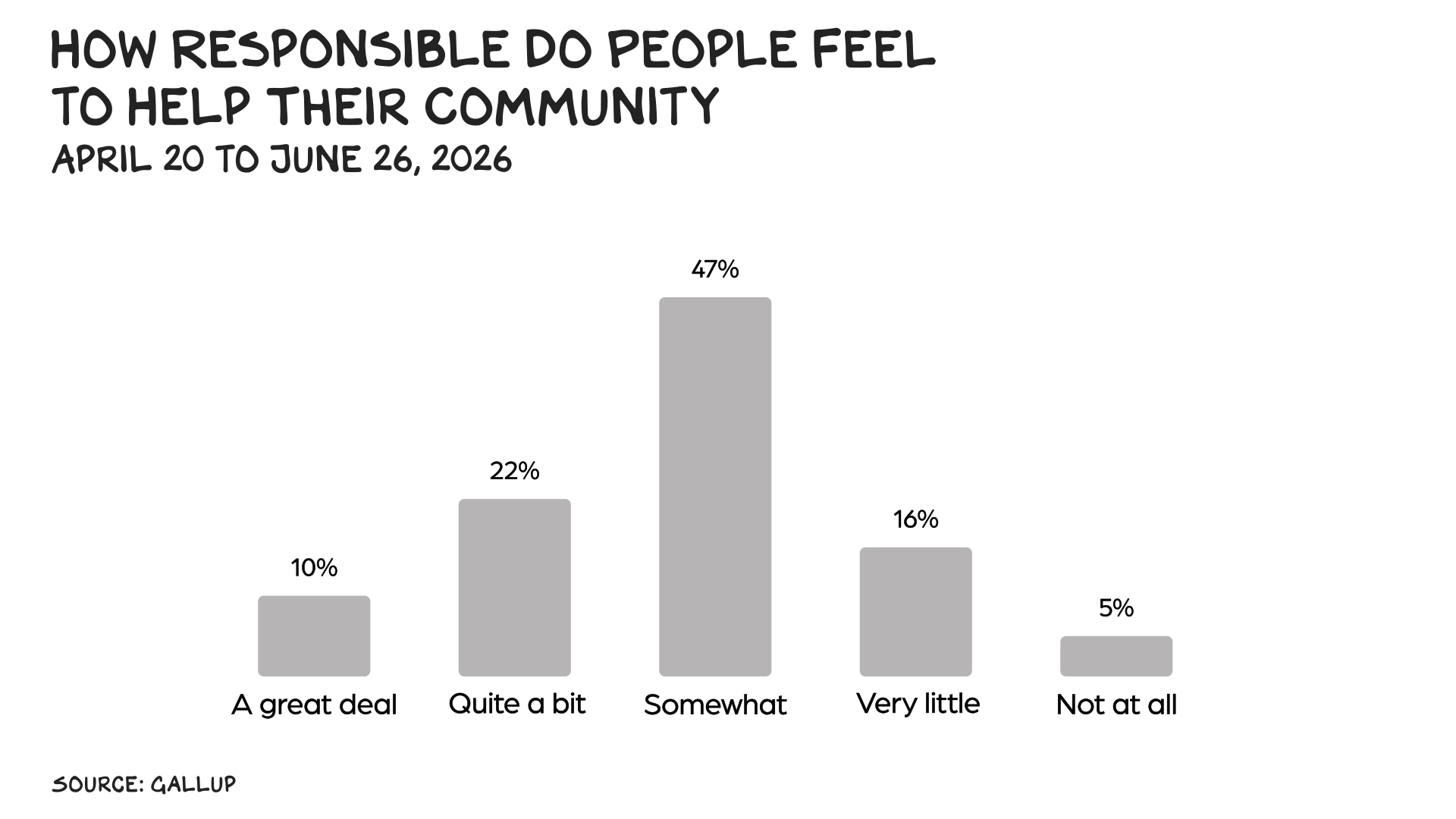
Our elections are approaching. A majority of those eligible to vote venture into a high school gym and get a new burst of oxytocin walking back to the car. Voting signals that you care about the country and others. What’s disheartening and disastrous is the increasing belief that we don’t owe each other anything at all. A recent Gallup survey found that a majority of Americans feel little to no responsibility to help their community. We’re drifting from e pluribus unum to everyone for themselves.
At the end of a 2023 report that called social disconnection the health equivalent of smoking 15 cigarettes per day, U.S. Surgeon General Vivek Murthy offered a prescription for loneliness that requires every segment of society to do its part. Government should treat social connections like infrastructure, appoint someone accountable for it, and run every policy — housing, transit, paid leave, etc. — through a “does this bring people together?” filter. Doctors should screen for loneliness the way they check blood pressure. Schools and offices should be places where people build relationships, not just educational and economic output. Tech companies should optimize for community and real connections, rather than outrage and isolation. The rest of us should step up … every day, everywhere. Call a friend. Limit screen time for yourself and your kids. Show up for something bigger than yourself.
Strangers
The Seattle Mariners finished the 2026 season with a losing record, but one of their fans demonstrated the key to winning — not in sport, but in life. Rhenda Strub lost her 27-year-old son, Wyatt, to muscular dystrophy three years ago. In her grief, the 71-year-old found comfort sitting in her son’s room, quilting and watching baseball. The routine helped somewhat, but loneliness compounded her grief. This season, Strub purchased two season tickets and wrote a Facebook post inviting strangers to join her. “This season ticket adventure is part of me finding my way back out — getting out of the house, being around people, and doing something that brings a little joy again,” she wrote. Her inbox filled with emails from people with “remarkably similar stories,” she told the New York Times. Strub was looking for someone to share a hot dog and a ballgame with. She found friends and a community of people quietly carrying a comparable emotional weight.
Income inequality, loneliness, homelessness, polarization. There are a myriad of obstacles and potential solutions. But there’s only one answer: each other.
Life is so rich,

P.S. AI was supposed to replace writing. Instead, it’s making storytelling more valuable. In our latest Deep Dive, I explain why companies are paying a premium for perspective and taste in a world flooded with AI-generated content. Watch it here.
Real Diversification Isn’t What You Think

Do you know how concentrated your public stock fund actually is?
A handful of mega-cap stocks with an AI story are doing most of the work - that’s not real diversification, especially as so much value creation now happens before companies ever go public.
Alumni Ventures, ranked a Top U.S. venture firm by TIME and CB Insights, gives accredited investors a way to diversify into venture-stage and late-stage private companies, co-investing alongside firms like a16z, Sequoia, and Bessemer.
Scott, your point that the best thing you can do for your career is build relationships has hard data behind it. A 2022 study in Science followed 20 million LinkedIn members over five years and found that moderately weak ties, people we know but rarely talk to, were the most likely to lead to a new job. Not our closest friends. The acquaintances we rarely think about.
That makes loneliness a career risk, not just a health risk. When people pull away, they lose the very connections that carry opportunity to them.
I see this every week with career changers and laid-off professionals. The ones who land fastest are rarely the most qualified on paper. They are the ones someone remembered and recommended.
Rhenda Strub’s extra season ticket is a lesson for every job seeker. Invite someone in. Comment on a former colleague’s post. Reconnect before you need anything.
Cooperation built our species. It still builds careers. Each other is the strategy.
As a New Yorker with homeless people right outside on my block, I'd rank this second in society-wide American failures, a cultural marker both obvious and ignored in plain sight.
First place goes to mass murder of school children, ongoing now for far too long,
and nothing and no one to stop it.
Have we really lost the will to solve our most shameful problems?