


There are a few seats left for the Markets podcast tour. Get yours now, or regret it forever. Purchase tickets here.
How do you kill millions of people? A: slowly and methodically. Note: This isn’t advice, but an observation from my personal Yoda, the psychologist Daniel Kahneman. “The world makes much less sense than you think,” Kahneman wrote in Thinking, Fast and Slow. “The coherence comes mostly from the way your mind works.” Our brains have two thinking systems: fast (intuitive, emotional) and slow (logical, calculated). Fast thinking blames America for killing an estimated 250,000 civilians with atomic bombs; slow thinking notes Japan’s military killed 3 million to 10 million civilians during World War II. We’re moved by the cinematic power of mushroom clouds, not the death toll, because 95% of our thoughts are the product of fast thinking.
As Joseph Stalin supposedly said, “A single death is a tragedy; a million deaths is a statistic.” The statistical tragedies resulting from the closure of the Strait of Hormuz are invisible to the fast-thinking mind, which is fixated on energy prices, markets, and shitposts cosplaying as statesmanship. So let’s slow down and think about the second-order effects stemming from a world without freedom of navigation.
The Spice Must Flow
America’s earliest conflicts were fought to further the principle of freedom of navigation, i.e., the right to move goods across oceans without the threat of violence or the bribe of tribute. In 1798 we fought an undeclared war against France to stop it from seizing our merchant ships. A decade later we took on the British empire to stop it from kidnapping American citizens and forcing them to serve aboard its ships. Between those two wars, we fought two campaigns against the Barbary states in North Africa, ultimately ending the need for American merchants to pay bribes for safe passage. These conflicts are largely forgotten, save for two familiar artifacts: That “shores of Tripoli” line from The Marines’ Hymn and the Mameluke sword, which remains part of the Marine dress uniform to this day.
Those 18th century American sailors and marines laid the foundation for today’s global prosperity. Over the next 200 years, freedom of navigation evolved from an idea, available only to nations with the maritime firepower to enforce it, into a system of laws and norms that benefit everyone. Today, 85% of goods by volume and 55% by value are moved by sea. Already, the U.S.-Israel war on Iran has caused an (unevenly distributed) energy shock. In its second rapid assessment of the Hormuz crisis, the United Nations Conference on Trade and Development noted that increases in energy prices are spilling over into supply chains, “raising the cost of producing and moving goods across the world.”
Finding Out
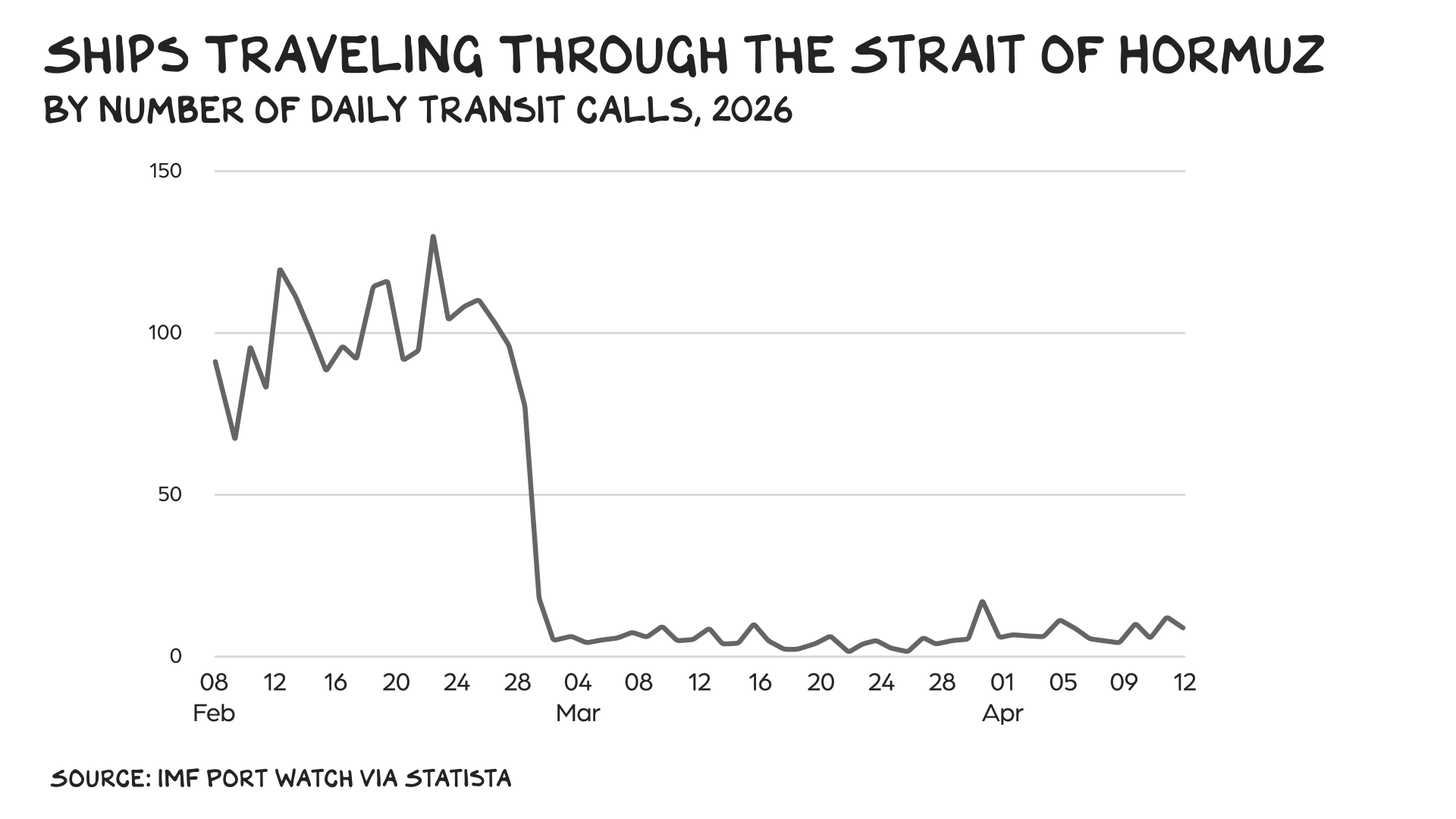
This week marks the war’s two-month anniversary. The strait has been closed most of that time, but markets, while volatile, have hit record highs. Explaining the cognitive dissonance between bad news and market optimism, European Central Bank President Christine Lagarde said, “This is a crisis where we’re learning bit by bit, day by day what the consequences will be.” Because tankers and cargo ships move about as fast as bicycles, we’re only now beginning to transition from the fuck-around phase to the find-out phase. Some things we’re finding out:
Karex, which makes a fifth of the world’s condoms, said it would raise prices by 30%, increasing the cost of safer sex and probably leading to unwanted pregnancies.
Dow said it plans to double a previously announced 15¢-a-pound price hike for polyethylene, which is used to make bottles, bags, tubing, and textiles. The price increase follows a 10¢ boost in March.
The U.S. Postal Service announced a temporary 8% surcharge on packages, meaning everything you buy online just got more expensive.
Essential Element
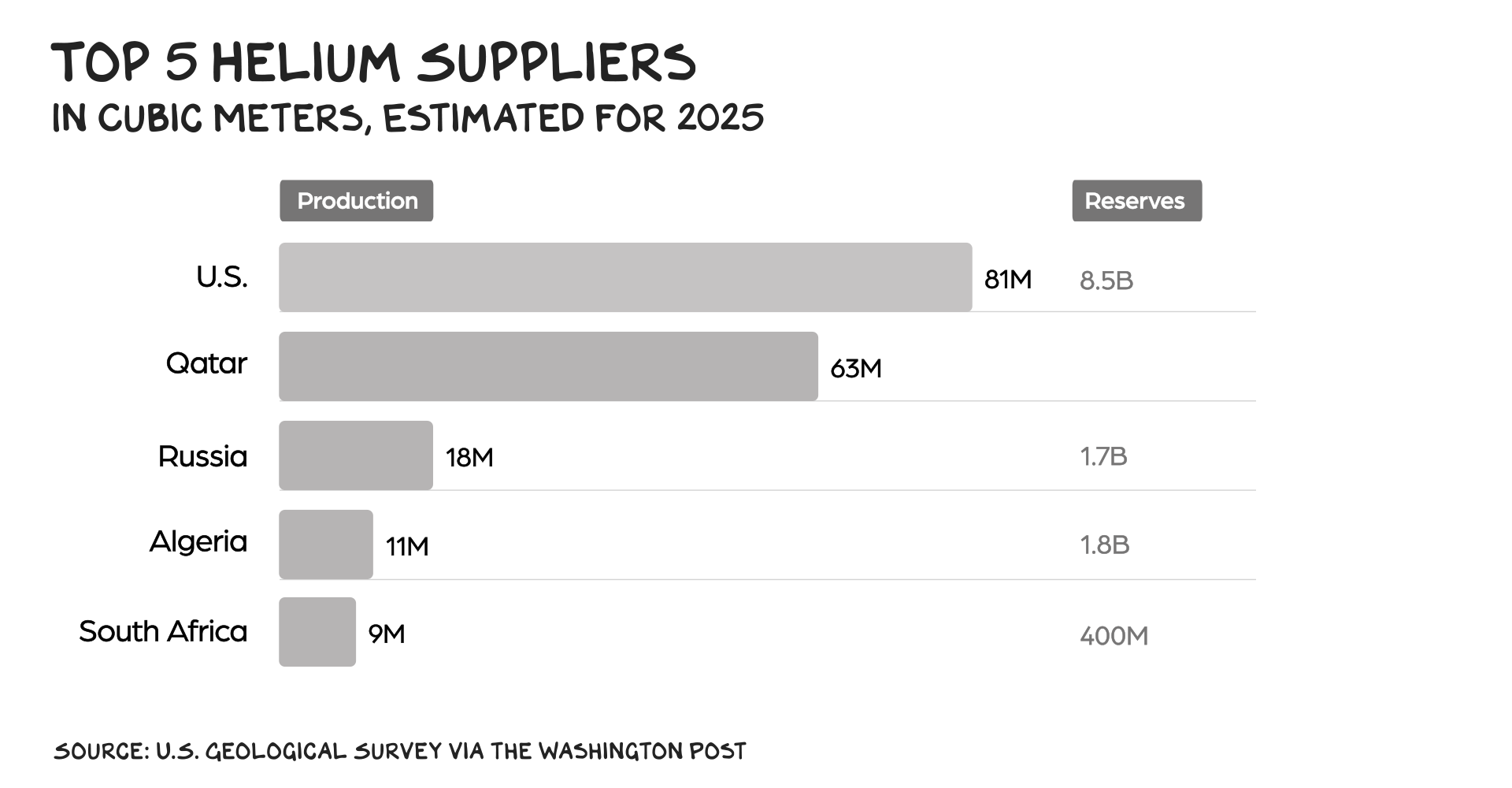
Helium is abundant in the universe but rare on Earth. Between the closure of the strait and damage to Qatar’s production facilities, 30% of the global helium supply has been disrupted. Spot prices for the gas have doubled since the start of the war. But even if the conflict ends soon, experts say it could take years for Qatar to repair its damaged production capacity. Meanwhile, U.S. helium suppliers have begun notifying customers that they won’t be able to fulfill orders. “This is the big one that we always feared would happen, it’s the black swan event,” Cliff Cain, an executive at the helium exploration company Pulsar, told the Wall Street Journal. “It is just going to be a building crescendo of who’s going to be able to get their molecules and who is not.”
Helium molecules are embedded throughout the supply chain, and in many cases there’s no good substitute. Affected sectors include semiconductors, aerospace, and fiber optics. The AI build-out is especially vulnerable, as helium is used to produce chips and cool data centers. Eventually, constrained supply will meet the AI boom’s increasing demand. “There’s no physical shortage right now at the end-user level,” a helium industry consultant told Scientific American. “It’s like a nice sunny day on the beach, but you heard there’s a tsunami out there.” When the tsunami hits it will pit AI against healthcare. In the U.S., one-third of the total helium supply is used to cool MRI machines. Healthcare systems are already talking about passing costs on to patients and rationing care.
Humanitarian Crisis
Since the start of the war, prices of urea and ammonia — the two most common nitrogen fertilizers — have risen by 65% and 40%, respectively. An estimated 30% of the world’s fertilizer passes through the strait, further straining already crimped global fertilizer production. In Russia, the world’s No. 1 fertilizer exporter, plants have been targeted by Ukrainian drones; one recent attack temporarily knocked out 5% of Russian production capacity. China, the second-biggest exporter, banned exports to guard domestic supply. In the U.S., higher fertilizer prices will hurt some farmers more than others, depending on their location and whether they bought fertilizer ahead of the spring planting season. U.S. futures markets have already priced in higher fertilizer costs, but if the strait remains closed into the summer, next year’s food prices will rise.
For poor nations, the crisis is here. An estimated 500 million farmers produce 70% of the world’s food supply on farms smaller than 24 acres. Their margin for error is zero. The longer supply chains remain jammed, the worse it gets. One analytics firm estimates that a six-month disruption will spike global food prices by 12% to 18% above pre-war levels by the end of the year. Germany’s Kiel Institute predicts food-price inflation will reach 30% in Zambia, 11% in India, and 8% in Venezuela within a year. By midyear, the World Bank estimates 45 million people, mostly in developing nations, will experience acute hunger. According to Michael Werz of the Council on Foreign Relations, we’re witnessing a “slow-motion famine machine.” Compounding the suffering, wealthy nations cut development assistance 23% from 2024 to 2025. As a UN official told the Economist, “The humanitarian shock absorber isn’t there anymore.”
Famines are humanitarian crises in their own right, but they can also precipitate riots, revolution, and war. Marie-Antoinette likely never said “Let them eat cake,” but the infamous line speaks volumes about the immediate cause of the French Revolution. The average 18th century worker spent half their daily wage on bread. After grain crops failed in 1788 and 1789, bread prices in the country spiked to 88% of the daily wage, lighting the fuse for the violence that followed. Food insecurity also set the stage for the Arab Spring. As a Jordanian activist told Time in 2011, “This is a hunger revolution.” From a political stability standpoint, food insecurity is both a cause and consequence of violence, contributing to a vicious cycle UN researchers call a “conflict trap.” Aeschylus was correct: The first casualty of war is the truth. But in a globalized world, casualties continue to mount long after the initial conflict and supply chain disruption are resolved.
Toll Booths
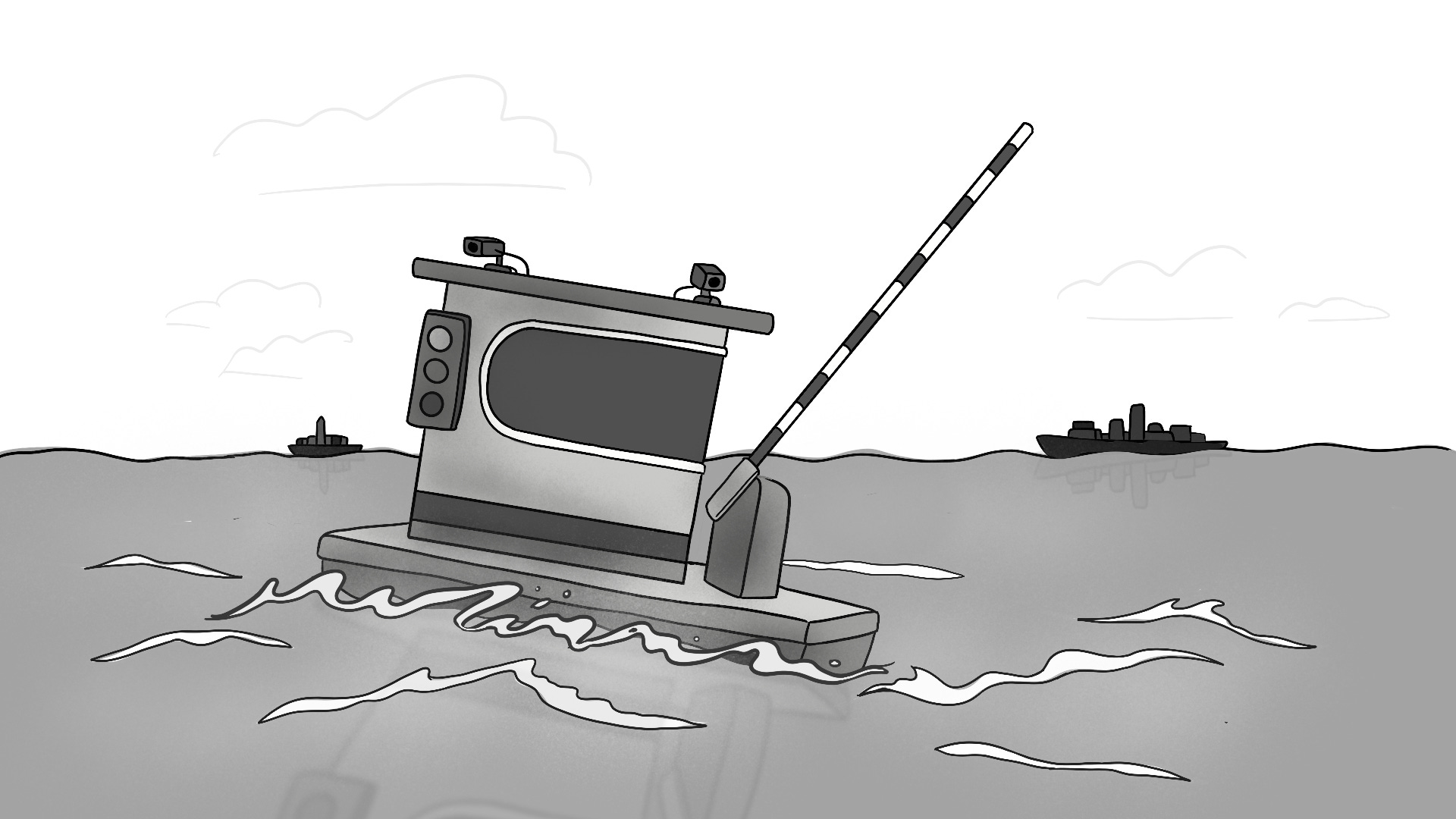
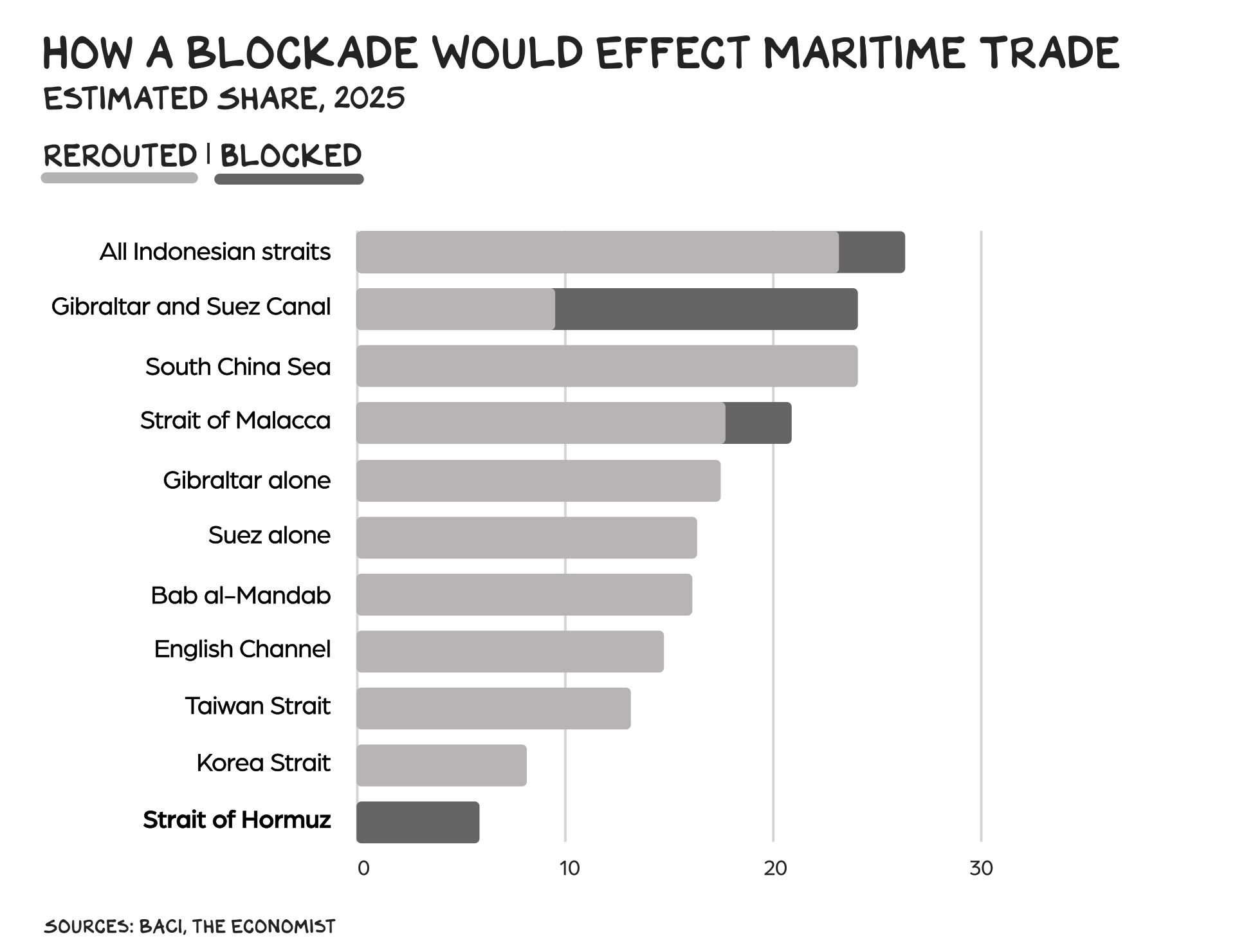
Fighting a war to open a waterway that was open before hostilities began is stupid, i.e., we’re hurting others while hurting ourselves. But that’s me thinking fast. Thinking slowly, the stupidity compounds and metastasizes. The strait isn’t open, but it isn’t entirely closed either: Iran has created a toll booth where previously there was free sailing. The economic consequences of a single toll booth are small. As the Brussels think tank Bruegel noted, the Gulf nations would pay a toll that amounts to $1 to $2 per barrel, increasing the global price by only $0.05 to $0.40 per barrel — a hit that wouldn’t register for consumers. The danger isn’t the toll, but the precedent. “The concept of the blue highway is going away,” Salvatore Mercogliano, a former naval officer and associate professor of history at Campbell University in North Carolina told the Wall Street Journal. “We won’t see a return to the normalcy we had prior to this no matter what.” One ominous sign? Iran is collecting tolls in crypto and Chinese Yuan, undermining dollar supremacy. The greater risk, however, is that toll booths will spread. “If the world accepts paying tolls for the Strait of Hormuz, then how do we handle the claim China has made that the entire South China Sea is Chinese territorial waters?” asked retired U.S. Navy Vice Admiral John “Fozzie” Miller. “If they control the South China Sea, they essentially control the global economy.”
Gangsterism
The nightmare scenario isn’t worldwide toll booths or even simultaneous blockades. We can tolerate higher prices and more frequent disruptions. What we shouldn’t tolerate is a descent into gangsterism. In the U.S., Donald Trump has undermined capitalism and the rule of law. (See: TikTok, tariffs, deploying prosecutions to attack Fed independence and political opponents, etc.) Trump’s strategic incompetence in Iran is exporting gangsterism to the world. In effect, we’re trading in our world policeman badge for regional protection rackets. That’s not the art of the deal, but the illusion of the steal. The question isn’t whether America has the economic and military firepower to prosper in Trump’s gangster paradise, but what we lose when we abandon the rules-based order we helped create. A: Everything.
Life is so rich,

P.S.
For those in the back. Ed Elson and I will be recording our Markets podcasts with live audiences in San Francisco, Los Angeles, Miami, Chicago, and New York. Buy your tickets here.
But, Prof G never answered the question of why stock markets are at a record high? Is Scott shorting the market or not? Or has his February high tech boycott already done too much damage?
Ah yes, the classic “everything is about to collapse” thesis—always a crowd favorite. If you read this piece too quickly, you’d think we’re about three missed container shipments away from returning to bartering goats and arguing over sacks of grain.
Let’s inject a little reality.
First, global markets—those cold, profit-driven, hyper-informed machines—are not exactly panicking. In fact, they’re brushing this off like a minor inconvenience. That’s not because traders are clueless; it’s because they’ve seen this movie before. Supply shocks happen. Routes reroute. Prices spike, then normalize. The system bends—rarely breaks.
Second, the idea that one chokepoint disruption equals global famine ignores something important: adaptation. Fertilizer doesn’t magically disappear—it gets repriced, redirected, and substituted. Same with helium, plastics, shipping, you name it. Painful? Sure. Apocalyptic? Hardly.
Third, invoking the French Revolution every time food prices tick up is a bit theatrical. Yes, food insecurity can destabilize regions—but jumping from “higher fertilizer costs” to “global conflict spiral” is like predicting a house fire because someone lit a candle.
And this “end of globalization” angle? We’ve heard it after every crisis—2008, COVID, Ukraine. Yet here we are, still trading, still shipping, still optimizing.
Bottom line: this isn’t a “slow-motion famine machine.” It’s a messy, uneven, but ultimately resilient global system doing what it always does—adjusting under pressure.
Doom sells. Reality adapts.