


This week on No Mercy No Malice, we’re featuring a guest post from Richard Reeves. Richard, a writer and a scholar whose work focuses on what I believe are pressing issues, has become my Yoda regarding the conversation concerning failing young men. We hosted Richard on the Prof G Pod last fall, and it was our most-listened-to episode. He’s a blue-flame thinker who combines data-driven insights with empathy and a perspective. You can hear from him regularly via his substack, Of Boys and Men. His 2022 book, Of Boys and Men: Why the Modern Male Is Struggling, Why It Matters, and What to Do About It, is a landmark book on the topic.
Head of the Class
by Richard Reeves
My favorite high school teacher was Mr. Wyatt. He taught English, mostly poetry and Shakespeare. He was also a Korean War veteran, a part-time bus driver, and a curmudgeon. I loved him. And because of him, I also came to love reading and writing. It’s no exaggeration to say that he changed my life.
Mr. Wyatt was living proof that masculinity and literacy could go together. To a 15-year-old boy, that really mattered. Seems I’m not alone in this regard. In the U.K., where I grew up, 1 in 2 men say a male teacher was an important role model. Ask the men in your lives about the educator who had the biggest impact on them; most will name a man.
But my own sons had fewer opportunities to connect with a male teacher, for the simple reason that there are many fewer of them around. In 1980 men accounted for 33% of K-12 teachers in the U.S. Today it’s down to 23%.
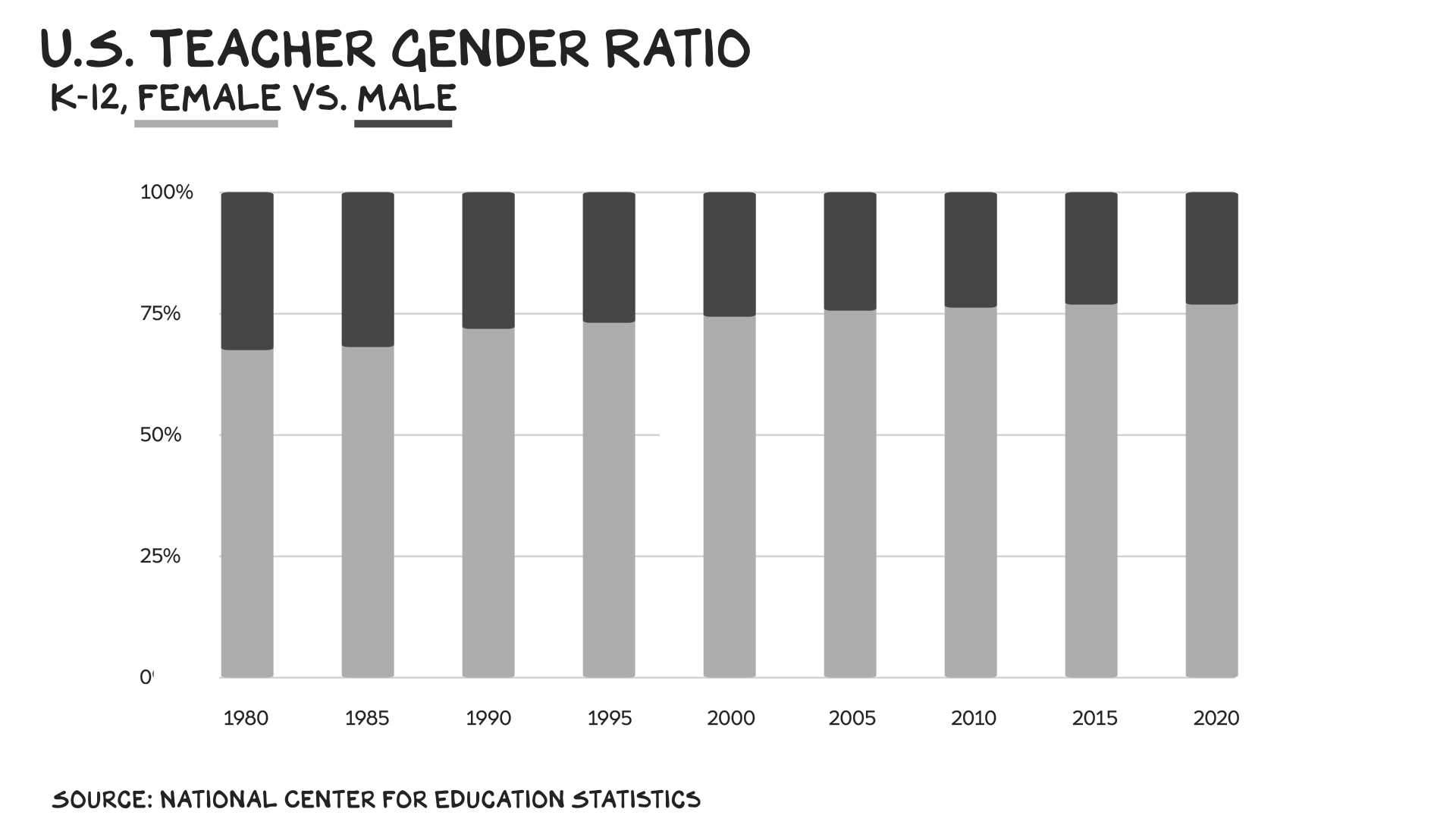
If the male share had remained at 1980 levels, we would have an extra 400,000 men teaching in our schools. (That’s more than the total number of teachers in California.) The male share is set to drop even further unless something’s done about it: In the 2019-20 school year, only 18% of education majors in college were men.
Each year, the National Center on Education Statistics publishes a report blandly titled “Characteristics of Public School Teachers” showing the steadily falling share of male teachers. Each year, it fails to get any serious attention from either the media or policymakers.
If the share of women was declining in a major profession, it would, quite rightly, generate headlines. There is lots of concern, for example, about the lack of women in the tech industry. Among the workers at the big five companies — Amazon, Apple, Facebook, Google, and Microsoft — only 31% are women. That 31% may well be too low a share of women in Big Tech, but it’s a lot higher than the 23% share of men in education. The lack of women in tech is often described as an existential crisis, while the lack of men in schools merits barely a mention.
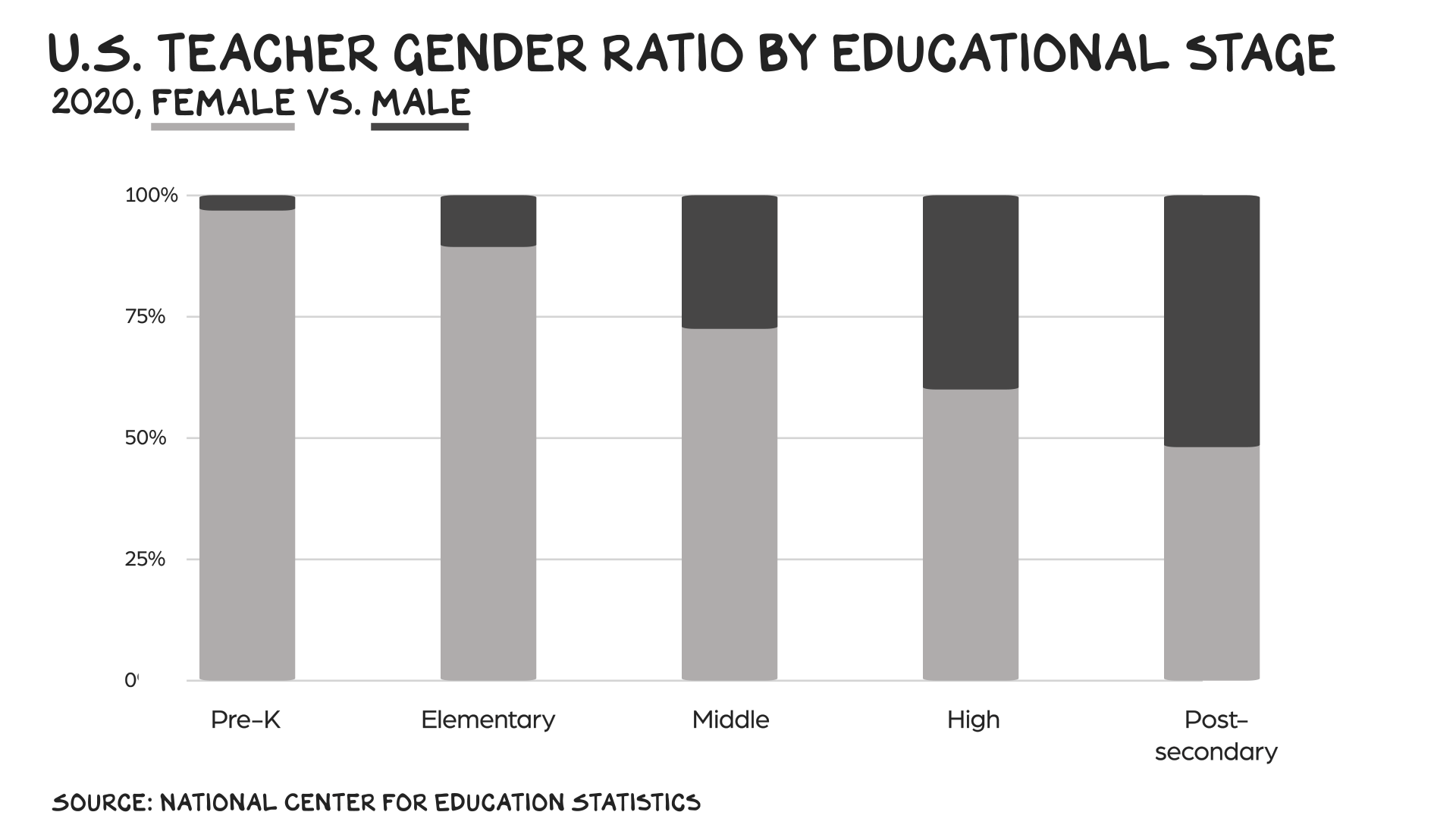
Male teachers are especially scarce in the early years. Only 3% of pre-K and kindergarten teachers are men. In fact, as a share of their professions, there are twice as many women flying U.S. military planes as there are men teaching kindergarten.
“It takes some degree either of social ignorance or of personal courage for a man to enter teaching at the elementary school level,” noted education professor George Brown. For a man to teach young children, he wrote, “is to spit in the face of a strong societal stereotype.” That was in 1960. Today I’d wager the stigma is, if anything, even greater.
My own son, who teaches at the elementary level, has faced stigma and suspicion. A man who wants to work with children is seen as, well, weird. This is a vicious cycle. The more scarce men become in teaching, the weirder a decision to enter the profession will seem. My fear is that we are close to a tipping point, where, almost by definition, non-weird men will think twice about choosing teaching as a career option. (My son, for the record, is not weird.)
“If this trend continues, we may see a day when 8 of 10 teachers will be female,” wrote Richard Ingersoll and his colleagues in a 2018 report from the University of Pennsylvania (one of the very few attempts to draw attention to this crisis). “Given the importance of teachers as role models, and even as surrogate parents for some students, certainly some will see this trend as a problem and a policy concern.”
I do think it is a problem and a policy concern. The emptying out of men from our schools is bad news for at least three reasons.
First, having a male teacher improves educational outcomes, especially in certain subjects like English (where boys are lagging furthest behind girls). One study suggests that If half the English teachers in middle schools were men the achievement gap in reading between girls and boys would fall by approximately a third — a massive effect. (Important note: the performance of girls in English doesn’t seem to be affected by teacher gender.)
But it turns out that English, where male teachers might have the biggest classroom impact, is the subject men are least likely to teach. Men account for just 1 in 10 middle school English teachers.
Second, male teachers are much more likely to take on after-school activities, especially coaching sports teams. A recent Brookings study finds a gender pay gap among K-12 teachers of about $2,200 a year in favor of men. The difference in base pay is just $700 a year. Most of the gap, about $1,200 a year, is explained by the extra pay men get from doing extracurricular work.
The researchers write about this as a problem to be solved. Which it is, if the only thing we’re worried about is the gender pay gap. But if male teachers are working extra hours to coach their students on the soccer field or debate stage, and getting paid for it, I’m more inclined to clap than wring my hands.
The role of coaches in the lives of many students is close to a sacred one in our culture. This is especially true for boys without dads. And there are more of those all the time. Since 1980, the share of children being raised by a single mom has risen from 18% to 24%.
So: More homes without dads and more classrooms without misters. That’s a bad combination.
Third, the men in our schools are mentors to both male and female students. A recent study published by the National Bureau of Economic Research found that having an informal mentor in high school improved educational performance across a range of measures; most impressive was a 9% increase in college attendance.
But one finding in the paper did not get much attention. Men make up 59% of high school mentors, even though they account for only 40% of high school teachers. So male teachers are stepping up in a big way to mentor both boys and girls.
The term “teacher” doesn’t get close to describing the impact of the men and the women working in our school system. But it does a particular disservice to male teachers, who are even more likely than their female colleagues to provide coaching and mentoring to their students.
In short: Male teachers rock. So, how do we get more of them? Here are five suggestions:
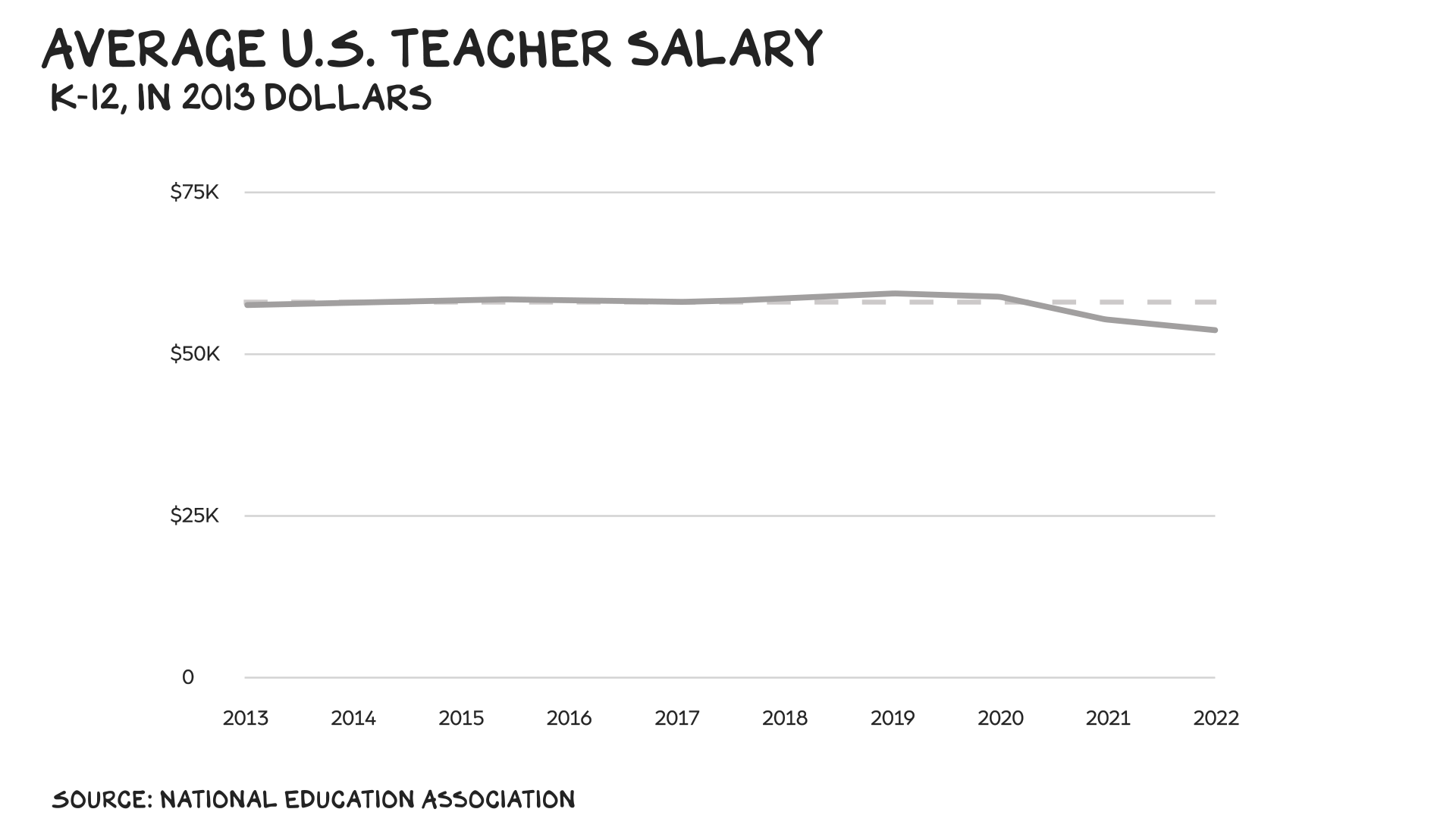
1. Increase wages. K-12 teacher pay has been essentially flat, in real terms, for at least a decade. According to the National Education Association, in 2019 almost two-thirds of school districts offered a starting salary below $40,000 a year. The low salaries are especially offputting to men. (Caveat: The teachers who should get the most money are the good ones and/or those working with the poorest students.)
2. Double extra-duty pay. Teachers who stay late to run clubs or coach sports should not just be rewarded, they should be doubly rewarded. Extracurricular activities provide students with precious opportunities, especially for kids from poorer backgrounds, and there’s a growing class gap in access to after-school sports.
3. Scholarships. Generous college scholarships ought to be available to men who want to pursue education as a career, especially in crucial subjects like English. This is not a radical idea: After all, there are thousands of college scholarships for women seeking to enter traditionally male fields, including STEM.
4. Celebrate misters. School districts, counties and states should support and fund the creation of male teacher learning networks, award “Male Mentor of the Year” prizes, and plaster the faces of successful male teachers across billboards. Remember the line that feminists taught us: You can’t be it if you can’t see it.
5. Set a 1 in 3 target. Last but not least, let’s set some concrete goals. How about we aim for the same share of male teachers as when Ronald Reagan was first elected? That means at least 1 in 3 teachers should be male. School districts, states, teacher training colleges, and the Department of Education should set this 1 in 3 share as an explicit goal and publish annual progress reports. The Biden Administration has a Million Women Into Construction Initiative. California awards $25 million a year in grants toward the same end. Great! Where are the equivalent initiatives and investments to get Men Into Education?
Unless we act quickly, there will be fewer and fewer men in our classrooms every passing year. If policymakers don’t think that’s a problem, they should explain why not. If they think it is a problem, they should do something about it.
Richard Reeves