



Every conversation about the future of college in 2026 is a conversation about AI. Will students still learn if a chatbot writes their essay? Will professors still matter if a chatbot grades it? Will a degree mean anything when there are faster — and cheaper — ways of knowing everything a graduate knows?
These are legitimate questions, and Prof G Media has covered many of them. But they’re also a distraction from what’s actually happening right now, which is that the American university is going out of business, one campus at a time, for reasons that have nothing to do with artificial intelligence.
More than 4,720 degree-granting institutions existed in the U.S. in 2013. Since then, the count has fallen by at least 800. The Philadelphia Fed projects another 80 could close by 2029. The Education Department has about 400 schools on what it calls heightened cash monitoring, a bureaucratic term for “having financial troubles,” and about 20 on the more severe track, or those “having even worse financial troubles.” Overall, more than a quarter of private colleges in America are at risk of closing in the next 10 years.
For now, the question isn’t whether AI will kill college. It’s why college was already dying in the first place.
Fewer 18-Year-Olds, and Fewer of Them Want to Go
In 2025, the largest high school class in U.S. history graduated 3.9 million students. That was the peak. From now on, each graduating class is projected to shrink. The class of 2041 will have 3.4 million students — 13% fewer than the class of 2025. That means 576,000 fewer 18-year-olds contemplating college, roughly the entire undergraduate population of the University of California and the SUNY systems combined.
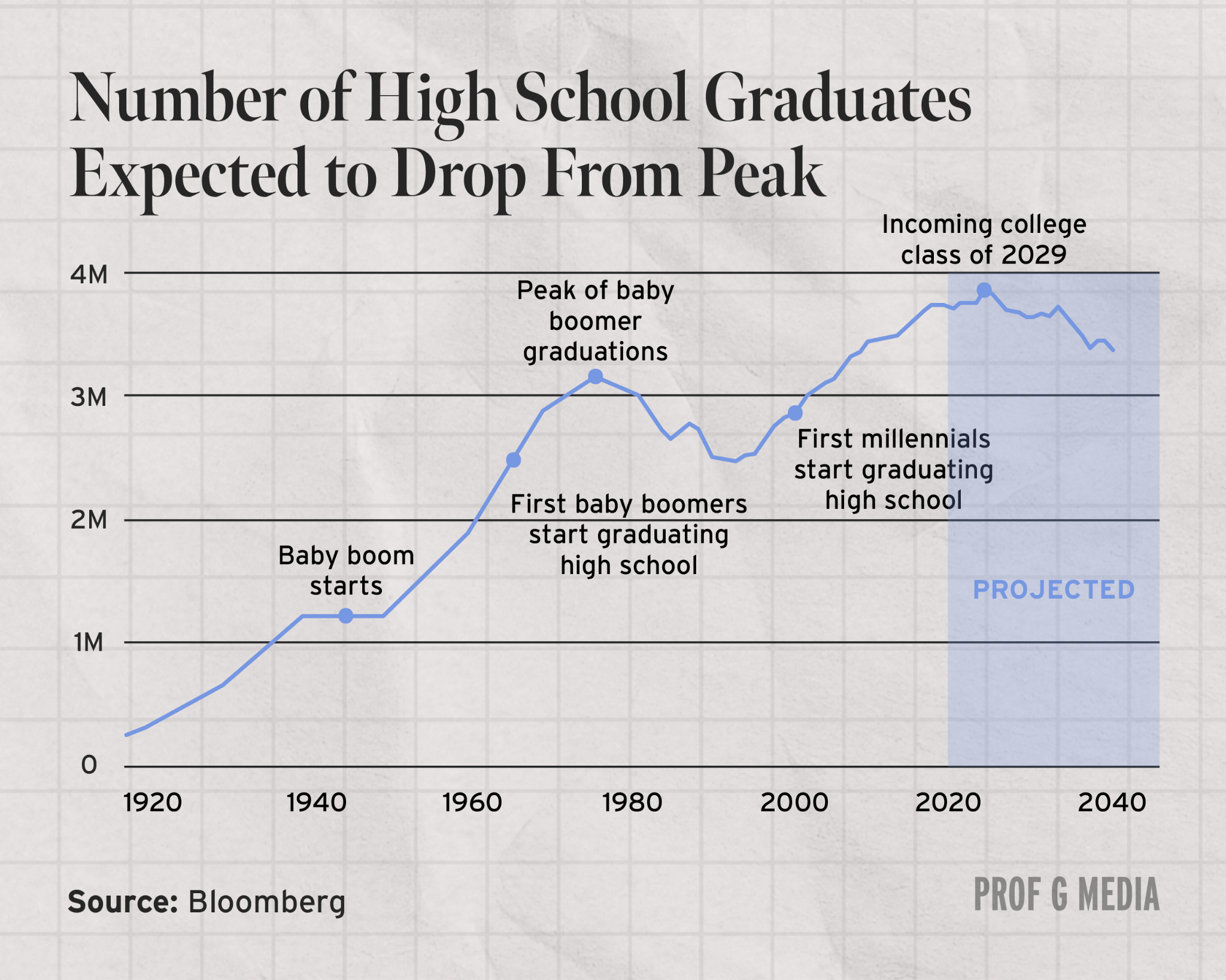
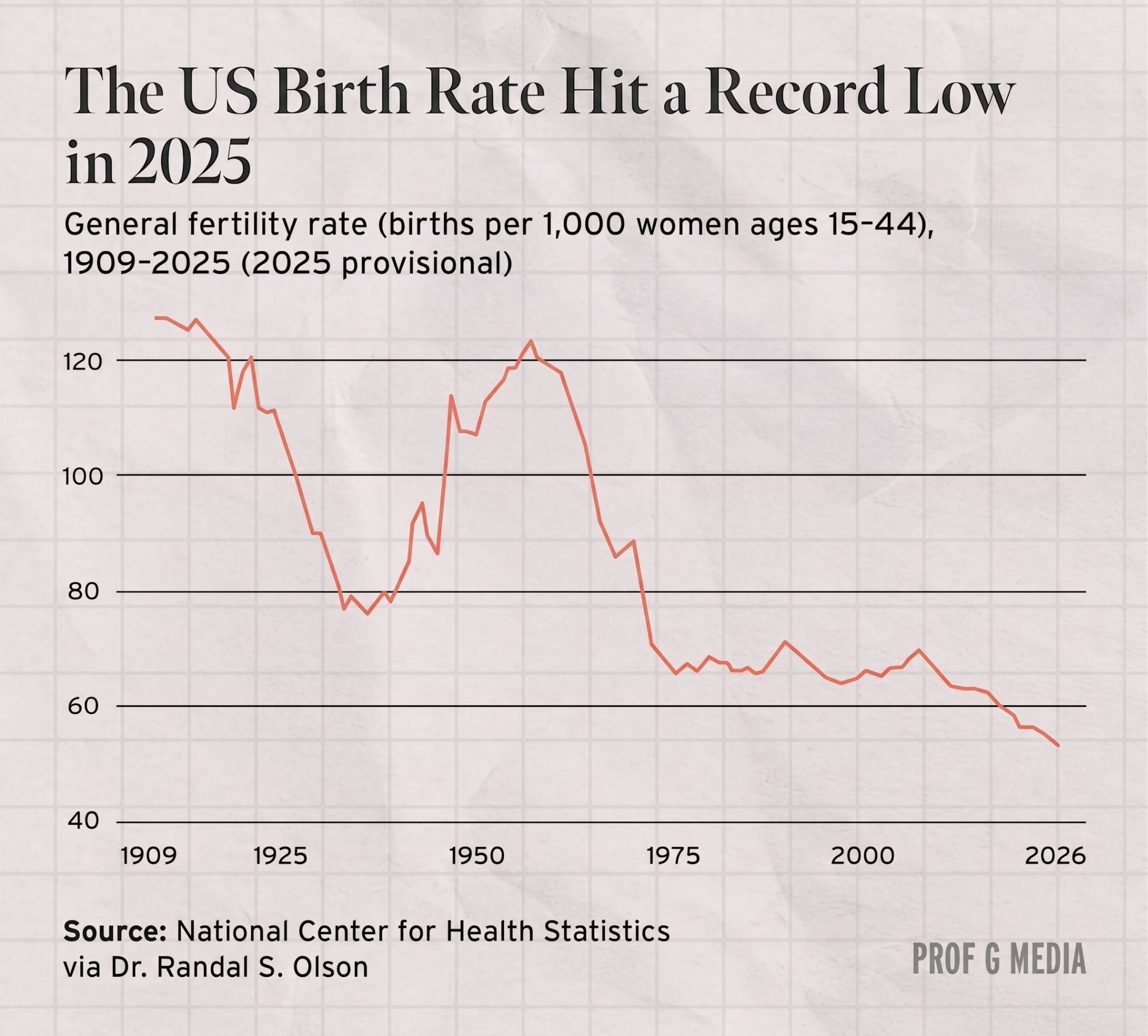
Why? Americans aren’t having kids. Births peaked at 4.3 million in 2007 and have fallen almost every year since. Add 18 years to that, and you get an admissions office staring at a smaller pool of applicants than the year before, every year, for the foreseeable future.
None of this is a surprise. Demographers have been publishing these projections for over a decade — but the future is easy to ignore until it becomes reality.
It’s not just that there will be fewer kids. It’s that fewer of the kids will want to go to college. The share of high school graduates enrolling in college right away has dropped to around 63% from 70% a decade ago. Adult enrollment (25 and older) is down by roughly a quarter since its 2011 peak. Demand is falling independently of demographics.
Think about what this will do to the college business model. Roughly 4,000 degree-granting schools in the U.S. spend every fall recruiting from the same pool of 18-year-olds. Starting now, that pool will get smaller and smaller every year. Harvard won’t notice, as it already rejects 96% of applicants and can dig deeper into the pile forever. The regional private schools that admit 80% of applicants are already noticing.
Tuition Went Up. The Money Went to Administrators and Lazy Rivers.
Colleges will eventually notice because of what it does to their bottom line. The average annual tuition at a public college is 40x as expensive as it was in 1963. Since 1983, tuition has risen 2x as fast as medical costs and about 4x faster than home and gas prices. No other industry has weaponized its pricing power like higher ed.