


In the past two weeks, Mark Zuckerberg shut down the virtual reality platform Horizon Worlds, the foundation of his metaverse project, and OpenAI killed Sora, its video creation engine and social media platform. Prof G predicted both. How?
Some Redditors suspected that Scott had insider information. He didn’t. Scott has been making predictions for years, and while he doesn’t always get it right, he’s pretty good at it. Ten out of his 11 predictions for 2025 came true.
I’ve made Scott’s annual predictions deck since 2021, so I’ve had some exposure to how he comes up with these bets. The following is my best estimation of the Prof G Media predictions framework.
How to make a good prediction:
Read constantly and let data guide your hunches.
Never underestimate human nature.
Be skeptical when the crowd is certain.
Remember: Greatness is in the agency of others.
Read Constantly and Let Data Guide Your Hunches
If you want to make a good prediction, you need a deep understanding of the subject matter. If you’re making a prediction about the markets, for example, you should be reading, watching, and listening to market-related content all the time.
Continuity is important for pattern recognition. You can’t just be really plugged into financial news for three days. To make a good prediction, you need to treat the markets (or whatever you’re predicting about) like a best friend. You should be close to them for months — years even, to understand how they work and how they react to different situations.
Your reading should be biased toward data-heavy sources. Let that data guide you. Words lie easier than numbers.
We anticipated Sora would fail because we were following the data. The app was released at the end of September, and by December, downloads were decreasing more than 30% month over month. In January, they declined another 45%.
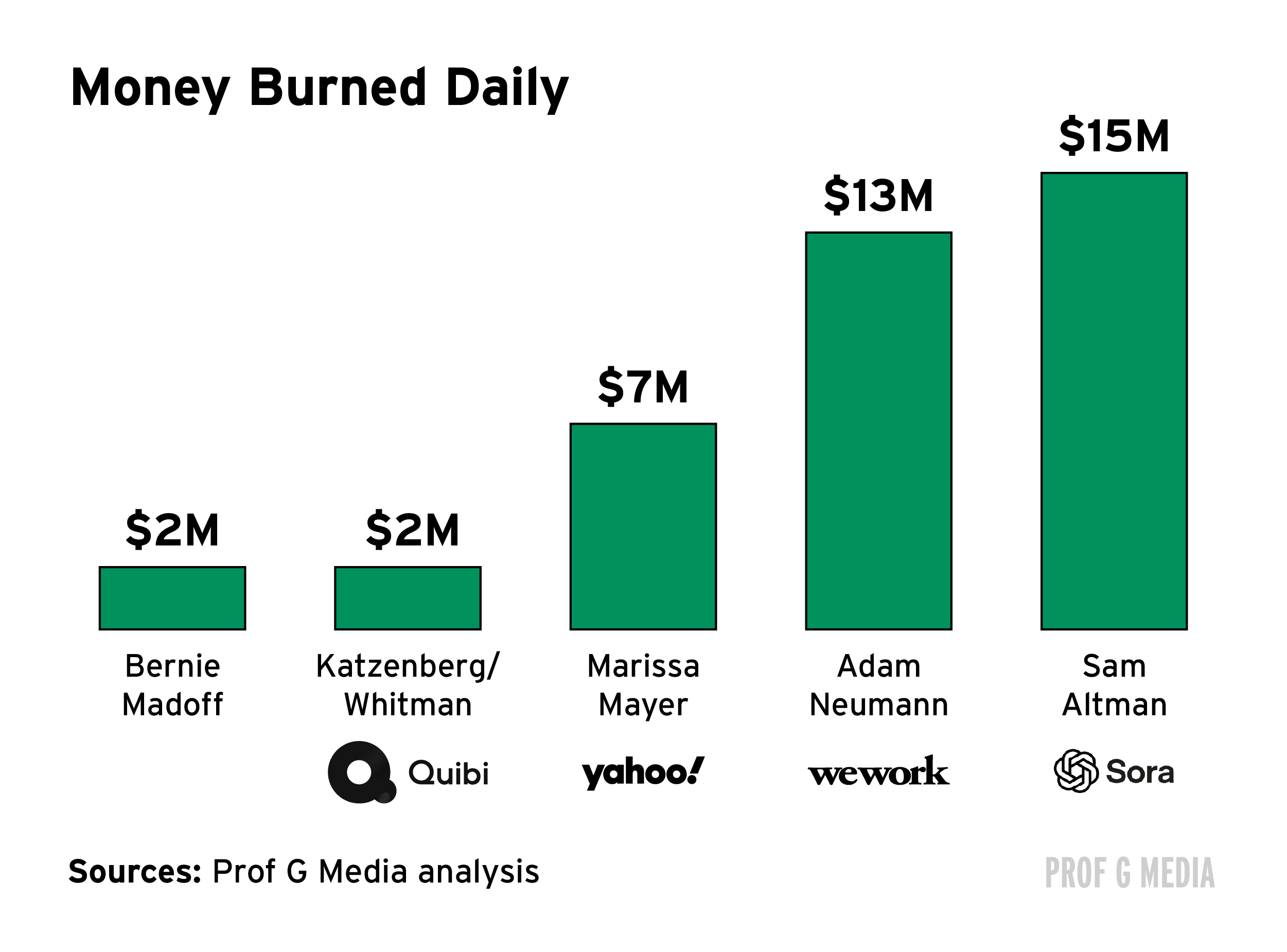
Not only was it unpopular, the economics were mind-bogglingly bad. AI video generation is 2,000 times more energy intensive than text, and more than 150 times more expensive. Forbes estimates that Sora burned $15 million per day. That’s more than Adam Neumann burned every day at WeWork.
In terms of revenue, Sora generated about $2 million from in-app purchases; in other words, its revenue covered the first three hours of its operation.
There was just no way that a side bet that disastrous could continue.
Horizon Worlds was even less popular than Sora. At its peak, it had roughly 300,000 monthly active users. MySpace, a social network popular in 2005, has almost 800,000 monthly visitors.
Never Underestimate Human Nature
Society and technology move faster than evolution. Ten thousand years ago, the most-exciting technological advancements were stone tools and the domestication of cows. Today, we have artificial intelligence in our pockets, but we’re navigating the world with the same controls (genes) as paleolithic humans.
This is all to say: Innate evolutionary tendencies are hardwired into our brains, and they influence us more than we’d like to think. We still have a desire for sugary and fatty foods because our bodies are built to avoid starvation. Negative memories are more salient to us because in our cave days, missing danger was costlier than missing an opportunity.
An understanding of biology and psychology fueled Scott’s prediction that the metaverse would fail back in 2021. Prof G explained that headsets obstruct our peripheral vision, exposing us to stalking predators (real quote), so people have a natural revulsion toward putting them on.
They also look stupid. Everything we put on our bodies is, at some level, about broadcasting attractiveness and value to a potential mate. VR headsets are sex repellant (his words).
Be Skeptical When the Crowd Is Certain
Predictions are trends, and as they grow in prominence, they can also appear to grow in prescience. As more people hop on the bandwagon, they bring with them their own justifications for why ___ is going to happen. Then the size and power of the trend starts to influence the media, which converts even more people.
The problem is that when predictions become trends, it becomes easier to overlook risks or ignore the potential for other possibilities. When everyone is already convinced of something, no one has to actually investigate the specifics.
In his book Mastery, Robert Greene argues that true expertise means developing such a deep understanding of a field that you can detect anomalies and outliers that others haven’t processed yet. Sometimes the contrarian call is just stating what’s plainly in front of you.
This is what happened with Sora. AI-generated videos from the platform went viral on social media, making everyone think this was the next big thing. Case in point: Disney bet $1 billion on this trend. But after the initial hype, no one stopped to consider whether this made it a good business, or if the masses actually wanted to create AI videos of themselves.
A skeptic might have realized that media consumption has long followed the “1% rule,” where a small fraction of people create content and the vast majority consume it.
4% of YouTube videos account for 94% of views on the platform.
3% of videos on Instagram account for 84% of all views.
5% of videos on TikTok generate 89% of the views.
The top 25 podcasts reach nearly half of U.S. weekly listeners.
Consumers don’t want to produce their own entertainment. They want to be entertained.
Greatness Is in the Agency of Others
Scott didn’t have insider information on Sora. The prediction came from Dan Chiolan, a member of our research team.
One of Scott’s superpowers is attracting and retaining top talent. He hires smart young people, and then gives them (us) a ridiculous amount of responsibility. Dan is 22. He made a prediction on a major platform that Scott put his name behind. At 24, Ed Elson, a classics major, became the co-host of a prominent finance podcast. At 26, I produced all of Scott’s slides for his TED Talk, a presentation that has now been viewed more than 17 million times.
Prof G Media exists and works because Scott is great, but also because Katherine, Drew, Claude, MJ, Mia, Ed, Claire, Jenn, Allison, Dan, Bella, Kristin, Laura, David, Erikk, Billy, Jorge, Gil, Corinne, Michael, Kami, Karen, and Lucy … are great.