


Instead of our usual markets recap, we're covering something different this week: the link between money and masculinity. It's a topic we get asked about constantly, and the data is more surprising than you'd expect.
The traditional male is making a comeback. At the top of his defining characteristics? Provider.
After decades of liberalizing what it means to be a man or a woman, young Americans are embracing a return to traditional gender roles faster than any other age group.
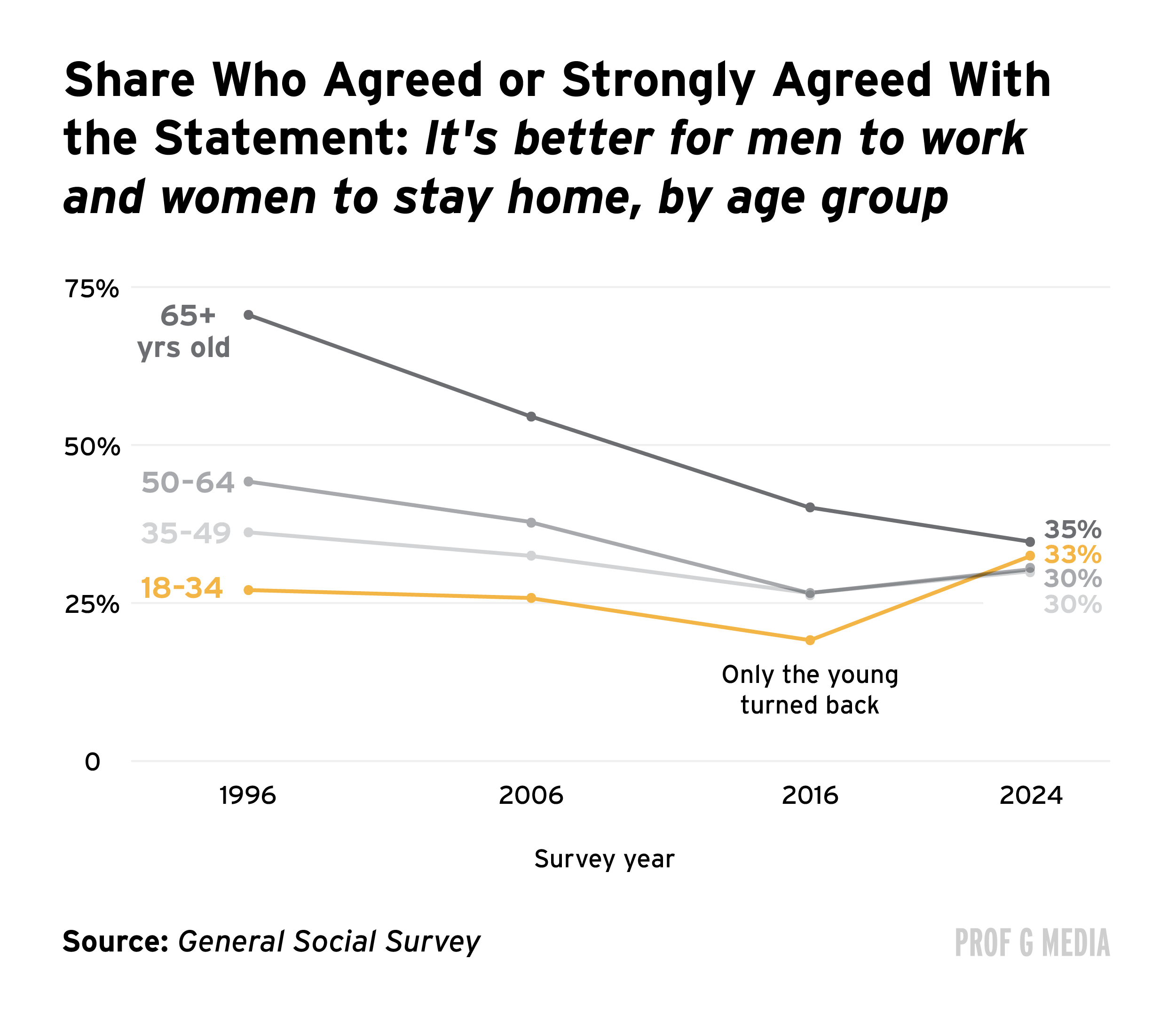
When Americans ages 18 to 34 were asked how they felt about the statement “It’s better for men to work and women to stay home,” 11% said they strongly agreed, the highest single-year reading in the General Social Survey’s 47-year history .
Young men are leading that shift. In 2016, 13% of men ages 18 to 34 agreed with the aforementioned statement; in 2024, it was 37%, the highest reading in more than three decades. Young women’s agreement rose to 29% from 25% over the same period.
We talk about young men a lot at Prof G Media — the challenges they face, the policies that help and hurt them, and the roles they play at home and in society. One question that’s come up repeatedly is central to the man-as-breadwinner stereotype: How important is making money to being a man?
We’re revisiting that discussion today. We’ll explore what the most recent data tells us about the role that providing plays in modern manhood, and what happens when masculinity is built on shaky ground.
The Provider Mandate
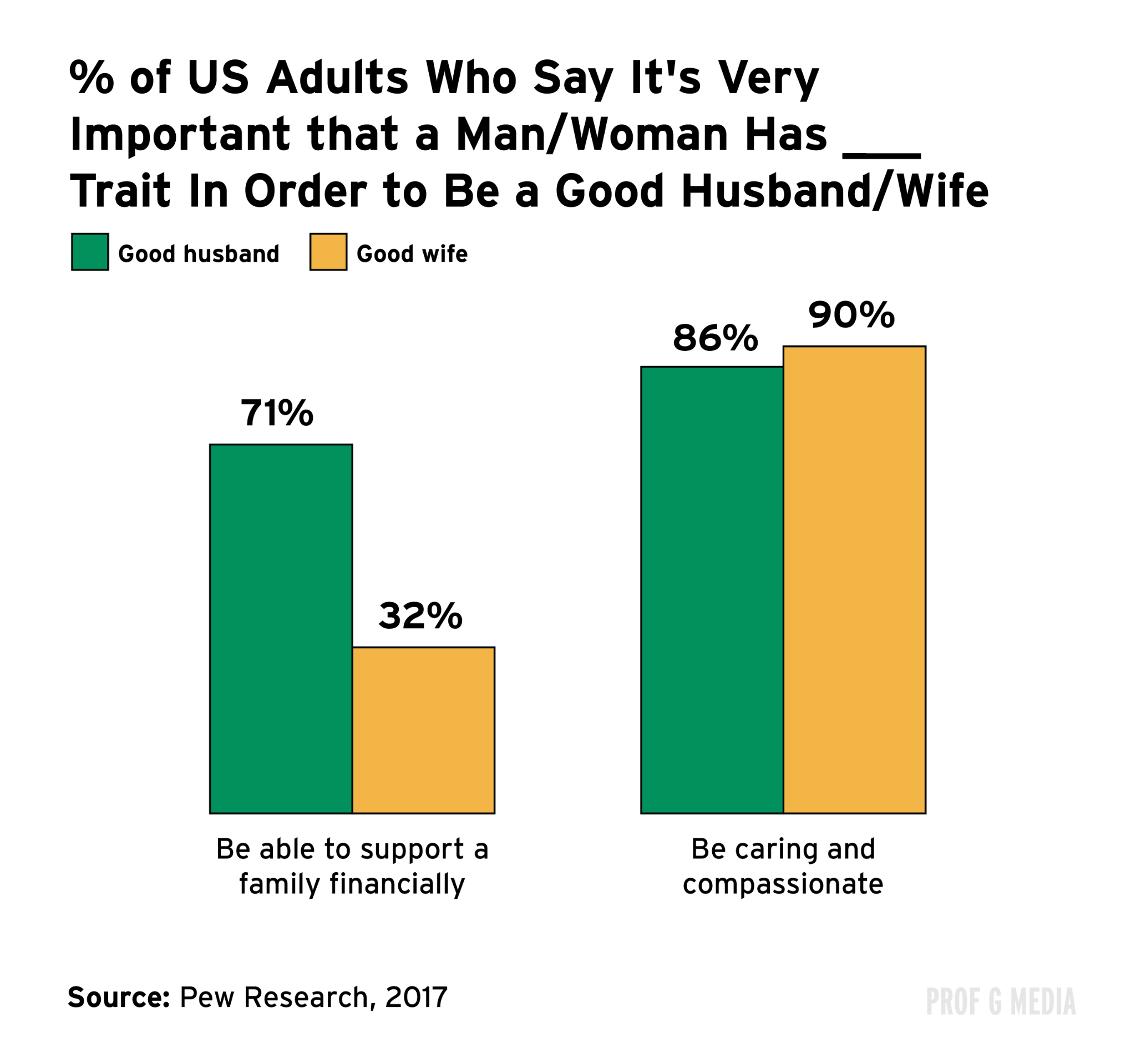
It may not be woke to admit it, but men (and women) associate economic power with masculinity. When asked what being a man is, 86% of American men chose provider as the number one trait. Seventy-seven percent of women also chose provider as the top trait for a man. Men rated being a friend and being strong in second and third place, respectively.
This carries over into marriage expectations: Husbands are expected to provide in a way that wives are not.

In my book, I wrote that masculinity comes down to being a “protector, a provider, and a procreator.” I got some fair pushback, especially on the provider point.
One thoughtful critique is that I reverse engineered what worked for me into advice for everybody. Developing economic security and having a family has been immensely rewarding for me, but those might not be priorities for some people.
However, I stand by the notion that in a capitalist society, money plays a larger role in masculinity than we’d like to believe. I’m not suggesting you need to work for Goldman Sachs, but you need a plan. You need to have the discipline to spend less than you make, pursue certification, and demonstrate grit, such that at some point you might be in a position, should you choose to, to be able to support or at least be a large contributor to a family.
Beyoncé could work at Burger King and marry Jay-Z. The opposite is not true. Men are disproportionately and unfairly evaluated based on their economic viability. Women are unfairly and disproportionately evaluated on their aesthetics. That is not the way the world should be. It is the way the world is.
Scott’s instincts are right — research confirms that money plays an important role in men’s success in the dating market.
In a study of online dating, men with higher incomes received 10x more profile visits than men who have lower listed incomes. This dynamic didn’t show up with women.
Furthermore, men in the highest-income category are 57% more likely to get married than men in the lowest-income category. Income is unrelated to marriage for women.
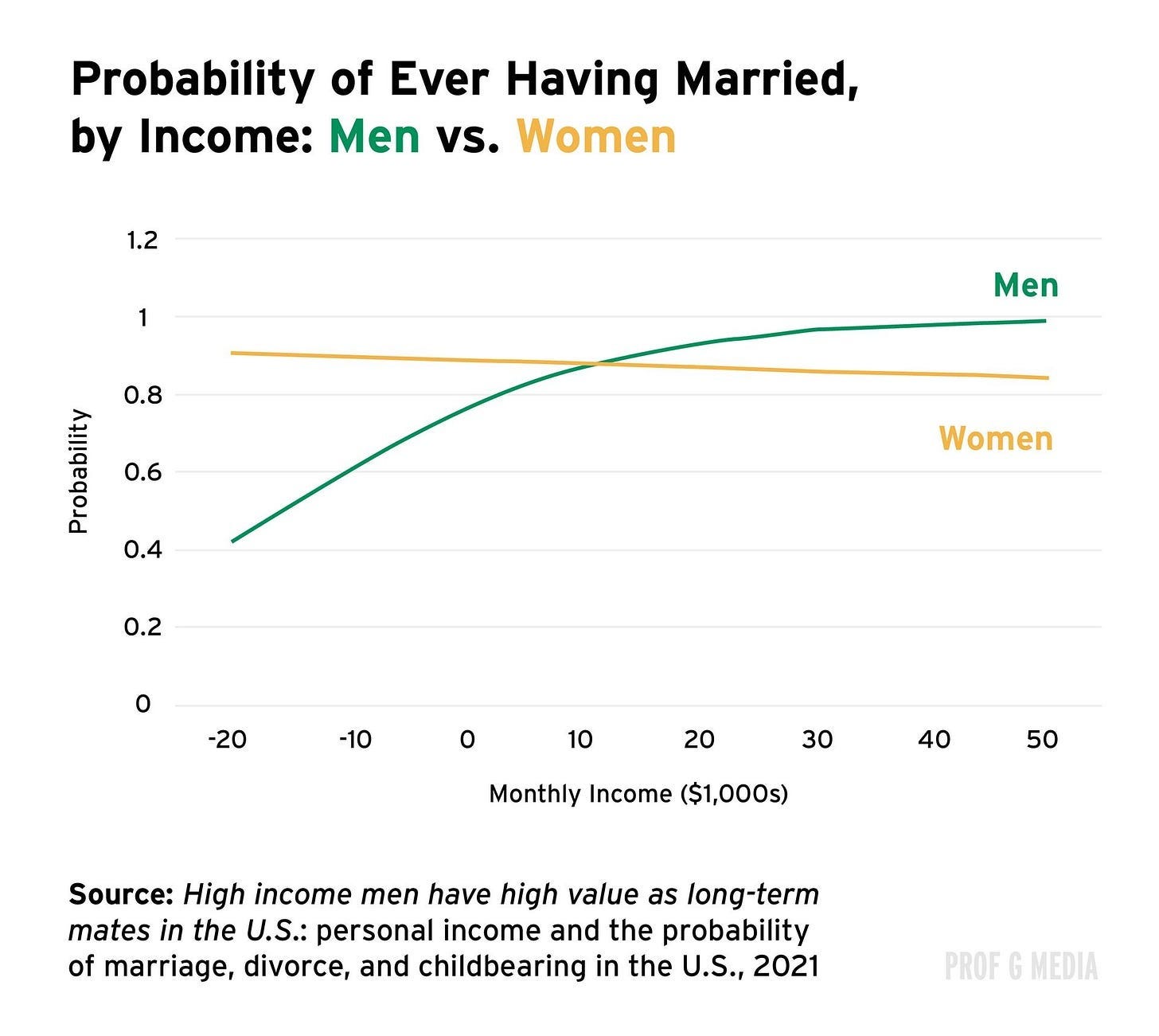
There isn’t just a correlation between money and marriage for men. Data indicates a causal relationship. As Lyman Stone, the director of research at the consulting firm Demographic Intelligence, pointed out, when women win the lottery, their marriage rates don’t change. But when men win the lottery, they get married.
Money also impacts divorce rates. One study of marriages found that the more time the husband spends unemployed, the higher the likelihood that the couple will get divorced. A woman’s employment, or lack thereof, however, has no impact on the likelihood of divorce.
The Weight of Providing
Money doesn’t just shape a man’s romantic prospects: The ability to provide, or lack thereof, shapes how men see themselves. In fact, men who experience economic anxiety are twice as likely to say they wish they were more masculine.
The inherent risk is that when men can’t provide, they struggle more — psychologically and emotionally — than women in the same position. A woman who loses a job loses a job; a man loses his job and his identity. The data bears this out. Men who are facing financial instability are 16x more likely to have suicidal thoughts than men who aren’t, while women who face financial anxiety are 7x more likely.
When your identity depends on your economic or professional success, it’s harder to bounce back when the American Dream isn’t working out. And for many men right now, it’s not.
You’ve heard it before: Men are struggling. Men ages 25 to 34 are 33% more likely than women the same age to still live with their parents, and 15% of men have no close friends today versus 10% of women.
Fewer men are graduating from college — only 40% of bachelor’s degrees last year went to men, less than the percentage of degrees awarded to women in 1970.
Those who do graduate are unemployed at a higher rate: 7% of recent male grads are unemployed, versus 4% of women. A major reason for this disparity is that two-thirds of the jobs created in the past three years were in healthcare, a field that employs mostly women.
This trend is getting worse: Nearly 90% of jobs created since President Trump returned to office have been filled by women.
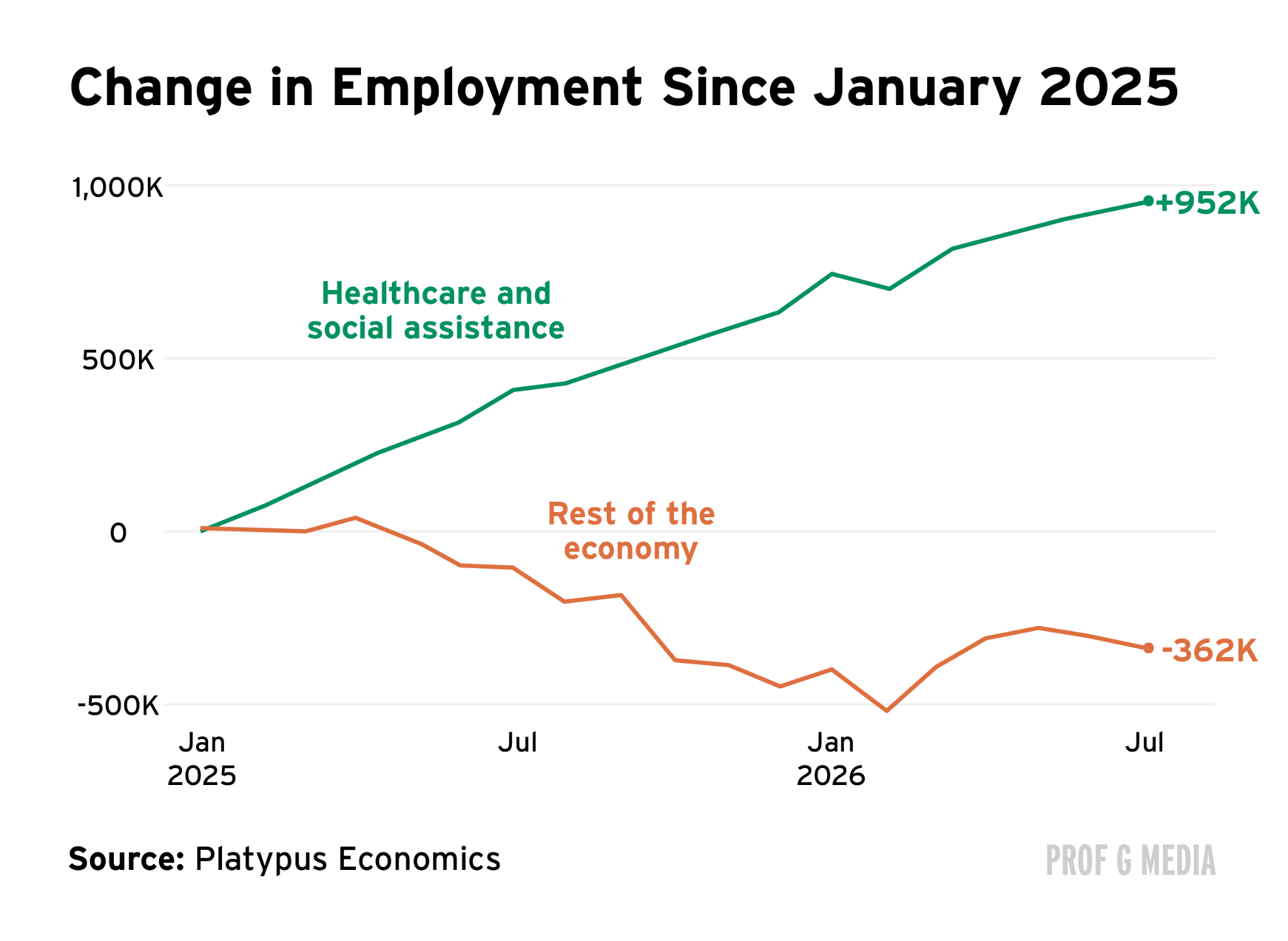
Industries that traditionally employ men, like professional services (law, engineering, architecture) have grown modestly this year, while those that employ men without college degrees, like manufacturing, warehousing, and transportation, have been on a steady decline.
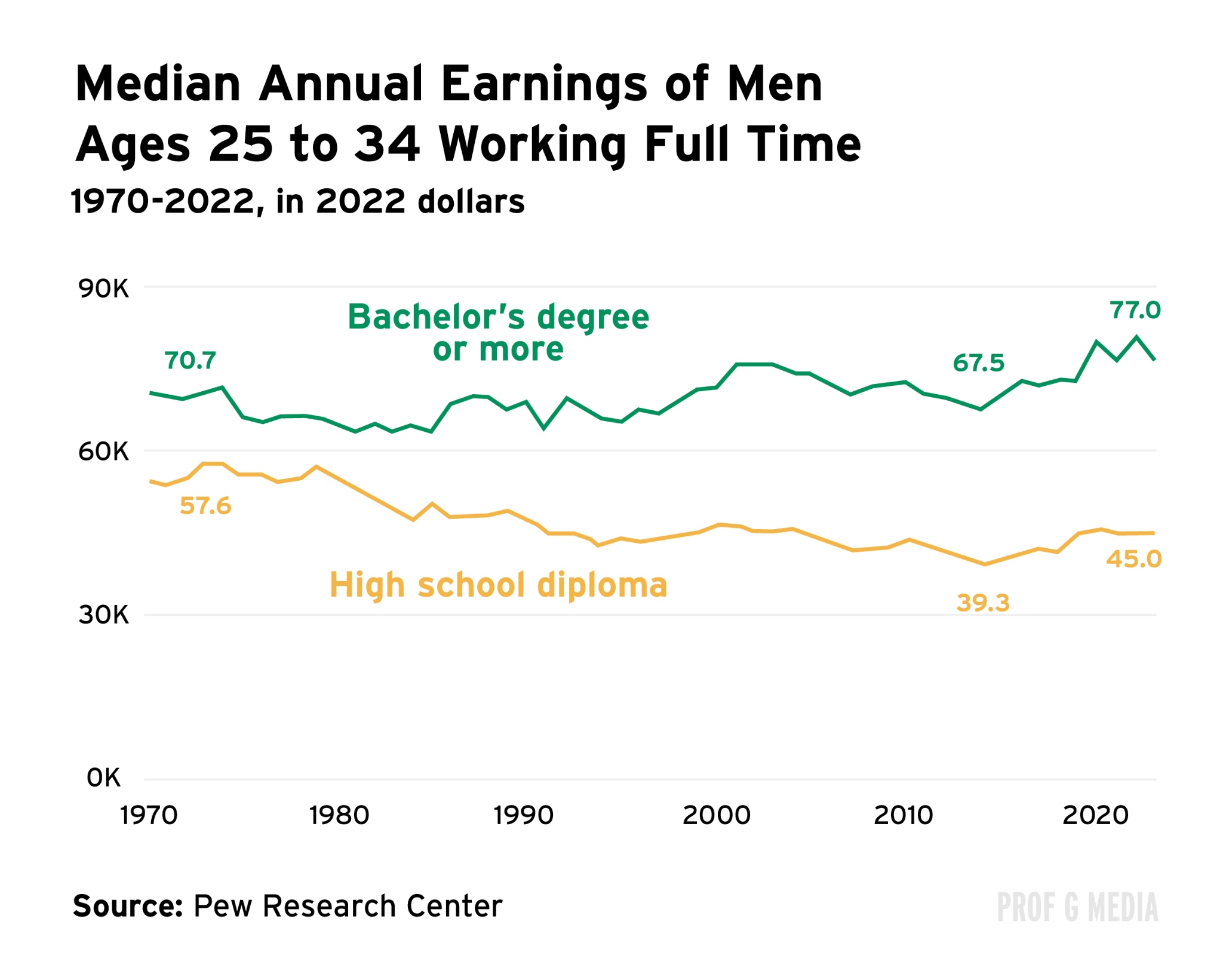
The net effect is that men who don’t attend college are falling even further behind. Men without college degrees now earn less, when adjusted for inflation, than they did in 1973, per the latest Pew Research data. Young women are earning more.
The Manosphere Distortion
Money plays a vital role in being a man, but it’s important to draw a distinction between zero-sum interpretations of masculinity and a more-grounded view of how money, gender, and partnership actually intersect.
Small but vocal online subcultures teach that money is the primary determinant of a man’s value — that status and “provider capacity” are all women look for. For unattractive men, money is the only reliable way to compensate for low attractiveness.
At the core of this thinking is the claim that women are primarily economic actors seeking security and lifestyle upgrades. They say marriage is an economic risk for men, and commitment is a financial trap.
Versions of its logic show up in commentary from well-known figures:
Andrew Tate: “Women want money and use ‘love’ to get it.”
Nick Fuentes: “[Women] expect so much from the men. They want the man to be rich and provide.”
Sneako: “All women are gold diggers.”

People in the black pill movement think women just want to use you for your money.
But the magic of money isn’t what it does in terms of your sexual currency. The magic of money is what it does to you as a potential partner.
It’s not that women want you because you have a Lamborghini. It’s that if you have money, it probably means that you are more self-actualized. You’re more confident. You believe in yourself. You’re more stable. You feel less like a victim.
I think women want a man who is mature and who can make them feel safe, and money turns out to be a pretty good indicator of those attributes.
The Reframe
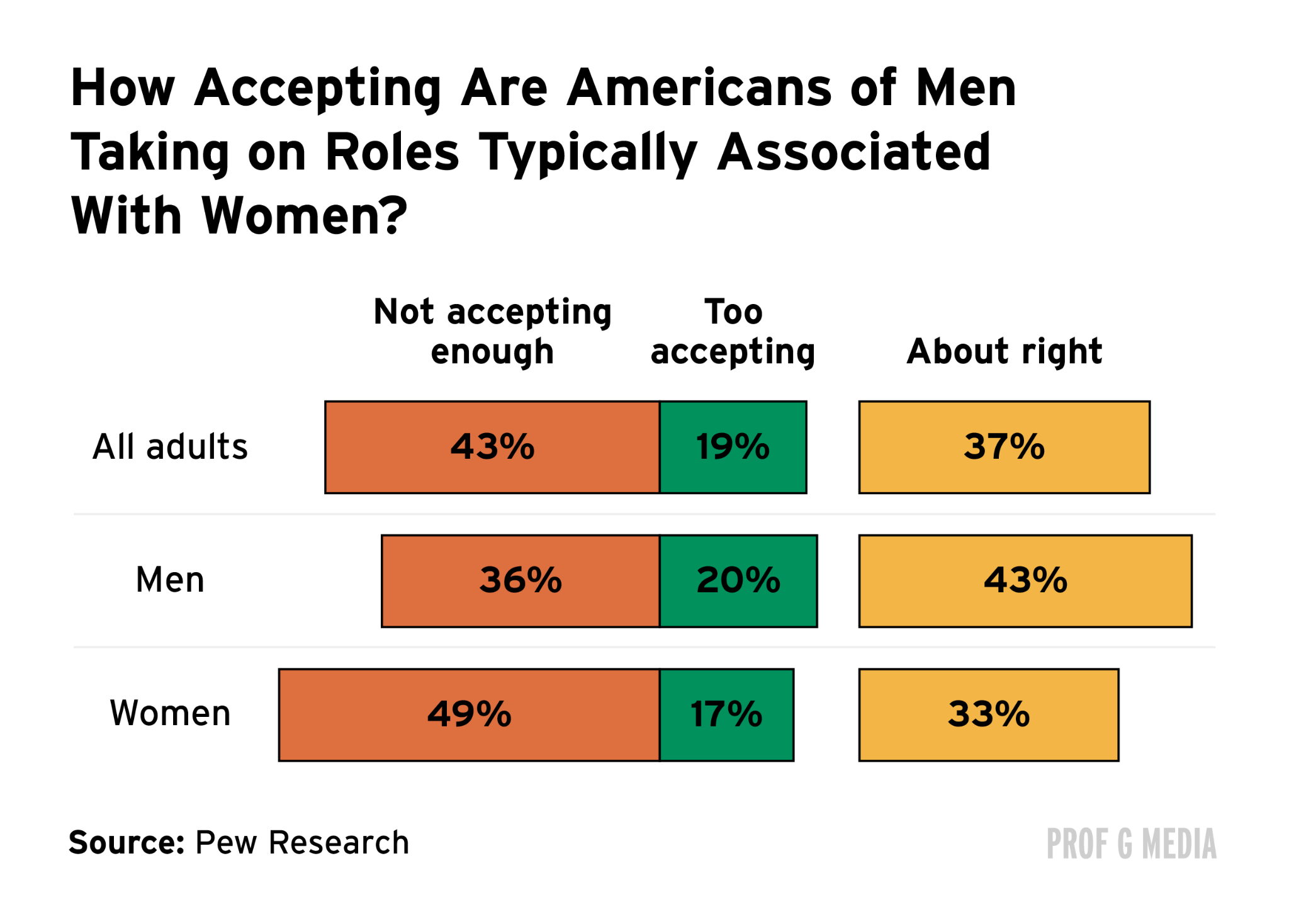
There is more than one way to be a provider. Emotional support and taking on additional household and childcare tasks can be just as valuable as monetary support. Does society judge these options differently? Yes — for now. But there are signs that this is changing. Dads now make up 16% of stay-at-home parents, up from just 10% in 1989, and a plurality of U.S. adults say that society should be more accepting of men who take on caregiving roles.
If I had to define an aspirational form of masculinity, it comes down to this notion that Richard Reeves, president of the American Institute for Boys and Men, taught me, and that is surplus value.
A lot of males go their whole life and never become men. In my view, the metric is not a religious ceremony or age or experiences or money. It’s: Do you create more value than you absorb?
Are you providing more comfort than’s been given to you? Are you providing more love and more care for other people than has been provided for you? Do you have the ability to really see people where they are, understand them? Are you a better father to your son than your father was to you?
Once you are adding surplus value, that’s when you become a man and a better human.
Solutions
How can we help young men who are struggling?
1. Expand male mentorship for boys growing up in single-parent homes. Positive male role models provide structure, accountability, and a vision of healthy masculinity that isn’t shaped by online extremists or grievance communities.
2. Put more economic power back into the hands of young people.
Universal childcare, a higher minimum wage, and breaking up Big Tech would create more jobs, reinvigorate upward mobility, and make it easier for young people to form partnerships and families.
3. Teach young men that they have more agency than they think. Young men cannot be victims. They should work on being kind, exercising, building skills, and taking risks. Stop outsourcing responsibility to conspiracies about women or immigrants. Granted, this is easier said than done — another reason why we need more aspirational male role models.

America has become an entrepreneur’s paradise
How sustainability fell out of fashion
The newest workout class: Prenups and pilates
Programming note: The Markets team is going on vacation. We’ll return to your inbox again in September.