



52%
of Americans ages 18 to 29 have gone through their partner’s phone without their knowledge.

Tesla and SpaceX are weighing a $3.5 trillion merger, very likely the biggest deal in corporate history.
Amazon spent billions on Nvidia chips and has nowhere to plug them in.

SpaceX Is Growing Fast. Tesla Isn’t. Why Merge Them?
Last week, Elon Musk’s two biggest companies delivered very different results. Tesla’s revenue was flat year over year, auto sales declined 3%, and operating margin fell to 2.6% from 5.8%. The stock slid 3% after reporting.
SpaceX, meanwhile, had a strong quarter. Revenue surged 161% year over year, profits beat expectations, and capital expenditures came in slightly below what investors had anticipated.
But the biggest story wasn’t in the numbers. Musk officially confirmed that special committees at Tesla and SpaceX are evaluating a potential merger between the two companies. The deal is likely to be the largest in corporate history, resulting in a combined company worth roughly $3.5 trillion. Investors are increasingly betting that it will happen. On Kalshi, the odds of a Tesla-SpaceX merger before 2028 have climbed to 75%.
There are synergies between the two firms. Tesla has the manufacturing capacity to develop physical assets that SpaceX needs, like batteries and data center satellites, and SpaceX has the data center infrastructure to power the AI behind XAI and Tesla’s self-driving cars.
Still, discussions about the merger are already fraught. That’s partly because SpaceX and Tesla are at two very different stages of the corporate life cycle. Though they were both founded in the early aughts (SpaceX in 2002, Tesla in 2003), SpaceX is growing at the pace of a startup, while Tesla has stagnated, dramatically underperforming the S&P 500 over the past five years.
The challenge of this mismatch is that SpaceX, being the larger company, would have to issue new shares equal to 92% of its current shares outstanding, thus diluting existing shareholders. Tesla shareholders would end up owning nearly half of the combined company, and with it nearly half of SpaceX’s future earnings.
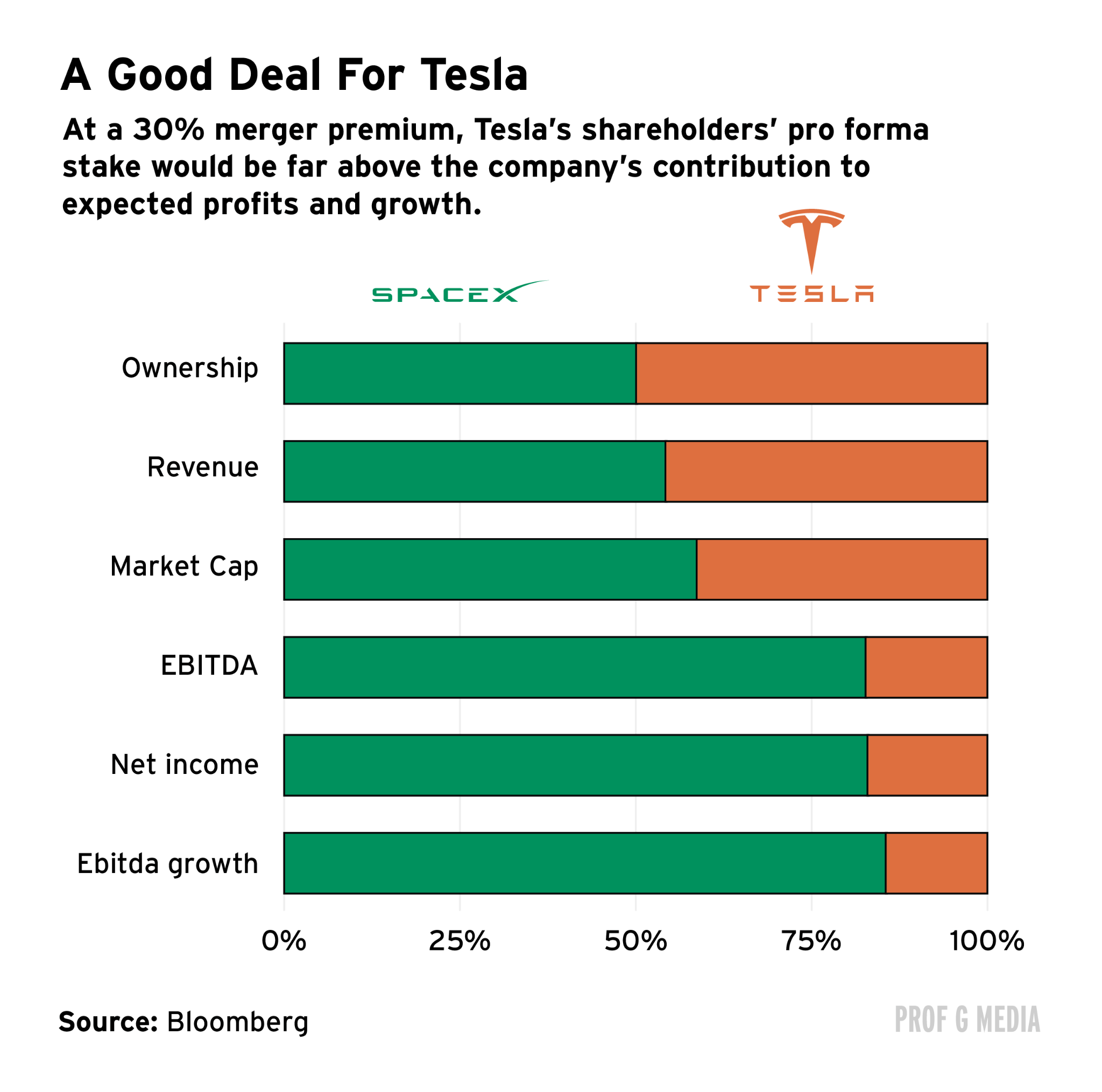
Musk has a track record of merging his companies when one starts to fail. In 2016, Tesla acquired struggling solar panel provider SolarCity (of which Musk was chairman and the biggest shareholder) in what investors alleged was a bailout, and in 2025, after roughly 50% of its advertising revenue disappeared, he merged X (FKA Twitter) with XAI.
There are also personal reasons why Musk might favor a combined company. Musk currently has 80% voting control at SpaceX but only 20% at Tesla. A merger would give him majority voting rights in the new entity. It would also boost his fortune. According to Bloomberg, combining the two companies could add $110 billion to Musk’s wealth by accelerating the vesting of Tesla shares that otherwise wouldn’t vest until 2028.

A brand is one part promise, one part performance.

This merger lets Musk hide Tesla’s problems inside SpaceX, and it could also sneak SpaceX into the S&P 500. I think of it as brand laundering. It’s also multiple laundering. Tesla trades at 14x sales. SpaceX trades at 87x sales. So the move is: Let’s put them both in the same bucket, and maybe people will stop asking why car deliveries are declining.
The S&P part is really what worries me. SpaceX can’t join the index today. Its float is too small, and it hasn’t traded publicly long enough. But there is an exception to S&P rules that would allow it: If a company outside the index buys a company inside it, and pays in stock. That’s exactly how this deal will work. JPMorgan estimates index inclusion would force passive buying equal to about 10% of the combined company’s free float. Every index fund investor will end up owning SpaceX whether they want it or not, and all that forced buying pushes the price even higher.
in partnership with

Financial clarity for your small business

Successfully running a small business means staying on top of every cost, all day long. But to do that, you need something more powerful than a spreadsheet. Xero is a small business accounting and financial management platform that makes managing business finances easier from day one. Accounting, payments, payroll and analytics are available in one connected platform. Reports, visual dashboards, forecasts and AI insights help owners better understand cash flow and make smarter decisions.

Amazon Is Buying Nvidia Chips Faster Than It Can Plug Them In
Amazon is buying Nvidia chips faster than it can use them. According to Business Insider (BI), Amazon is spending billions of dollars a month on Nvidia server racks and graphics processing units (GPUs) that it can’t immediately install. As a result, some of those racks are sitting in warehouses, waiting to be used. Amazon told BI that staging hardware near deployment sites is standard practice.
But this arrangement is new. Amazon used to take ownership of racks only once they reached a data center. Under a program it calls “Early Rack Receipt,” it now pays sooner. Amazon is spending cash on hardware that isn’t earning anything yet.
The data centers themselves are the problem. Goldman Sachs estimates only about half of planned data center capacity will come online in the next two years because of delays and cancellations. There are three main causes.
Local opposition
Americans don’t want data centers as neighbors. Seventy-one percent said they opposed building one in their area, which, for context, is only slightly lower than the share of Americans who opposed more strip clubs in their neighborhood (76%).
There are now nearly 900 data center opposition groups in the U.S., up from 396 at the end of 2025, and roughly $200 billion of data center investments have been delayed or canceled after local pushback.
Construction
Anyone who has renovated a home knows construction often runs late and over budget. Large developments are worse: In fact, 98% of major construction projects face delays or cost overruns or both. Just getting a permit to build a data center can take up to 18 months, and prices are increasing as the delays stack up. The average cost to build one square foot of data center capacity has increased 67% year over year.
Power
This is the biggest bottleneck. A data center can’t run until it connects to the grid, and the pipeline to get the necessary equipment is backed up for years. Power transformers take about three years to arrive in the U.S., and the average wait for a grid connection in the main data center markets is now more than four years. GE Vernova, one of the largest gas turbine makers, is selling delivery slots for 2031.
Microsoft’s exit from an Nscale project shows what this looks like. Microsoft had agreed to be the main customer for a 50-megawatt Nscale data center in Loughton, England, with 23,040 Nvidia GPUs. It was supposed to open early next year. Then the local grid operator said it couldn’t supply enough power until the 2030s, and Microsoft pulled out.
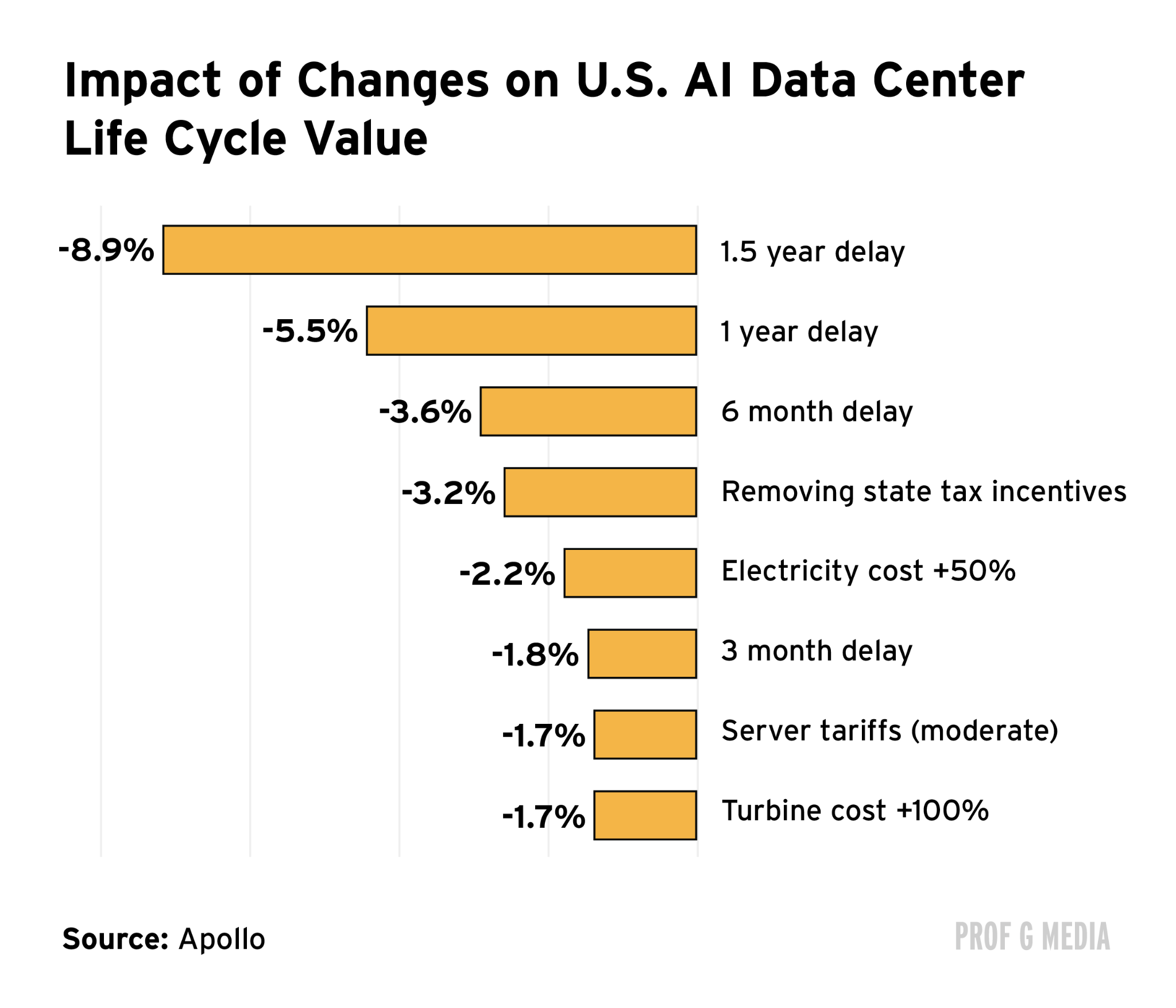
These delays are a problem for the neoclouds. They borrow heavily to buy GPUs and build data centers, and the interest on that debt comes due whether or not the chips are plugged in or customers stick around through delays. Investors have noticed, and Nebius, CoreWeave, and Cipher Digital are down 33%, 36%, and 56%, respectively, in the past month. Meanwhile, shares of Amazon, which is large enough to absorb the cost of chips sitting in a warehouse for a year, have declined only 2%.
Ed Zitron, CEO and founder of EZ Primary Research, predicted we’d see warehouses full of unused AI chips, and people called him crazy for it. Credit to him, because that’s exactly what happened.
Where I disagree with him is the idea that it’s some grand conspiracy cooked up by Jensen Huang to sell more chips than the system needed. They just thought they’d get the chips online, and they ran into delays, and now they have all these chips depreciating in a warehouse.
We’ve seen this before. Look at the railroads in 1873. Those companies didn’t go bankrupt because they were grifting their customers. They went bankrupt because they had mismatched durations. They laid down railways for traffic that did come, just not on time, and the ones that miscalculated their timelines and took on too much debt went out of business. Same thing here. A handful of the neoclouds are going to go out of business, and the market is already taking them to the woodshed.
I know exactly why Amazon bought chips it can’t use, because I did the same thing at Sizzler in college.

The biggest winner of the AI boom will be Meta. It already has relationships with 500 million businesses and 3 billion daily users, top AI models, the cash flow to pay for all of it, and I hate to admit it, but Mark Zuckerberg is the best operator in business right now.

Why we can’t stop reading stories about Mount Everest
How do Fed chairs allocate their time?
Apollo’s Torsten Slok: AI has delivered no financial payoff outside of tech