



26%
An experiment found that waitresses serving male customers earned as much as 26% more in tips when they wore red versus any other color.

Democrats swept Congress as voters punished Republicans for high prices.
Voters rejected data centers, and the AI trade took the hit.
Young voters swung toward Democrats and a younger generation of leaders.

The Midterms Were a Vote on the Cost of Living. Here’s What That Means for Markets.
A blue wave swept both the House and the Senate in a historic election last week. It was a resounding victory: The Democrats won the House by the biggest midterm popular-vote margin since Watergate and also flipped five governors’ seats — all in states that President Trump won in 2024.
Voters were angry about the rising cost of living, and they voted against the most prominent scapegoats: Trump’s war in Iran, which pushed up gas prices and inflation, and AI data centers, which they blamed for rising power bills. Americans also rallied for younger leaders, and elected a record 97 Gen Z and millennial politicians to the 120th Congress.
Stocks rallied on Wednesday after Trump accepted the results and said he would work with Democrats. The Dow Jones closed up 3% for its best day in more than a year, and the S&P 500 increased more than 1.5%.
But those gains disappeared on Thursday. The Nasdaq 100 sank 6.4%, erasing $2.3 trillion in value for its worst single-day loss on record. Chip stocks took a beating: The Philadelphia Semiconductor Index dropped 12%. For both indexes, it was the biggest one-day percentage drop since March 2020.
The market sank on investors’ concerns that a Democratic Congress could bring tougher regulation, and that new Democratic governors could delay data center construction in their states. Either would slow the AI buildout that has powered both the market and the economy.
Voters Rejected Data Centers, and the AI Trade Paid the Price
The midterms offered a glimpse into how Americans feel about AI — and it wasn’t good. Over 80% of both Republicans and Democrats supported candidates who favored AI safeguards, and in local referendums, voters overwhelmingly rejected data centers.
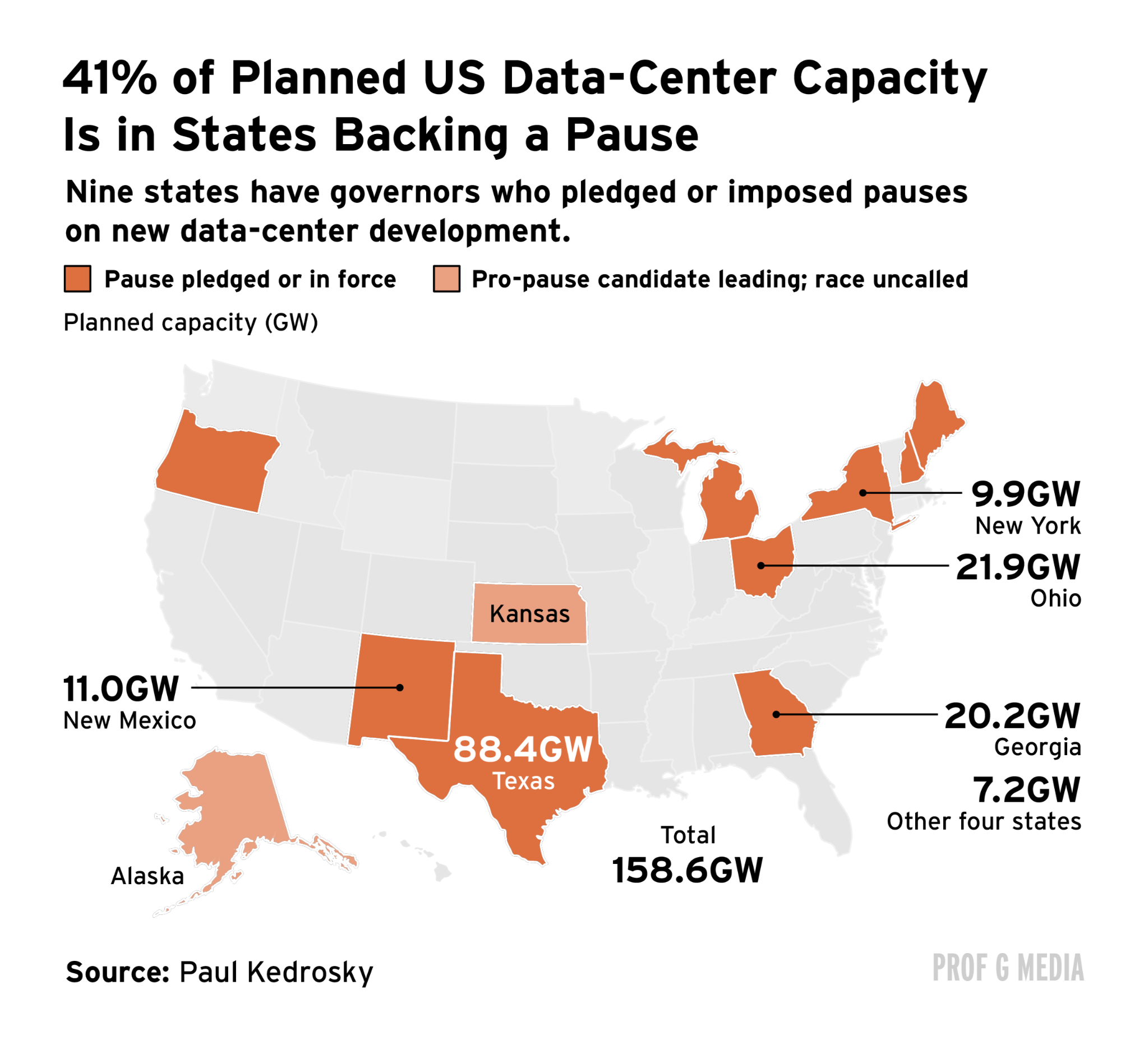
Of the 41 local ballot measures on data centers, 40 of them lost. And voters in the three states that account for more than 40% of all planned capacity in the U.S. — Ohio, Georgia, and Texas — all elected Democratic governors who campaigned on stopping or slowing data center development.
This most likely won’t stop the development of data centers, but it is likely to delay construction projects and make them more expensive.
Chip and AI infrastructure stocks most likely to be affected by these delays were hit hardest in Thursday’s rout. Chipmakers Western Digital and SanDisk fell 17% and 22%, respectively, Micron and AMD both declined more than 17%, and the neoclouds continued their descent into the red. CoreWeave, Nebius, and IREN have lost nearly 50% of their value in the past month.
The election wasn’t the only factor driving the decline. On Thursday, Bloomberg reported that Microsoft, one of the first Big Tech companies to rent capacity from the neoclouds, is stepping away from some data center projects from Nebius, IREN, and Nscale, and is debating whether to sign new contracts.
The sell-off hit the AI IPO pipeline too. On Kalshi, the odds that Anthropic goes public by December 1 briefly fell to 59% from nearly 90% earlier in the week. Bloomberg also reported that prospective IPO investors are valuing the company at $1.1 trillion to $1.3 trillion instead of the $2 trillion target that was discussed in early October.
Big Tech stocks declined last week too, but Amazon, Microsoft, and Alphabet ended the week in the green. While AI regulation could pose challenges, data center delays might be accretive for the hyperscalers. They account for 48% of global data center capacity. If new construction slows, the capacity they already have becomes more valuable.

The most important thing for the markets coming out of this election was

Data centers are the worst-managed brand in America. They’ve become the empty vessel for income inequality. People are angry at the tech billionaires, and the one way they can vote against them is to vote against data centers. OpenAI is now trying to rebrand by calling them “compute campuses,” but that won’t work. It’s like calling a landfill a “legacy materials park.”

Voters Blamed the Iran War for Higher Prices
Trump told voters to pretend he was on the ballot in the midterms 63 times before Election Day, including more than 50 times in October and early November, according to The Washington Post. Many voters did, and it didn’t go his way.
As the results came in, Trump changed the narrative.

The president’s decision to go to war with Iran may have cost the Republicans the election. Nearly three-quarters of Americans called the war a crucial or major factor in their vote, and that group backed Democrats 62% compared with 35% backing Republicans.
Even Vice President JD Vance blamed the Iran war for the GOP’s losses the day after the election.
Markets took that as a sign the conflict could end sooner. The price of crude oil retreated 13%, and the U.S. aerospace and defense ETF fell 1% last week.
But Democrats can’t end the war on their own. Senate Democratic Leader Chuck Schumer has pointed to Congress’ control over spending as a way to stop it, but Democrats lack a veto-proof majority in either chamber.
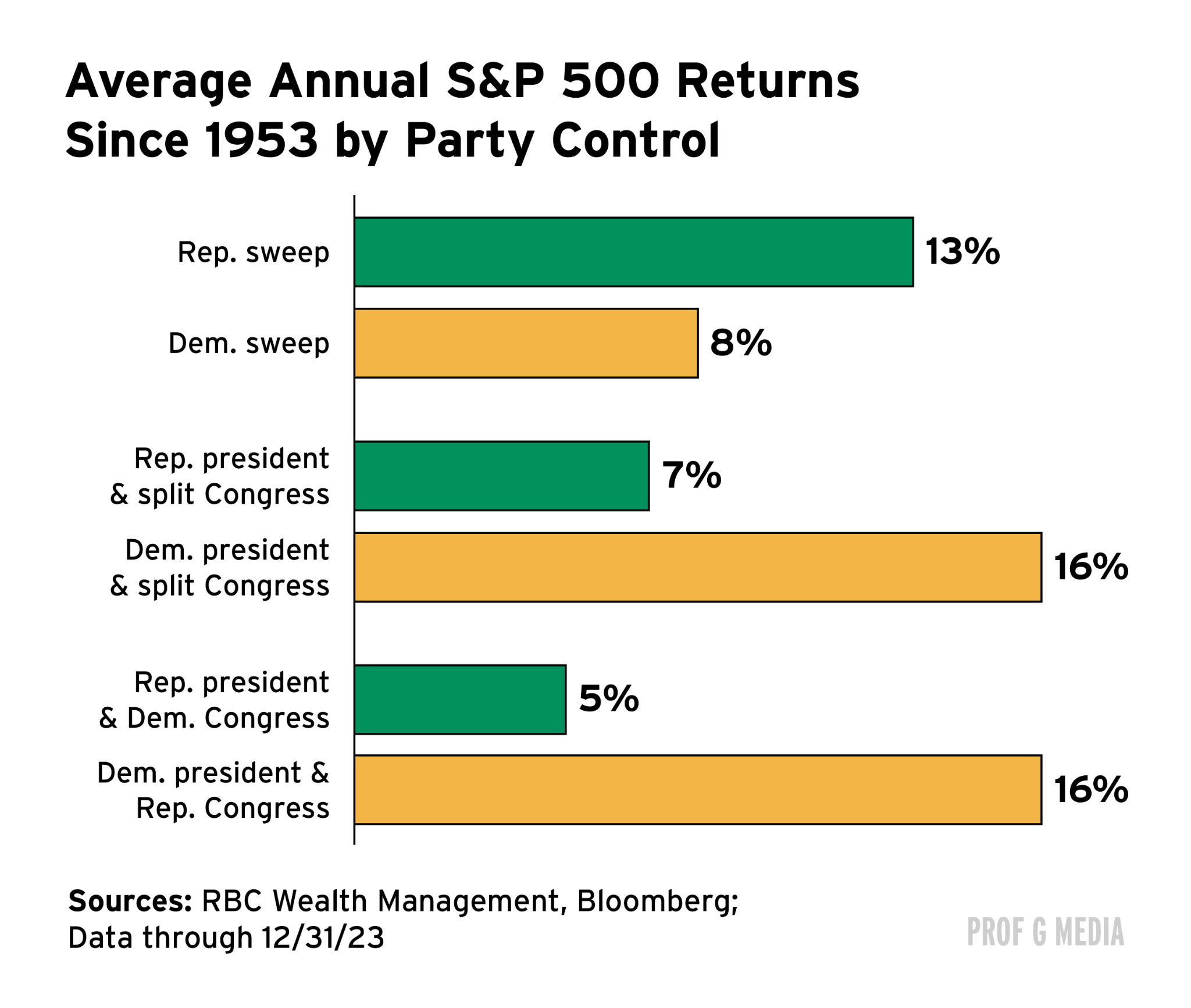
The more likely result is gridlock, and that has historically been bad for stocks. Since 1953, a Republican president with a Democratic Congress has produced the weakest average S&P 500 returns of any combination of party control, according to RBC.
Real Diversification Isn’t What You Think

Do you know how concentrated your public stock fund actually is?
A handful of mega-cap stocks with an AI story are doing most of the work - that’s not real diversification, especially as so much value creation now happens before companies ever go public.
Alumni Ventures, ranked a Top U.S. venture firm by TIME and CB Insights, gives accredited investors a way to diversify into venture-stage and late-stage private companies, co-investing alongside firms like a16z, Sequoia, and Bessemer.

Young Voters Elected a New Generation of Leaders
Young Americans helped get Trump elected two years ago, but voted overwhelmingly for Democrats in the midterms. Democratic support from men under 30 increased to 59% in 2026 from 51% in 2024, and among young women, it rose to 70% from 61%.
Cost of living concerns were top of mind for the Gen Z electorate. In Harvard’s fall Youth Poll, 91% of young voters called the cost of living important to their vote, more than any other issue.
Affordability has become the defining issue because Trump and the Republican Party promised to fix it but failed to deliver. At an August 2024 rally, Trump said: “Starting on day one, we will end inflation and make America affordable again.”
Instead, inflation rose from 3.0% when he took office to 3.7% in September, erasing all real wage gains for Americans, and workers now take home 52.8% of what the economy produces, the lowest share since the government started tracking it in 1947.
Trump’s go-to economic talking point does little for young people. He regularly points to record stock market highs as proof the economy is working, but young people own a relatively small share of the market. Millennials and Gen Z hold 9.3% of U.S. stocks and mutual funds, while baby boomers hold 54.5%.
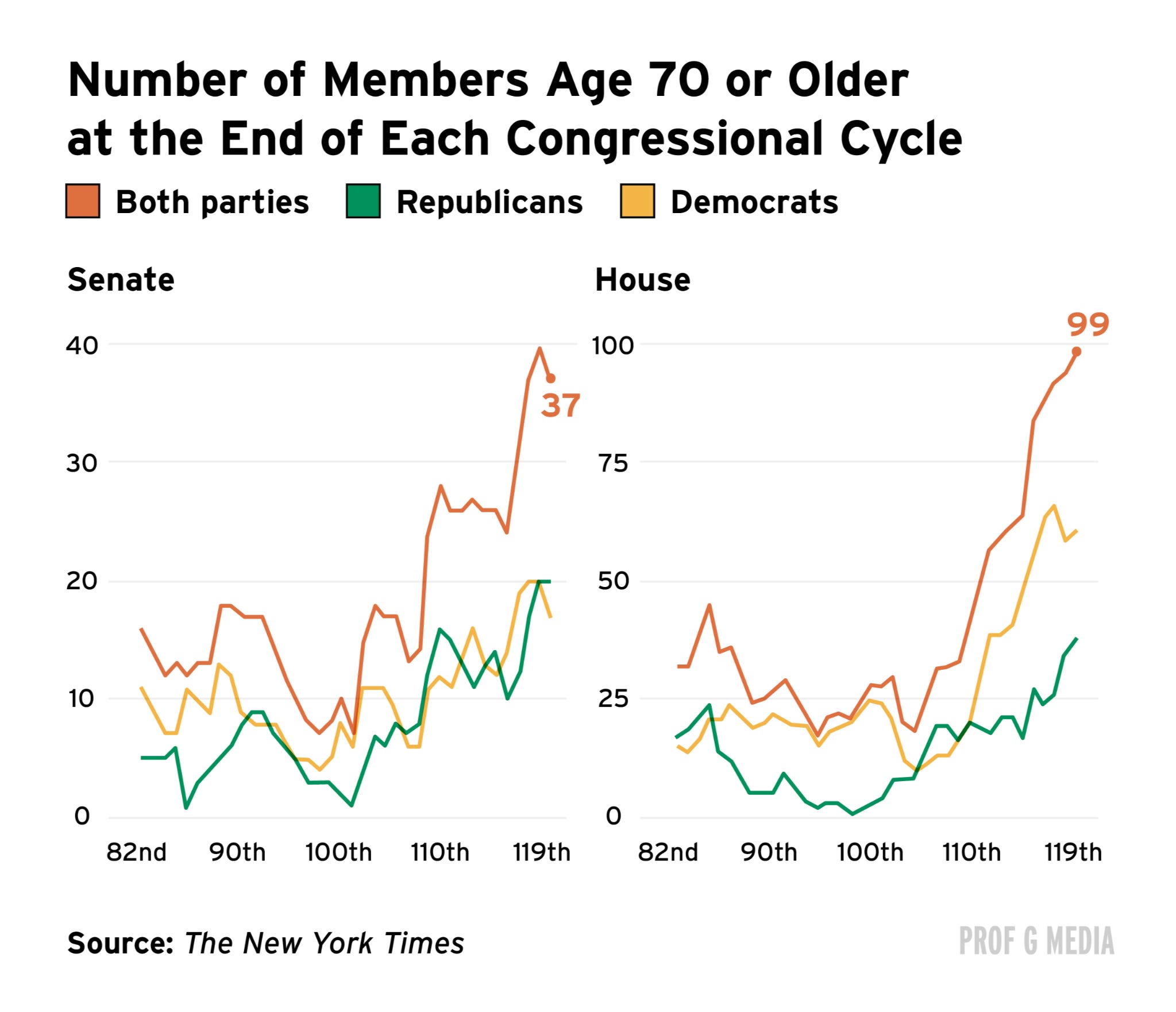
Young voters want a new generation of leadership. In Harvard’s spring Youth Poll, they said the ideal age for a congressional candidate is 39. The average member of the 119th Congress was nearly 59 when it began, and in a CNN poll this summer, nearly 6 in 10 Americans called it a “major problem” that a quarter of Congress is over 70.
That frustration showed up on the ballot. More than a third of this year’s congressional candidates were under 45, and for the first time, millennials were the largest generation running for the Senate.
Everything we’ve been calling for finally happened. Young people showed up, young candidates ran, and a lot of them won.
Young men liked Trump because he was kind of a bro. He went on podcasts, and it was funny for a while. But the half-life on that was a couple of months. Then they realized they’d been lied to.
Now I want to see Democrats take generational inequality seriously, and come up with some real policies to try and fix it. That could mean equalizing the tax rates on income and capital gains, or means-testing Social Security. Those are tough conversations. But if Democrats say they care about young people and then do nothing, young people will turn on them, too.
The people most likely to swing are young men, and look what’s happened to them.

We are about to enter the era of sensible AI regulation.

How a brain injury made a middle school teacher a musical genius
Elon Musk wants to give stock to kids. What’s the problem?
How CrossFit helped shape the macho fitness culture of Trump’s America
in partnership with
