


Right now, outside the National Assembly in Yeouido, on the western side of Seoul, lies a giant pile of funeral wreaths. Stacked high in white and yellow arrangements, they appear at first to commemorate the loss of lives. As you get closer, however, you see the signage next to them. “Abolish single-stock leveraged ETFs,” they read. The memorial isn’t for people, but savings accounts.
Last week, two trillion dollars in market value was erased from the South Korean stock market. The KOSPI (South Korea’s version of the S&P 500) crashed more than 40% in a matter of weeks. More than 1.2 million South Korean investors received margin calls, and nearly 400,000 saw their accounts liquidated. It was the nation’s worst stock market crash since the Great Financial Crisis.
Inside the National Assembly building, chaos ensued. Staffers scrambled as the president’s approval rating sank to its lowest level ever. Meanwhile, the Finance Minister issued profuse apologies as the stock exchange halted trading and the Health Ministry announced a suicide response office. The final week of July will go down in South Korean history as one of the darkest hours ever.
How did this happen, and what can we learn from it? Today I’ll share five lessons I took away from the South Korean crisis. Don’t stop reading, as I saved the most important for last.
Lesson #1: Too Much Concentration Is Dangerous
The simple explanation for what happened is that the South Korean stock market became too dependent on too few companies. Or, more specifically, two companies: Samsung and SK Hynix. Both produce (yes) AI chips. At the end of 2023, the two chipmakers made up an uneasy 22% of the nation’s entire stock market. Today, they account for … more than half. No market is less diversified than South Korea’s.
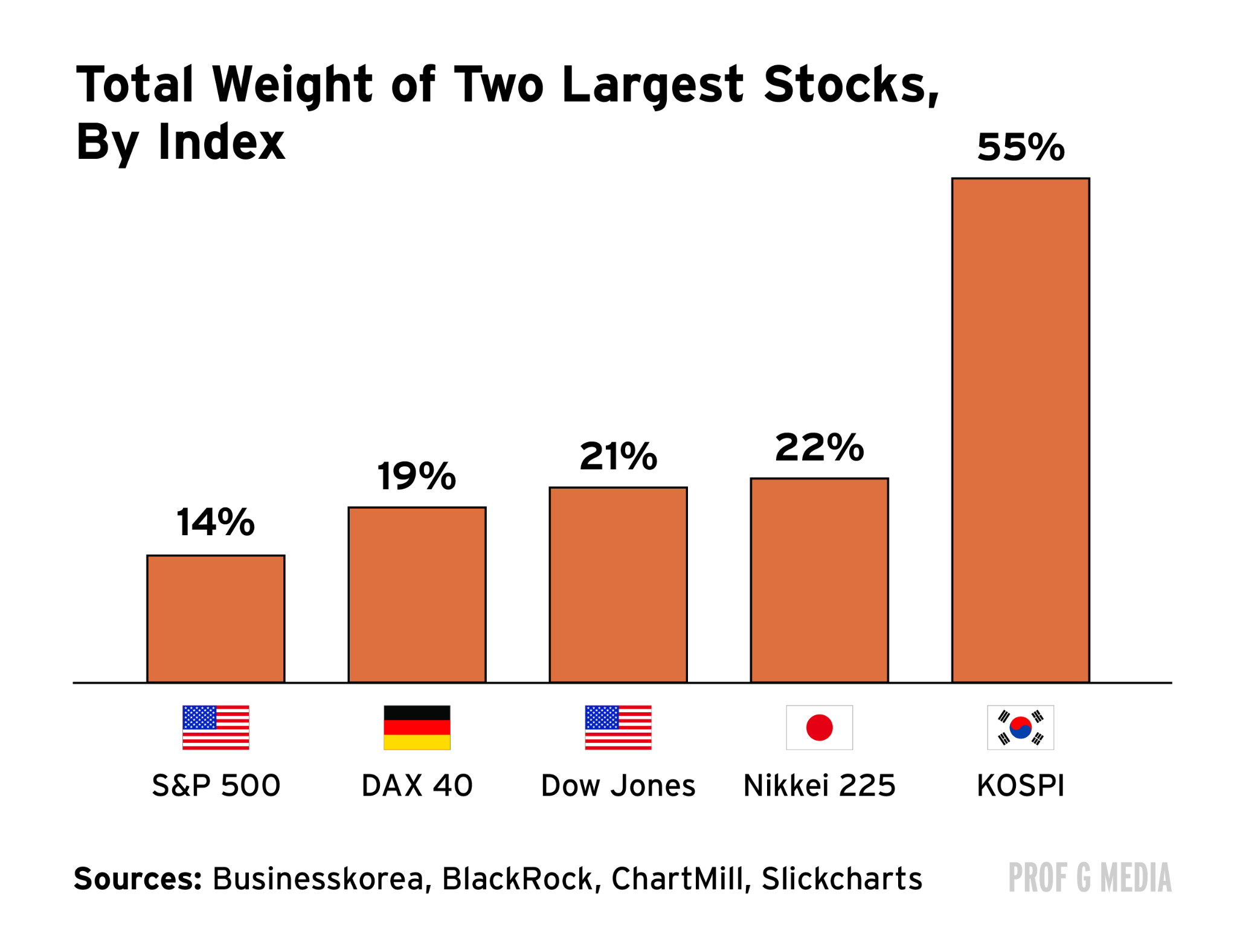
Highly concentrated bets can yield both phenomenal returns and ruinous losses. This is the story of South Korea. In the first half of the year (when the AI trade was hot), the KOSPI doubled in value. But as soon as the narrative lost steam (due to revelations of unsustainable debt and circular financing), it got cut in half. This is why diversification is so important — it’s insurance against anything going wrong.
Lesson #2: Beware of Leverage
If concentration was the match that started the fire, leverage was the gasoline that fueled it.
What actually is leverage? It means taking on debt to amplify your investment returns. It can be useful as a hedging strategy, but requires caution as it also amplifies your losses. An example of when you shouldn’t use leverage: Going all in on a highly-concentrated bet with significant downside risk — i.e., exactly what Leopold Aschenbrenner did last week before his fund blew up.
This is where South Korea comes in. In addition to over-concentrating themselves into two names, the nation also levered itself to the hilt. By the summer of this year, nearly forty trillion won’s worth of margin debt had accumulated in investors’ loan balances — the highest number ever.
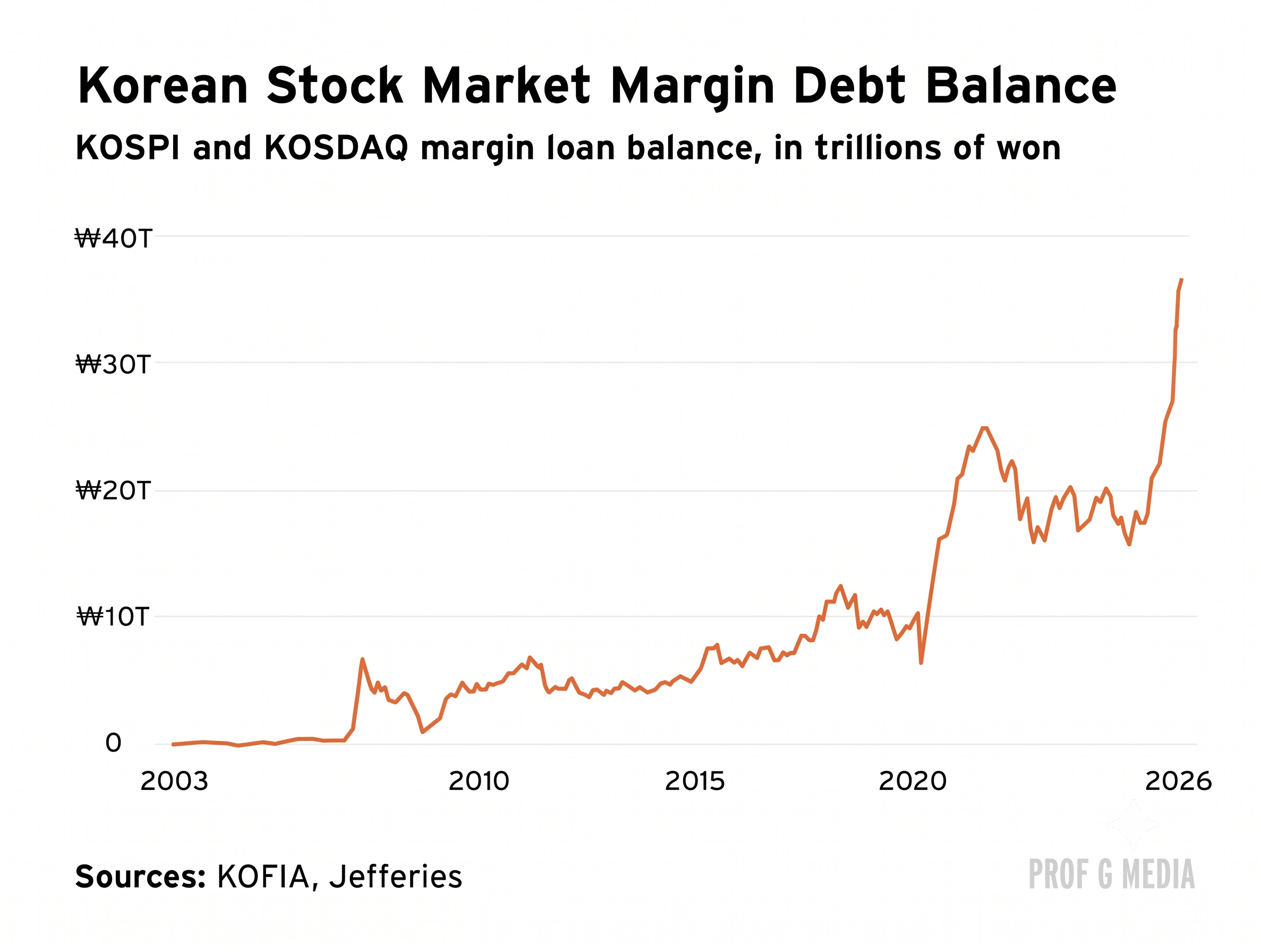
How did this happen? The boom was largely fueled by the arrival of a hot new financial instrument known as the single-stock leveraged ETF. These funds allowed investors to lever up their investments in individual companies like Samsung and SK Hynix by two, three, even five hundred percent. Once the ETFs received regulatory approval in April, retail investors began pouring into them to the tune of billions of dollars. By late June, they accounted for more than 70% of all trading value in the KOSPI index. The higher Samsung and SK Hynix climbed, the louder the party got. Soon enough there were nearly 110 million active stock trading accounts in South Korea — two for every citizen. The market was no longer a market, but a betting house.
When the chip stocks went down, the party turned into a bloodbath. What should have been a violent downswing was made lethal by leverage. Retail investors lost an estimated $39 billion on leveraged ETFs. More than 3% of South Korean adults received a margin call. On brokerage chat rooms, one investor asked when they might “get out of this hell.” Another put it more bluntly: “My life’s screwed.”
Lesson #3: Regulation Is Critical
The sign at the National Assembly said it all: Regulators should never have let these leveraged ETFs run as wild as they did. Soon after the crash, South Korea’s Chair of the Financial Services Commission admitted they’d “fallen short” on regulation. One Parliament member called the leveraged ETFs a “man-made disaster.” Another said the country had “turned into a casino.” They’re all correct.
Is the answer to abolish these products? Probably not. As with alcohol, leverage can be used responsibly. But stronger guard-rails should clearly be put in place. Examples could include stricter leverage caps, higher deposit requirements, and stronger exposure restrictions. Anything, really.
Lesson #4: Loneliness Is Fatal
There’s a deeper question we must ask ourselves: What kind of person would put their life savings into a 3X-levered Samsung ETF? Answer: the same person who’d do it in America — a broke and lonely young person.
It’s not a coincidence that more than 60% of the accounts that got wiped last week belonged to investors in their 20s and 30s. It’s also not a coincidence that investor debt among South Koreans in their 20s more than doubled in a single year. From rising housing prices to general inflation, young people in South Korea are struggling, and many feel levering up on AI stocks is their only ticket to financial security.
That’s the rational reason they did it, but the other reason is more upsetting. Like drugs, day-trading is an addictive substance — and it’s particularly dangerous for people who lack purpose and have little to do. That describes a disproportionately large share of young people in South Korea, of whom 5% are, according to the national government, in a state of “extreme social withdrawal” — out of school, out of work, and out of contact.
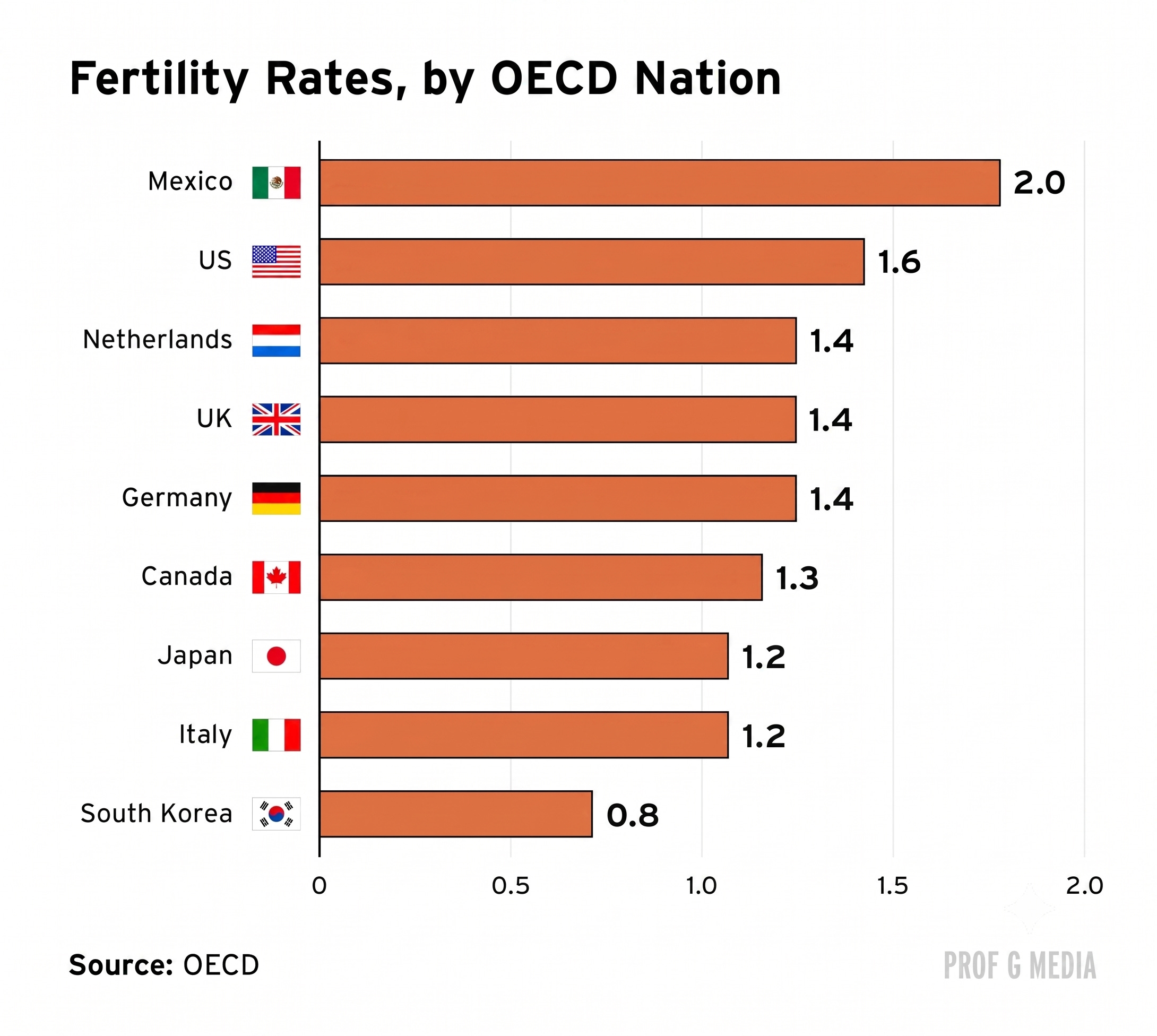
In fact, South Korea’s loneliness epidemic has gotten so bad that it’s now altering the demographic trajectory of the country. Marriages fell 40% between 2013 and 2023, and fertility rates have plummeted to 0.75, the lowest of any OECD nation by far. The population is in such a fierce spiral of decline that local governments are now resorting to paying people to get married.
These statistics are made even darker once you realize what drives them. Among the top decile of Korean male earners ages 26 to 30, roughly a third have gotten married or moved in with a partner. In the bottom decile, that number is 8%. As romantic partnership becomes a luxury item, it’s quite possible that many young men in South Korea believe the only way to get a girlfriend is to become rich overnight.
Lesson #5: It Could Just As Easily Happen Here
South Korea is a warning to the rest of the world. It is the inevitable result of what happens when a lonely and unequal society is sold an endless supply of ever more exotic financial products with little to no regulation or oversight. If that also sounds like the U.S. to you, it is.
U.S. leveraged ETF assets hit a record AUM of nearly $200 billion this summer, and average daily volume is up 50%. Of the more than 1,000 ETFs launched in America this year, nearly a quarter have been leveraged single-stock funds. We are careening down a collision course to a KOSPI-like event — only ours will (due to our size) be bigger and more painful.
The obvious solution is to regulate. Regulate the leverage, the listings, and the exposure. Instead, we’re taking the opposite approach. The SEC has been gutted, index funds have been hijacked, and insider trading has been, in essence, legalized. If ever there was a time when reckless financial speculation was encouraged, it is now. The president has told us quite plainly that the best way to make money in 2026 is to cheat.
Many will try to play the game, and many will lose — and, as with crypto, those will be the stories you don’t hear. The cautionary tale has already unfolded, right before our eyes, halfway around the world. Where it’s headed next is anyone’s guess.
See you next week,
Ed
I am so appreciative of your and Scott's "mission" of enlightenment. When the world we live in IS a casino, it's 'dear leader' being the central casting MC, there is a devotion to get-rich-quick, and why not, when young people see the Kardashians' glory and Trump's meteoric rise from a Reality Show Bimbo to the president of the United States.... We are a country addicted to schemes because traditional opportunities and values have grown thin - or the patience of the striver has.
I am sharing your and Scott's pages to my son, an ambitious, hardworking young man, who sees with both eyes. I want the right example of advisors to be within his grasp and attention.
Thanks, Ed, and thanks, Scott.
Like your link at the top with a funeral arrangement, Ed, because financial crises are a bit like deaths, aren’t they? We know they happen but we somehow convince ourselves that they don’t happen to us! As if it’s a tragedy that only happens elsewhere. The attitude - understandable, to a degree - makes it all the more shocking when the crisis arrives.