


We’ve been played, again.
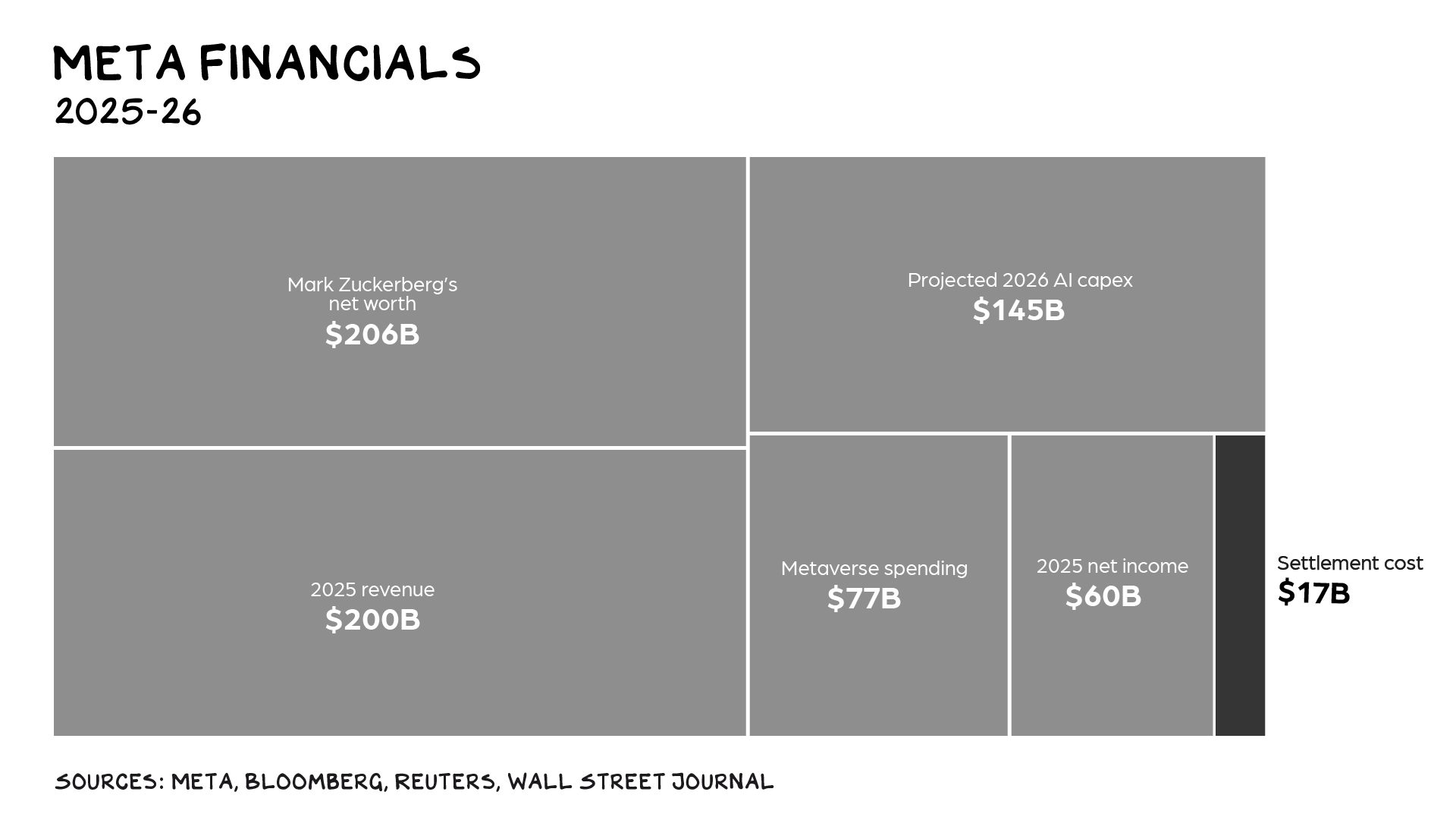
Last week, 47 states and the District of Columbia settled with Meta, resolving claims that the company had designed addictive algorithms targeting minors, violated youth privacy, and endangered children. The company didn’t admit any wrongdoing, but it agreed to pay up to $17.1 billion in penalties and make changes to its products. (Texas settled separately on the same day for $1 billion and similar terms.) The markets shrugged off the settlements, however, with Meta’s shares rising 1% on the news. For those keeping score at home, a 1% increase in market cap on a $1.4 trillion company means the settlements — breaking the fever of uncertainty — paid for themselves.
I often call Meta the Big Tobacco of the attention economy. Tobacco destroys individual lungs and pollutes the immediate airspace; Meta’s cancer metastasizes across our entire society. The conventional wisdom says this settlement is Meta’s “Big Tobacco moment.” Finally, justice. Bullshit. This is the Meta knife, thrust a foot deep into the West’s corpus, pulled out a centimeter.
The Good, the Bad, and the Ugly
Let’s start on a positive note. A bipartisan group of state attorneys general took action against a harmful organization run by amoral people. Disgusted by the company’s scant regard for child safety — but evidencing some measure of self-awareness — one Meta employee acidly noted, “Targeting 11-year-olds feels like tobacco companies a couple decades ago.” Others likened their products to drugs and themselves to drug dealers. It’s great that state AGs acted. But that it fell to them shows just how feckless Washington is.
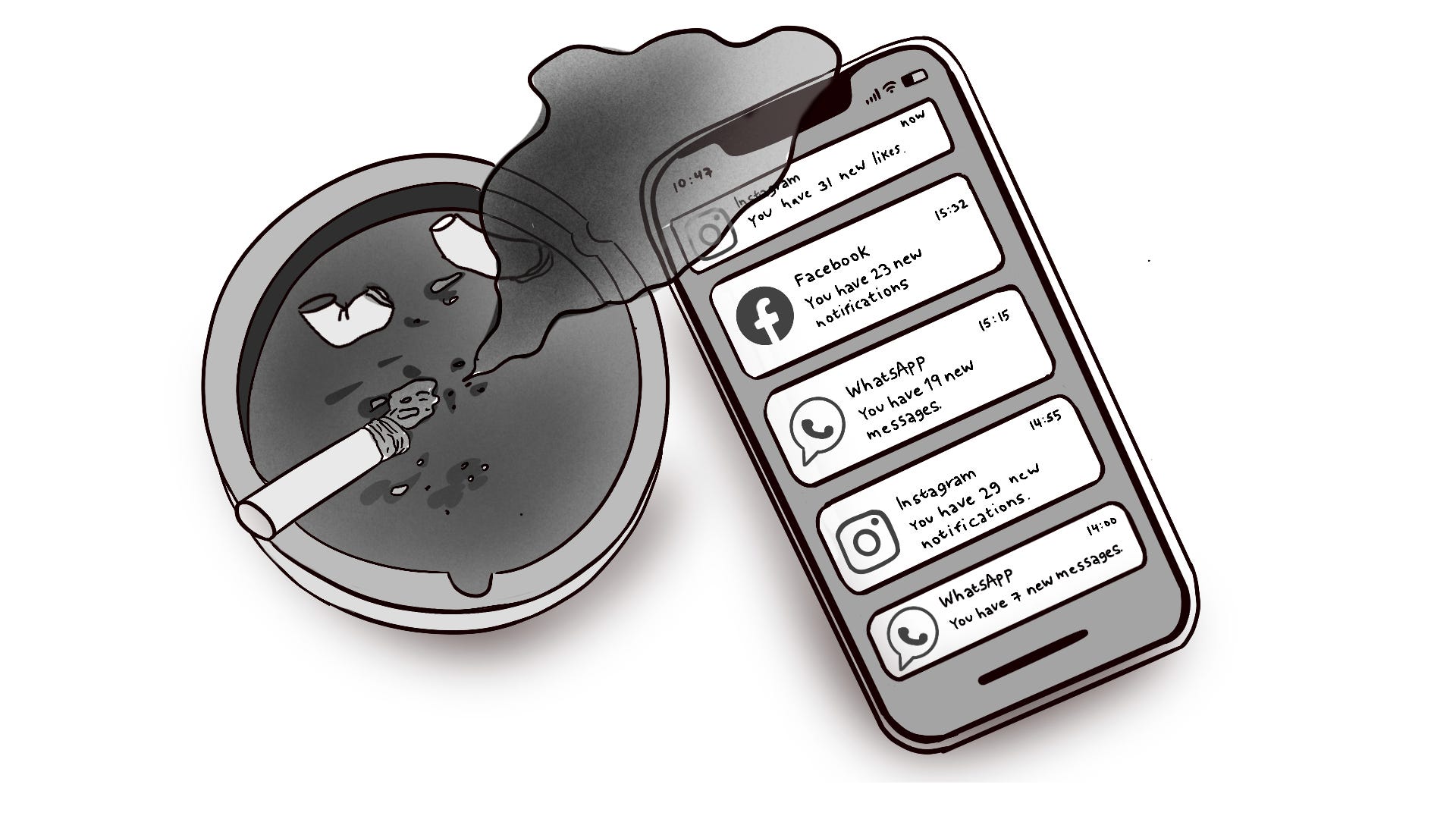
The settlement calls for changes to Meta products, though Meta began introducing some of those changes last year and simply agreed to follow its own roadmap. The changes include limiting teens to two hours of scrolling per day, unless their parents say otherwise; barring usage between midnight and 6 a.m; and turning off notifications during school hours. That’s telling your kids they can only light up after class and not between midnight and 6 am. Teens can also turn off “autoplay” and switch their settings from the “for you” style algorithmic feed to a chronological one. Meta promised to disable counting on the Like button and ban “extreme makeup filters,” which will supposedly throttle back teen anxiety, depression, and body image issues. Meta said it would strengthen protections against “unwanted contact from strangers” — a weird thing to have ever opposed, as the absence of such safeguards was a gift to child predators. Lastly, Meta promised to invest in age verification, though responsible corporate citizens already do this.
What the settlement doesn’t do is change Meta’s design priorities. As my friend and colleague Jonathan Haidt, an NYU social psychologist, noted, the settlement leaves many of the most harmful features untouched, including the algorithm: “Meta’s AI-powered recommendation engine is still running, engineered to maximize young people’s engagement even with content that harms them.”
The ugliest part of the settlement: It makes Meta stronger. First, the company can weaponize compliance, digging a moat against new entrants. Second, by conditioning additional safeguards and $5 billion of the fine on YouTube and TikTok agreeing to similar terms, Meta has turned its competitors into corporate shields. Maison Zuckerberg even launched an ad campaign to pressure YouTube and TikTok and position itself as the leader on child safety. If laddering is highlighting your brand’s strengths while de-positioning a competitor and illuminating their weaknesses — the way I use the term in my Brand Strategy course at Stern — Meta’s settlement is a roundhouse kick knocking the feet out from under its rivals. (Fun fact: Don Draper deployed laddering to weaponize government regulation to Lucky Strike’s advantage in the pilot episode of Mad Men.) Meta’s behavior is far worse and its reach far greater than those of its competitors … but sure, they’re all the same.
Speeding Ticket
Mark Zuckerberg coined the phrase “move fast and break things” in 2012 to describe the culture of innovation he built at Facebook (now Meta). More than a decade later, it’s clear that by things he meant us. Fines are supposed to be a financial deterrent against future breakage. Seventeen billion dollars is real money, but applied to an enterprise of Meta’s scale, it’s a speeding ticket.
Imagine if I told my Prof G Media team to create an addictive product that’s always in your ears, inspires five-plus hours a day of doomscrolling, leverages network effects and addictive design to lock in users, renders them depressed and anxious, and envelops society in a toxic fog of rage and polarization. Some Prof G Media employees would likely blow the whistle. But imagine if I responded by deploying publicists and lobbyists to smear them, conceal our culpability, promise to do better, and engineer legislative paralysis such that Prof G Media operated with impunity. How big would the fine have to be to deter my behavior? Prof G Media generates $20 million in annual revenue, with an operating margin of 60%. Meta’s 2025 revenue was $200 billion, with an operating margin of 41%. Its market cap is $1.4 trillion. A $17 billion fine, scaled down to Prof G Media and spread out over 10 years, would equal a $256,000 annual hit to our operating profit. That’s not a deterrent, but a green light to move faster and break more things.
Big Tobacco Moment?
The 1998 Tobacco Master Settlement Agreement levied a fine of $206 billion ($422 billion adjusted for inflation), payable over 25 years, against the four largest cigarette makers. Two of those companies, Philip Morris (now Altria) and R. J. Reynolds, are still selling cancer sticks. (The other two, Brown & Williamson and Lorillard, are now owned by R. J. Reynolds: Regulatory friction catalyzes consolidation.) Since 1998, federal taxes on cigarettes have increased fourfold, while state taxes, on average, have increased by 6x. Smoking rates among adults dropped 73% between 1965 and 2022, and rates for teens fell by 86% from 1997 to 2021. But the tobacco companies didn’t stand still, they innovated. In 2019, 1 in 3 American teens reported using e-cigarettes, which are taxed at lower rates than the analog version. The numbers have fallen, thanks to some states banning flavored e-cigs, but curbing the negative externalities of tobacco is a game of whack-a-mole. As Stanford historian Robert Proctor told The New York Times, “Today is not the beginning of the end for social media, any more than 1998 was the beginning of the end of Big Tobacco. Americans still smoke more than 170 billion cigarettes every year, and inhale tons of additional nicotine from ‘electronic’ variants.” The picture is even grimmer if you widen the lens. Globally, 1 out of every 5 adults is a customer, and 80% of them live in low- and middle-income countries. This is by design, as tobacco companies pivoted to developing nations, with a continued emphasis on targeting young customers. Big Tobacco is still … killing it (i.e., others).
Age-Gating
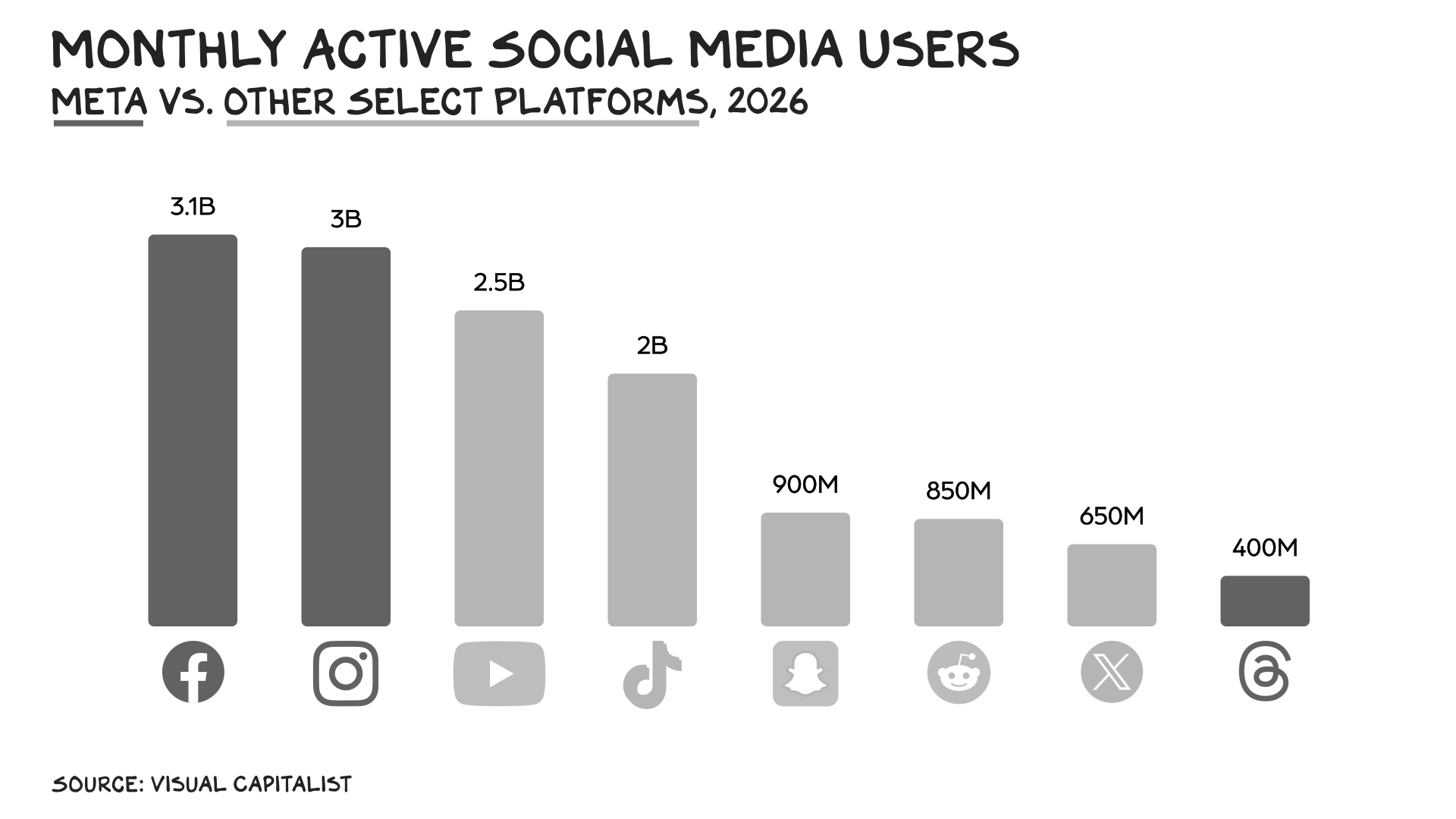
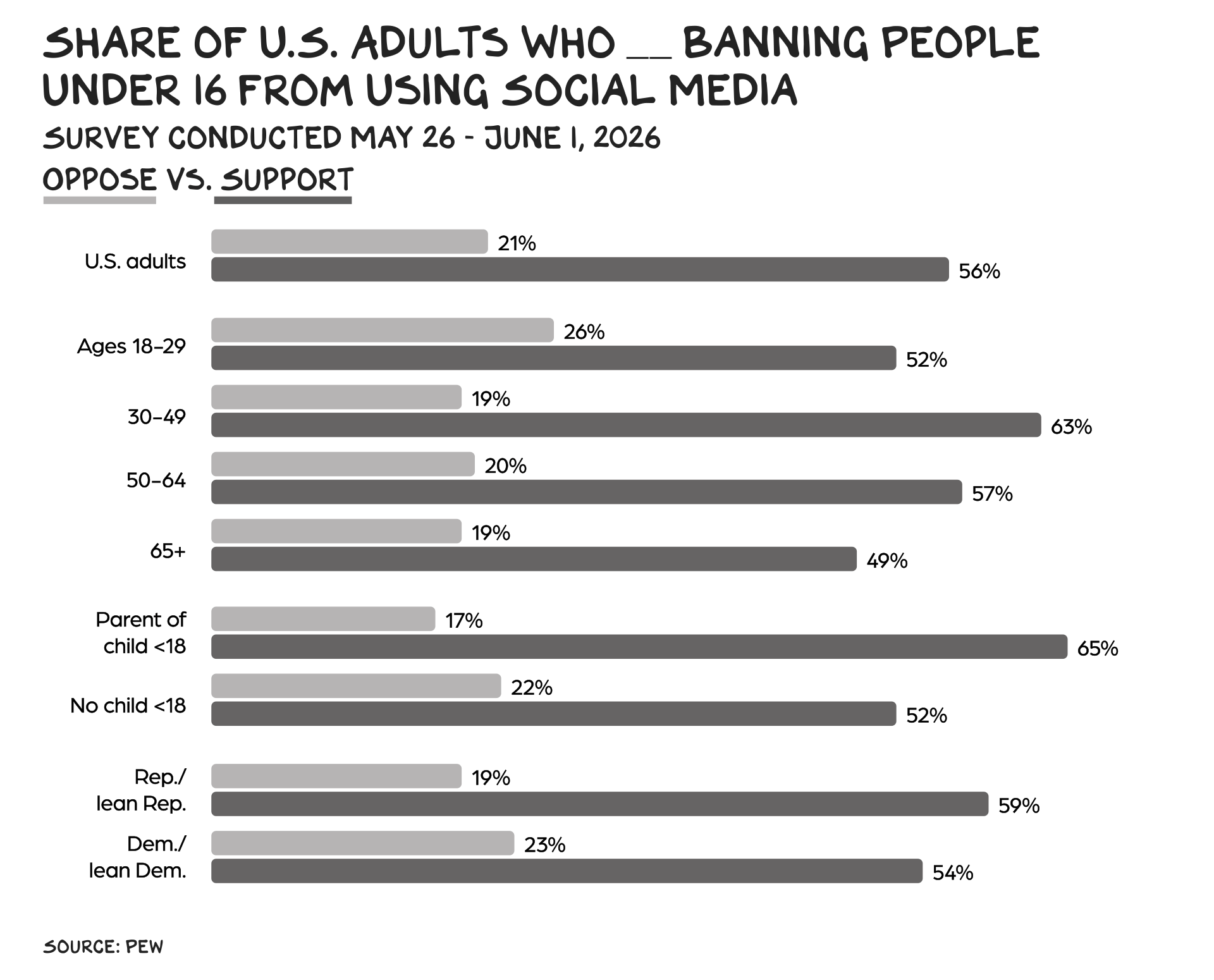
The media business is built on the back of an attention-to-profits arbitrage. But for centuries, the conversion technology was rudimentary, and its emissions were tolerable. Also, because distribution was physical, age-gating was practical. The U.S has a long history of age-gating harmful things that are otherwise legal for adults: guns, booze, porn, etc. This isn’t paternalism, it’s common sense. When we released ad-supported reticulated pythons into the online ecosystem, however, they became an invasive species and common sense died. Zuckerberg didn’t invent social media emissions, but Meta scaled them … to over half the planet. Despite the proliferation of content that would earn R, NC-17, and X ratings at the movies, we’ve treated social media as G-rated. An overwhelming majority of Americans support age restrictions. In fact, nine states have active age-verification laws, while another eight have passed laws that courts have subsequently blocked.
Teeth
If there’s a problem with age-gating, it’s that we have bought the free speech vs. child safety narrative (i.e., bullshit). Assuming it passes constitutional scrutiny, however, age-gating only restricts the flow of new customers, not the product. Reform with teeth will require changing the incentives. Here are three angles of attack.
First, reform Section 230, which protects platforms and websites from legal liability for the content their users post. The 1996 law was written for online bulletin boards, not trillion-dollar behavioral engineering machines. A better framework: Keep immunity for third-party speech, but impose liability for algorithmic amplification, just as we impose liability for physical products. If you elevate content, you’ve made an editorial decision, are a media company and should be held to the same standard(s) as every other media firm. Social media would change overnight — not because executives would grow a conscience, but because the Chief Legal Officer would have a bigger number (legal risk) than the Head of Growth (revenue upside). Incentives drive behavior, and the upside of continuing to harm kids is still greater than the downside.
Second, reboot antitrust. Technology isn’t neutral; its design is a function of the degree to which economic power is concentrated. “The great monopolists are not passive,” Columbia Law professor Tim Wu wrote in The Age of Extraction. “They actively defend their market position by acquiring threats/competitors.” See Meta’s acquisitions of Instagram and WhatsApp or Google’s acquisitions of YouTube and DeepMind. Going Teddy Roosevelt on information monopolists would benefit … everyone. The lessons of Standard Oil and AT&T are that breakups unlock shareholder value, ramp up innovation via competition, reduce rents on consumers, and provide workers with more bidders for their labor. The framing: Antitrust could be the biggest tax cut in history.
Finally, tax social media’s emissions. If the tech platforms are too big to regulate, shrink them by taxing revenue from sales of targeted digital ads. As economist Paul Romer wrote in 2019, companies seeking to avoid the tax play into our hands, as they’re likely to pursue an ad-free subscription model (e.g., Substack). Success for those companies would no longer hinge on surveillance and addiction, but a clear value exchange. Some platforms will continue with the targeted ad model, regardless, but a progressive tax, with higher rates for larger companies, would render Big Tech … tech.
Our “Big Tobacco moment” ended with Meta’s shareholders richer, competitors weaker, and its business model intact. We’ve been played, again.
Life is so rich,

P.S.
I’m speaking live with economist Noah Smith exclusively on Substack next Tuesday, September 8, at 2 p.m. ET. Paid subscribers only. RSVP here.
Oh yeah, I bet the Meta team is really freaking out about forking over a whole 8.5% of just one year's revenue to get totally off the hook for this mess in the US. Thanks for giving us this the context it deserves, PSG.
"Move fast and break things," sounds like the Trump regime's action plan. Zuck's a cuck.
Facebook started with a pout: Zuck got jilted by a date who didn't show up and started Facebook to get revenge. He's an immoral man. And he harms children. What's the moral cost of that?