


On Friday, four astronauts returned to Earth after venturing deeper into space than anyone has gone before. The mission, Artemis II, sent a rocket weighing 5.7 million pounds around the moon and back, setting the stage for a future lunar landing. This incredible feat is a timely reminder that American excellence still exists — if only under the NASA logo.
NASA is a point of national pride, a driver of technological progress, and a reason for top minds around the world to choose America. It is one of the most underrated brands in the world.
What unites humanity more than space exploration? Passion for sport? Love for our families? The list is short. A fifth of the world’s population — 650 million people — watched Neil Armstrong and Buzz Aldrin walk on the moon in 1969. Five decades later, Americans are still excited about it.
In 2019, 45% of Americans said there hadn’t yet been any other national accomplishment that gave them as much pride in the U.S. as the moon landing.
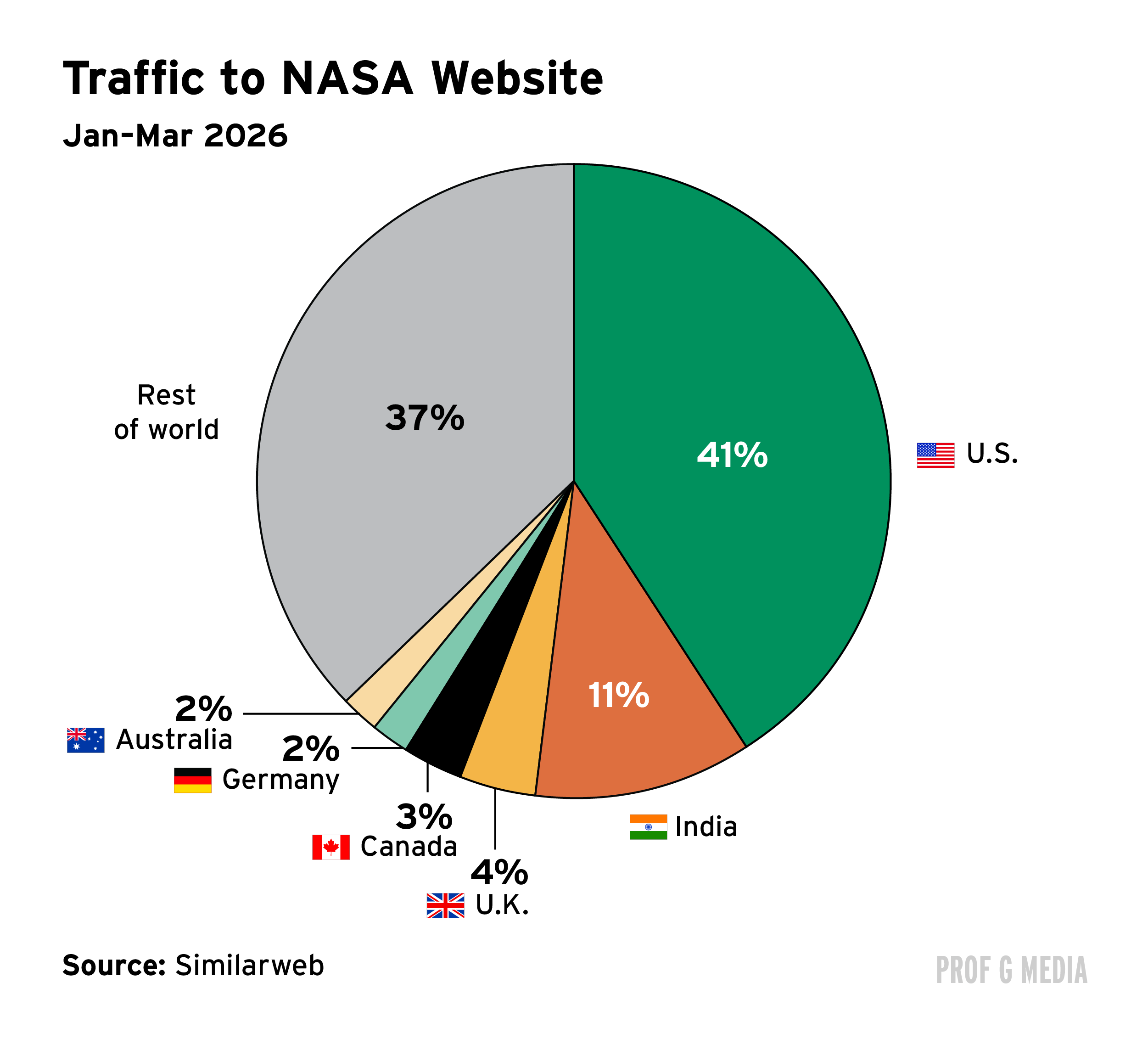
The NASA website gets more site visits than The Economist, twice as many as SpaceX, and almost as many as Tesla. Of all traffic, less than half is from the U.S.
Today, NASA is the most popular federal institution, ahead of the U.S. Postal Service and the Department of Veteran Affairs. That is despite the fact that NASA is vastly less efficient than the privately run SpaceX. Over 118 space missions, NASA saw an average cost overrun of 90%. Over 16 missions, SpaceX saw an average cost overrun of 1.1%.
Yet, as recently as last week, 80% of Americans hold a favorable view of NASA. What other seemingly inefficient government agency do 80% of Americans like?
The NASA logo is so broadly admired that it has become a status symbol. Coach, Balenciaga, Kith, Estée Lauder, Nike, Adidas, and Vans have all collaborated with NASA or used its iconic red branding. Ariana Grande named a song after the agency, and NASA has been mentioned more than 230 times in rap lyrics since the 1990s. How many other icons can claim that kind of cachet?
ROI
NASA may look inefficient compared with SpaceX, but be clear: Its second-order effects on innovation and America’s reputation make it one of the most valuable U.S. assets. President George H.W. Bush reportedly called the Apollo program “the best return on investment since Leonardo da Vinci bought himself a sketchpad.”
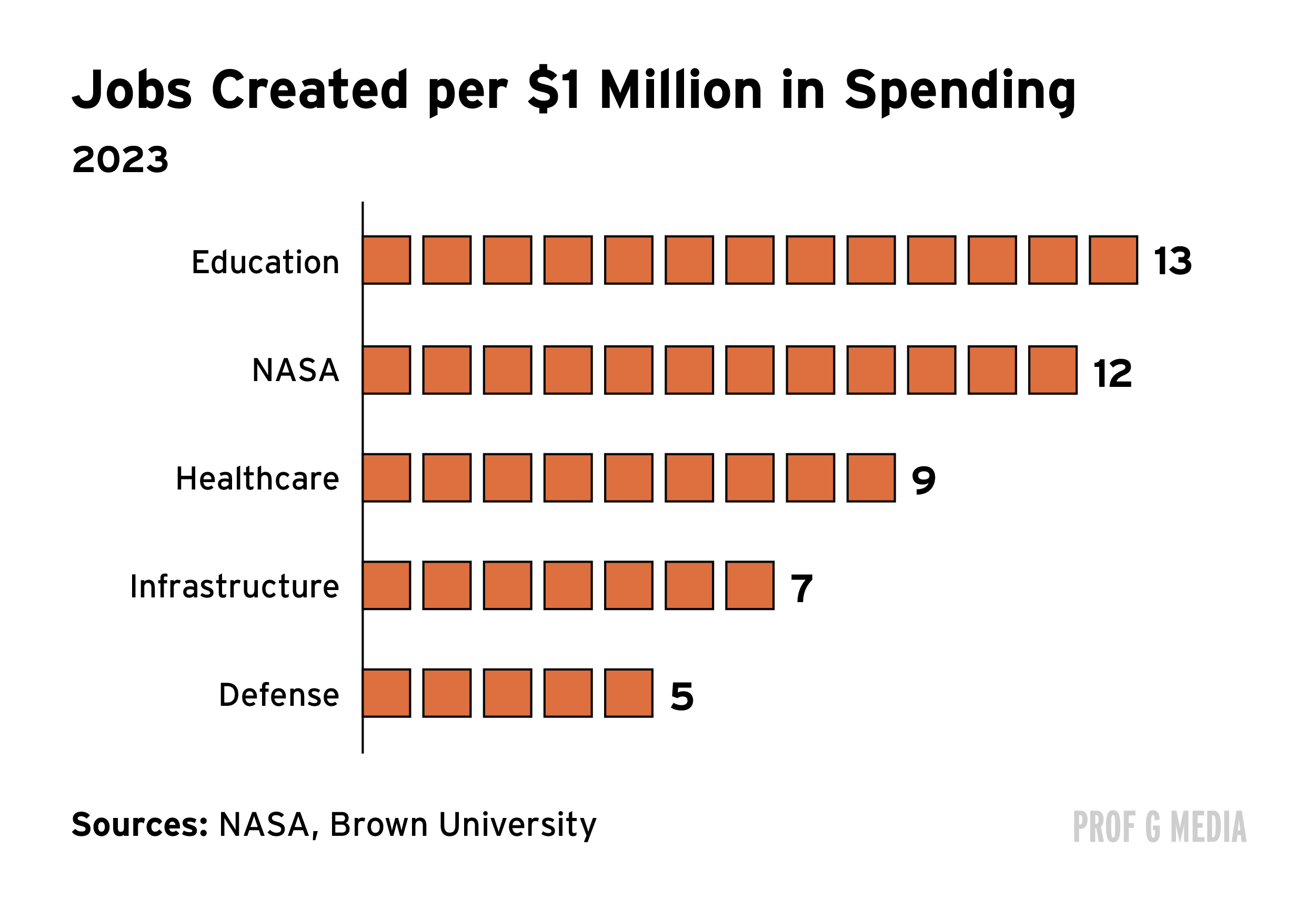
For each dollar invested in the Apollo program, the U.S. got $7 back. Today, NASA creates more jobs per million dollars in budget than federal spending on defense, healthcare, or infrastructure.
It is also the launchpad for crucial American innovations. NASA calls the commercial products and services that have emerged from its research “spinoffs.” Most notably, NASA funding kick-started microchip and computer innovation in the 1960s. It is estimated that the Apollo program accelerated computer technology by 10 to 15 years.
Other spinoffs include products as impressive as precision GPS, solar panels, satellite TV, implantable heart monitors, and LASIK surgery, and as mundane as memory foam, golf ball dimples, and invisible braces.
Even more importantly, NASA’s achievements have inspired students and innovators. In the decade following the 1961 launch of the Apollo program, the rate of doctoral degrees in physics conferred in the U.S. tripled. Even as late as 2009, 50% of high-profile scientists named the Apollo missions as a major reason they pursued science.
Elon Musk, one of the most gifted entrepreneurs of this century said, “Landing on the moon was probably the most inspiring thing in history. It certainly inspired me. I’m not sure SpaceX would exist if not for Apollo 11.”
Vivek Ranadivé, a tech entrepreneur and billionaire, decided he wanted to study in the U.S. after hearing the moon landing broadcast on a transistor radio in Bombay. He now owns the Sacramento Kings.
NASA’s future
In many ways, space is Trumpian. It’s full of superlative opportunities — the farthest flight, the most powerful engine, the biggest rocket, etc. Space also provides another frontier — a key ingredient in America’s manifest destiny ideology. Last December, Trump signed an executive order calling for the U.S. to return to the moon by 2028, and establish a permanent lunar base by 2030. (Prediction: Trump names a moon crater after himself.)
Future lunar missions depend on SpaceX’s Starship to transport astronauts to the moon. NASA’s reliance on SpaceX makes the American space program vulnerable to Elon Musk’s whims — but that’s a separate post.
Another motivating factor behind our return to the moon is that China is trying to beat us there. Since 2015, China has increased funding for its space program by over 1,000%, and its robotic space missions have already retrieved samples from the far side of the moon — a feat the U.S. has not achieved.
National treasure
When Americans were asked what our country’s greatest achievement of the 20th century was, the most common answer was our space program. That sentiment doesn’t seem to have faded. Today, nearly 70% of Americans say it is “essential” that the U.S. continue to be a leader in space exploration.
We may be more divided than ever, we may be at war, and the American brand may be tarnished — but the American spirit is alive and well in NASA. In fact, NASA might be the last bastion of American patriotism, and it is undoubtedly a timely reminder of human unity.

Children in Juárez, Mexico, watched the launch livestream of NASA’s Artemis II mission. Source: Jose Luis Gonzalez/Reuters