




19
Of the 20 horses in the Kentucky Derby lineup this weekend, 19 were related to Secretariat, the record-breaking winner of the 1973 Triple Crown. The winner, Golden Tiempo, was one of the descendants.

OpenAI’s week from hell
Spirit Airlines cancels all its flights and shuts down
Big Tech’s earnings report card
There are 23 days left ’til the Prof G Markets Tour kicks off in San Francisco. Join Scott, Ed, Claire and surprise guests live in the Bay, LA, Miami, Chicago, or New York. Visit profgmarketstour.com to get your tickets.

Courts, Cash, and Competition: OpenAI’s Week From Hell
Last week, the WSJ reported that OpenAI missed its own targets for new users and revenue. CFO Sarah Friar has privately told company leaders that she is worried OpenAI might not be able to pay for future computing contracts if revenue doesn’t grow fast enough.
Related: The board of directors have been more closely scrutinizing Sam Altman’s data center deals as the business slows down.
Meanwhile, court proceedings kicked off in Elon Musk’s lawsuit against OpenAI, seeking to oust Altman and unwind the company’s conversion into a for-profit entity. The case centers on claims that OpenAI abandoned its original nonprofit mission.
Separately, families of victims from a mass shooting in Canada have filed a lawsuit against OpenAI and Sam Altman, alleging that ChatGPT played a role in the attack and that company safeguards fell short.
Taken together, these three stories touch on three concerns that have been raised about OpenAI: financial viability, leadership, and safety. OpenAI said there is “no truth” to the Journal’s reporting, and that the business is “firing on all cylinders.” But the company that has spent years selling the world on a more intelligent future is now struggling to convince its own board, its critics, and the courts that it has things under control.
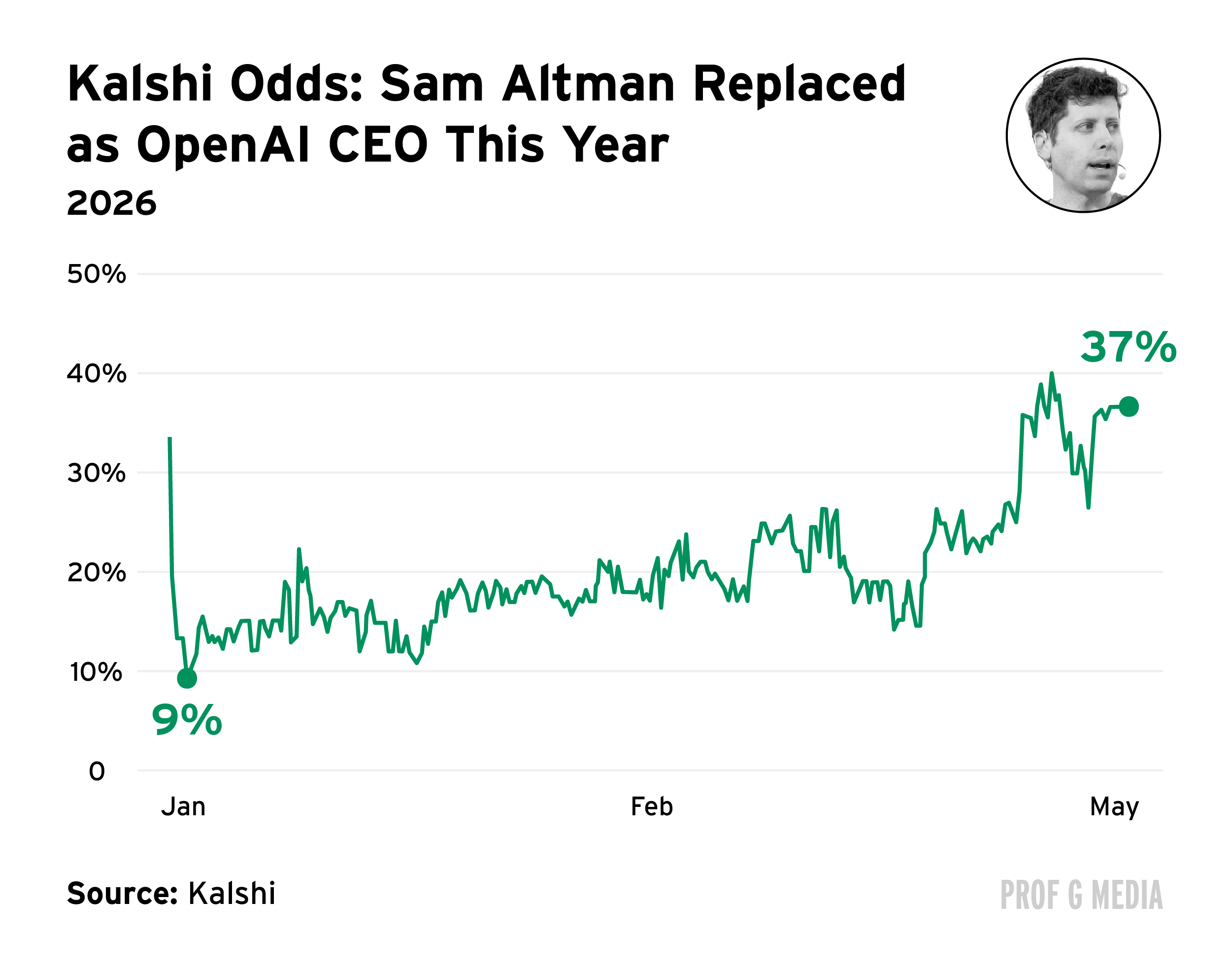

OpenAI set extraordinarily ambitious internal goals, so the financial miss is more an issue of optics than substance. But the real story is how fast the competitive picture has shifted.
Anthropic, a company that was a distant second just six months ago, is now squarely the leader. Anthropic recently hit a $30 billion run rate; OpenAI is now at $25 billion. Anthropic expects to break even by 2028; OpenAI not until 2030, and it plans to burn 14x more cash.
On the Musk-Altman lawsuit, I actually think Altman comes out on top. According to people close to the matter, Musk was the one who pushed to convert OpenAI into a for-profit company, demanding 80% ownership and control. When OpenAI said no, he walked and signed away all rights. He then went and founded xAI, arguably the AI company with the fewest safety guardrails. This isn’t about principle; it’s seller’s regret. The one corner of the internet he didn’t get to own. The defense will have no trouble painting that picture.

One of our team members, Kristin O’Donoghue, said it best: We’re not in an AI bubble right now. We’re in an OpenAI bubble.
AI businesses broadly are doing exactly what you’d expect: growing off enormous bases at startup-like rates, posting the kind of numbers that shouldn’t be possible for companies this size. The problem is that OpenAI has spent the last year making commitments that don’t match its actual capabilities. They announced plans to spend $1.5 trillion over the coming years on a $13 billion revenue base. When that number became embarrassing, they revised it down to $600 billion by 2030. That’s still an extraordinary figure for a company generating what Meta spends in a single quarter. Yet they’re valued on secondary markets at around $880 billion, roughly 35x sales. The math only works if you believe the growth trajectory is essentially guaranteed. This week suggests it isn’t.
What’s changed is that Anthropic has emerged as the more credible operation. A year ago, OpenAI had a 75% chance of IPOing before Anthropic. That’s now down to 34%. Anthropic is trading at a $1 trillion valuation on secondary markets, ahead of OpenAI. The revenue gap has closed fast.


Spirit Airlines Is Going Out of Business
After 34 years of operation, Spirit Airlines shut down for good this weekend after failing to reach a bailout agreement with the federal government.
Spirit filed for bankruptcy twice in the past two years, including most recently last August. It was aiming to emerge from its second bankruptcy this summer, but those plans were derailed by an 80% increase in the price of jet fuel since the start of the U.S. war in Iran.
The airline’s closure means that thousands of travelers with Spirit Airlines tickets now need to file for a refund and rebook, and Spirit’s 9,500 employees and 7,500 contractors need to find new jobs.
Ultimately, the government bailout deal didn’t materialize because the Trump administration insisted the government get paid back first if Spirit went under — meaning existing lenders would have little chance of getting any of their money back.
Industry analysts worry that Spirit’s closure will lead to higher ticket prices. Spirit exited 90 routes between 2024 and 2025, and those tickets rose on an average of about $19, or 14%. That compares with a 6% to 7% typical airfare inflation on routes where it continued to operate.
The only time a government bailout makes sense is when the failure is systemic. The 2008 bank bailouts were defensible because if JP Morgan or Bank of America had gone under, you would have had lines around the block and food shortages. That’s an existential risk. In contrast, Spirit Airlines had a 3% share of the U.S. airline market.
A government bailout would have been conscripting taxpayers into being unwilling, unwitting equity holders in f*cking Spirit Airlines.

sponsored content
Don’t wait to become a victim. Take control of your identity
Over 422 million people had their personal data exposed last year alone. And the easiest targets? People whose info is still floating around online.
Incogni tracks down and removes your personal details from over 420+ data broker sites, people-search pages, public records, and more—automatically. They periodically check if your information appears on the data broker sites and remove it, so you get total peace of mind.
With their Unlimited plan, you can go even further. Google yourself and send them any link you find with your info on it. Their privacy team will assist you in getting it wiped.
Stop making it easy for identity thieves. Lock down your personal data before criminals take advantage of it.
Get 55% off with the code PROFG
sponsored content

Microsoft, Amazon, Meta, Google, Apple: Earnings Season Recap
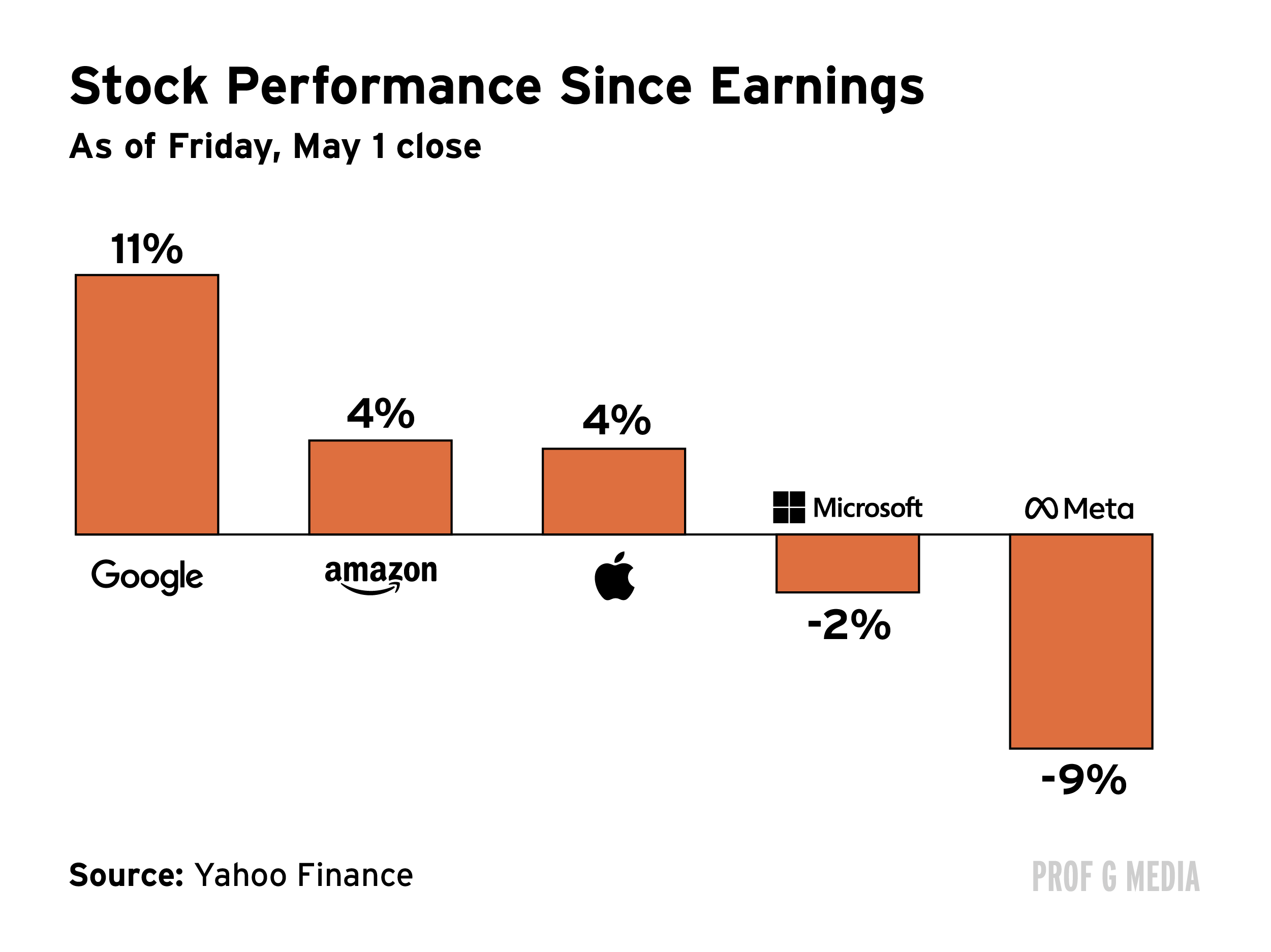
Big Tech delivered across the board last week, with Microsoft, Amazon, Meta, Google, and Apple all reporting objectively strong earnings.
However, the market’s reaction was mixed — perhaps in part due to the massive capital expenditure commitments that these once-capital-light businesses are making.
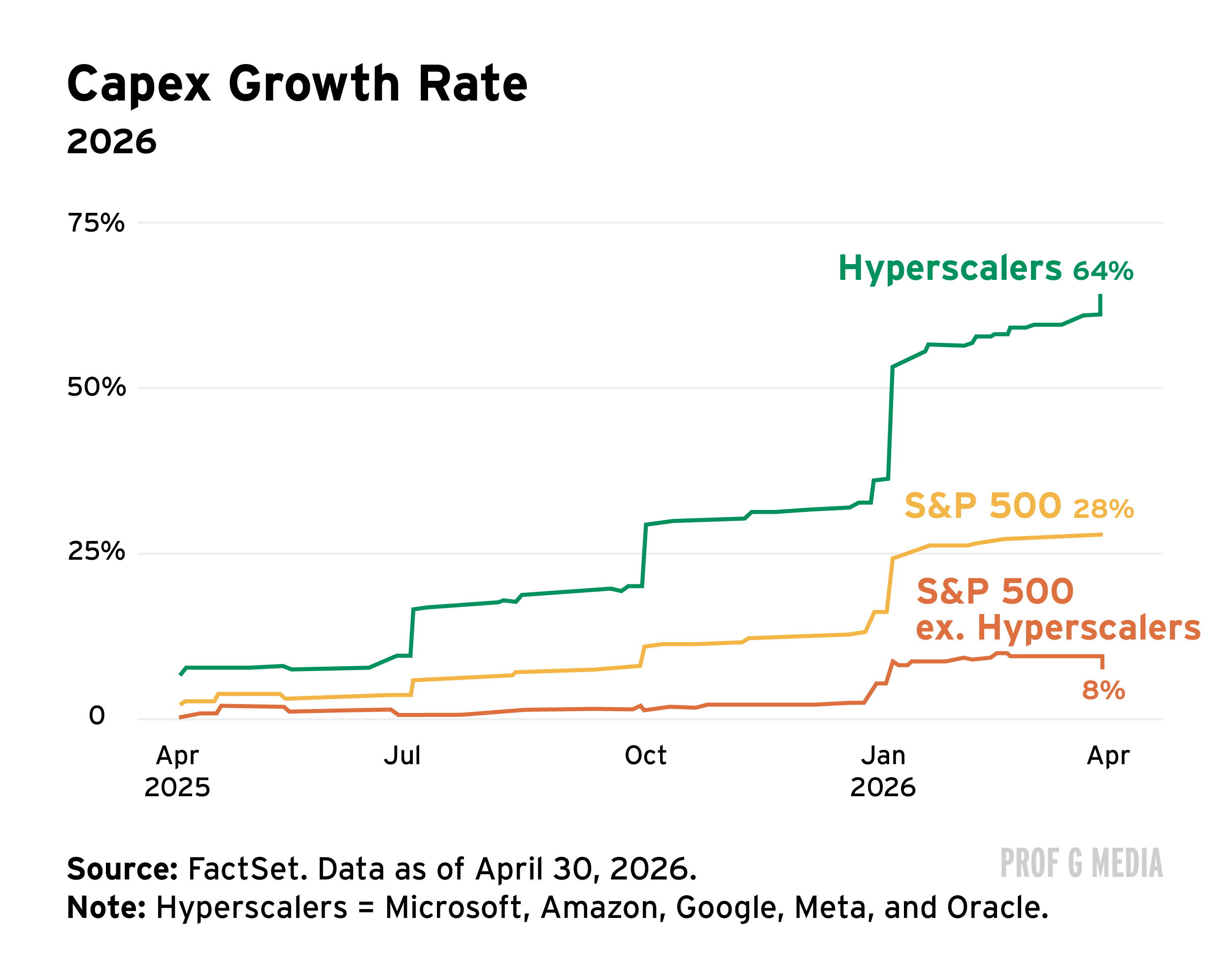
In the first quarter alone, Microsoft, Amazon, Meta, and Google spent $131 billion on capex, up 71% from a year ago. In other words, these four companies are spending the equivalent of the Manhattan Project every month.

Microsoft
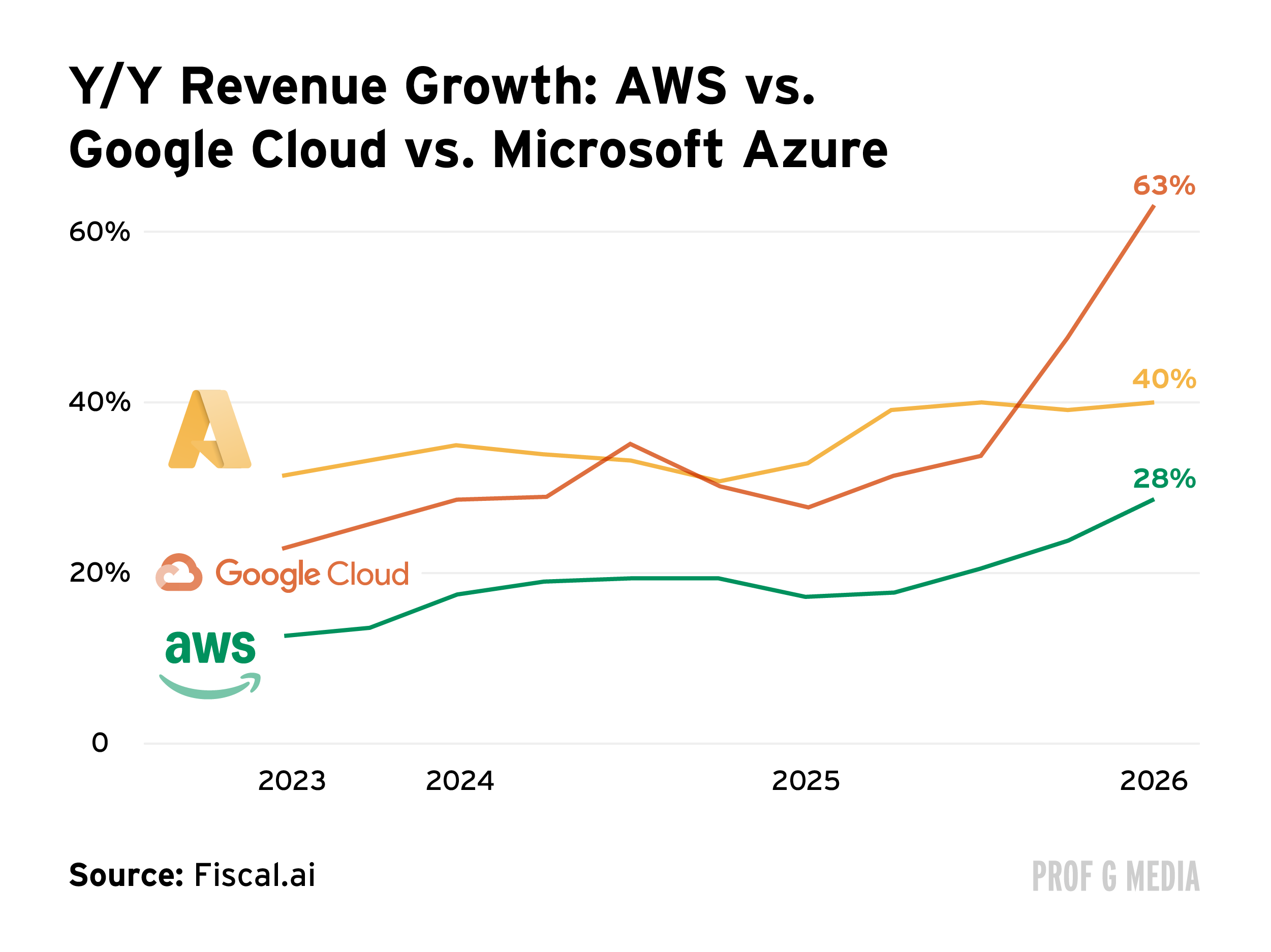
Microsoft’s revenue rose 18% year over year, and Azure revenue grew 40%. However, shares are still down 12% year to date amid uncertainty about capex spending and Microsoft’s relationship with OpenAI.
Microsoft’s own AI products are now generating $37 billion in ARR, up 123% year to date. That’s more than OpenAI and Anthropic are making on AI. Microsoft also reported that engagement with its AI assistant, Copilot, is now at the same level as Outlook, its email app.
Amazon
Amazon also topped expectations with strong cloud and AI growth. Amazon Web Services (AWS) revenue increased 28%, the fastest growth in 15 quarters, and its AI revenue run rate is now over $15 billion — nearly 260x larger than it was three years ago.
Another highlight noted on the call was Amazon’s progress in developing and selling its own AI chips. CEO Andy Jassy called Amazon “one of the top three data center chip businesses in the world,” noting that if Amazon’s chips were a stand-alone business, it would be generating $50 billion in ARR (that’s more than AMD and about as much as Intel).
Amazon’s earnings beat expectations as well, but notably, more than half of Amazon’s pretax income for the quarter came from gains from its investment in Anthropic. The company’s $8 billion investment in Anthropic is now worth more than $70 billion.
Prof G Media’s Big Tech stock pick of the year (Amazon) is looking pretty good so far.
A former colleague of mine at NYU Stern, Peter Golder, had a piece of research I’ve held on to for 15 years: Innovators aren’t the ones that reward shareholders. If you look at the first movers in PCs, smartphones, and online platforms, those companies probably don’t exist anymore — CompuServe, AltaVista. It’s usually the second mouse that gets the cheese.
Amazon is second-mousing like no one’s business. They saw an opportunity to be number two in space connectivity behind SpaceX, and they created Amazon Leo. Now Jassy is saying Amazon is one of the top three data center chip businesses in the world.
And I think what the market is responding to is a narrative shift. The street no longer wants I’m going to raise a trillion dollars and buy $300 billion of compute. That’s the Altman narrative. What they want is: We’re participating in the AI boom, our core businesses are strong, and we’re adults about capex.
Alphabet
Alphabet had the best quarter of the group. Revenue grew 20%, and net income grew over 80%, but Google Cloud was the highlight. Sales increased 63%, and now represent 18% of Alphabet’s total business, up from 14% a year ago.
Cloud margins have also expanded from 9.4% a year ago to 32.9% in Q1.
Shares rose 10% on the news, adding $421 billion in market cap — the second-largest single-day market-cap gain for any stock in history. Alphabet finished April up 33%, its best month since October 2004, the month it went public.
Meta
Despite posting 33% revenue growth — its fastest in five years — Meta fell 10% after raising capex guidance. The company also reported its first decline in daily active users across all its properties since it began tracking the metric seven years ago. Management pointed to internet disruptions in Iran and a WhatsApp restriction in Russia.
The only company with a gigantic question mark — explained by both its valuation and its stock performance since earnings — is Meta. Meta raised capex guidance to $125 to $145 billion for the year, comparable to Microsoft, Amazon, and Google. The difference is Meta is the only one without a cloud business. Microsoft has Azure, Amazon has AWS, Google has Cloud. Meta generates 97% of its revenue from advertising. It is purely an ad business.
So the question for Meta is: What are you actually going to do with these data centers? Are you going to monetize them, or just use them to turbocharge your existing ad business? They haven’t explained it. They’ve used vague allusions to AI being the next big thing — okay, fair enough — but with the other companies you can see the ROI right now. Meta can’t show you that. They need to get their messaging straight and tell Wall Street what the actual monetization plan is.
Because right now you’re basically praying Zuckerberg figures it out. And given what happened with the metaverse — where he plowed billions into a distant dream and said trust me — you’re asking a lot from investors. Meta’s forward PE is now 20, the lowest of the group. Google’s at 34, Amazon 33, Apple 32, Microsoft 21.
Apple
Apple reported revenue growth of 17%, its fastest quarterly growth in four years. iPhone revenue grew 22%, Services hit an all-time high, and sales in China jumped 28%. Unlike its peers, Apple made no significant changes to capex guidance.
There are different types of risk. Apple risks missing out on upside by not making forward-leaning AI capex bets — but they don’t face an existential threat from AI. They’re the plumber of Big Tech. Nobody is talking about vibe-coding an iPhone or replacing the App Store with the latest Claude update.
But I think Apple’s saying, no, our job is to create the most aspirational signaling ecosystem in history. Nothing signals that you’re part of the 1 billion most attractive mates in the world more than having an iPhone. And that supply chain,I don’t think it can be replaced by AI. Figuring out a way to get 2,000 distinct parts from probably 400 different sources to different regions in China and then build a phone for $400 that would cost $3,000 anywhere else is really hard.
Apple got criticized for not getting into the search wars and for killing the car project. Both turned out to be smart. They’re making the same call on the capex race around AI. They might be wrong — but if they are, the consequence is they miss out on earnings growth. Not that they get disrupted.

Intel gets cut in half within the next 12 months. Intel is up roughly fivefold since we called it a buy, and at these levels now it is a short. The stock is now trading at 118x forward earnings, the highest forward PE of any large-cap chip stock, while its business is expected to grow slower than every peer trading at a lower multiple. Good for anyone who bought in when the thing was nearly left for dead. But at 118x earnings, look out below.

Not related to this article, but I’d like you to cover what’s going on with Xanadu (XNDU).
big fan of your work..