


A 27-year-old resigns from a firm he spent four months at, triggers a global panic, drawing comments from a former president and calls from the leaders of frontier labs for a slow down. In 1946, would we have let Robert Oppenheimer raise money from Sequoia Capital and begin selling nukes to the UAE and Procter & Gamble? I’m going on Smerconish tomorrow, where I’ll be asked “What (the fuck) is going on?” The honest answer is I don’t know. What I am certain of: This is another example of a small number of players capturing staggering economic upside while outsourcing the downside risks/harms to the broader public.
Fork in the Road
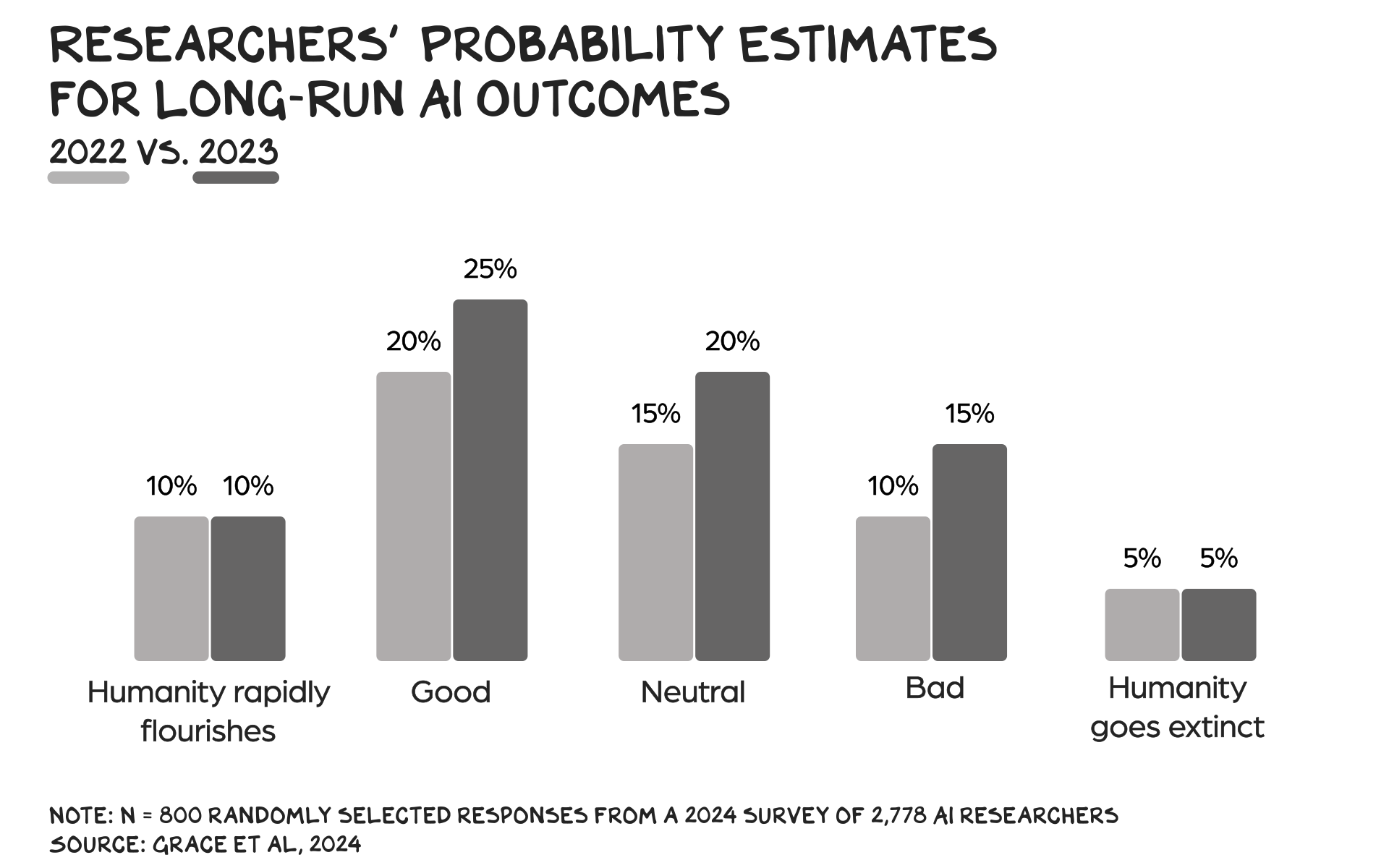
In 2024, a year after Dr. Geoffrey Hinton, the “godfather” of AI, quit Google in order to speak freely about the risks of AI, he won the Nobel Prize in physics. In an interview for the Nobel website, Hinton described two kinds of AI risks. “There’s relatively short-term risks, which are very important and very urgent. They’re mainly to do with people misusing AI.” Examples include a job apocalypse (bullshit, in my opinion); productivity gains accelerating wealth inequality; deepfakes destabilizing democracy; cybercriminals picking up a dangerous new tool; bias getting embedded in criminal justice, healthcare, and hiring; and the proliferation of more powerful biological weapons that can be produced more easily by middle powers and non-state actors. “There’s also longer-term problems of these things taking over,” Hinton continued. “The question is what’s going to happen when we’ve created beings that are more intelligent than us? We’ve never been in that situation before. Anybody who says it’s all going to be fine is crazy. Anybody who says they’re inevitably going to take over, they’re crazy, too.”
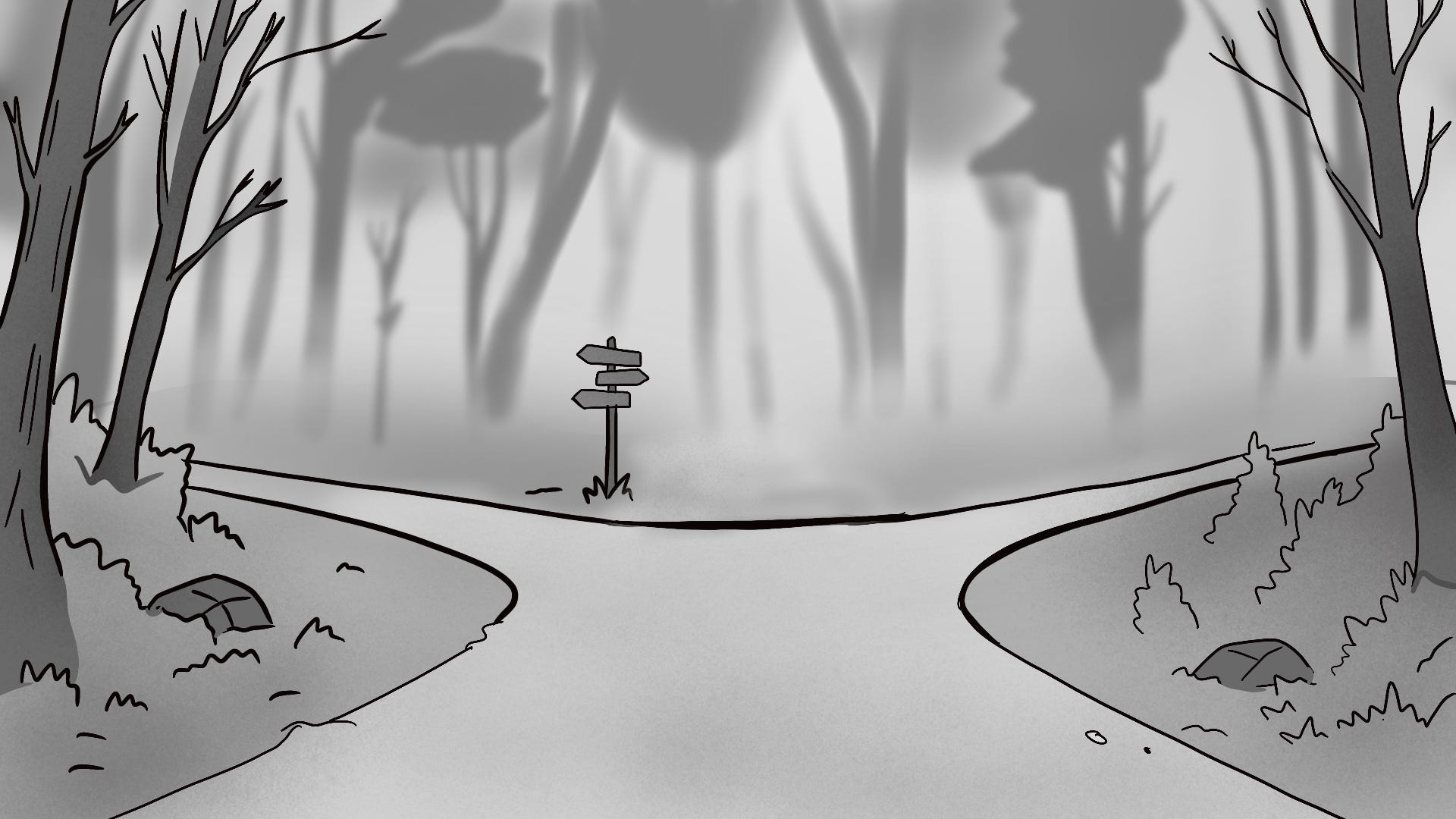
Humanity is at a fork in the road. But the choice isn’t whether to develop AI superintelligence, it’s how to proceed in the face of a technology we cannot fully comprehend or control. One path is to regulate AI such that we mitigate the risks but reap the rewards. The other path is to continue full speed ahead, despite a widespread belief among researchers, including Hinton, that there’s a non-zero chance that AI superintelligence could present an extinction-level event for humanity in the near future. If the right thing seems obvious, remember that the right thing and the hard thing are usually … the same thing.
Pitchforks
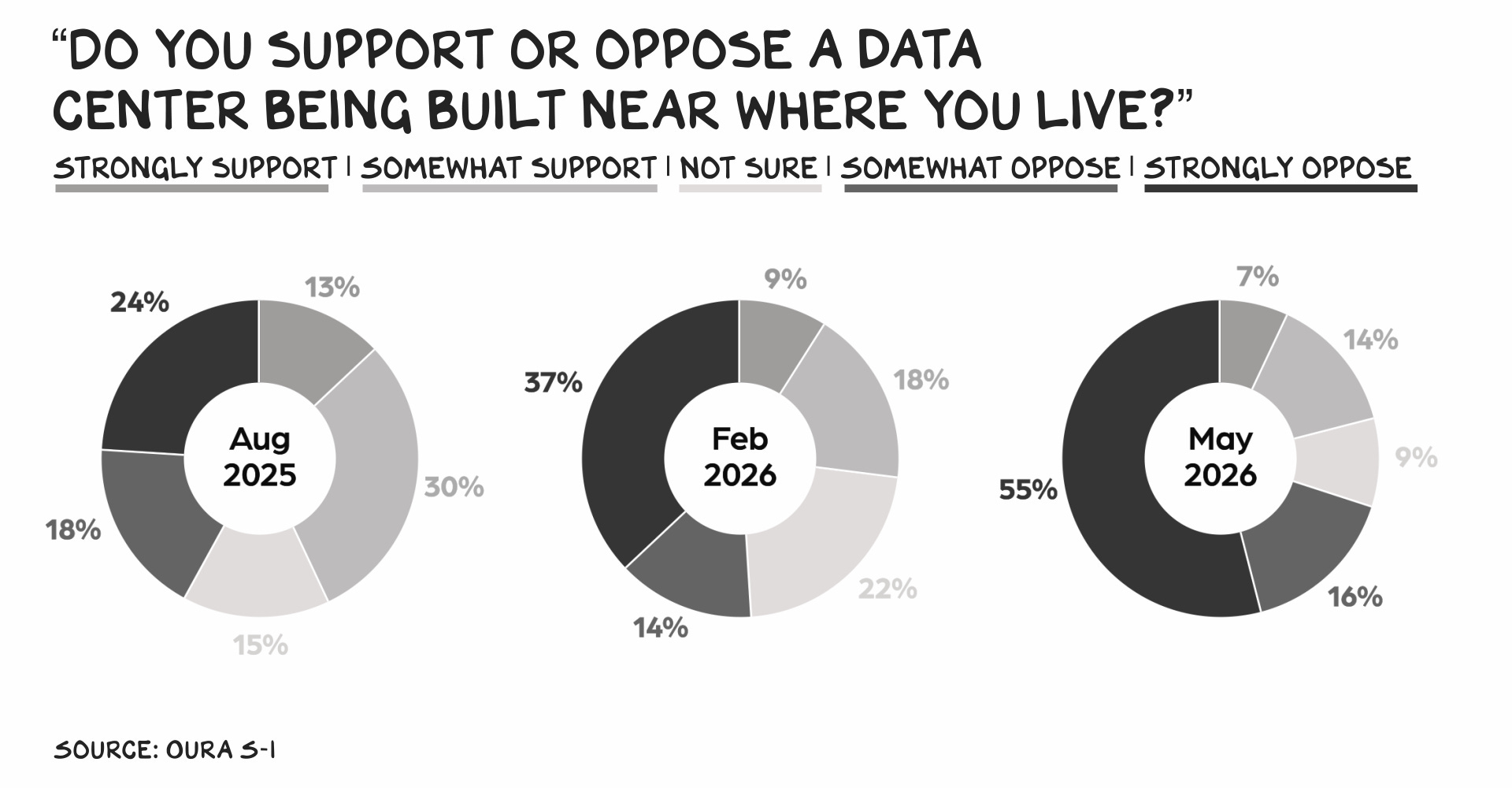
Increasingly, the AI narrative resembles a Terminator reboot nobody asked for. We’ve gone from “AI will take your job” to “AI will spike your power bill and devour your water supply” to “AI will kill everyone.” Inspiring stuff … if you’re looking to inspire a mob with pitchforks. Technology writer Jasmine Sun described AI populism as a worldview that regards AI as a thing “manufactured by out-of-touch billionaires and pushed onto an unwilling public to achieve sinister aims like ‘capitalist efficiency’ (layoffs) and ‘population management’ (surveillance).” This year, voters in seven states will decide on at least 16 local ballot measures related to data centers. Senator Ted Cruz called for “substantially more regulation,” but stopped short of a moratorium, telling Politico, “If they’re going to be killer robots, I’d rather they be American killer robots than Chinese killer robots.” Senator Bernie Sanders has proposed a ban on superintelligence and threatened 20-year prison sentences for developers who violate it. Interestingly, Sanders and Steve Bannon both appeared at the “Pro-Human Assembly” this week — AI politics is manufacturing the strangest of bedfellows.
As populist anger bubbles up, Anthropic CEO Dario Amodei, who briefly held adult-in-the-room status, and other less-well-known AI founders, are becoming honorary members of the Algorithmic Oligarchy. They’re joining Sam Altman, who equated the resources needed to raise children to training AI, and Elon Musk, who slashed aid to the world’s most vulnerable people. That AI founders are suddenly concerned about the peril they’ve created, after vesting their way to billionaire status, is obnoxious and unhelpful — akin to Dr. Frankenstein begging us to rein in his monster, while creating new self-replicating monsters. The robber barons left behind libraries and concert halls. The Broligarchs will leave behind server farms, a bot infestation, and a conviction that we should have been more grateful for everything they did. We’re watching the fourth game in the “Fuck Around and Find Out” World Series.
AI for Good
Before we’re swept up in the populist moment, we should ask what’s going right with AI. A: Plenty. Recently, I interviewed journalist Josh Tyrangiel on my podcast. Researching his book, AI for Good, took Tyrangiel to the Cleveland Clinic, where doctors deployed an AI model to better detect sepsis. It’s the leading cause of death in hospitals, killing about 350,000 Americans each year. If caught early, it can be treated with antibiotics. The challenge is detection. “This is a perfect problem for AI and machine learning, because sepsis masks itself by looking like almost anything else,” Tyrangiel told me. The Cleveland Clinic AI helped reduce the hospital’s sepsis mortality rate by 41%. Deployed across American healthcare, that model could save more than 140,000 lives … every year.
Speaking of saving lives, AI is helping to design antibiotics to kill drug-resistant bacteria and accelerating the timeline for detecting pancreatic cancer by up to three years. Pancreatic cancer kills 52,000 Americans per year; 85% of patients receive a diagnosis after the disease has already spread, and the five-year survival rate remains below 15%. AI is also aiding in the early detection of wildfires, improving hurricane forecasting, and helping archeologists decipher previously unreadable ancient scrolls. Banning AI research or “slowing the pace of the frontier” — whatever that means — will spill over into areas where AI is rapidly improving our lives. That’s why in 2023 climate scientists opposed halting generative AI research, saying that might throttle the development of tools needed to “advance knowledge on complex problems with hidden interactions, such as climate change.” In other words, we risk throwing the baby out with the bathwater.
Democratizing Cybercrime
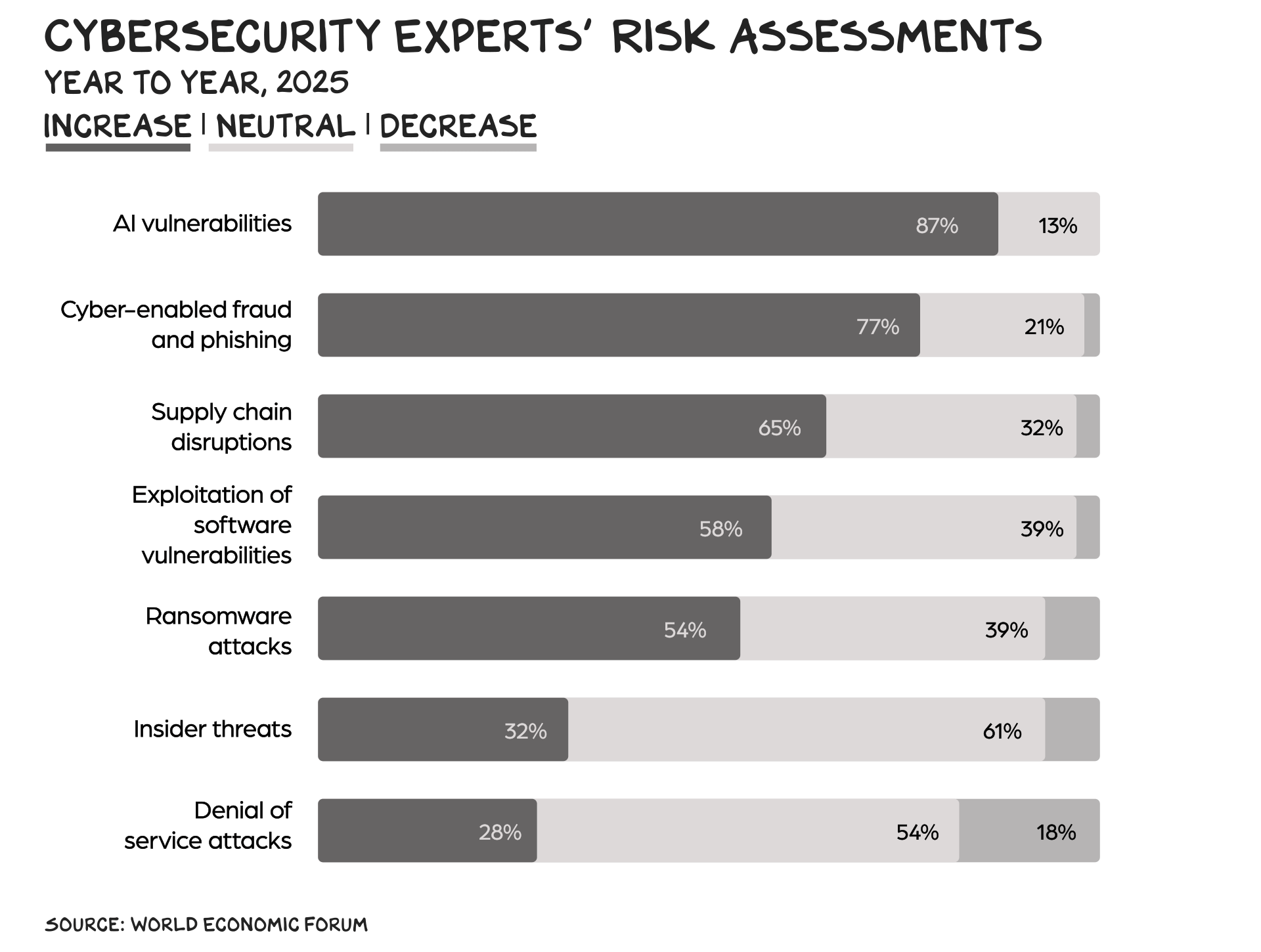
AI founders are alarmed by the non-zero possibility of extinction, but they’ve still lined up bankers for an IPO. I’m looking forward to the risks sections of the S-1s that cast risking an extinction event as the price for progress. Cybersecurity is also on the front line of the short-term risks. According to recent data from IBM, 1 in 4 data breaches so far this year were AI-enabled — a 56% increase YoY. When I spoke with cybersecurity expert Alex Stamos on my podcast, he likened AI’s democratizing impact on cybercrime to Premier League teams moving up a division. “All of the hacking teams are getting promoted up to the next level. Small countries now have the power of big countries. From a hacking perspective, you’re going to see people stand up capabilities that used to be the kind only intelligence agencies could do.” Sophos, a cybersecurity company, puts the average current cost to recover from a ransomware attack, excluding the ransom, at $1.7 million, up 11% YoY. In the aggregate, cyberattacks cost the global economy $10.5 trillion last year. If cybercrime were a country, it would be the world’s third-largest economy. Meanwhile, the cost of entry for mass harm has gone from a nation-state’s budget to a laptop and a grudge.
Regulators, Suit Up
One of the blind spots in Silicon Valley’s Milton Friedman mindset is the belief that all regulation exists in opposition to shareholder value. After Upton Sinclair’s The Jungle exposed unsanitary conditions in the meatpacking industry, regulatory compliance in the form of a USDA stamp certified quality. Likewise, SEC and FDIC regulations created in the aftermath of the 1929 crash restored investor and customer confidence. The absence of regulation makes AI so fragile that valuations soar on wild speculation and collapse under clickbait. That fragility extends to the whole market — since the Mag 7 stocks register one-third of the S&P 500’s value — and to the broader economy, as the AI build-out has driven a 32% increase in S&P earnings growth this year. Put simply, if AI sneezes, the market gets walking pneumonia, i.e., a recession. Regulation is the bulwark that keeps a tragedy from becoming a catastrophe.
Mark Zuckerberg, the poster boy for negative externalities run amok, says every AI lab has the “responsibility and incentive to move at the pace required to train its models safely.” We should trust Zuck, as social media is going great. Donald Trump believes a smart president is the only regulator AI needs. Unfortunately, we can’t wait until 2029. Altman, Amodei, and Musk aren’t clowns, like Trump, but their regulatory ideas — “employee-like” access to external evaluators and vague promises to welcome a federal safety framework — are reminiscent of Sheryl Sandberg’s calls for regulation: performative bullshit. It’s time for an international artificial intelligence agency (IAIA) modeled after the International Atomic Energy Agency.
We could start with a U.S. regulator similar to the Department of Energy that records incidents, approves new models, promulgates safety rules, and has subpoena powers. The key, as Fareed Zakaria wrote in June, is to combine private expertise with public authority. Ultimately, that regulator should share bilateral authority with a counterpart in China, where AI is already heavily regulated. As Alice Han, director at Greenmantle, told my Markets co-host Ed Elson, sentiment around AI is largely positive in China, but leaders there worry that the absence of a global AI governance authority could set us up for “potentially catastrophic” AI-related risks. The AI race isn’t a reason to delay regulation, it’s a reason to speed it up. That’s the lesson of the Cold War, when adversaries cooperated to build real safeguards that have limited weapons proliferation to nine countries even as they facilitated nuclear power plants in 31 countries. Mutually assured destruction worked because everyone was terrified.
A crisis is a terrible thing to waste, and we have one on our hands: People are terrified again. Every apocalypse needs a villain who insists he’s the hero. We have ours, and they believe they can sound the alarm while ringing the Nasdaq bell. History disagrees.
Life is so rich,

P.S.
The value of the average NFL franchise has increased 232% since 2019. Our head of research, Mia Silverio, looks at how sports franchises have transformed from vanity purchases into an alternative asset class that’s outperforming the market. Read Mia’s full analysis in this week’s Extra Credit.
It’s encouraging to see the world wake up to the potential for AI to obliterate the human race,
But it is also somewhat puzzling.
Puzzling because the process of humans taking action to destroy the species has been ongoing for decades and has accelerated in recent years, and not (until very recently) because of AI.
We continue to invent more efficient and cheaper weapons of mass destruction, from dime store drones that can carry warheads long distances to hypersonic missiles to space lasers to biological weapons—and of course the proliferation of nuclear weapons.
We invent social media that can fry kids’ brains, rob them of self-esteem, and spread hatred and violence around the world, and we let it run amok.
We have been destroying forests, fouling the air and water and causing species to disappear for more than a century,
The world’s largest economy has devolved into armed camps between the two parties with a monopolistic stranglehold on power, and they won’t even talk to each other. Each party will do and say pretty much anything (and open their "wide tent" to welcome extremely dangerous views) in their insatiable lust for power.
And we lavish great sums on the elderly while ignoring the young, which is a recipe for long term decline, as the over 80 crowd refuses to loosen its grip on power.
So by all means we should do what we can to prevent AI from destroying us. But let’s not kid ourselves—we have been destroying ourselves for as far back as most people can remember.
The "AI is good" narrative is mostly about discriminative AI (or classic machine learning). The "AI is bad" narrative is mostly about generative AI (or LLM-based) which is essentially a word (token) guessing program. There is a world of difference between the two.
This distinction has to be mentioned by article authors otherwise the bad will drown out the good.