


The Dells announce a $6.25 billion gift at the White House to fund investment accounts for 25 million kids, and social media spins up memes and videos portraying Mrs. Dell as a ghoul from Michael Jackson’s “Thriller.” A podcaster casts doubts on Jane Doe’s claims of assault at Cornell due to her appearance, suggesting she was “probably thrilled to be so admired.” What do these stories have in common? A: Both have been the subject of conversations I’ve had with my boys.
Negative ROI
We dropped our oldest son off at college in September. Our youngest is a teenager, i.e., more interested in hanging out with friends (good thing). Seeing our boys accelerate toward launch is gratifying, but as they approach escape velocity, I’ve been struggling with my purpose moving forward. That’s not to say I’m unhappy. Happiness is a sensation I can engineer with Netflix and edibles, and I’m good there.
Purpose gives life meaning. A decent litmus test for finding purpose is negative ROI. When you engage in an unselfish pursuit that cannot possibly generate an (observable) positive return — volunteering in your community, national service, mentorship, etc. — you may have found it, as you’re working for the agency of something greater than yourself. Preparing my boys for others represents years of investment that will never register a traditional return. I doubt they’ll ever be up at 2 a.m. worried about me. No matter how nice a home they put me in, the flow of resources is largely one way. Building up their physical, emotional, and mental fitness is my purpose, but the dividends will accrue to their future partners, children, colleagues, and the country.
Certainty
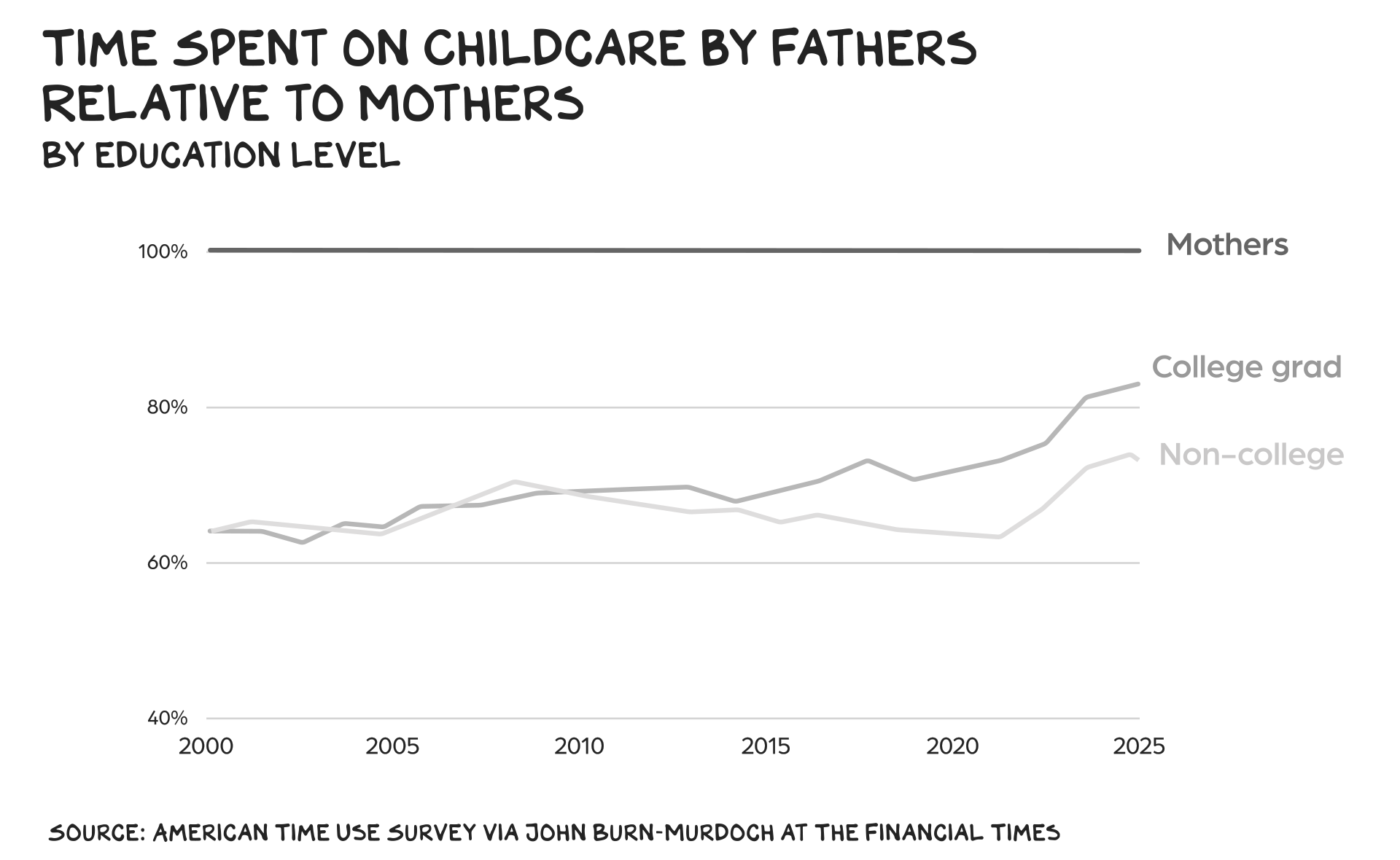
Certainty is dangerous, and it infects me across a number of domains. However, I have a healthy dose of uncertainty around pretty much every aspect of parenting. This post isn’t a how-to; it’s a what-I-do. I believe the single most accretive investment a dad can make in the world is to show up (more). Engaged fathers produce better men. The good news is men are increasing the time they dedicate to childcare. Unfortunately, Pew found that 37% of young adults say they talk to their father less than they’d like, nearly double the 20% who say the same about their mother. It’s not enough for fathers to just show up; we also have to speak up.
Hallmark (Not)
Our conversations don’t play out like Hallmark movies, with my boys basking in their father’s sage-like wisdom. Most nights, they’re mildly engaged, or maybe just humoring me. I ask their views, then share mine. I could speak for hours but limit my thoughts to minutes so they’ll pick up the thread the next night. Something that’s been easy to discuss is the life their grandparents led in Europe and how smart of them it was to be born in America. Lately, we’re talking about something much more complicated: women and sex.
First, never say anything critical about a woman’s appearance … ever. There are two doors: compliments or silence. There is no door 3, as there is no upside to shit-talking a woman’s looks, as you insult her and debase yourself. Women are constantly, unfairly judged by their appearance. Part of this is biological. Our job as a species is to propagate, so men instinctively notice fertility cues — facial symmetry, soft skin, wide hips, etc. But modern masculinity isn’t acting on instinct, but recognizing it, owning it, and then overriding it with something better: judgment and emotional regulation (i.e., discipline). Instinct is the factory setting. Character is the software update.
Second, when you make sexual contact with a new partner, you should both be sober — or nearly (trying to be realistic). When you’re in a relationship, it’s a lot of fun for both of you to get fucked up and have sex. But when you’re still getting acquainted, intoxication destabilizes trust, diminishes your capacity to read your partner’s signals, and can morph into a blur of assumptions and ambiguity. The downside is asymmetrical: Waiting costs a night; getting it wrong can cost you both … a lot.
Third, consult your conscience. If you’re in a room with six other guys and an intoxicated woman, treat her as you would want others to treat your mother or sister: with care and respect. Consider how your future self would judge your behavior. If your actions are likely to cause you shame later in life, choose a different course. Be the guy looking out for others even if it casts you as the killjoy in that moment. As you age, memories of partying will evaporate, but the moments when you acted with moral clarity (or didn’t) will endure.
The Talk
My oldest was 14 when my partner said, “It’s time for you to have the talk.” One day we went down to the beach, and as soon as I said, “Let’s talk about sex,” he screamed at the top of his lungs, “No!” Mission (not) accomplished. But it opened the door to a series of conversations we’ve been having ever since.
I talk to my boys about safer sex: You’ll never regret using a condom … ever. Unwanted pregnancies and STIs are bad, but the anxiety the next day is as bad or worse. Every time you have unprotected sex, you’ll likely convince yourself the next day that you contracted Ebola and should get your affairs in order, as you will certainly be dead within the week. Wrap. It. Up. Also, if you want repeat customers, possessing a condom (and using it) signals responsibility, respect, and care for others, i.e., qualities women look for in men.
I tell my sons that one of the great things about sex is the opportunity it offers you: the chance for self-discovery to be truly you, to be naked … so to speak. Outsourcing that to porn, or the manosphere, or AI chatbots robs you of one of life’s best experiences. There’s nothing wrong with waiting. I lost my virginity at 19. I had a few opportunities before, but I was just a bit freaked out by the whole “sex” thing. We talk a lot about telling our girls they can/should wait until they’re ready, but spend less time telling our boys that society, and some fucked-up sense of masculinity, should (also) not dictate when they should have sex. Unfortunately, we live in an age where the internet has likely engaged in a debased version of this talk via porn. According to the American Institute for Boys and Men, the average age of first exposure to online porn is 12. More research is needed, but exposure to porn among adolescents is linked to more permissive attitudes toward sex, earlier sexual activity, and a greater likelihood of engaging in the sexual acts they see depicted online. Consenting adults have the right to do what they want, but I tell my boys that I view choking, slapping, coercive scenarios, and having multiple partners, specifically one woman and more than one man, as violence.
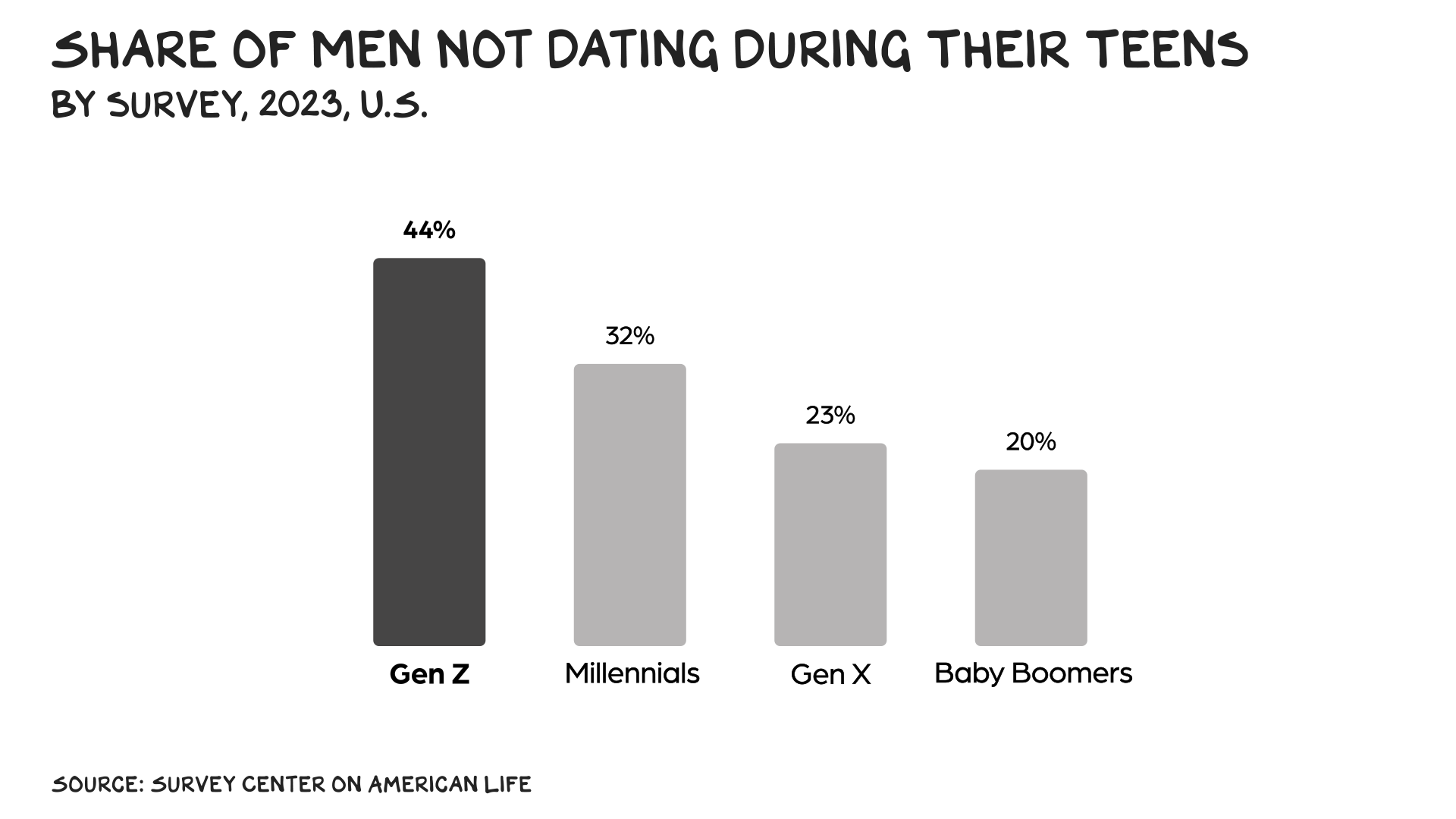
I encourage them to develop the skills, and courage, to initiate contact with girls and ask them out. My father told me that whenever you walk into a room with strangers (e.g., class, bar, dining hall), you should immediately, within 30 seconds, approach and speak to someone. Walk in, walk up to someone, and introduce yourself. Forty-four percent of Gen Z men report having no romantic relationship experience at all during their teen years. As Daniel Cox, a senior fellow at the American Enterprise Institute and director of the Survey Center on American Life, wrote in a post for the AIBM, “Parents invest an incredible amount of time and energy curating and cultivating learning opportunities and enrichment activities for their children. But dating and relationships are not things most parents stress, except in the negative.” That’s a problem for boys, as male friendships don’t fully prepare them for healthy romantic relationships in adulthood.
I want my sons to be good husbands someday, so I encourage them to approach girls with confidence, initiate a conversation, listen, and ask questions. Also, nothing is more attractive than a man who makes others feel safe. Men online make bullshit excuses about how they’re risking their professional reputation by approaching strange women. No, you’re not. If you’re respectful, and they’re not interested, everyone will be just fine. Also, rejection is a key input for building resilience. I had plenty of practice at rejection, and I’m a better man for it. One of the downsides of a digital age is the dangerous belief that we can avoid friction, much less rejection. Few young men are taking their shot unless it’s a (digital) layup. I tell my sons to take plenty of 3-point shots — applying for jobs you’re not qualified for, asking people out who you believe are out of your league. Nobody’s watching; nobody cares about your success/failure as much as you think they do.
Kids Want to Hear from Their Parents
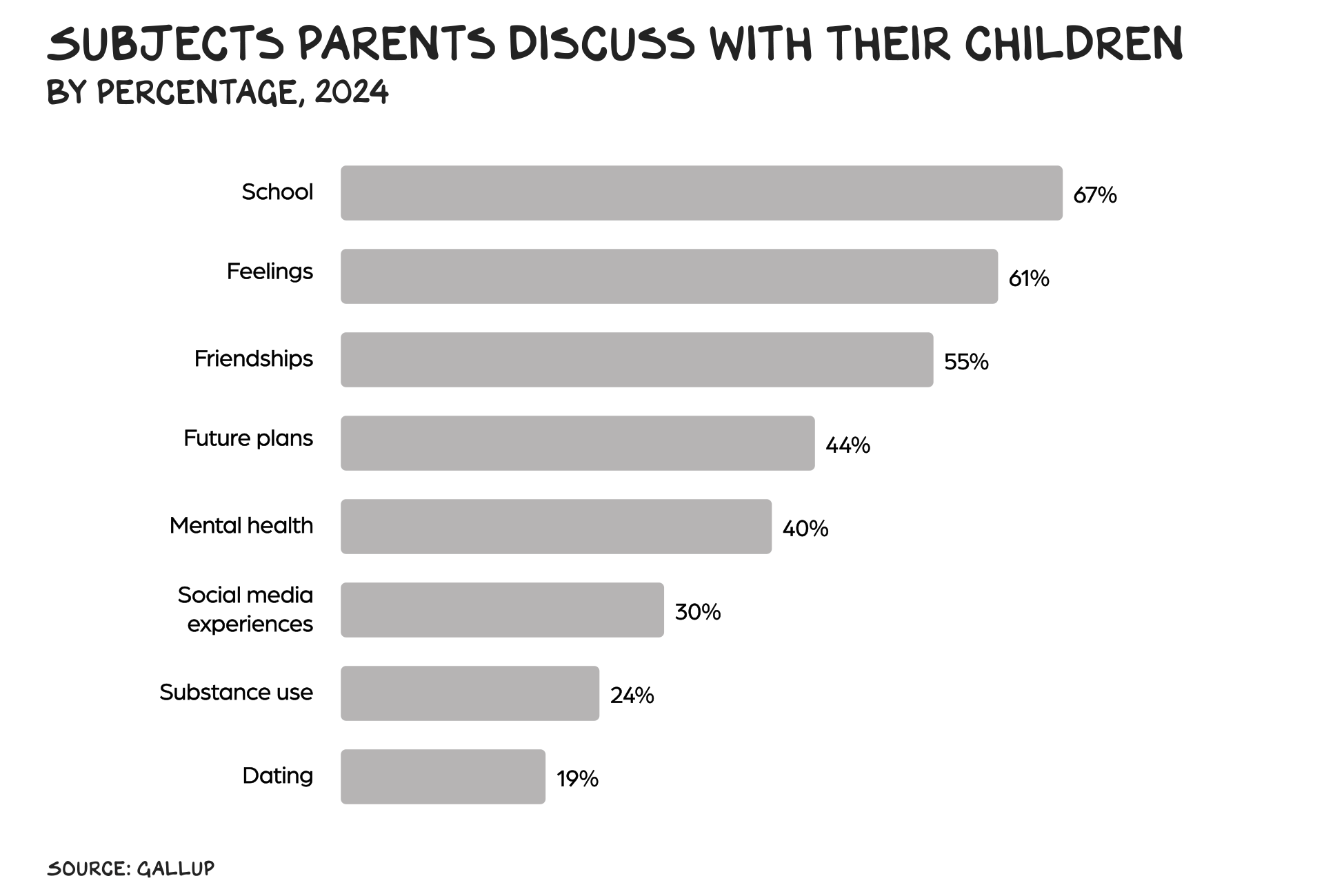
When we speak, I often get the feeling that my boys aren’t listening and don’t care what I say, i.e., they’re normal kids. But as they enter adulthood, children often wish their parents had talked to them more about sex and dating, even if their younger selves ran from the topic kicking and screaming. In a Harvard Graduate School of Education study that surveyed 2,200 men and women ages 18 to 25, 70% said they wished they had received more information from their parents about the emotional aspects of romantic relationships. According to Gallup, however, parents are 3.5x more likely to talk to their kids about school than dating. These talks are hard. But, as I often say, the right thing and the hard thing are usually … the same thing.
Father Figures
Motherhood is sacred, while fatherhood is misunderstood. Academics long viewed fathers as breadwinners and disciplinarians, i.e., tangential to raising children. But according to evolutionary anthropologist Anna Machin, fathers build an equally powerful but different attachment to their children than mothers do. “The bond between father and child is built upon stimulation, on physical activity, and on pushing the boundaries of development forward,” Machin wrote in an AIBM blog post, adding that fathers are the “parent of mental resilience.” For girls, whose identity and self-esteem are a function of close interpersonal relationships, fathers help navigate social complexity. For boys, fathers influence education and the development of an identity that expresses their masculinity. In other words, they prepare them for others.
Or Not
My father was absent during my formative years. I didn’t get many real conversations. Without my father’s presence, I suffered from a lack of character. I wasn’t a bad kid; I just wasn’t much of anything. No real code, or sense of how to behave in the myriad of random situations life throws at an only child left to his own devices as his mother worked and there were no tracking vehicles called iPhones.
I was also fortunate, as the void was filled by my friends’ dads, my mother’s romantic partners, a stockbroker who took an irrational interest in my well-being, fraternity brothers, and bosses who would pull me aside and tell me when I was fucking up. “This may be seen by some as a controversial statement,” Machin wrote, “but all teenagers need a father — whether biological, social, step, or adoptive.” My father figures never saw a return on their investment in me. Their purpose was preparing me for others. In chasing success, the biggest downside was absence. Specifically, I was on the road a lot. And, especially when my boys were young, things had a tendency to come off the rails at day 10 (days away from home).
The Little Prince
The first movie I remember feeling something about is The Little Prince. My partner gave me a ring inscribed with the line I love most: “What is essential is invisible to the eye.” I’ve spent most of my life chasing the visible: the house, the businesses, the stuff, the books, the status. All of it, I now recognize, was the means. The ends are invisible. Someday, in a room I’ll never enter, I’m hoping people will feel safer because my son(s) are in it. My oldest put a thread through the ring and wears it around his neck.
One day soon I’ll be gone. The houses will belong to someone else. The businesses will have new names. It’s all happening and disappearing so fast. My fear of death, however, is waning, as while I’ve spent my life trying to build things that would outlast me, I now recognize I’m raising them. And that’s comforting.
Life is so rich,

P.S. Thoughtful comments improve the quality of the Prof G community and inspire responses from yours truly (what a thrill). Spam, personal attacks, and off-topic comments devalue No Mercy / No Malice … for everyone. So we’re trying an experiment, restricting commenting to paid subscribers. Upgrade here to join the conversation.
How about the companion line,"On ne voit bien qu'avec le coeur." More or less, one can only see well or corectly with the heart. Classic.