




10
That’s how many grams of protein are in Buffalo Wild Wings’ Espresso Proteini, a cocktail infused with Buffalo Dry Rub.

OpenAI launches super app in bid to reverse Anthropic’s gains
A briefing for Disney’s new CEO: The clip economy is here
The Iran War could cost you $1,400
Newsletter Exclusive: The business of spirituality is booming

OpenAI Narrows Its Focus Amid Rising Competition
OpenAI is undergoing a major strategy shift. Last week, the company announced plans to merge ChatGPT, its web browser Atlas, and its coding platform Codex into one desktop “super app.” In a post on X, OpenAI CEO of Applications Fidji Simo wrote that the company was refocusing, doubling down on successful products and avoiding distractions.
Over the past year, OpenAI has announced a range of new products, including Atlas, Codex, and video generator and social media app Sora. According to The Wall Street Journal, employees say that this “do everything” approach has created a lack of focus and made it harder to understand the company’s strategy.
Once the clear front-runner in the AI race, OpenAI may be at a vulnerable crossroads. Despite an impressive suite of products, rival Anthropic’s public feud with the Pentagon and deft marketing have made it a more trusted brand. OpenAI has morphed into the kind of AI brand people fear — antihuman and disingenuous.
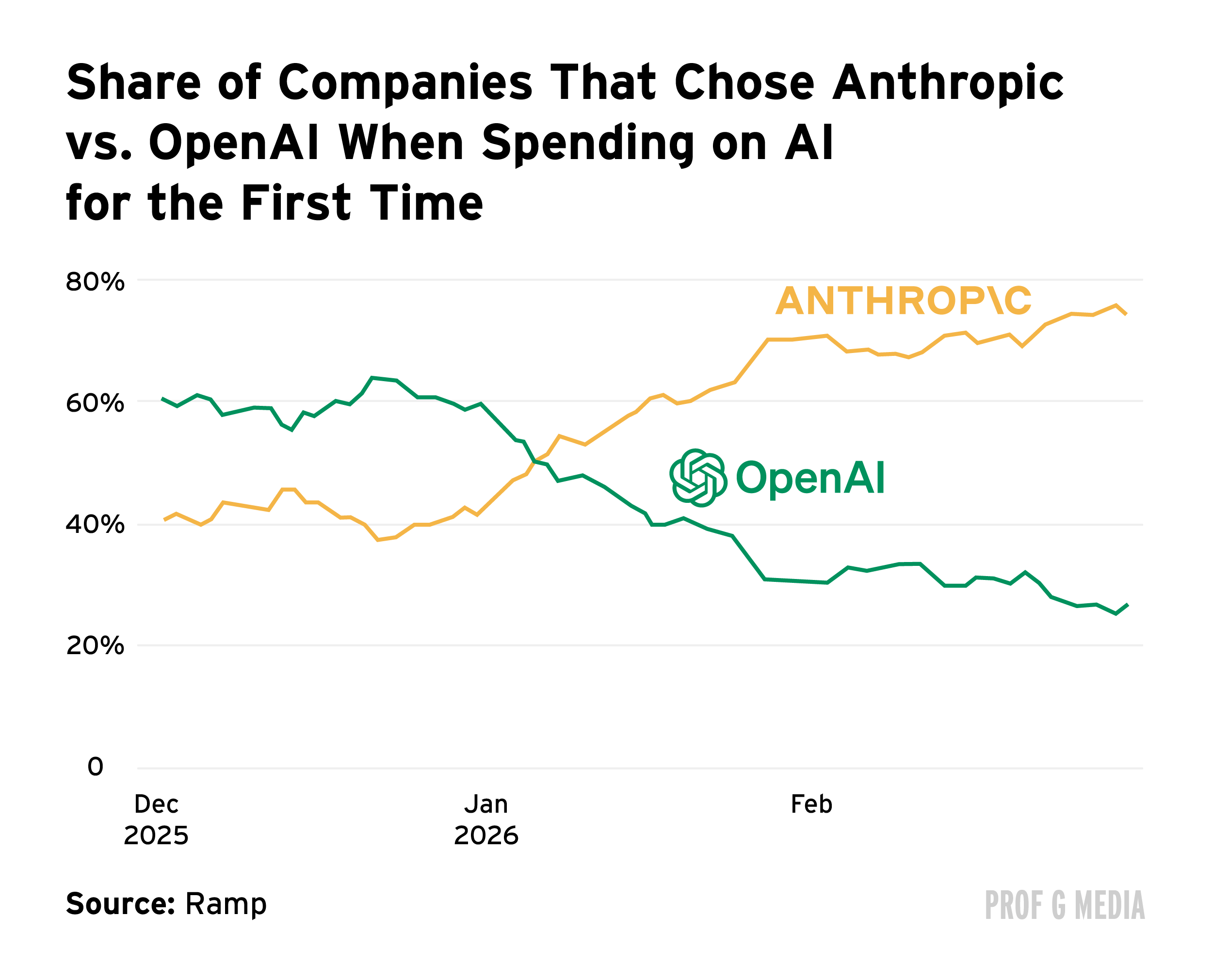
Anthropic’s lead in the B2B market has soared. It now captures over 70% of all spending among companies buying AI tools for the first time. As recently as December, OpenAI was capturing 60% of that spend.

This is a really good move on the part of Sam Altman and OpenAI. When you become a CEO, the question isn’t what to do — it’s what not to do. Every day you’re going to be pitched great ideas from vendors, investment bankers, employees. Everyone wants to be generous and visionary with your capital.
Whether a side bet works comes down to management. What often happens is a senior person has a vision, and the people who work below them know the way to get promoted is to tell them how amazing their side project is and what a visionary they are. Then the senior person starts ignoring the data.
A CEO’s job is to have the stones to try new things and the backbone to stop when they’re not working.
You need to define success before you start. Put hard metrics around success and failure and keep coming back to them.
You also have to understand sunk costs. The money you’ve spent is gone, the effort is gone. The only question that matters is: From a standing start, right now, would we continue to fund this side venture if we were outside investors with no legacy investment, no affection for it, no skin in the game?

What makes a good side project? When does it work? When does it not work? We discussed this as a team and we came up with three questions leaders should be asking.
Do you have the money for a side project? Amazon was generating hundreds of millions in annual free cash flow from retail before AWS launched in 2006. Meta’s metaverse bet failed, but its $80 billion in losses didn’t tank the company because the core business was strong.
Does it leverage existing infrastructure? In other words, are you the right person/company to be doing this? If you’re a clothing brand, you shouldn’t launch a candy company.
Instagram plugged directly into Facebook’s existing ad infrastructure.
Apple launched the App Store on top of iTunes’ existing billing relationships with tens of millions of paying customers.
Uber Eats plugged into the driver network and dispatch technology already built for rides.
Is it actually a good idea? No amount of capital or infrastructure will save a bad idea.


Disney’s New CEO Inherits a Company At a Crossroads
Disney has a new CEO. Josh D’Amaro officially took the helm last Wednesday, stepping in at a difficult time for the company. D’Amaro most recently served as chairman of Disney Experiences, which includes theme parks, cruise lines, and merchandising and accounted for 57% of the company’s total profits last year.
D’Amaro’s appointment suggests the company is refocusing on Experiences. Disney has already pledged a $60 billion expansion of the division through 2033, including doubling its cruise ship fleet and building its first Middle East theme park in Abu Dhabi.
But despite Disney’s unbelievable IP and must-visit parks, the stock has struggled. A $10,000 investment in Disney stock 10 years ago would now be worth $8,000, after adjusting for inflation. A similar bet in the S&P 500 would be worth about $20,000.
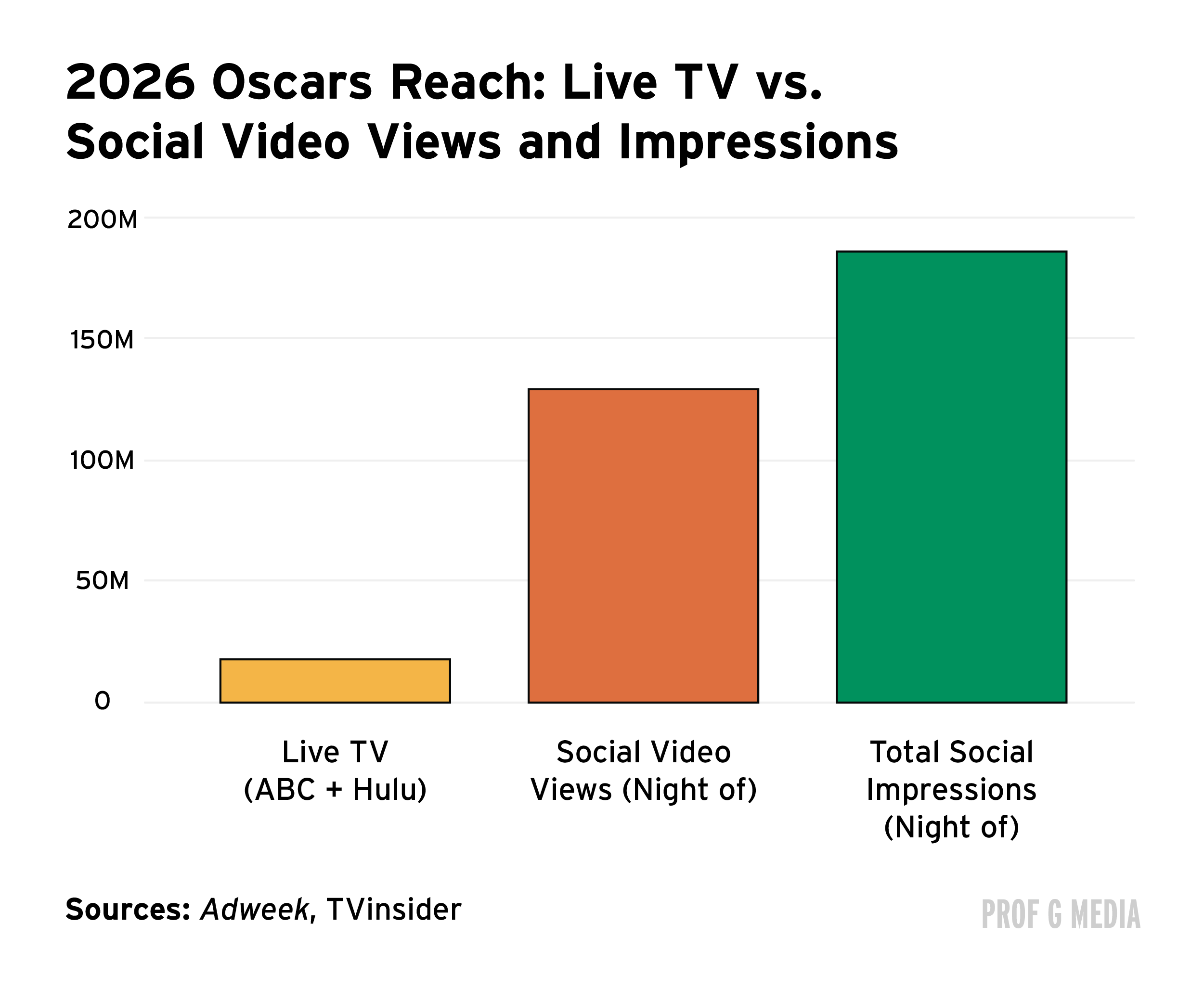
Part of the challenge is that live events like the Oscars, once advertiser magnets, are in decline. Oscars viewership last weekend fell 9% from a year earlier, and in the 18-to-49 key demographic, viewership fell 14%.
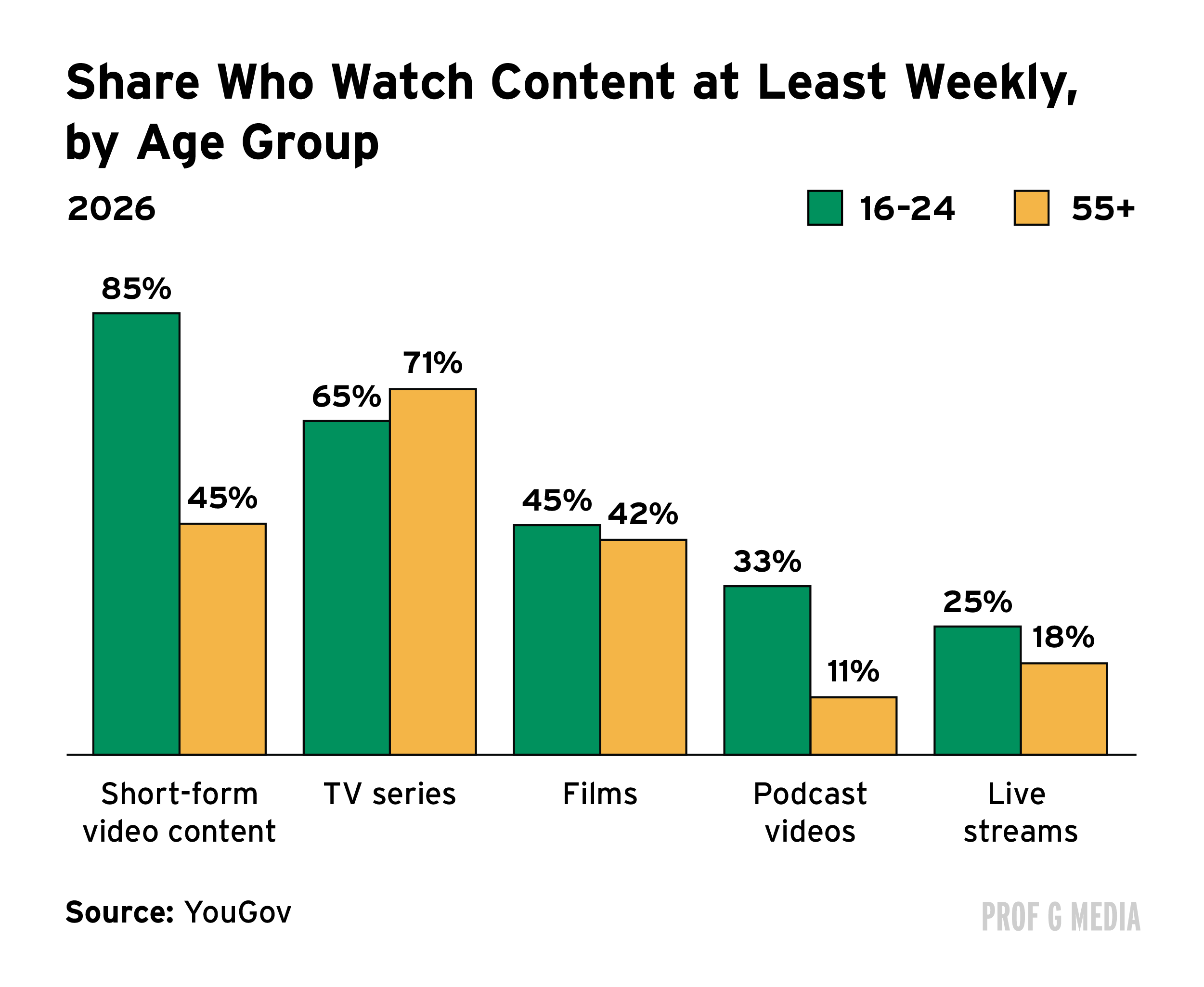
Young people are still watching these events, but they’re not watching on TV, or even on streaming services — they’re watching clips on their phones. Almost 70% of Americans ages 16 to 24 watch clips from shows instead of the full versions.
Even in live sports, roughly half of NFL, NBA, and MLB fans between 18 and 34 say they prefer watching highlights of their favorite sports over full games.
Now just 31% of sports fans ages 18 to 24 watch live full-length matches, compared with three-quarters of fans ages 55 and older.
This trend has given rise to “clippers,” people who break long-form content down into catchy bite-sized clips. They’re typically paid between $1 and $5 per thousand views, so they’re motivated to find the most viral moments. Some are making as much as $30,000 per month, proving that the demise of one industry is an opportunity for another.
The live Oscars on ABC are a Trojan horse. The live event is really just a vehicle for the clips that get put out on social media the day after — that’s where people are consuming all of this content.
If I had to give advice to Disney, they should start investing in the clip economy.
The problem right now is monetization. If you just post clips on Instagram and collect whatever Instagram pays you, Instagram owns the advertiser relationship — not you. You have to get aggressive about owning that relationship — working with advertisers directly and negotiating deals before anything goes live.
You shouldn’t post a clip on social media unless an advertiser is directly paying you for it. The current system is that media companies just do it for free, thinking that it’s marketing. But it’s not. The clips are the content. That’s where all the money is being made.
If you’re watching the Oscars on ABC, it means you’re also at that point where you need an opioid-induced constipation medication. Conan O’Brien, one of the most talented people in the world, summarized it perfectly when he said that the next host is gonna be Mr. Beast. He was joking, but it’s kinda true.
The future for awards ceremonies is bleak. The future is experiential events.
I met with the Board of Governors for the Academy, and they asked for advice. I told them: What you should be doing is running live Oscars-viewing parties all over the world with an aspirational guest list — influencers, actors, etc. Charge brands a sh*t ton of money to sponsor them.
People would pay a lot of money to go to a great viewing party, get dressed up, feel fabulous, and meet interesting people.

The Iran War Is Coming For Your Wallet
Last week, the Trump administration requested up to $200 billion in additional military funding for the war in Iran, a conflict the president promised at the outset would be finished “pretty quickly.” The same day, news broke that the national debt hit a record $39 trillion.
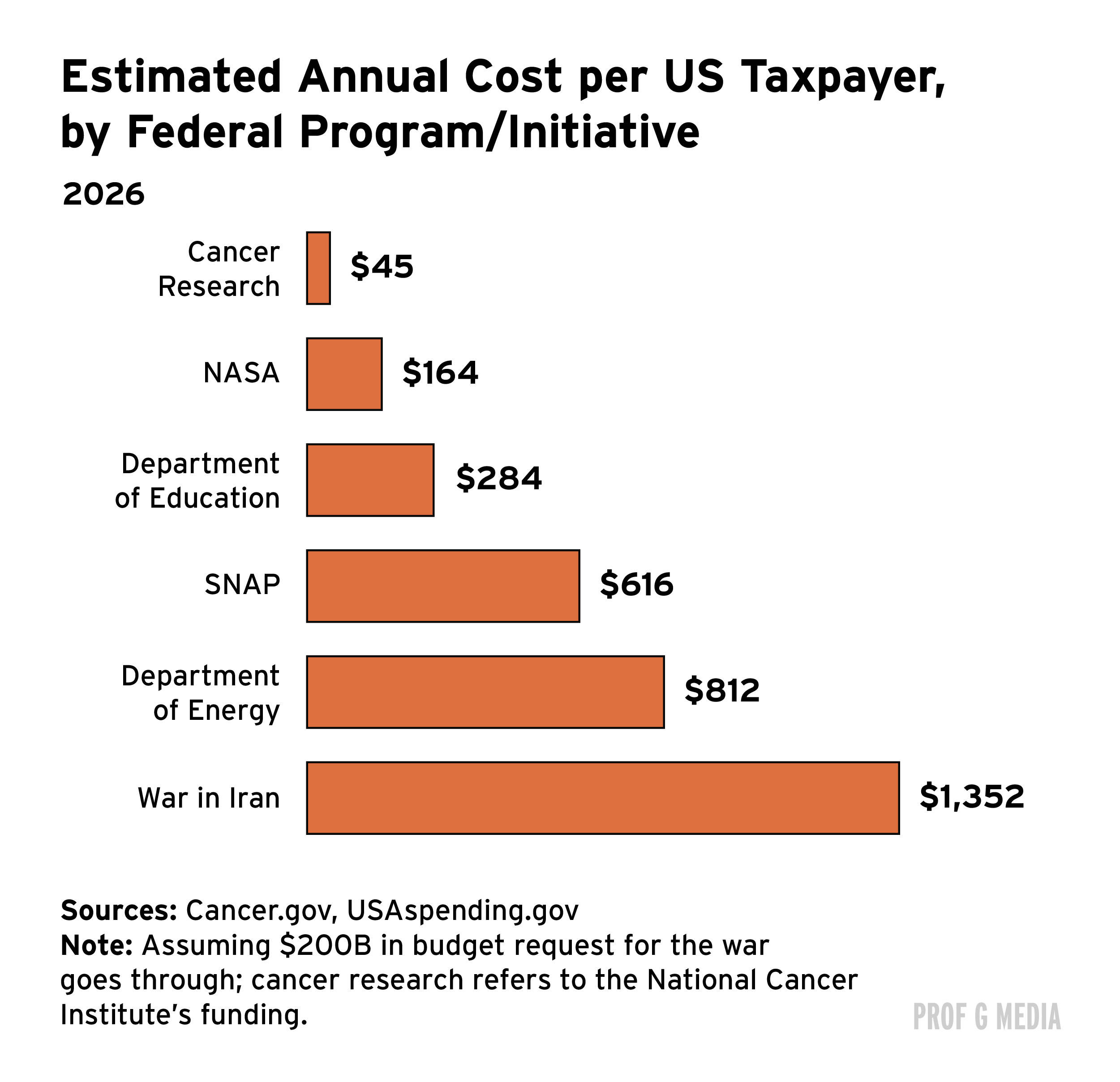
Operation Epic Fury has already cost $23 billion. That’s more than triple the National Cancer Institute’s funding. It’s enough to build more than 72,000 units of affordable housing, provide SNAP benefits to 2.5 million households, or offer free preschool to 1.5 million kids.
On an individual taxpayer basis, the war has already cost you nearly $140. If the additional $200 billion in funding goes through, the cost per taxpayer would be about $1,400. Do you have anything you’d rather spend $1,400 on?
A less obvious, but consequential impact of the war is its effect on interest rates. The Iran shock has pushed inflation expectations high enough that the Fed, which was expected to cut rates twice this year, might not be able to cut at all. This means that borrowing costs across the economy, from mortgages to car loans and credit card debt, will stay elevated.
This increases the risk of stagflation, a dangerous economic condition where slow growth is accompanied by high inflation and unemployment. Inflation already increased 3.4% last month, before the war pushed gas prices higher, and GDP growth for Q4 2025 was revised down to 0.7% from 1.4%.
I was more open to military action than most people. But there’s no denying it: The administration did not do any real scenario planning around what happens when the Strait of Hormuz closes, and Americans, along with the rest of the world, are paying for it across the board.
Contrast that with previous conflicts. The first Gulf War: George Herbert Walker Bush, 35 nations, $70 billion total cost, $62 billion reimbursed by allies, a UN resolution behind it. The second Gulf War at least had a symbolic coalition. This one is officially us and Israel.
This goes to what I think is the fundamental mistake of this administration: the belief that cooperation is not the key to Western prosperity. The American consumer is now absorbing the cost of that miscalculation at the pump, at the grocery store, and on their mortgage statement.
We’re 25 days into a war with Iran, and it’s making everything more expensive. Oil prices are surging because 20% of the world’s supply passes through the Strait of Hormuz. Prices at the pump are up over 30%.
For every dollar increase in gas prices, the average household has to spend an extra $530 per year. For low-income families this is extremely painful, as they already spend roughly a fifth of their income on energy costs.
What are the implications of this, and what should we do about it?
You can read more of my thoughts on the economic impact of the war in tomorrow’s edition of Simply Put. Subscribe here.


For Gen Z, the Horoscope Is Replacing the Hymnal
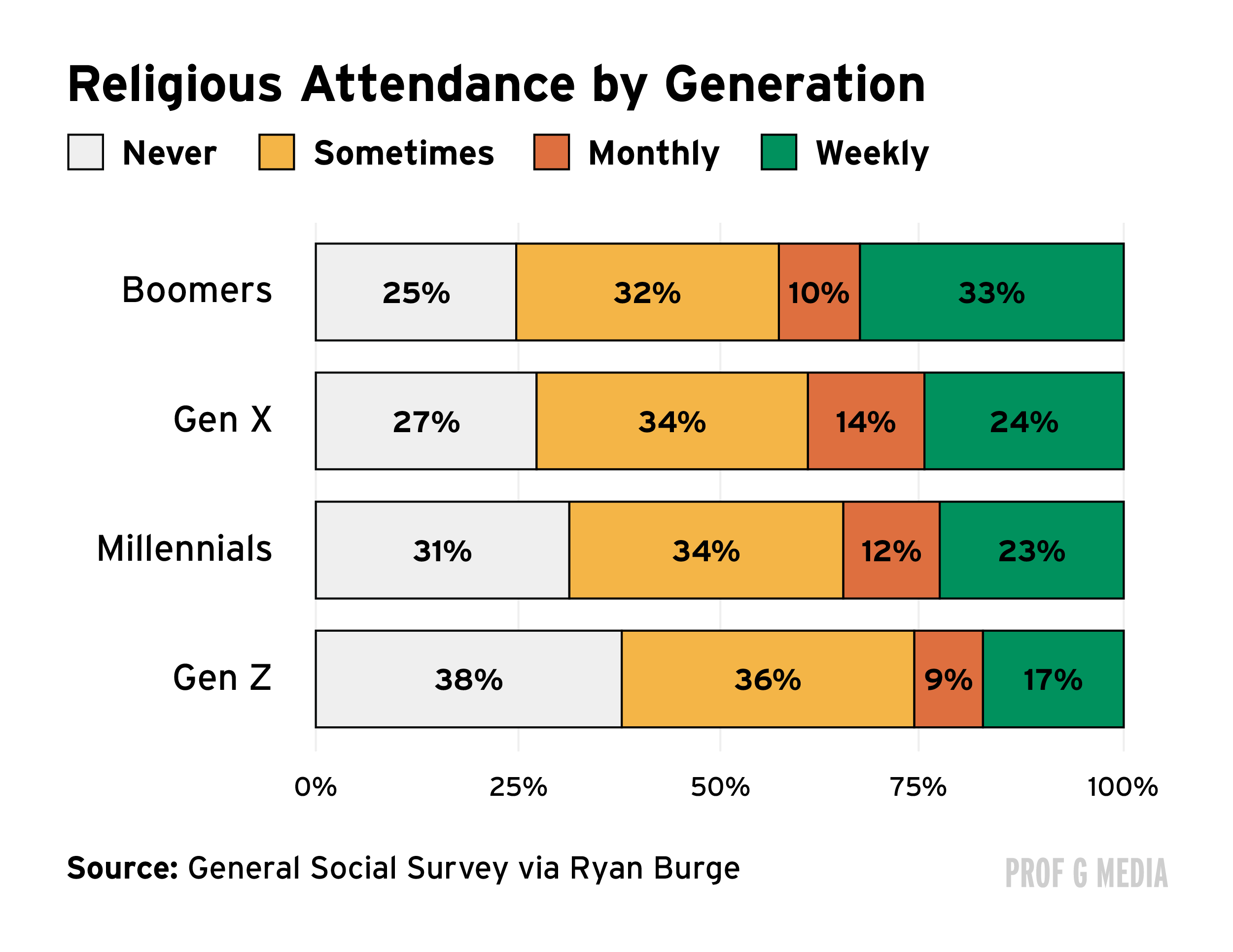
Gen Z is the least religious generation in American history — yet, they’re the biggest consumers of spiritual services.
Religion used to do three things: give people community, identity, and a framework for navigating uncertainty. Ironically, Gen Z needs all three more than any other generation. They’ve entered a job market that doesn’t want them: Entry-level hiring has dropped 35%. Eighty percent report feeling lonely, compared with 45% of baby boomers. And, they’ve gotten priced out of the lives their parents had: The average down payment on a home is 70% of household income, up from 45% in 2000.
This is a cultural shift, but it’s also an economic one. Organized religion contributes an estimated $1 trillion to the U.S. economy annually — as much as the entire sports industry. As Gen Z moves away from churches, temples, and mosques, their money will flow elsewhere. So far, it’s going to astrological apps and psychic content creators online.
Answers in the Stars
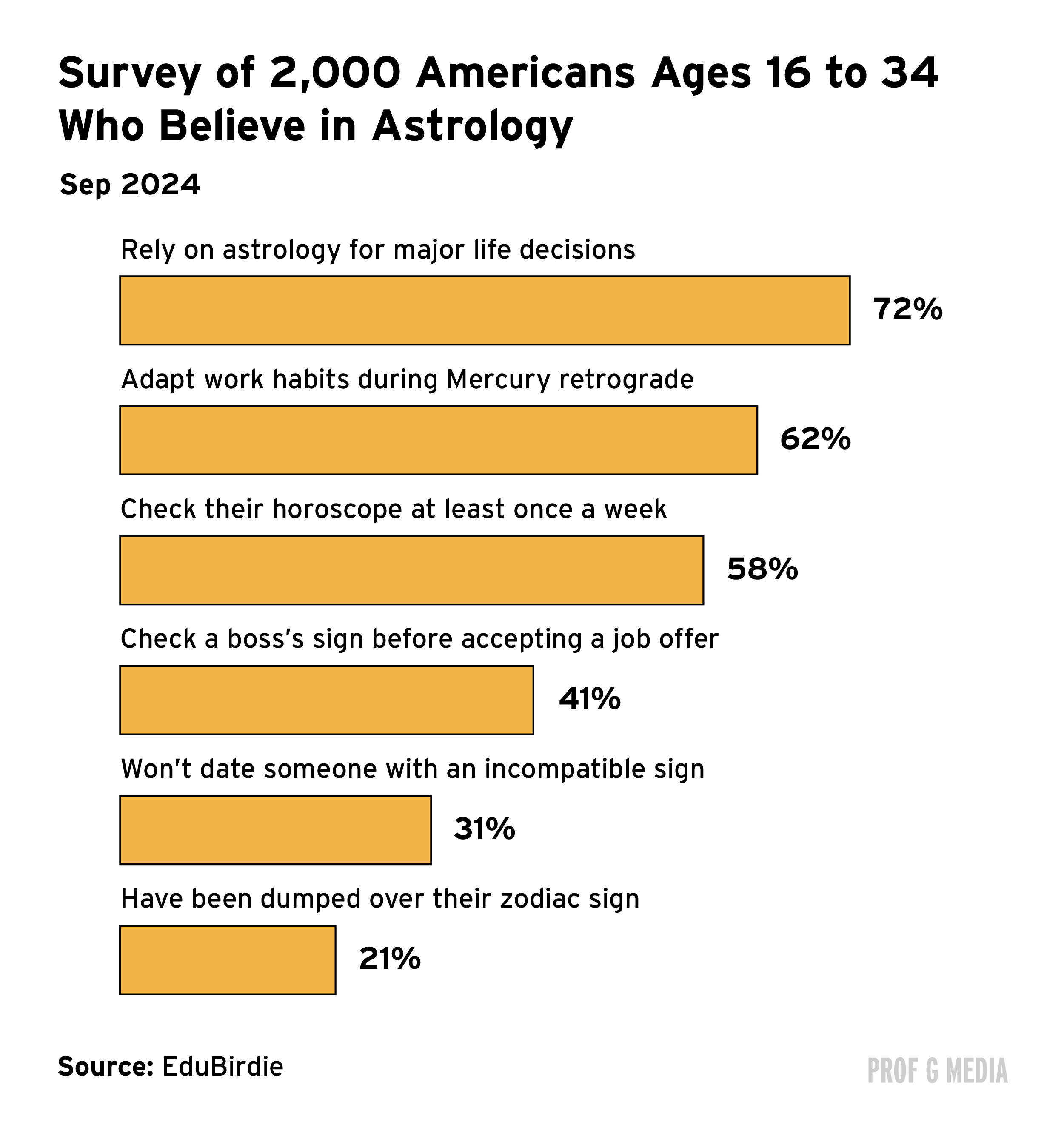
More than 30% of Americans under 50 believe in astrology — that the position of the stars and planets can affect people’s lives. Women are more than twice as likely to believe as men.
Astrophiles take their readings seriously: More than 70% of Gen Z and millennial believers use astrology to make major life decisions, and almost a third wouldn’t date someone with an incompatible horoscope.
Mainstream apps are catching on: Last week, Tinder unveiled a new “Astrology Mode,” which drove a 23% increase in likes.
These services don’t come cheap: Birth chart readings and psychic consultations can cost up to $350. If you want to become a practitioner, the highest-rated astrology certification courses cost $2,000 to $8,000.
The uninformed may also be surprised to learn that there is a thriving market for spells and curses on Etsy. Despite officially banning magical products more than a decade ago, the site has become home to thousands of listings, most under $20 and promising results within 24 hours.
Desperate job hunters buy employment spells, lovebirds buy spells for good weather on their wedding day, and disgruntled shoppers can buy revenge or karma curses. The top five spirituality sellers on Etsy have made nearly $40 million.
A new ecosystem of astrology apps have emerged with relative success. Ukrainian startup Nebula has 30 million global users and $50 million in annual recurring revenue. Starcrossed, which promises to help users find their astrological soulmates, hit $70,000 in monthly revenue within 90 days of launching. Co-Star, billed as an app that “deciphers the mystery of human relations through NASA data and biting truth,” has more than 30 million registered users.
AI Is the New Priest
The psychic industry then figured out what every other content business learned over the past four years: Mediocre content has no moat in the age of AI. Birth charts, horoscopes, tarot readings, and compatibility reports can now be produced algorithmically and delivered in seconds.
Earlier this month, Astro-Seek, one of the most popular free astrology platforms on the internet, went down after being overwhelmed by AI.
The cause: Astro-Seek added a ChatGPT data export tool that allowed users to feed their birth chart directly into AI. The feature became too popular, and the site crashed.
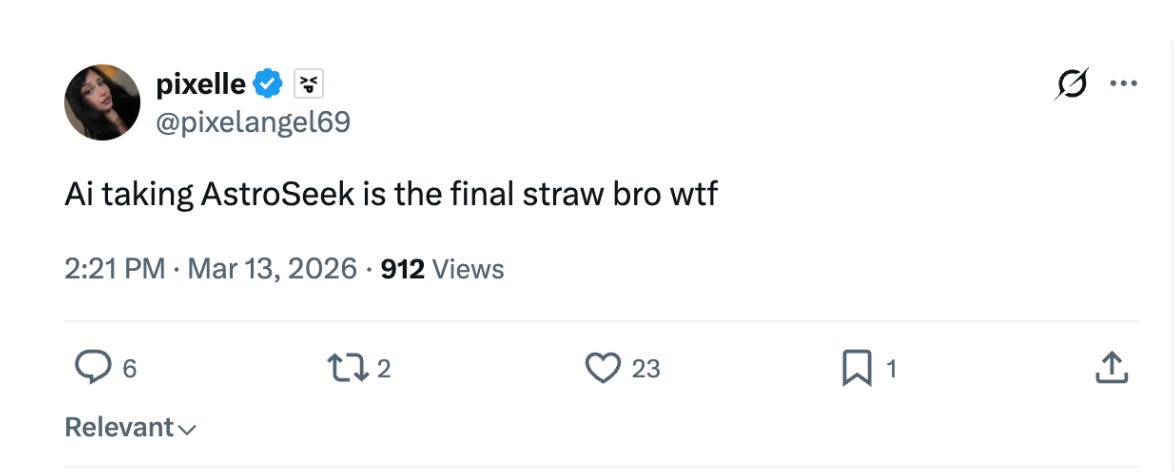
Naturally, Mercury was in retrograde.

Mercury in Retrograde
Three to four times a year, Mercury appears to move backward in the sky due to an optical illusion. In astrology, Mercury governs communication, technology, and travel, so when it goes into retrograde, believers say those systems go haywire: emails get lost, flights get delayed, exes return. Astrology believers attempt to avoid making major life decisions during this period.
There is no scientific evidence that it affects any of this.
Seeing the Future
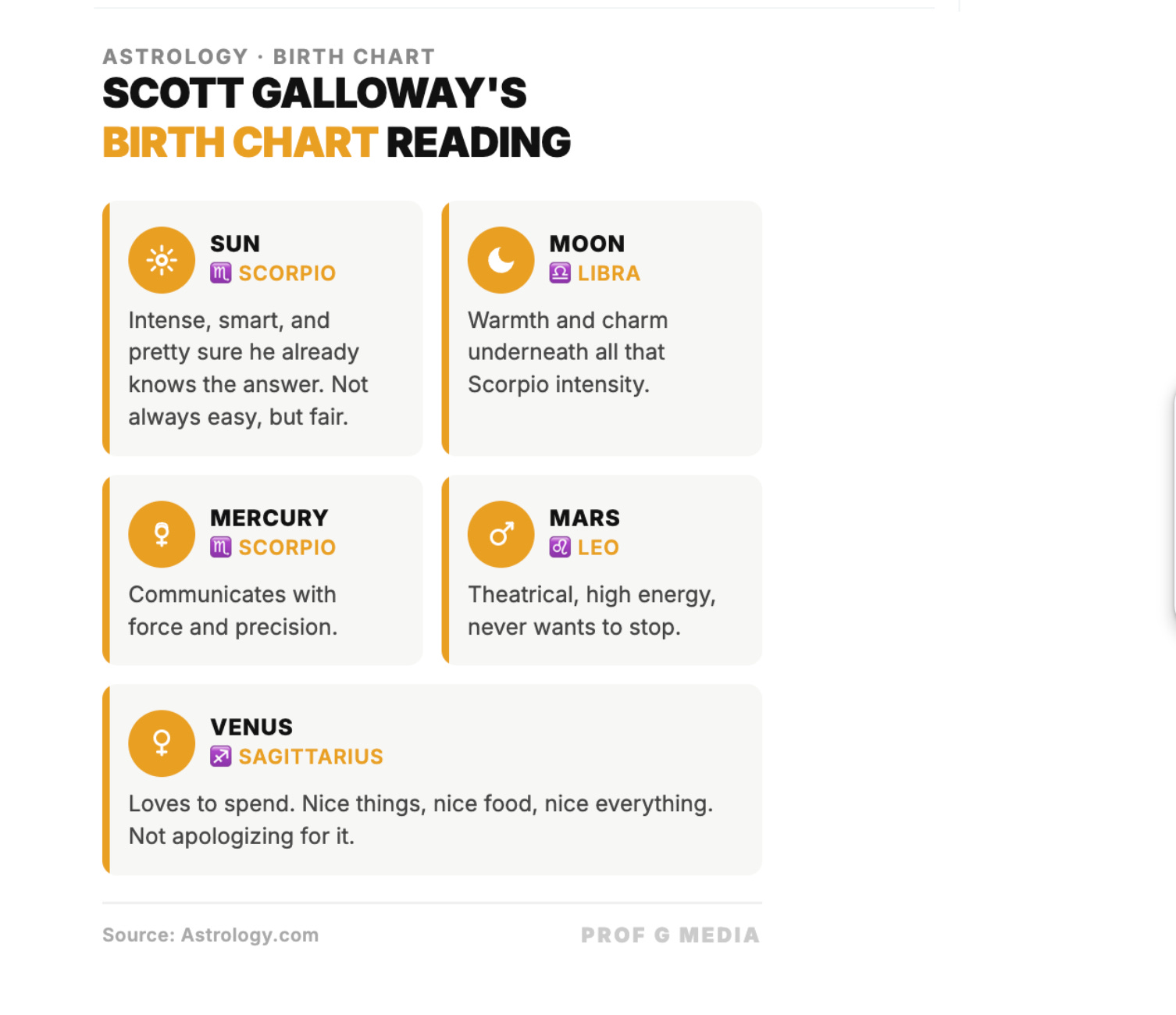
We make a lot of predictions at Prof G Media, but we have never gotten one from a professional. This week, we asked Carol — @astrostarr4 on TikTok — for her best markets prediction and birth chart reading for Prof G himself. If she’s right, we might just have to bring her in-house.

Saturn and Neptune just moved into Aries. Aries is the first sign of the zodiac — energy, action, beginnings. This is a really good time to make money. That said, Saturn is also telling you to slow down and check every detail before you sign anything. This is not a time to be careless.
On the world stage: The planets are pointing to a period of serious global conflict. A lot of skirmishing and instability. Pluto is in Aquarius for the next 20 years. A smarter, more connected world is coming. We are just in the messy middle of getting there.

OpenAI’s Sora social media app is going to be shut down. Sora is OpenAI’s version of TikTok, but it’s all AI-generated content. Downloads are collapsing — they fell 32% month over month in December and another 45% in January.
This app is not central to OpenAI’s core competencies, it’s not attracting users or revenue, and it’s going to be the first victim of the company’s renewed focus.

Join Scott live on Substack on Wednesday, March 25 at 1 p.m. EDT for a discussion of his latest book, Notes on Being a Man. Bring your questions. Prof G+ subscribers can sign up here.
Not a subscriber? Prof G+ includes ad-free podcasts, unlimited newsletters, and exclusive livestreams. Sign up here.

Don't these statistics on the lack of interest in organized religion contradict the rise in Bible sales? According to Publishers Weekly, "Bible Sales Break Records in U.S., U.K." I'd be interested to see your take on this contradiction, especially as I've heard that younger men are leading this interest in reading the Bible after the death of Charlie Kirk. How does that relate to your interest in young men?
Of late, whilst advocating for his earnest ‘resist + unsubscribe’ movement, an arguably rare but noble cause from Prof G et al, the Big Dog is also, incessantly imploring his followers to pay for his own Prof G+ content. I’ve followed Scott for years. Hired him to speak to my company (remotely) during Covid. Own 3 of his books. But this dichotomy is just too much. I deeply admire what he’s built. Call me jealous even, that’s not unfair. But, I think he’s lost touch here. Fandom only garners one so much willful ignorance. I’ll get hate for this, because righteous indignation is strongest from sycophants who don’t want their choices (or their heroes) questioned. It should be called out, regardless. He’s brilliant, but he has also lost touch. Both things can be true.