



A delivery problem on our end kept yesterday’s Markets newsletter from going out as planned. Sorry for the gap. It’s fixed, and the full issue is below. Thanks for reading.

21.4 million
That’s how many Americans used cannabis daily in 2025, making it the most frequently used substance, ahead of alcohol and cigarettes.

A leverage craze cost South Korean retail investors $39 billion
Big Tech earnings recap: the quarter the market turned on AI spending

How Leveraged ETFs Crashed South Korea’s Stock Market
South Korea’s main stock index, the KOSPI, fell 44% from its June 19 high last week — its worst crash since the Great Recession. Then, on Friday, after bullish reports of AI demand from Big Tech firms, the KOSPI rebounded 18%, its largest ever one-day gain. There’s one culprit behind this volatility: leveraged ETFs.
The initial crash stemmed from concerns over the circular financing, hidden debt, and record capex that is fueling the AI buildout. SK Hynix and Samsung, two key AI chip suppliers that make up more than half the value of the KOSPI, both fell as much as 24% and 29%, respectively, last week before rebounding.
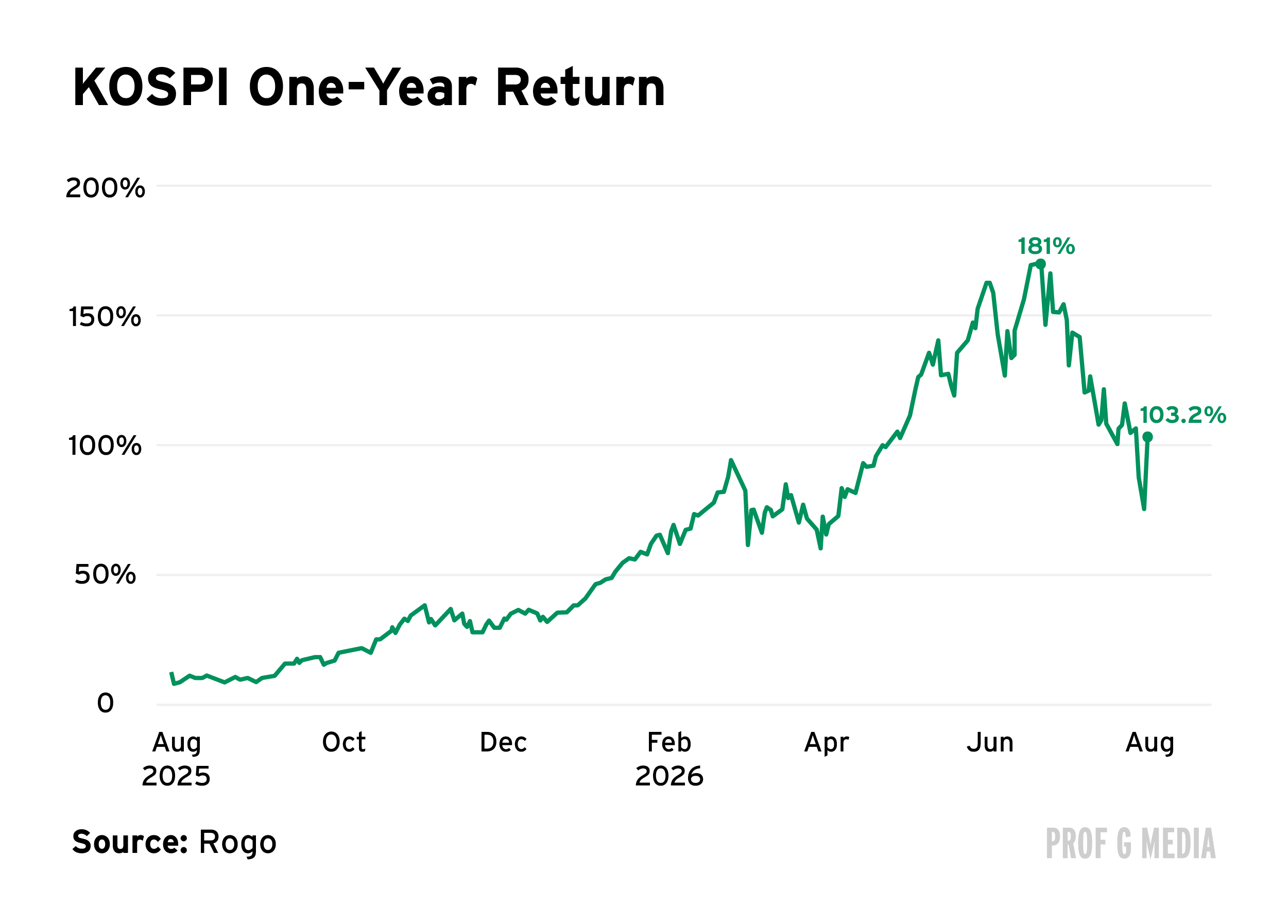
The drawdown wouldn’t have been so dramatic if not for a key ingredient: leverage. Single-stock leveraged ETFs, which multiply the daily price movements of one specific stock, launched on the South Korean market in May and quickly became popular with retail investors. By early July, leveraged ETFs, SK Hynix and Samsung made up 70% of all trading value on the South Korean market.
Leveraged ETFs amplify a stock’s upside — but also its downside. Ninety-two percent of investors in these ETFs were retail investors, and they’ve incurred an estimated $38.7 billion in losses. An estimated 1.2 million South Koreans — 3.4% of the adult population — have now received a margin call. It is estimated that between 1% and 5% of retail stock trading accounts in the U.S. received a margin call in 2008.
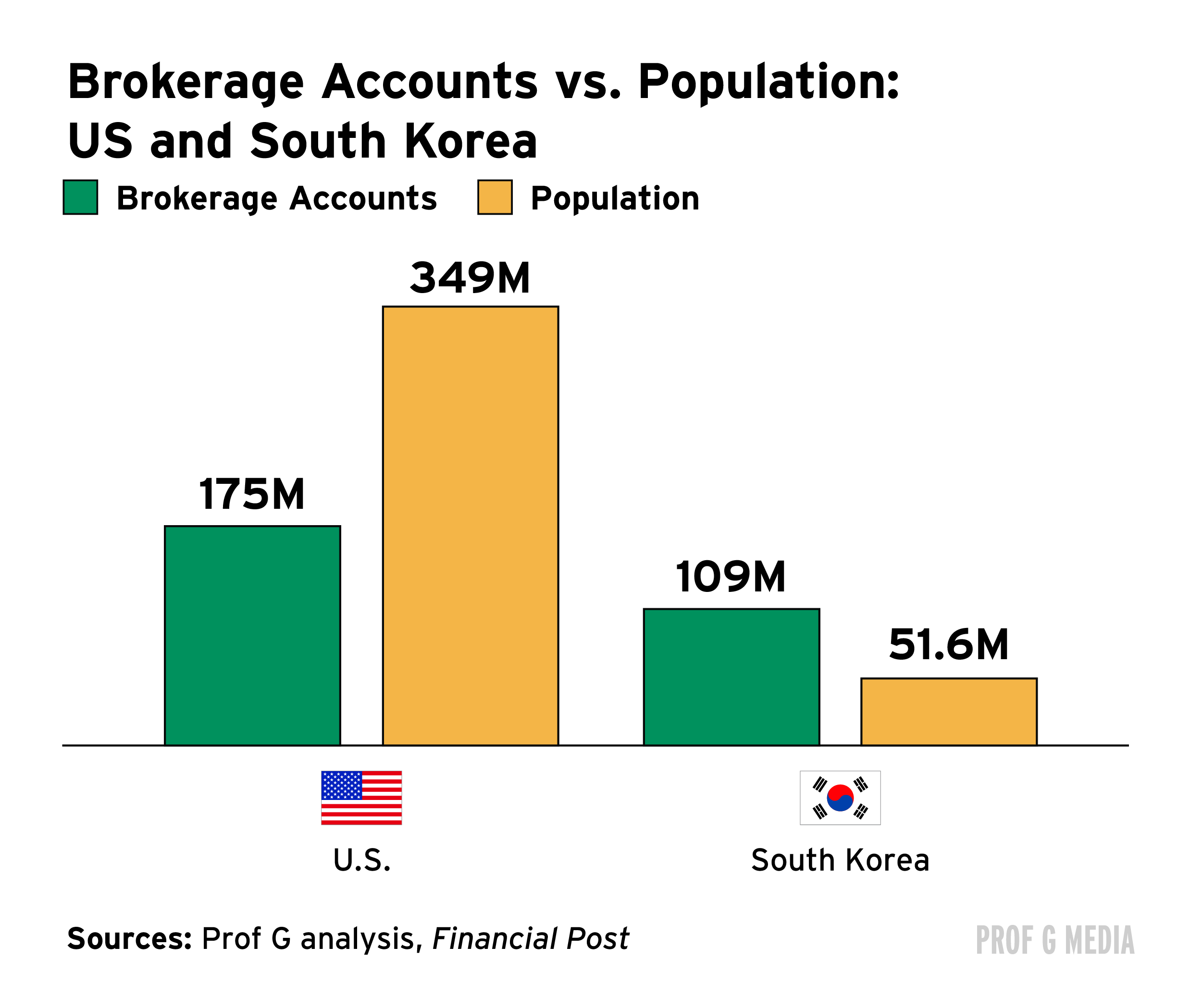
Earlier this month, South Korea’s Financial Services Commission announced plans for a nationwide debt-counseling hotline as part of a suicide prevention initiative.
South Korea’s finance minister apologized last week, saying the ETFs were introduced without careful consideration. Regulators are now restricting retail access and have halted new listings of single-stock leveraged ETFs.
One member of South Korea’s parliament, Lee Jong-wook, went a step further saying: “The country has turned into a casino.”
To many retail investors, this response has come too late. Outside the National Assembly Building in Seoul, funeral wreaths have appeared with signs reading “Slaughtering retail investors” and “Wait ’til pay back time, I will repay next time I vote.”
This isn’t just a South Korea problem. U.S. assets under management in leveraged ETFs have reached a record $218 billion, up 60% since the end of March. While they still represent a small share of the overall asset class (1%), they represent 40% of all ETF trading volume.

A margin call? First, you need to understand buying on margin. Buying on margin means purchasing stock using borrowed funds. For example, say you use $5,000 of your money plus a $5,000 loan to buy $10,000 of stock. If that stock rises 20% to $12,000, you pay back the $5,000 loan and keep $7,000, turning your $5,000 into a 40% gain instead of the 20% you’d have made without borrowing (minus a bit of interest the broker charges). Buying on margin is attractive because the loan amount stays fixed while the gains apply to the whole position.
But what happens if the stock falls? U.S. regulators require that investors maintain an equity level of 25% of the total value of their securities when buying on margin. So if your $10,000 position falls to $6,000, you still owe $5,000 to your broker, which means only $1,000 of that stock is actually yours. Once your stake falls under the minimum equity level (also called the maintenance margin), your broker has to issue a margin call: You must deposit more cash immediately to rebuild your equity level, or the broker will have to sell your stock to get the $5,000 back — usually while the price is still falling, which locks in your loss.


Charlie Munger famously said there are three ways a smart person can go broke: liquor, ladies, and leverage. The sin of leverage is that it steals your most powerful tool as an investor, which is time. An unleveraged investor can ride out volatility. A leveraged investor gets margin called out of the game before the recovery ever comes.

I have a theory about why this happened. Few nations face a loneliness crisis as severe as South Korea’s, where an estimated 5% of the country’s 11 million young adults live in a state of “extreme social withdrawal.” The marriage rate has fallen 40% in a decade, and it’s gotten so bad that local governments are now paying people to get married.
Part of the problem is that partnership is tied to economic status. Only 8% of the men in the bottom decile of earners in South Korea are in a relationship. In the top decile, it’s around 4x higher.
And getting rich the normal way isn’t working. Someone under 30 would need 22 years of saving all of their disposable income for a down payment on the average apartment in Seoul. Traditional paths to wealth creation seem futile, so 5x leverage on Samsung or SK Hynix starts to look like the only remaining shot at upward mobility.
We’re seeing the same patterns in the U.S. with loneliness and financial nihilism. Young people are levering up on stocks and praying it delivers not just money but also the life that money is supposed to buy them. South Korea is ground zero for a problem America is about to run into.

The Big Tech Earnings Scorecard
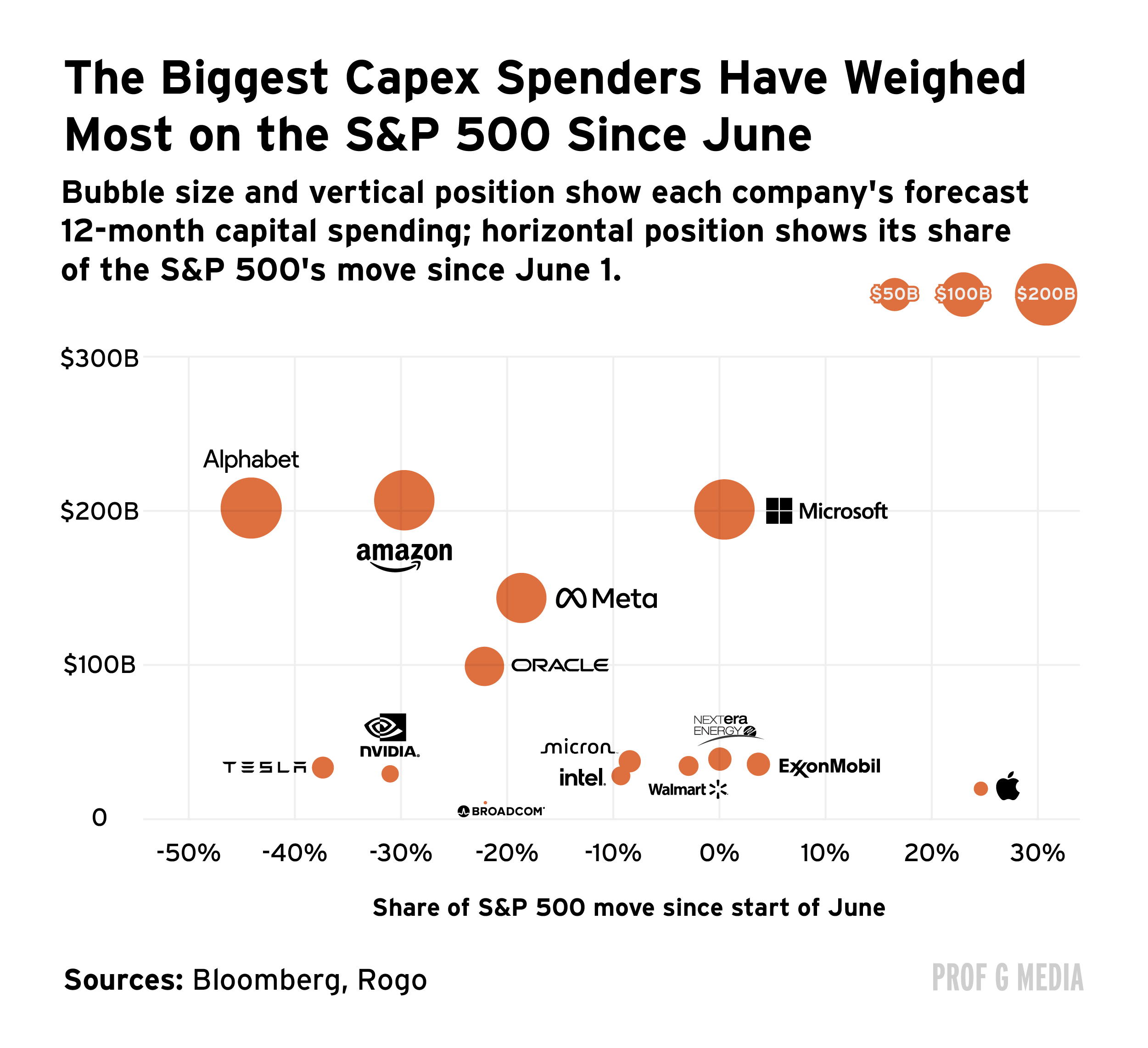
Capital expenditures guidance and commentary moved markets this earning season — and shaped analysts’ outlook on the broader AI economy. The numbers were astonishing: Amazon, Google, Microsoft, and Meta spent a cumulative $165 billion on capital expenditures this past quarter. That’s an 87% increase from a year ago and a 393% increase from three years ago.
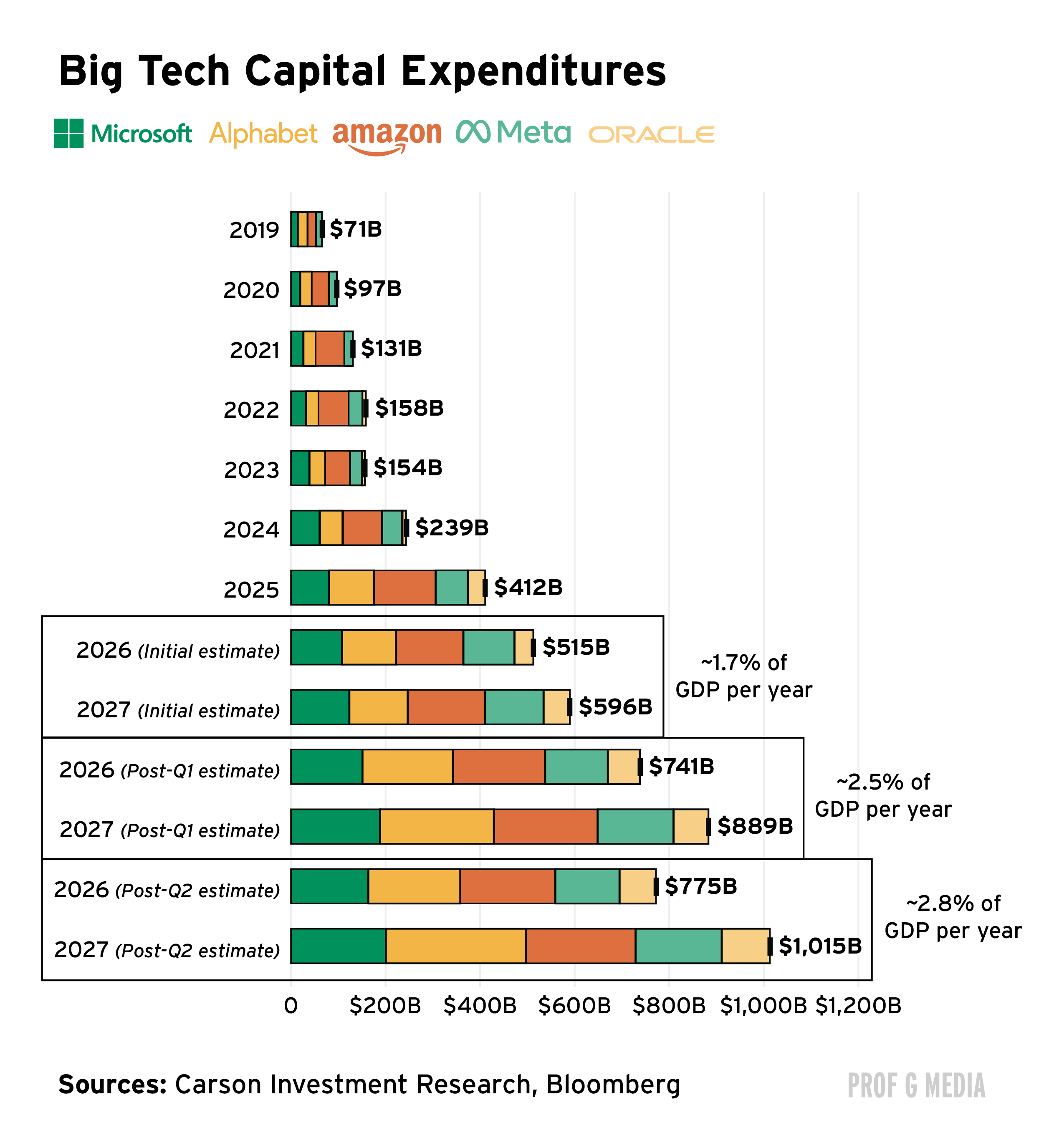
For most of the AI boom, investors viewed increased capex spending as a bullish sign of future growth potential. Hyperscalers were supposed to pour money into AI, and the ones that didn’t were going to be left behind. Now, the narrative has flipped, and investors have stopped rewarding capex without clear returns.
Investment in AI has grown astronomically. Big Tech is now spending more on AI capex annually than the U.S. spent on the Apollo program on an inflation-adjusted basis. Earning a return on this investment, according to The Economist, would require revenues of roughly $2.5 trillion per year. The cumulative revenue from AI today is about $150 billion.
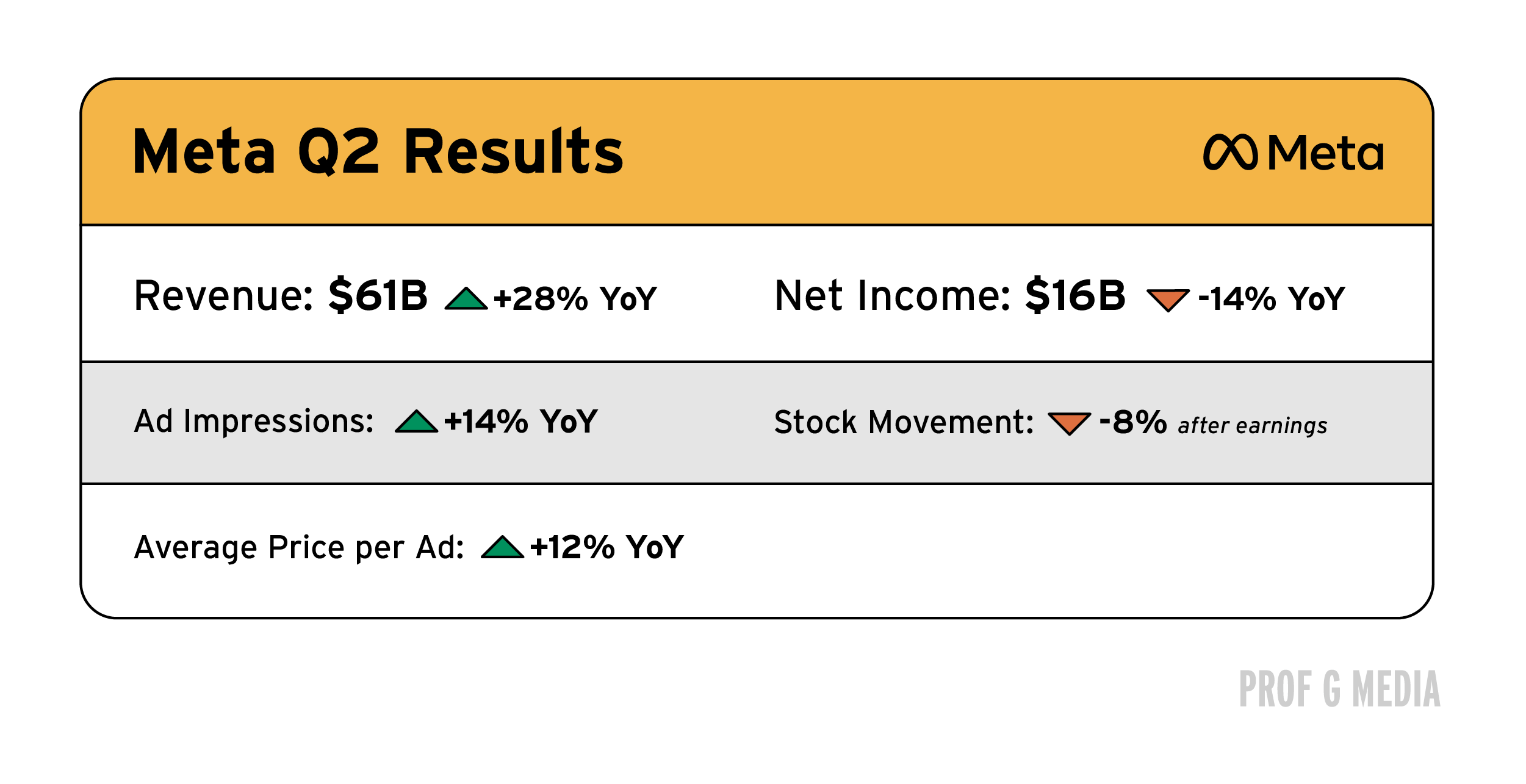
Meta shares plummeted after the company signaled weaker-than-expected revenue guidance and announced a 91% decline in free cash flow. Analysts now expect the company to report negative free cash flow this year for the first time since its IPO in 2012.
One of the biggest concerns for Meta is that, unlike Alphabet, Amazon, and Microsoft, it doesn’t have a cloud business to provide justification for its AI spending. On the earnings call, CEO Mark Zuckerberg failed to explain how the company plans to monetize AI, providing no details about Meta’s plans to sell excess compute or its deal with Anthropic.
Meta is spending tens of billions of dollars on data center infrastructure, and Zuckerberg did not have a clear answer as to how he’s going to generate a return on those investments. Remember, this is the man who lost $80 billion on the metaverse and renamed the entire company on a pipe dream. We’re getting to a point where you want to see more responsible spending — or at least reasonable justification for it.
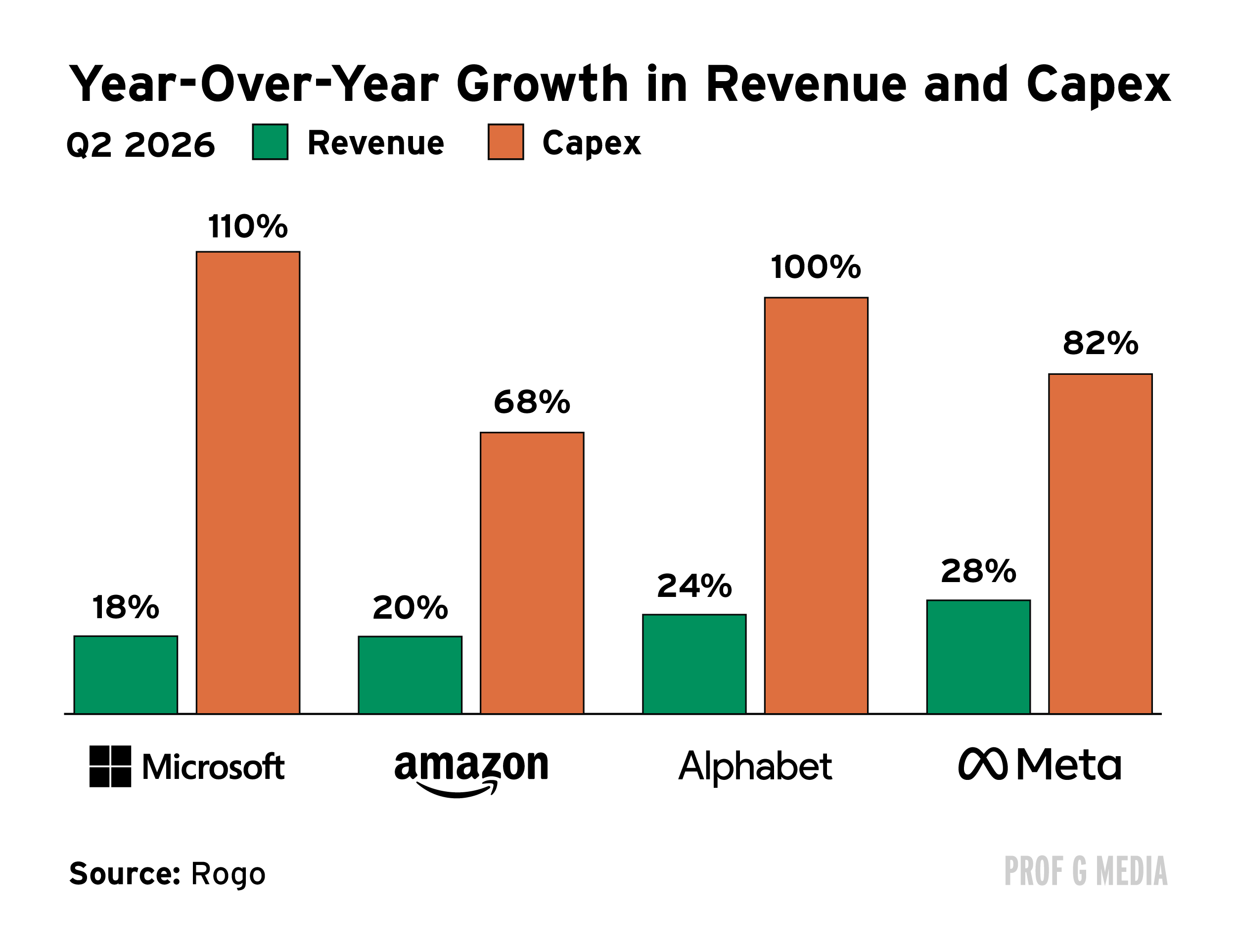
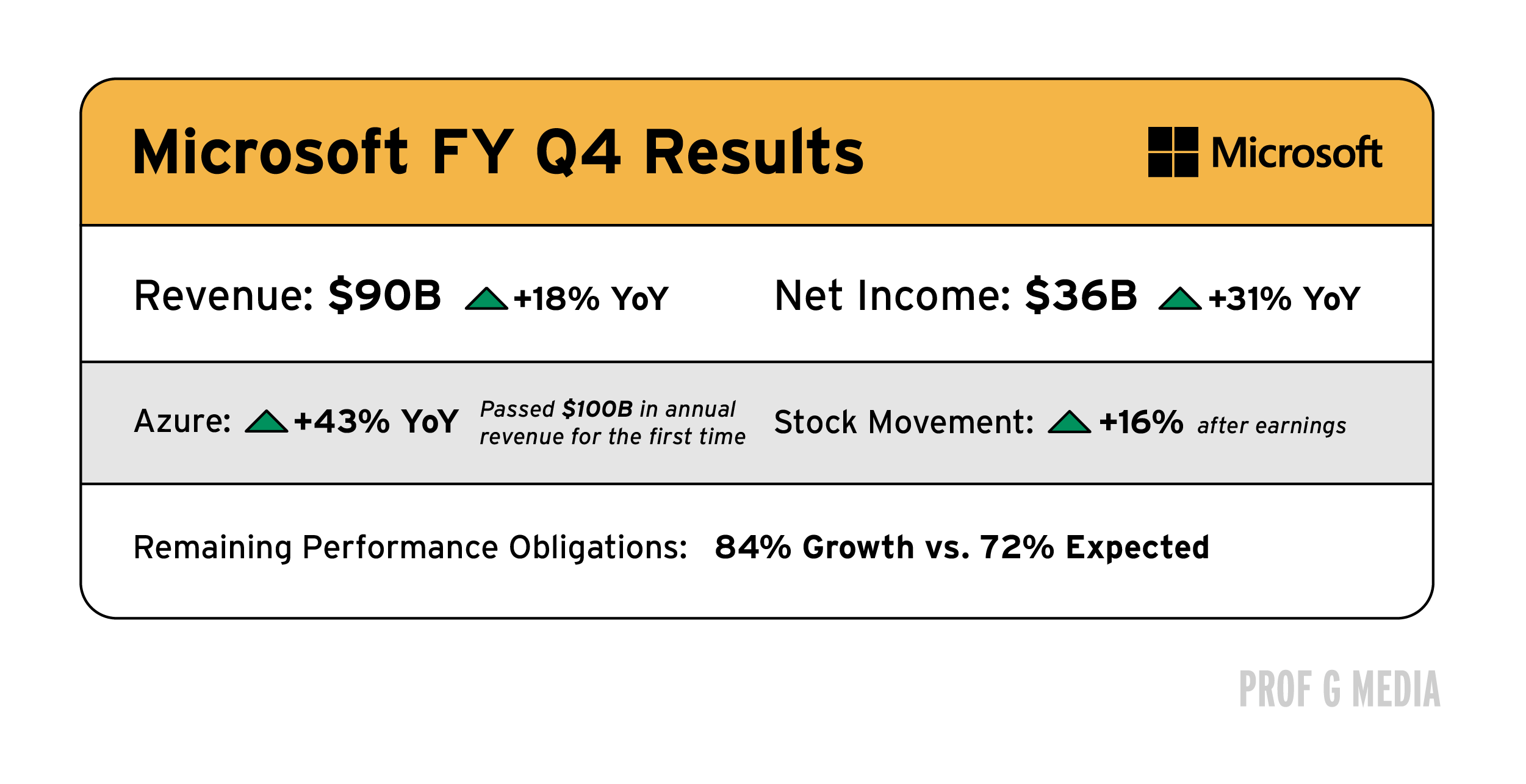
Microsoft was rewarded for turning AI investment into revenue. After reporting earnings, the stock popped 16%, adding roughly $450 billion to its market cap — the largest single-day jump for any company in stock market history.
Microsoft’s AI assistant, 365 Copilot, reached over 30 million paid seats, making it one of the largest revenue-producing AI products in tech. Azure crossed $100 billion in annual revenue, up 43% for the quarter. And Microsoft’s “Productivity and Business Processes” segment — the part supposedly most exposed to AI disruption — grew 14% year over year to nearly $40 billion for the quarter.
Just as important to the stock’s reaction was Microsoft’s decision to hold its capex forecast constant. Restraint and growth proved to be the winning combination.
If you can point to real AI revenue, the market’s going to reward you. That’s what Microsoft did here.
Microsoft is the one company here I feel good about in terms of AI risk. Free cash flow is coming down, but it’s still positive — unlike Google’s and Amazon’s, which went negative.
It’s also the only one being straight with us about customer concentration. Microsoft told us about their remaining performance obligations, which is their future revenue coming down the pipeline. In January, they told us that half of those RPOs were tied to OpenAI. This quarter, they said that the 82% growth they were registering in their RPOs would have been 25% if it weren’t for OpenAI. Amazon and Google are also reliant on OpenAI and Anthropic, but those companies haven’t been nearly as up front as Microsoft has been.
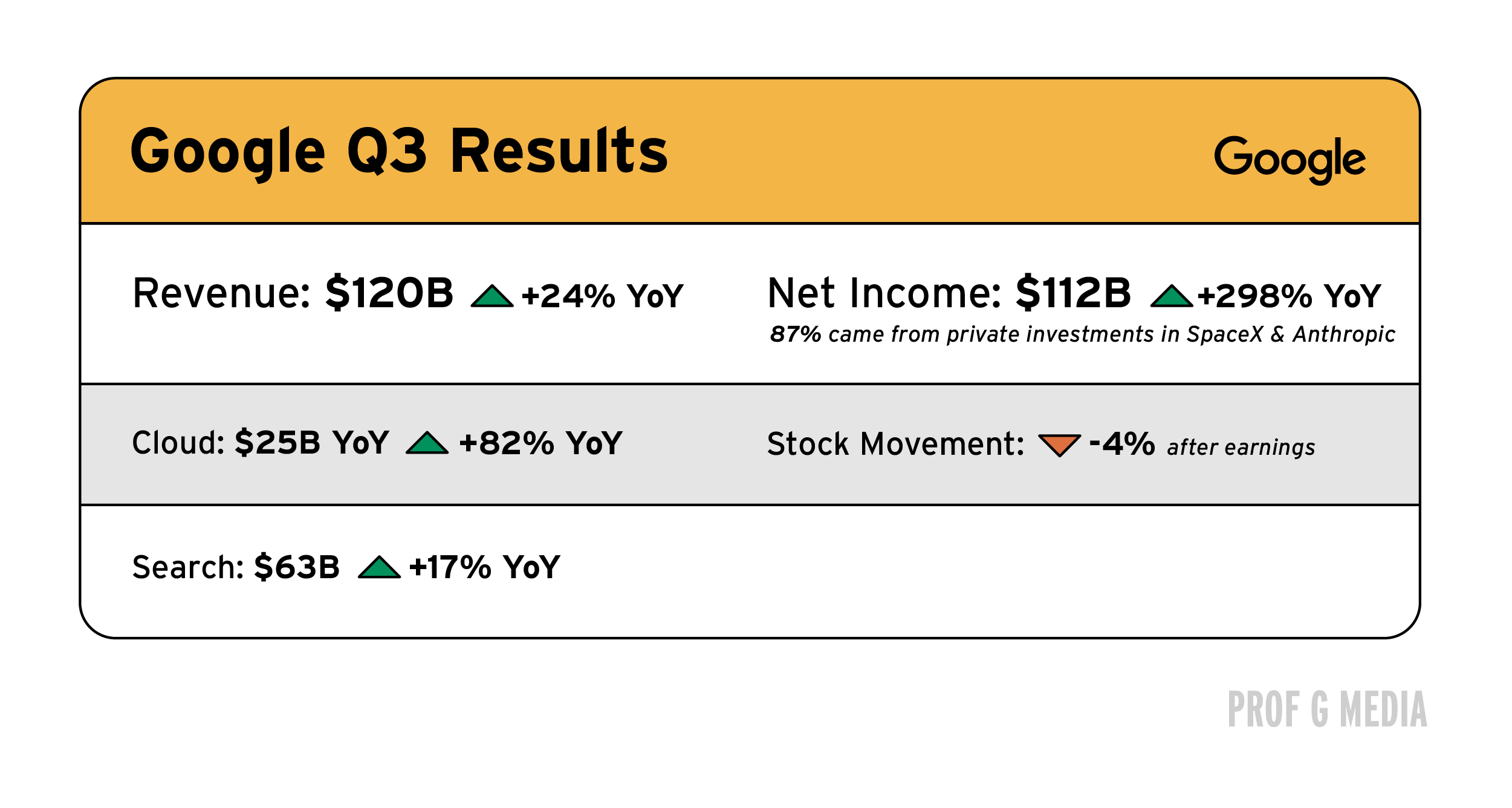
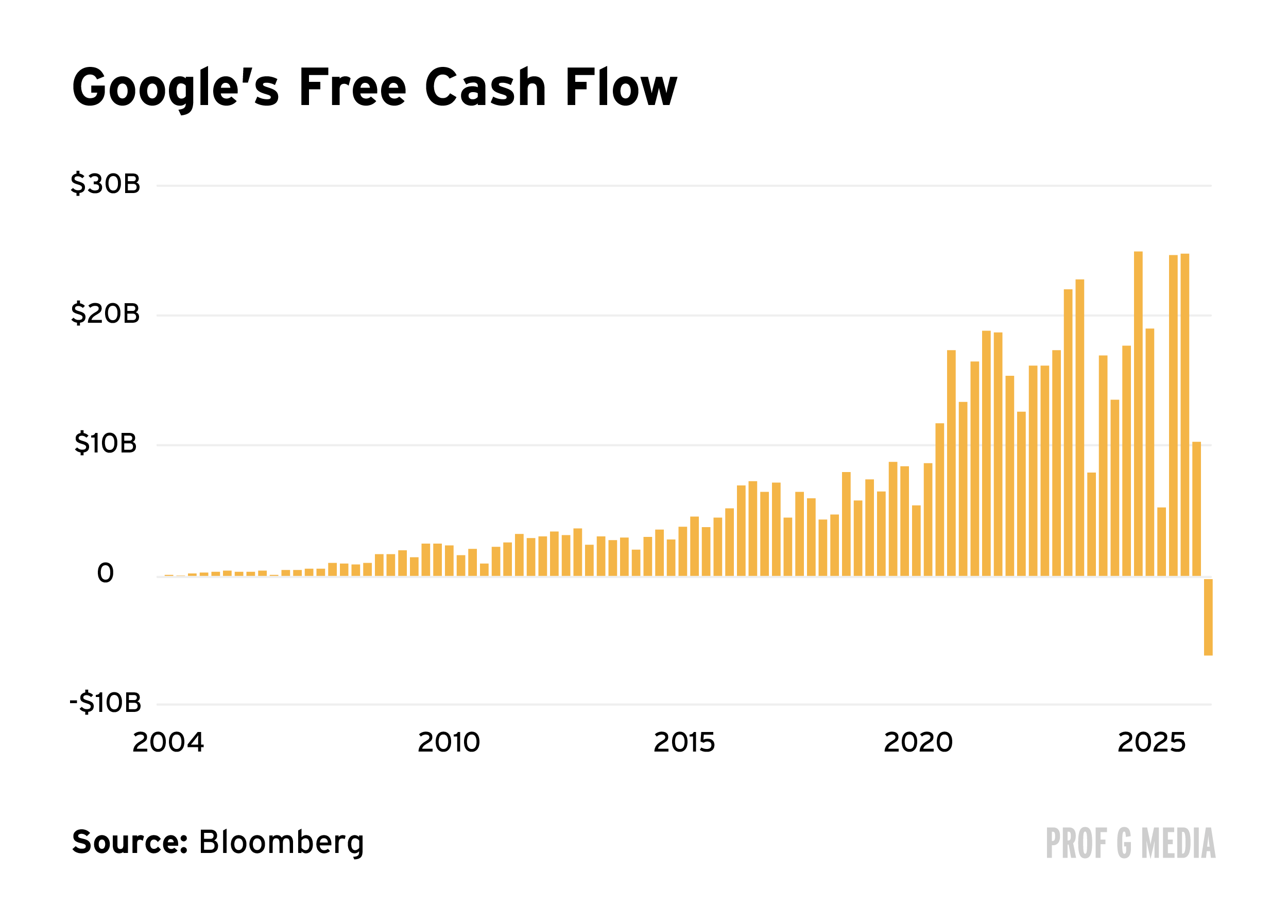
Google posted blowout results: 82% growth in the cloud business and 17% growth in search, but the stock still fell. The reason? For the first time in its history as a public company, Alphabet posted negative free cash flow. Capex spending has been eating away at the company’s revenues. Over the past three months, Google has spent nearly $45 billion on AI infrastructure — that works out to roughly $490 million per day. Also, capex estimates for the full year surpassed $200 billion. Analysts are now forecasting that capex for 2027 could be as high as $280 billion.
That being said, Google’s competitive position in AI is strong: Gemini reached 950 million monthly active users, closing in on ChatGPT’s one billion users, and CEO Sundar Pichai noted that nearly 90% of Fortune 100 companies have adopted Google’s Gemini Enterprise.
The company’s net income quadrupled, but there’s an important wrinkle: 87% of that came from markups in Alphabet’s stakes in Anthropic and SpaceX. By Prof G Markets analysis, Google’s price-to-earnings multiple of 17x is really 31x, excluding gains from private investments.
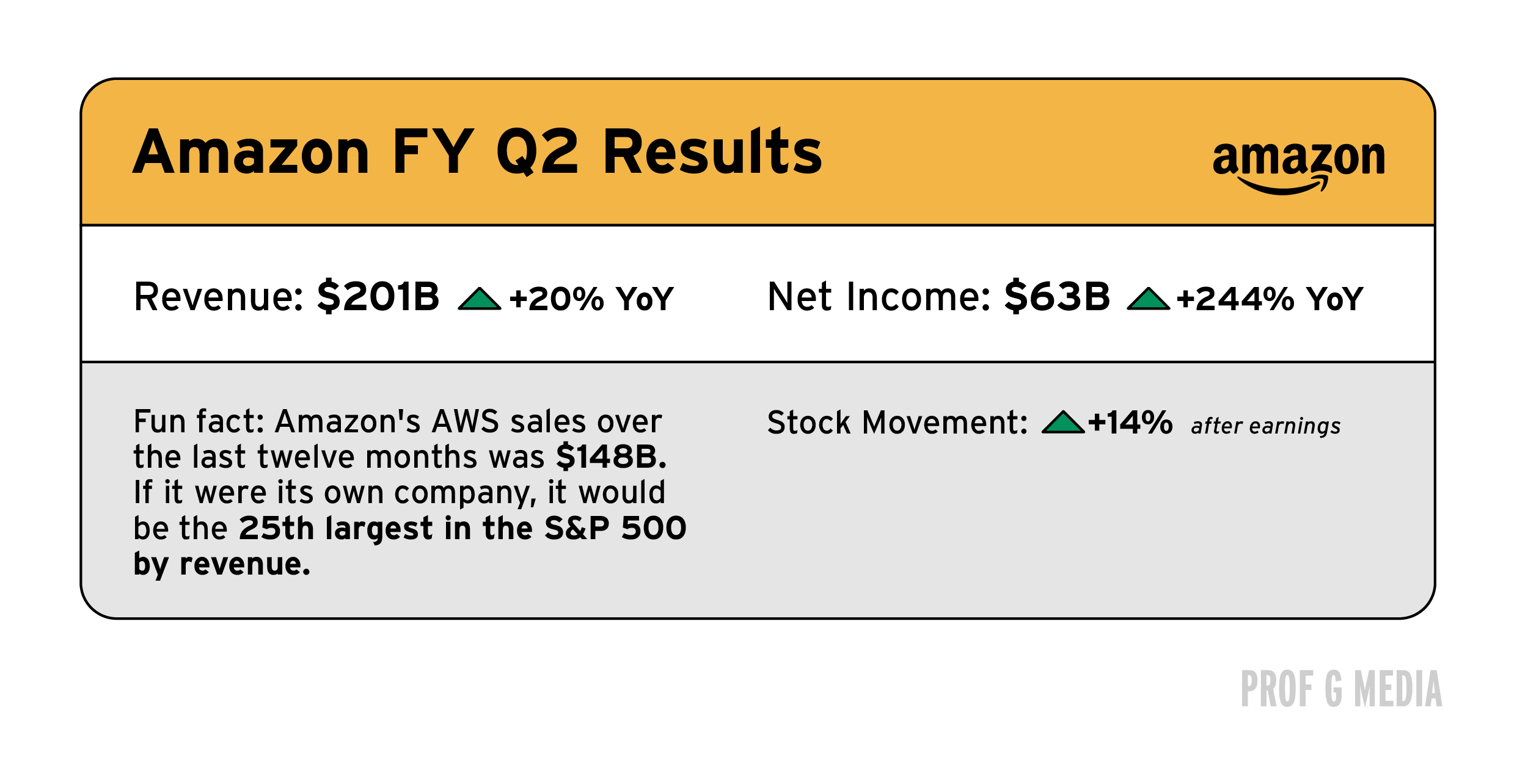
Amazon stock popped as much as 14% after reporting strong demand for its AI chips and cloud offerings.
Revenue from Amazon’s two custom chips, Trainium and Graviton, has hit a $25 billion annual run rate, and executives reported that Anthropic and OpenAI are two of Trainium’s biggest customers.
AWS revenue grew 37% year over year, its fastest pace since 2021. More than 60% of Amazon’s overall operating profit now comes from AWS. This strong cloud growth helped justify increased capex guidance and negative free cash flow.
Yes, Amazon successfully monetizes AI via the cloud, but how much of that is OpenAI and Anthropic? We don’t know, because Amazon hasn’t told us. The company reported net income of $62.6 billion, but that includes a nonoperating gain of $53.4 billion, primarily from their Anthropic investments. While it looks cheap at 19x, the Anthropic gain is juicing net income. Its real price-to- earnings multiple is 31x.
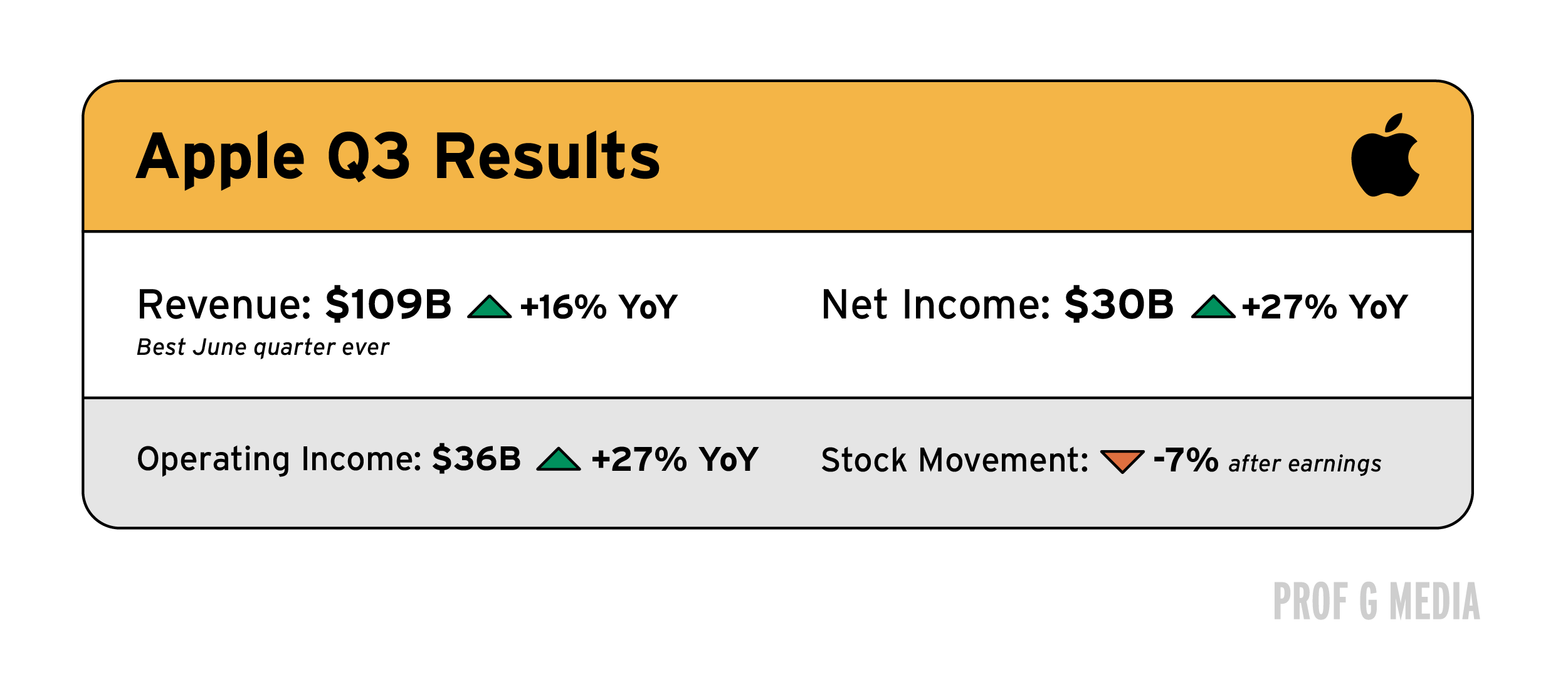
Apple beat expectations across the board, with revenue up 16% year over year — its best June quarter ever. It was a record quarter for iPhones too: iPhone revenue was up 22%, Mac up 29%, and Services paid subscriptions passed 1.5 billion.
Still, the stock fell 7% on weak guidance: The company said revenue growth in the current quarter will be between 9% and 11%. The guidance is mostly due to a global memory shortage. As we’ve discussed, demand for memory components has exploded during the AI build-out, leading to a crippling supply crunch.
On the AI front, Apple has decided to be the anti-hyperscaler. Rather than spend hundreds of billions on AI development, it’s licensing much of its AI and running on Google’s cloud. Analysts expect Apple’s fiscal year 2026 capex will be $14 billion. Amazon will spend more than that on capex in one month.
It was Tim Cook’s final earnings call as CEO; hardware chief John Ternus takes over September 1.
Apple’s the most overvalued of all of these companies — it’s trading at 35x earnings.
The market is communicating that it believes that there are huge growth opportunities for Apple, but I don’t know what those growth opportunities actually are. They can’t grow their share in the smartphone market, because they can’t reduce prices. The headset was a giant flop, and they’re not building a car anymore.
You could argue that they made the right call by not getting into AI, but what are they getting into?
Yes, Apple trades like it’s a growth stock when it’s really a mature company. But here’s what Apple would say: Our revenue’s up 16% — we grew the top line on one of the largest tech companies in history. We are a growth company and deserve a growth multiple.
I think Apple is the best managed brand in the world, maybe short of Stanford and MIT. It’s the ultimate indicator of wealth and creativity. Income inequality is infecting every nation, and the top 10% of every nation, even now in China, is starting to aggregate more and more of the spoils. Once you go into the middle class, you buy a car, you get air conditioning, and you start buying beef. Once you get into the top 10%, you buy an iPhone. I think there are going to be tens of millions of people in India and Indonesia and other growth markets who want to buy iPhones.
Also, Apple is a little more resilient to the vagaries and unknown Wild West of software, specifically AI, because they’re in the hardware business.
I’m not selling any stock, because if there’s one company in 10 years that I think will still be producing a product that has gigantic margins and never goes out of style, it’s Apple.

We’ve seen two big forced selling events tied to leverage: the crash in South Korea and the collapse of the hedge fund Situational Awareness. In August, we’re going to see more. As Warren Buffett says, “Only when the tide goes out do you discover who’s been swimming naked.”


The Athletic asked 13 athletes for the best mental advice they’ve ever received
The age of the Mag 7 is over
The geopolitics of air conditioning
At the least the Koreans actually invest in stocks. In the UK, everyone is obsessed by housing `wealth`
Thank you. Charlie Munger valued the words "the world is not driven by greed, but by envy."
The case in South Korea seems to prove that point.
Galloway points to economic stagnation as one root cause of the crash. People feel there is no normal way to get rich anymore. Add to that the rise of loneliness and the falling marriage rate. This environment makes it easy for envy to grow, especially when people keep comparing themselves to others.
Munger also said this on another occasion. "Everyone takes it for granted that they are five times richer than before. All they think about is that somebody else has more, and it feels unfair."
On top of that, X and other social media are full of people bragging about the wealth they made. Investors with less experience are especially exposed to this constant comparison. Financial institutions may have also played a role, offering products like leveraged ETFs again and again to this same group of people.
How well people can control the urge to compare their success with others may be the key to avoiding this kind of crash in the future.