


For thousands of years, alcohol has been at the center of (almost) everything we do. Socrates said wine “moistens the soul.” Ben Franklin said beer is “proof that God loves us.” It’s estimated that the first beer was brewed 13,000 years ago during the Stone Age. The invention of toilet paper came roughly 11,000 years later, which tells you something about our priorities.
We’ll turn anything into alcohol. Barley, wheat, rice, grapes, apples, potatoes, milk, you name it. Mix in some industrialization and alcohol eventually became a multi-trillion dollar industry. We consumed 77 million bottles of wine per day in 2024. We know it’s not great for us … but that never really mattered, as the pros (laughter, excitement, romance, confidence, dancing, intimacy, fun) always outweighed the cons.
Even during Prohibition in the U.S., alcohol found a way. Russia once banned it too. So did Finland, Iceland, and Norway. Outside of theocracies, prohibition rarely lasts, and even in countries with strict bans enforcement is never 100%. To imbibe is human.
That’s why I was intrigued to see in this quarter’s alcohol earnings a striking trend: drinking is going down. Last week’s results from Diageo, the British conglomerate behind brands like Johnnie Walker and Guinness, showed the American spirits business had fallen by 15%. Before that Pernod Ricard’s U.S. business posted a 15% decline. Constellation Brands, which distributes beers like Modelo and Corona, reported a 10% drop in sales. While ABinBev managed to eke out a (barely) positive quarter, their results, tellingly, were buoyed by growth in non-alcoholic beverages.
Could it be that our thirteen-thousand-year love affair with alcohol is coming to an end? And if so, why? This is the trillion-dollar question we’ll now explore.
The Rumors Are True
If you had any doubts if the whole “drinking is dying” trend was actually real, let me now put those to rest. Only 54% of U.S. adults say they drank in 2025 — that’s down from more than 70% in the 1970s. Meanwhile, the share of Americans who say they’re trying to drink less has risen 15 percentage points in just a few years to 49%.
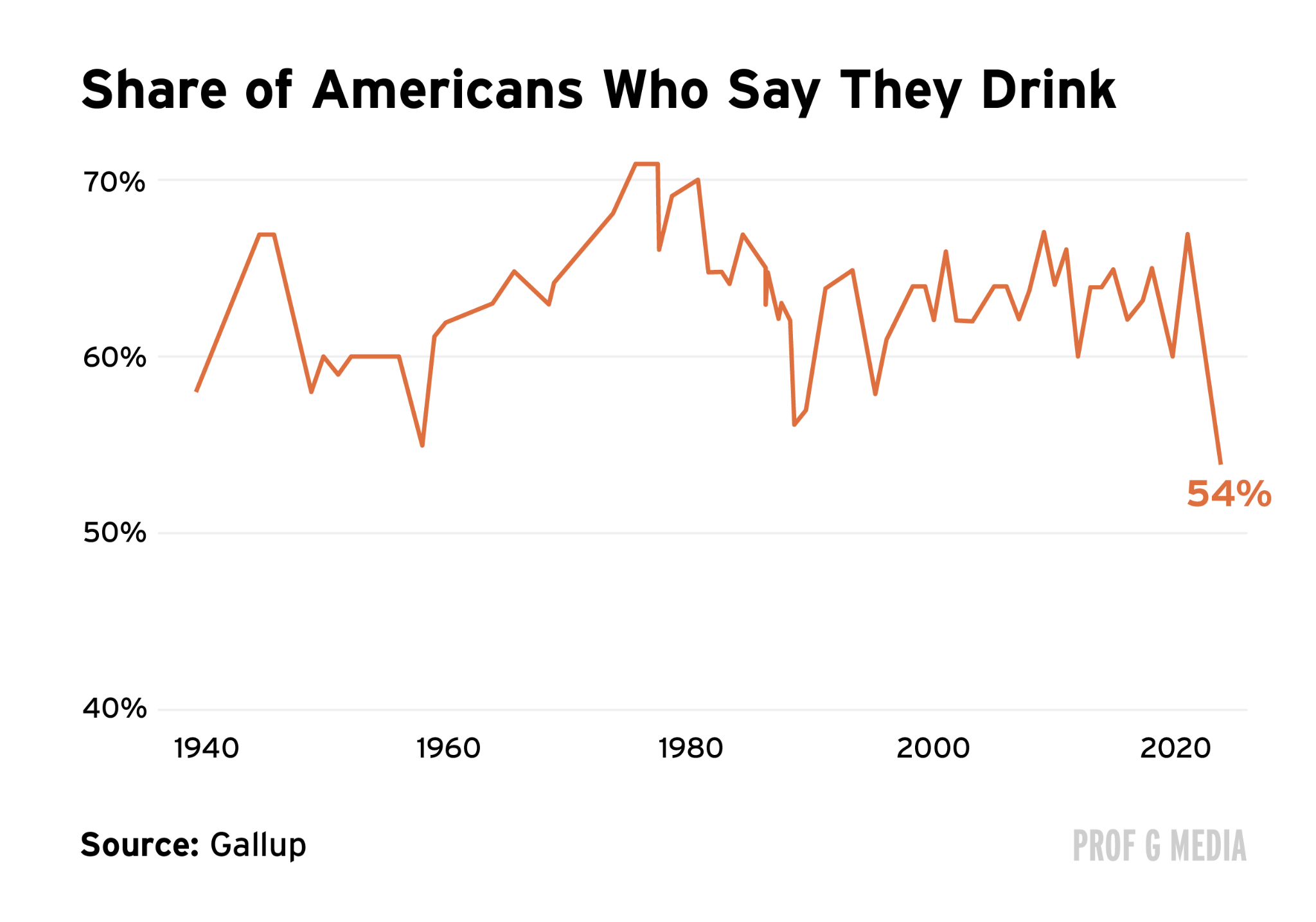
The lightest drinkers are those of my generation (Gen Z). Gen Z drinks 20% less than millennials did at our age. Which is striking, because millennials notably drank a lot less than their parents did. The share of people under 35 who drink at all dropped 10 percentage points over just two decades. The question isn’t whether young people are abstaining, but why.
Search for Answers
When asked this question, the Godfather of Nightlife, Diplo, pointed out that young people are more health-conscious than previous generations. They “don’t go to clubs as much anymore,” he said, “but they will go to experiences like a run club.” “The sauna world,” he added, “is exploding.”
Diplo isn’t wrong. Young people make up an outsized amount of annual wellness spend in America. We’re also four times more likely to want to meet people at the gym vs. at a bar. This is a fundamental shift in the way that we socialize, and it’s beginning to show up in the numbers. “Sober Curious” gatherings on Eventbrite are up more than 90%, and “Sauna Raves” are up 250%. I personally can’t picture anything worse, but that’s me.
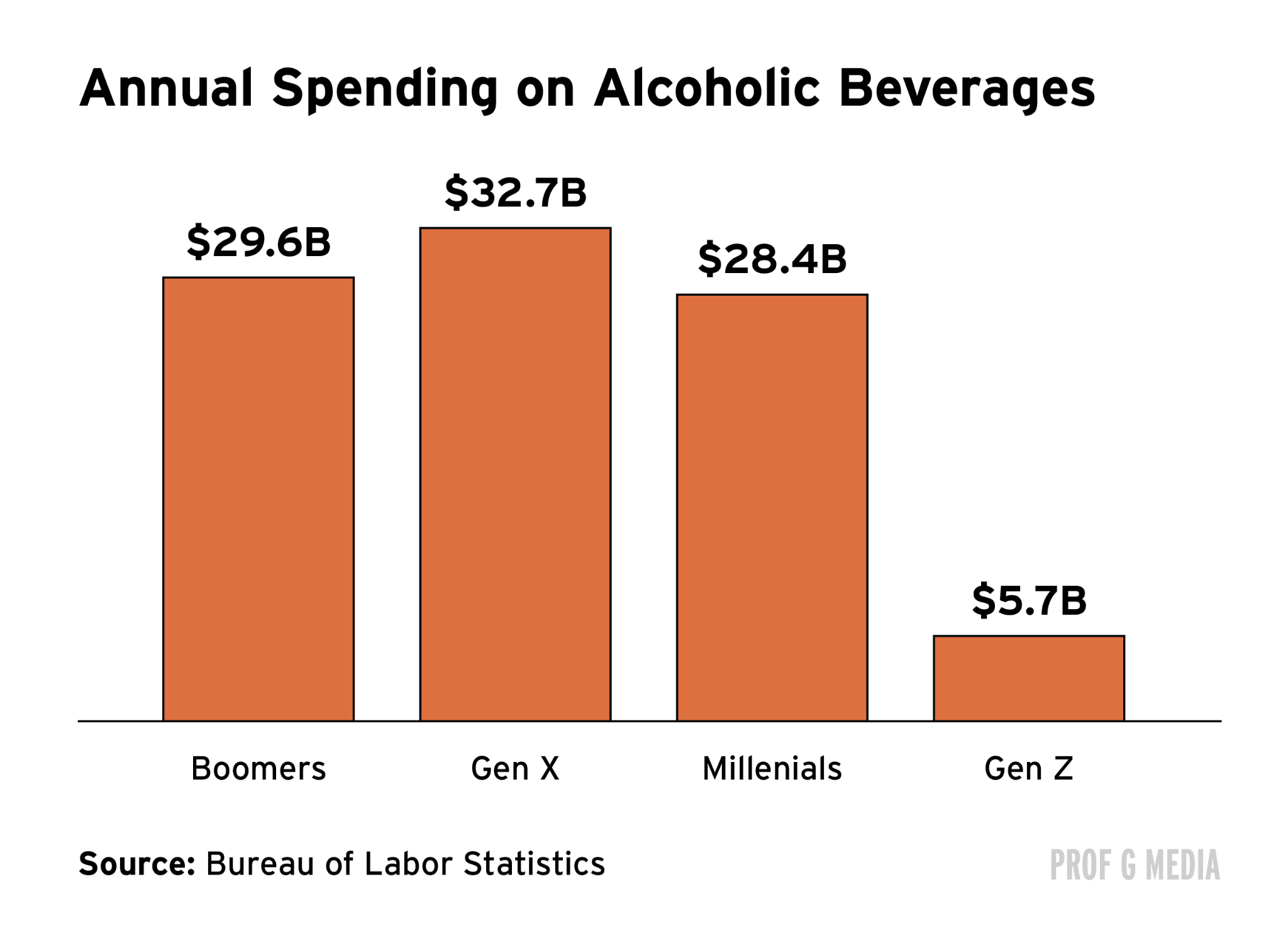
It’s gotten to the point where alcohol executives are now trying to rebrand alcohol as good for you. Per ABinBev’s CEO, “beer naturally has protein.” Perhaps this is how you get Gen Z to drink? Make it sound healthy?
Another potential explanation is the rise of GLP-1s. It’s reported that GLP-1 drugs can reduce alcohol consumption by as much as 75%. This is a seemingly perfect answer, as GLP-1 usage among Gen Z increased roughly 70% between 2023 and 2024 alone. At the same time though, Gen Z still makes up a tiny proportion of overall GLP-1 users — and certainly doesn’t account for the majority of us who aren’t drinking.
Maybe it’s cannabis, ketamine, or psychedelics? While these drugs are becoming increasingly normalized, their users still represent a very small portion of the Gen Z population. Meanwhile, researchers in Canada have found that the legalization of marijuana has had no discernable impact on population-level alcohol sales.
As much as I’d like to believe we’re the first generation in history without a substance addiction, something tells me that’s unlikely. It’s far more probable that we’ve simply substituted alcohol for something else. Hint: You’re using right now.
Screen-Pilled
In 2025, Gen Z spent an average of 7 hours and 43 minutes per day looking at screens, up nearly 5% from the year before. When you annualize that number it comes out to 118 days of the calendar year staring at a screen. For context, we spend roughly 122 days asleep — which leaves us with 125 days left over to do everything else.
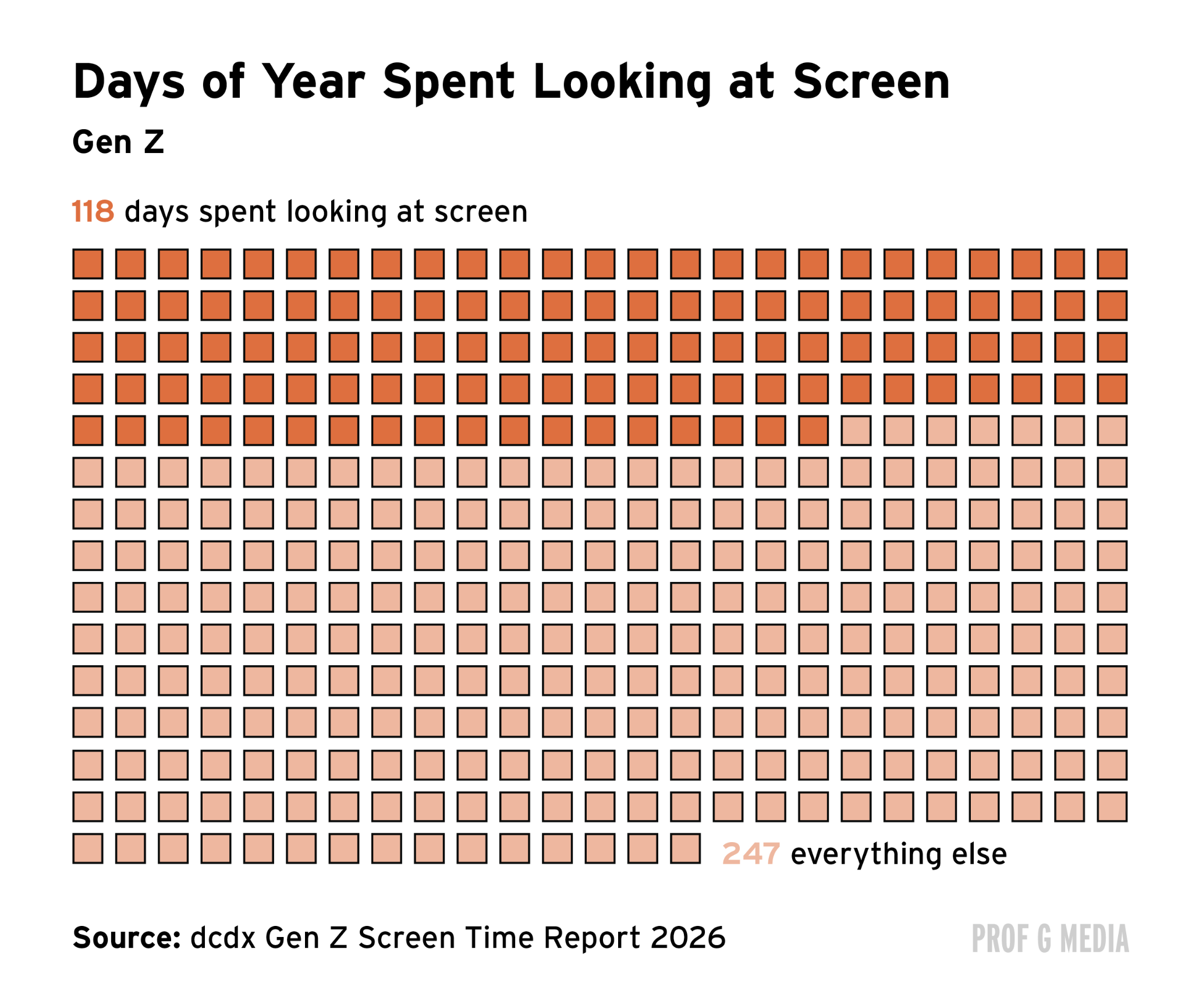
The phone isn’t something you pick up anymore — it’s something you put down (briefly) when you have to. About half of American teenagers say they’re online “almost constantly,” and more than four in five Gen Zers associate social media with the word “addicting.”
Once you consider the sheer volume of social media consumption plus our inability to quit, it starts to become obvious why we no longer drink alcohol: We found something better. Compared to alcohol, screens are more addictive, more powerful, easier to access, and cheaper. They are also seemingly healthier. Unlike drinking too much, which might kill you or ruin your life, watching a couple of videos is harmless. Or at least, that’s the story we were sold.
Addicts
Addiction is defined not as uncontrollably using something over and over, but uncontrollably using something despite harmful consequences. In other words, an addiction only becomes an addiction once it makes your life worse.
This is where it becomes illogical not to classify Gen Z screen use as substance addiction, because the reality is that it’s ruining our lives. 80% of Gen Z reported feeling lonely in the past year, compared to 45% of Baby Boomers. Nearly half of Gen Z have already received a formal mental health diagnosis, anxiety being the most common. The U.S. Surgeon General has declared loneliness a public health crisis, warning that chronic isolation carries health risks comparable to smoking fifteen cigarettes a day. As Jonathan Haidt has proven, the single greatest predictor of these symptoms is an addiction to your phone.
Lesser Evil
Which is worse: An alcohol addiction or a screen addiction? I don’t have the answer but I think it’s a reasonable question. The death of drinking has been positioned as an embrace of healthy living, but the more you investigate the lives of young people the more you realize we’re anything but healthy. What we lack in liver disease, we make up for in depression. We’re healthy from the neck down and sick from the neck up.
Our prospects in life depend on our ability to navigate trade-offs. You can’t build a decent life in the digital age without significant screen time. But without moderation you risk losing your life to the screen. Both extremes — terminally online and permanently analog — are untenable. We have to use these substances — the question is how.
Last night I had dinner with friends and ordered a Negroni. After that, I had another one. After that, one more. Our dinner lasted nearly four hours, and by the end I was in that mood where I decided to pay for everyone. Would this have happened without the Negroni? I don’t know. Either way, it made me feel good, and so did spending a full uninterrupted evening with friends. No phones, no screens, no scrolling. Research says those drinks were bad for my health. My gut tells me otherwise.
See you next week,
Ed
Well done, Ed. Thoughtful commentary as always and leads to the question nobody can answer (yet): How do we learn to put these damned things down and be human with each other again? I think your Negronis are a good start. Buying your friends dinner will (hopefully) prompt them to reciprocate. Cheers!
You didn’t mention the price of alcohol at all though?