



It’s more compelling, and lucrative, to be a catastrophist. History, however, is on the side of optimists. Any analyst/author/academic must adjust for history and ask “what could go right?” And optimism is a prerequisite for entrepreneurs. No business I’ve ever started, at the moment of inception, made any sense … until it did. Or didn’t. The only way to predict the future is to make it, i.e., summon the irrational optimism necessary to advance, despite the risks, into the unknown.
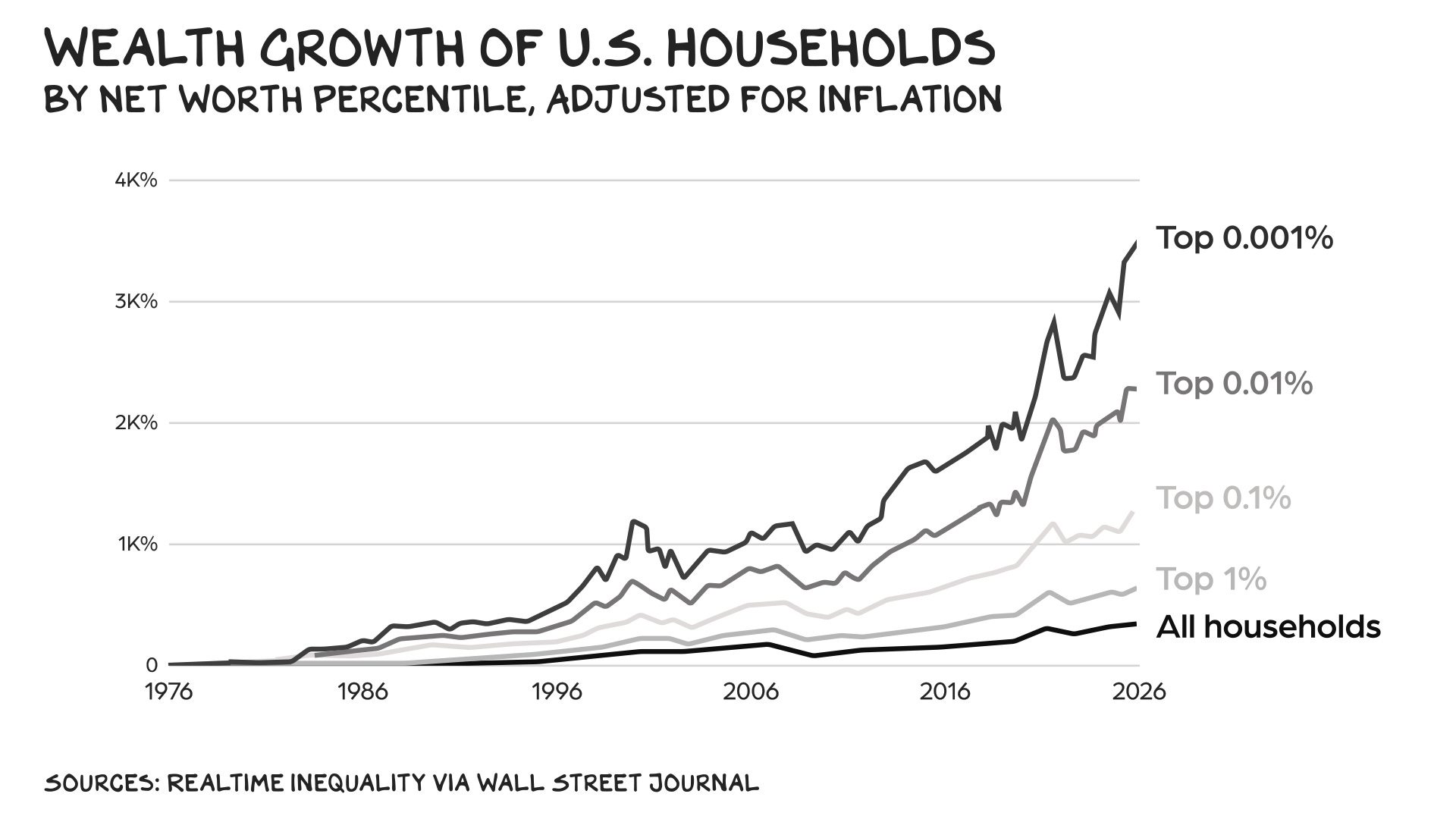
Macroeconomic conditions supply abundant reasons to catastrophize. What keeps me up at night? A: Tariffs, Iran, inflation, the national debt, Treasury yields, a stock market that’s seven companies, consumer sentiment, and the K-shaped economy. Despite all “this,” there is (always) cause for optimism. And wealth creation in the U.S. is a bright spot.
Everywhere Millionaires
The wealth flowing to Wall Street and Silicon Valley drives an inequality narrative, but that obscures American economic dynamism. For their new book, The Everywhere Millionaire, economists Owen Zidar and Eric Zwick analyzed IRS and Federal Reserve data, finding that more than half of the rise in income among the top 1%, since 1985, came via pass-through businesses. That’s IRS-speak for firms, most of them privately held, where the profits “pass through” to the owners, who pay taxes on those profits through their personal tax returns. The growth in so-called everywhere millionaires isn’t an accident, but the result of a policy choice. The 1986 Tax Reform Act lowered individual tax rates below the corporate rate, creating a loophole that allowed business owners to structure a business as a pass-through to pay the lower individual rate. In 2024, Treasury researchers estimated that S corporations (a popular pass-through structure) pay about 7 percentage points less in federal income tax than they would if organized as C corps.
Middle-Class Erosion
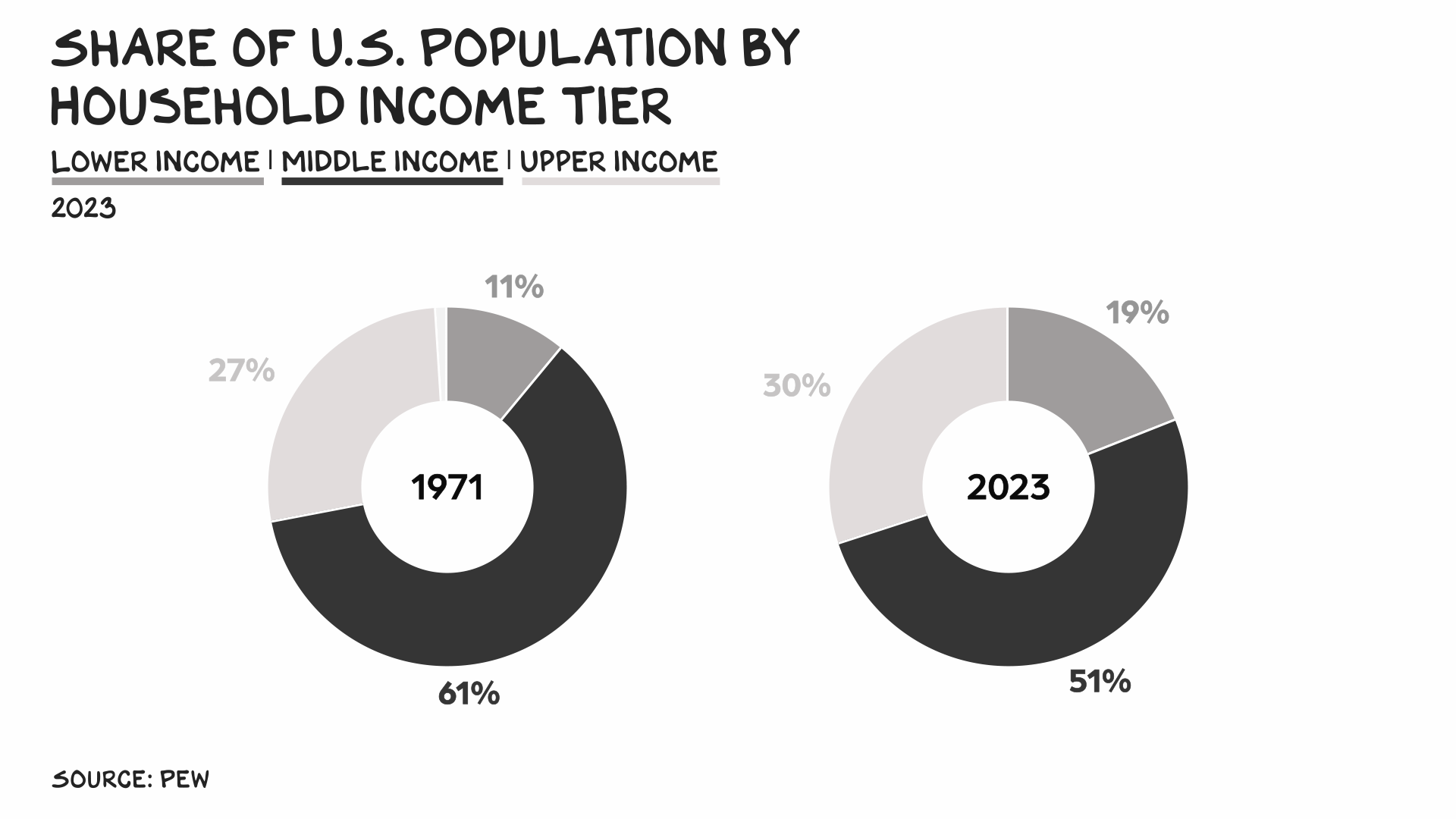
In news that won’t surprise anyone, the U.S. middle class is shrinking and falling behind relative to wealthier cohorts. Since 1970 the share of total U.S. household income held by the middle class fell from 62% to 43%. Over the same period, the median middle-class household income rose by 60%, compared to 78% for upper-income households. Here’s the counterintuitive part left out of stories about middle-class erosion: More middle-class families moved up than down in the past 50 years. America is a millionaire factory. We mint 40% of the world’s millionaires, more than the next 11 countries combined. There are currently 23.6 million of them in the country.
Your (Wealthy) Friends and Neighbors
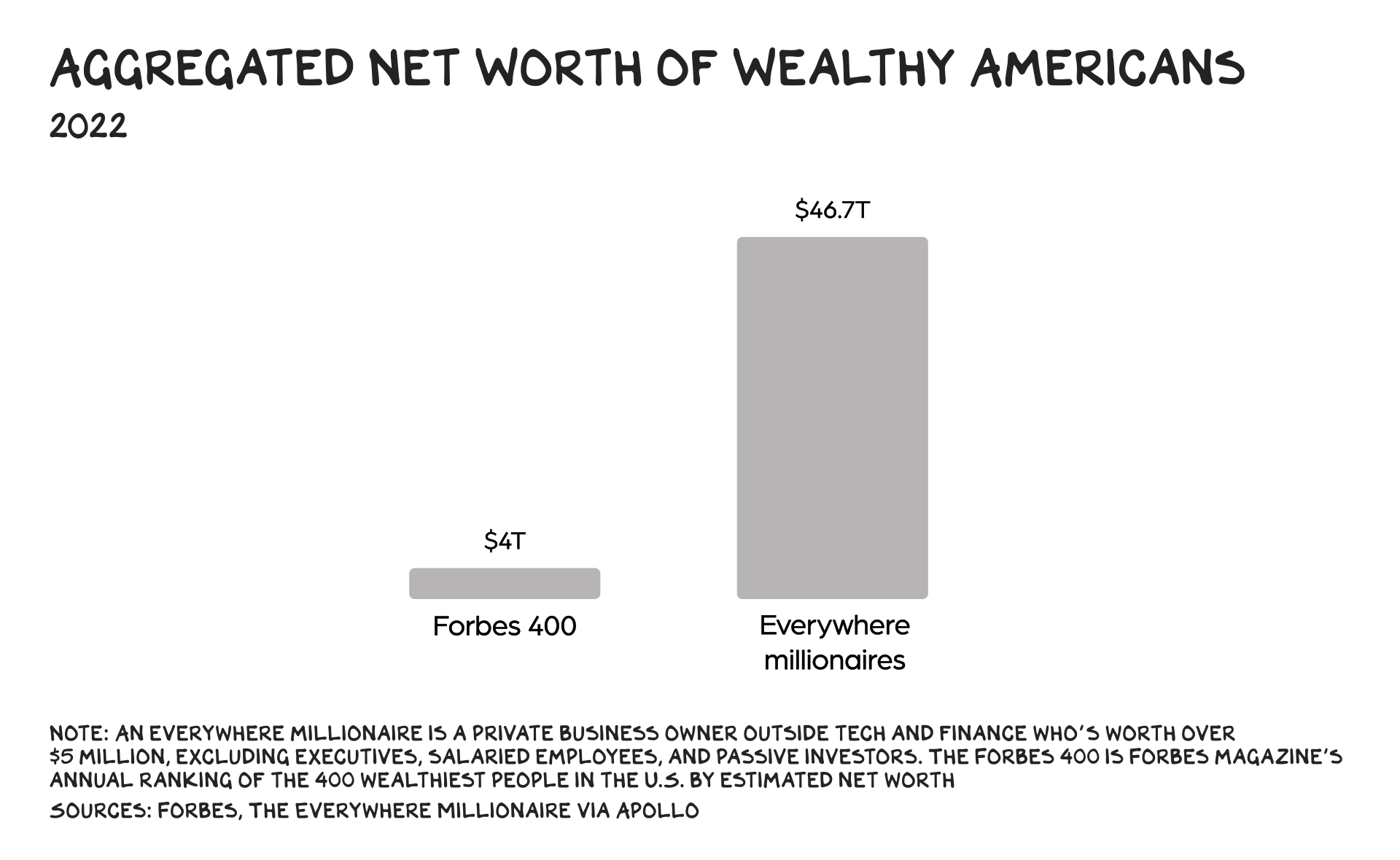
Zidar and Zwick identified 3 million wealthy private U.S. business owners, excluding tech and finance, with a net worth greater than $5 million. They also excluded corporate executives (CEOs of public companies), high-earning W-2 employees, and individuals whose wealth is primarily tied up in passive investments. The average net worth of the everywhere millionaire cohort is $25 million. Unlike the oligarchs and broligarchs, who cluster in major coastal cities, everywhere millionaires live … everywhere. An hour north of Birmingham, in Walker County, Alabama (pop. 65,000), the average top-bracket filer with a private business reported $1.9 million in pass-through income in 2023, the highest of any county in the nation.
Some of these businesses are famous. In 1963, former Marine Dick Portillo opened a hot dog stand in a 12-foot trailer with $1,000 in savings and a small investment from his brother (about $11,000 in today’s dollars). By 2014 he’d grown Portillo’s to 38 locations in four states, generating $300 million in annual revenue and carrying no debt. That year, Portillo sold his business to Berkshire Partners for nearly $1 billion. In 2017 three friends pooled $900 and started frying Nashville-style hot chicken at a pop-up located in an East Hollywood parking lot. Eight years later, Dave’s Hot Chicken, with 390 locations worldwide, was acquired by a private equity firm for $1 billion.
Some are lawyers, doctors, or dentists, but fewer than half of the everywhere millionaires hold a graduate degree. Many of the businesses Zidar and Zwick identified began as blue-collar owner-operators, i.e., the same person provided capital and labor. Think: a repo man in Las Vegas, an HVAC contractor in Memphis, or a boat-cover maker in the Ozarks. Most fly under the radar. “You probably know an everywhere millionaire, even if you don’t realize it,” Zidar and Zwick write. “They’re hiding in plain sight, as ordinary people who run businesses woven into the fabric of everyday life.”
Businesses that sell, repair, move, or install everyday goods and services register nearly half of the $31 trillion in total private business equity in the U.S. Construction is a common path to everywhere millionaire status, as the barrier to entry is low enough for a skilled tradesman to bootstrap their way from labor to owner. Analyzing Dun & Bradstreet data, Zidar and Zwick found 33,752 contractors’ businesses earning at least $5 million per year and 6,525 that earned $25 million or more. Ninety-eight percent of U.S. counties have at least one contractor business with a payroll. Auto dealerships have a higher barrier to entry, but they’re more likely to generate wealth. Zidar and Zwick estimate that half of the 21,000 car dealerships in the U.S. generate at least $5 million in annual revenue, while another quarter bring in more than $25 million. The lesson? Boring is sexy, and oftentimes businesses considered to be low status register a high ROI. As I often tell young people, “follow your passion” is terrible advice frequently given by people who became rich in unglamorous fields. Instead, you should follow your talent — discover something you can be exceptional at, then target your skillset to a growing field with an employment rate above 90%.
Ladders Up
One of the most corrosive narratives aimed at young people is the lie that college is obsolete, unnecessary, or a scam. In fact, higher education is akin to a wonder drug that extends life, makes you happier, healthier, and wealthier, and strengthens your relationships. In a rational world, we’d scale access. Instead, we sequester it behind ivy-covered walls and tuitions so high they command a 90%+ gross margin. By treating college as a luxury good, we misunderstand its purpose as an engine for upward mobility and how that engine works. That said, while the typical everywhere millionaire is a college graduate, their path hasn’t necessarily run through an elite school. The top 10% of SAT scorers become founders at a rate of 1.3x the median. “If you want to achieve the American Dream by being a salaried worker at a big company, an elite school triples your chances,” Zwick told Michael Smerconish. “If you want to be an entrepreneur, going to an elite school doesn’t have much of an effect.” The homeowner paying you to install soapstone in their kitchen doesn’t care where you went to school.
If we want to manufacture more millionaires, the recipe is simple: Invest in unremarkable kids — make college a viable option for anyone who qualifies and wants to attend. This year, preliminary data shows that the University of California system accepted 78% of in-state applicants. Nationally, public four-year colleges registered a similar rate on average. Access is one challenge; affordability is another. According to the most recent College Board analysis of federal survey data, nearly one-third of full-time in-state students at public four-year colleges received enough grant aid to cover their full tuition and fees in the 2019-20 school year. That same year, 39% of bachelor’s degree recipients from public four-year schools graduated without student loans. Meanwhile, half of all students in the University of California system pay zero tuition, and 63% complete their degree without any debt. I’m biased — UCLA undergrad, Haas School of Business, and recently joined the UC Board of Regents — but the more that U.S. colleges follow the University of California’s example, the wider the pathway for young people to achieve the American Dream. If stupid is hurting other people while hurting yourself, smart is helping other people attend college so they’re able to start a firm, create jobs, build wealth, and pay taxes that fund the Navy, food stamps, and education for future generations.
Wealth Transfer
The oldest baby boomers are turning 80 this year. Despite medical advances, exercise, better nutrition, and an industry devoted to anti-aging, biology remains undefeated. Delusions aside, nobody is getting out of here alive or taking anything with them. History’s greatest generational wealth transfer — $110 trillion according to one estimate — is underway. That inheritance tsunami won’t be evenly distributed. The top 2% of American households are expected to pass $62 trillion to their heirs; but 4 in 5 Americans won’t inherit anything at all.
The inheritance story hiding in plain sight is what happens to the wealth built by America’s everywhere millionaires. Three-quarters of those founders didn’t inherit their firms. According to Zidar and Zwick, just 12% of children born to the top 1% stay there, while 40% fall out of the top-fifth wealth cohort. Turns out, rich kids make better yacht owners than boat builders. “When a family business slows down after a generational transfer, opportunities arise for those who would compete with or acquire that business,” Zidar and Zwick wrote in The Economist. Somewhere in America, a 78-year-old plumber has a dozen trucks with his name on the side and a son who’d rather be an influencer.
The Factory
America’s greatest export isn’t software, weapons, or entertainment. It’s the millionaire, and most of them are manufactured in a workshop with no Instagram presence: the public university. It’s a factory that takes in unremarkable kids and turns out small business owners who sponsor the Little League team. America’s secret sauce isn’t genius, but access. I was an unremarkable kid from a lower-middle-class home in 1970s California, and the state decided, for reasons that made no sense at the time, to bet on me anyway. Everything I have is the return on that bet. The most American thing we do isn’t crowning an elite class of billionaires, but manufacturing millions of unremarkable millionaires.
Life is so rich,

P.S. The typical everywhere millionaire is a college graduate, but broadly speaking, is a four-year degree still worth it? A: Yes, but with some caveats. Prof G+ paid subscribers can catch my Deep Dive on the value of a college degree here.
Keep this up and people are going to think that you’re a capitalist!