


We spent most of our time on the show last week talking about Iran. Only one conclusion can be drawn: Between the time I write this and the time you read it, the situation will have changed many times over. We’ll continue to monitor as the war unfolds.
For this week’s post, I’d like to turn our attention to something else — another battlefield in which I actually have some experience: the media industry. Specifically, how it’s changed and where it’s going. Heads up: This isn’t another think-piece about the streaming wars or the death of cable. Those trends are old news. This is about something newer and more structural, a seismic shift that’s transforming the way we consume information at a global scale. Not streaming. Not AI. Clips.
Yes, clips, those one-minute videos you see every day on your social media feed. Some would simply call this “short-form content,” but clips are slightly different. They are specifically snippets of long-form content — things like podcasts, livestreams, and TV shows — a byproduct of something else. In other words, every clip is short-form content, but not all short-form content is a clip.
Why belabor the details? Because they’re important. As we’ll see, this specific format has taken over not just social media, but the entire media ecosystem itself. It’s therefore incumbent on all of us who care about the future of media to understand it.
So let’s dive in. Our journey into the world of clips starts with an unexpected character: OpenAI.
Technology Brothers
Last week we read a striking headline: OpenAI acquires popular tech talk show for ‘low hundreds of millions’. The tech talk show in question was TBPN, a live daily podcast that’s gotten quite popular in Silicon Valley. I was soon told by a friend that the deal was worth $200 million. That’s not confirmed, but for the sake of this post let’s assume it’s correct.
Let me put into context how much money $200 million is. The largest podcast deal in history was a $250 million agreement between Spotify and the world’s most popular podcast, The Joe Rogan Experience, which reportedly rakes in more than ten million listeners per episode. Another one of the most popular podcasts is Call Her Daddy, which inked a deal with SiriusXM for $125 million. This deal is larger than that. It also makes TBPN three times more valuable than Dish TV, and nearly ten times more valuable than BuzzFeed. In sum, the deal is enormous.
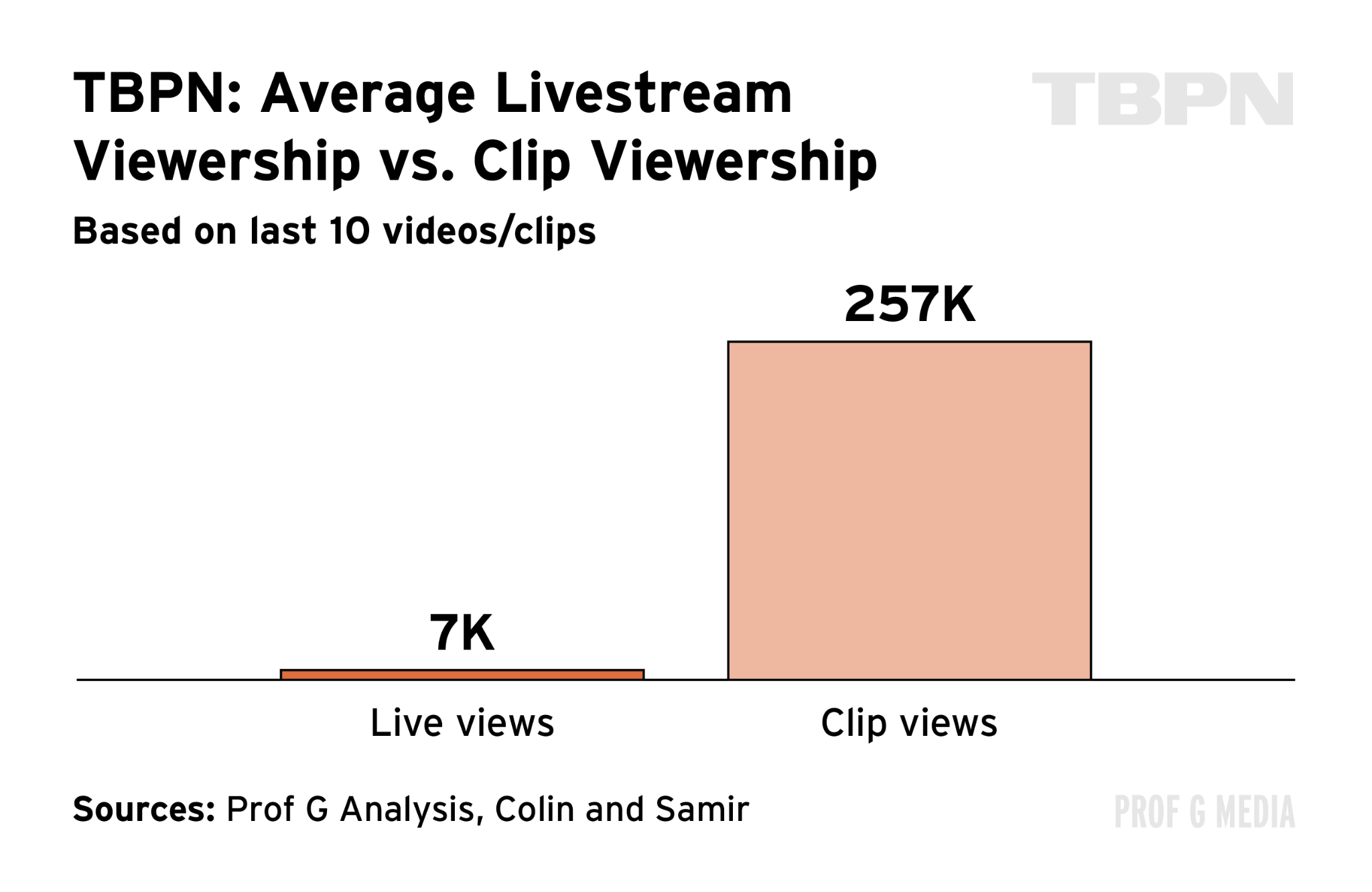
That’s why you’ll probably be surprised to hear the following statistic: The average TBPN show receives roughly 7,000 views per episode. For context, my show (Prof G Markets) reaches roughly a quarter of a million people per episode. So why on earth would OpenAI pay $200 million? One word: clips. Despite its relatively small live audience, TBPN reaches hundreds of thousands every day with its clips. The average TBPN clip receives around 257,000 views, thirty-seven times larger than the viewership of the show itself.
This is the part where legacy media says, “Cute, but clips don’t make money.” This is where they’re wrong. Unlike most media organizations, TBPN bakes ads directly into their clips. At the end of each one-minute snippet: “This clip was brought to you by …” Ads in clips are what enabled TBPN to generate $5 million in revenue last year, on track for $30 million in 2026. The podcast isn’t so much a podcast as a vehicle for generating clips. The same could be said of many podcasts, by the way, but the ingenuity of TBPN is that they are the first organization whose business model actually reflected that.
Creators → Clippers
TBPN is the tip of the iceberg. Over the past couple of years, clips have birthed an entire generation of media stars. There’s Nick Fuentes, for example, the new king of the far-right. Or Hasan Piker, the controversial progressive livestreamer. Or Clavicular, the viral looksmaxing star. You might not have heard of these people, but for Gen Z, they’re practically household names. All of them have one thing in common: Their clips go extremely viral.
Despite a modest livestream audience of less than 20,000, Nick Fuentes reaches more than half a million people on average through his clips. One of his most recent clips reached eleven million people. That’s more than the population of New York City. Clavicular’s reach is similar: His actual show averages only 16,000 viewers, but his clips average a quarter of a million. Meanwhile his past ten TikToks reached roughly seventy million, more than the population of France. From TBPN to Clavicular to Hasan Piker, the pattern is roughly the same — the shows are small, but the clips are massive.
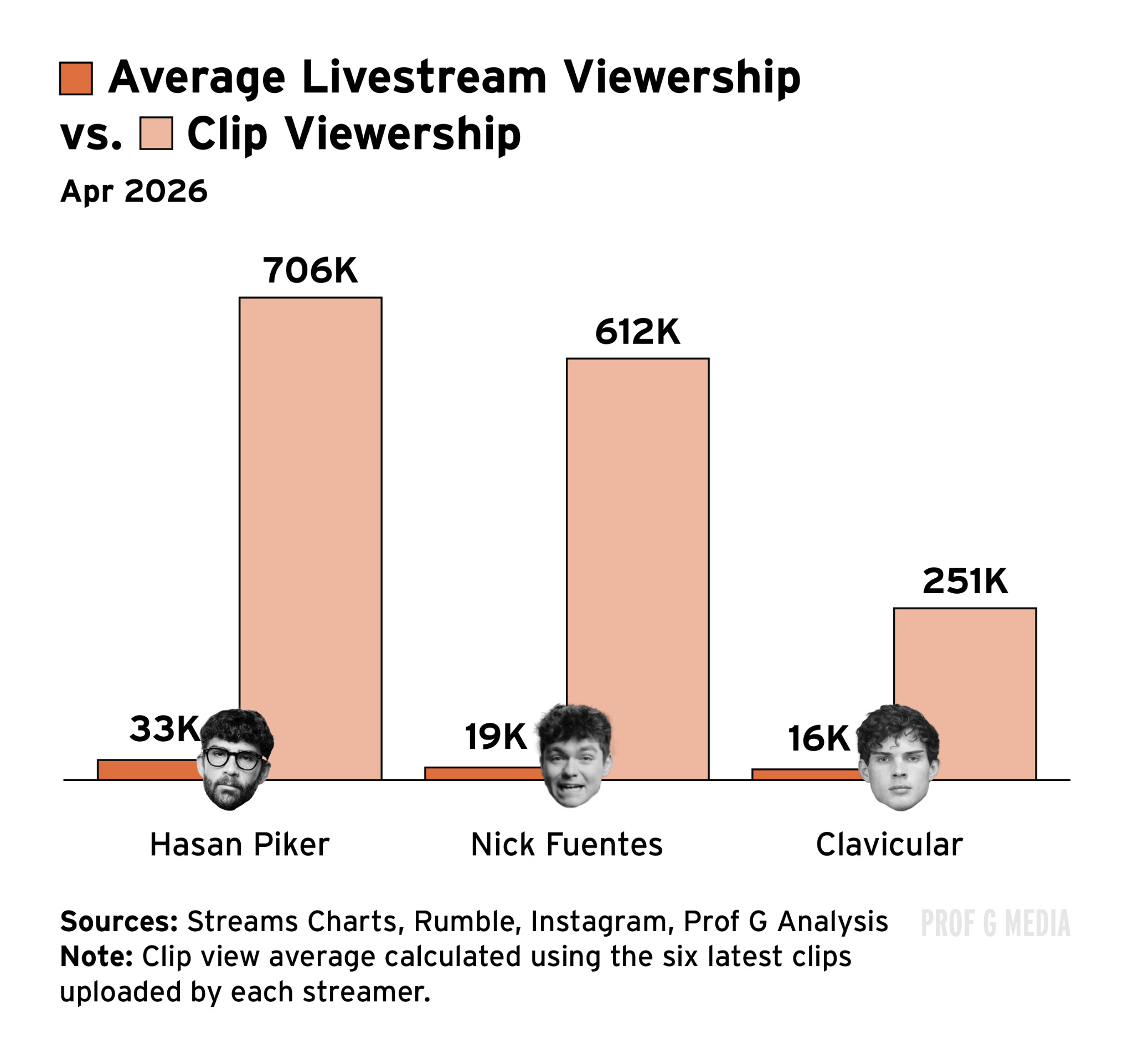
The craziest part about these clip numbers is that they’re actually underestimates. That’s because they reflect only the views of clips that are posted directly by the creators themselves, but don’t account for the millions of times those clips are re-clipped by other social media accounts (“fan accounts”), which often draw even larger audiences. (We’ll discuss this more in a moment.)
Soon you realize most of the hot new “shows” you see today aren’t actually about the show — they’re about the clips. I’ve even experienced this with my own show. Whenever a fan recognizes me in public, I ask them if they listen to the podcast, and every now and then I receive a striking answer: “No, but I watch your clips.” The first time I heard this I was confused. I thought our clips were the promotional material for our content. It soon dawned on me that wasn’t the case. For much of our audience, the clips are the content.
This is the crucial point to understand: Clips are no longer the byproduct of the main product — they’re the main product. Once you grasp this you start to realize how the entire media ecosystem is being flipped on its head. We’re entering a new media economy, what I call “the clip economy.”
The Clip Economy
The clip economy has gotten enormous, but as with any economy, it can be gamed. The man who pioneered this happens to be one of the first clip-stars: Andrew Tate. Tate realized that the best way to win the clip economy isn’t to post clips yourself, but to have other people post them for you. So in 2021, he started an online course (pyramid scheme) called Hustlers University. The stated goal was to help young men “escape the matrix,” but the real goal was to get young men to post his clips.
The business model was simple: Tate instructed his subscribers to clip his livestreams and post them on social media with an affiliate link to his “community,” and with each new subscriber, the clipper received a commission. The result? Clips of Andrew Tate were viewed over 11 billion times on TikTok before he was banned. Despite the ban, however, Tate clips still regularly go viral on the platform. That’s the other great thing about having a clipping army: Even if you get cancelled, your clips live on.
The pay-to-clip model has since gone mainstream. “Clipping agencies” are now popping up all over the internet. In fact, one popular streamer known as “N3on” recently revealed how much he pays his clippers collectively each month. Answer: one million dollars. His clippers are paid on a per-view basis, and the best ones make millions of dollars a year.
But N3on is just one streamer, and not even in the top ten. MrBeast recently launched his own clipping platform — he pays clippers to post clips of his new theme park, Beast Land. Kick, one of the largest streaming platforms, also started a clipping program. It’s even trending in Washington: Last presidential election both Trump and Harris hired employees to clip their content. Clips are already the beating heart of every new media endeavor and we’re just getting started.
The Path Back
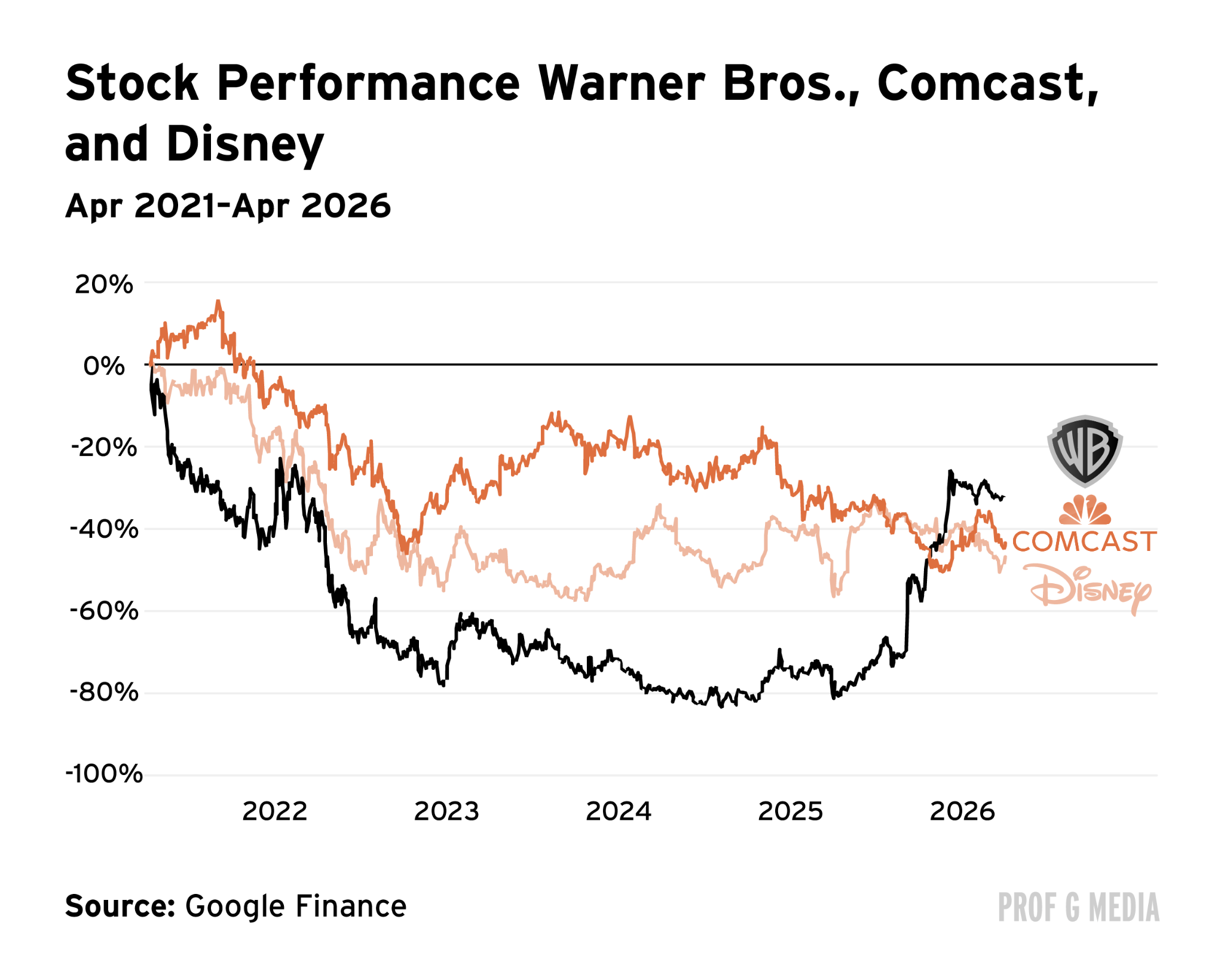
It’s no secret that legacy media isn’t doing well. Over the past five years, companies like Disney, Warner Bros. Discovery, and Comcast have all lost more than a third of their value. No amount of streaming acquisitions, rebrands, or spinoffs has been able to stop the bleeding.
Their problem is simple: People don’t watch traditional content anymore, they watch clips. Since before the pandemic, time spent watching video content on social media has more than doubled, and in that same period Meta’s revenues have nearly tripled and TikTok’s have grown tenfold.
This really hit home for me the night of the Oscars. I asked my girlfriend (who is a Chalamet fan) if she wanted to watch it, and to my surprise she said no. “Why?” I asked. Her answer was clarifying: “It’s too long and boring. I’ll just wait for the morning and watch the clips.”
There’s only one path back for legacy media: They have to win the clip economy. The bad news is it’ll feel beneath them. The good news is it will be easy. Legacy media is better at original content than anyone, and original content is to clips what light sweet crude is to gasoline. Put another way, Disney and Warner Bros. are sitting on a clip-field the size of the Permian Basin.
The next step will be monetization, which will also be easy. “This clip of the New Year’s Eve Ball Drop was brought to you by Heineken.” “This clip of Fareed Zakaria GPS was brought to you by T-Mobile.” “This clip of Shark Tank was brought to you by Capital One.” Sure, it’s a little dystopian. But the way I see it, legacy media has two options: Either sell clips, or die.
Call Me
If any media executives are reading this and want to discuss, feel free to reach out. I think about this every day for my own business, and I also find it fascinating.
And for those of you who find this all mostly depressing, I hear you. There is indeed a large body of evidence that suggests short-form content isn’t good for us. It decreases our attention span, makes us more anxious and depressed, and it’s very addictive. The clip economy will also exacerbate our polarization problem, which I’ve written about.
But the point of this post isn’t to say the clip economy is a good thing or a bad thing. It’s simply to tell you the truth about where we’re headed.
See you next week,
Ed
I think part of it has to do with the pure quantity of content that is put out on a weekly basis. If you wanted to keep up with all your favorite podcasts, newsletters, YouTubers, news outlets, sports, political breakdowns, business headlines, it would be more than a full time job! If you only have a little free time with work, family and other commitments, clips is kinda the only way to try to do it on the consumer side!
Excerpts and quotes of books taken out of context are often more impactful and more lasting than the full book itself. Call Me Ishmael but the trick is getting viewers to ingest the long form or a longer form of the content based on the proper clips.