



TL;DR
How the Supreme Court Just Undermined the IMF’s Warning to China
China’s Unlikely Rise as a Global Medical Tourism Destination
Seedance 2.0 and the AI Threat Hollywood Can’t Stop
Newsletter Exclusive: Why Tang Jackets Are Everywhere Right Now
IMF Warns China to Pivot as Supreme Court Reshapes the Trade War
The IMF released a major report on China last week with a clear message: the export-driven model has run its course. China grew 5% last year, but the IMF projects growth slowing to 4.5% this year, warning that the current strategy is not sustainable. Nearly a third of that growth came from net exports, and the yuan is estimated to be significantly undervalued, a combination that has fueled a record trade surplus and rising tensions with the US and Europe. The IMF’s prescription: pivot inward, boost domestic consumption, and reduce reliance on exports.
Title: China’s Goods Trade Surplus
Subtitle: 2010-2025
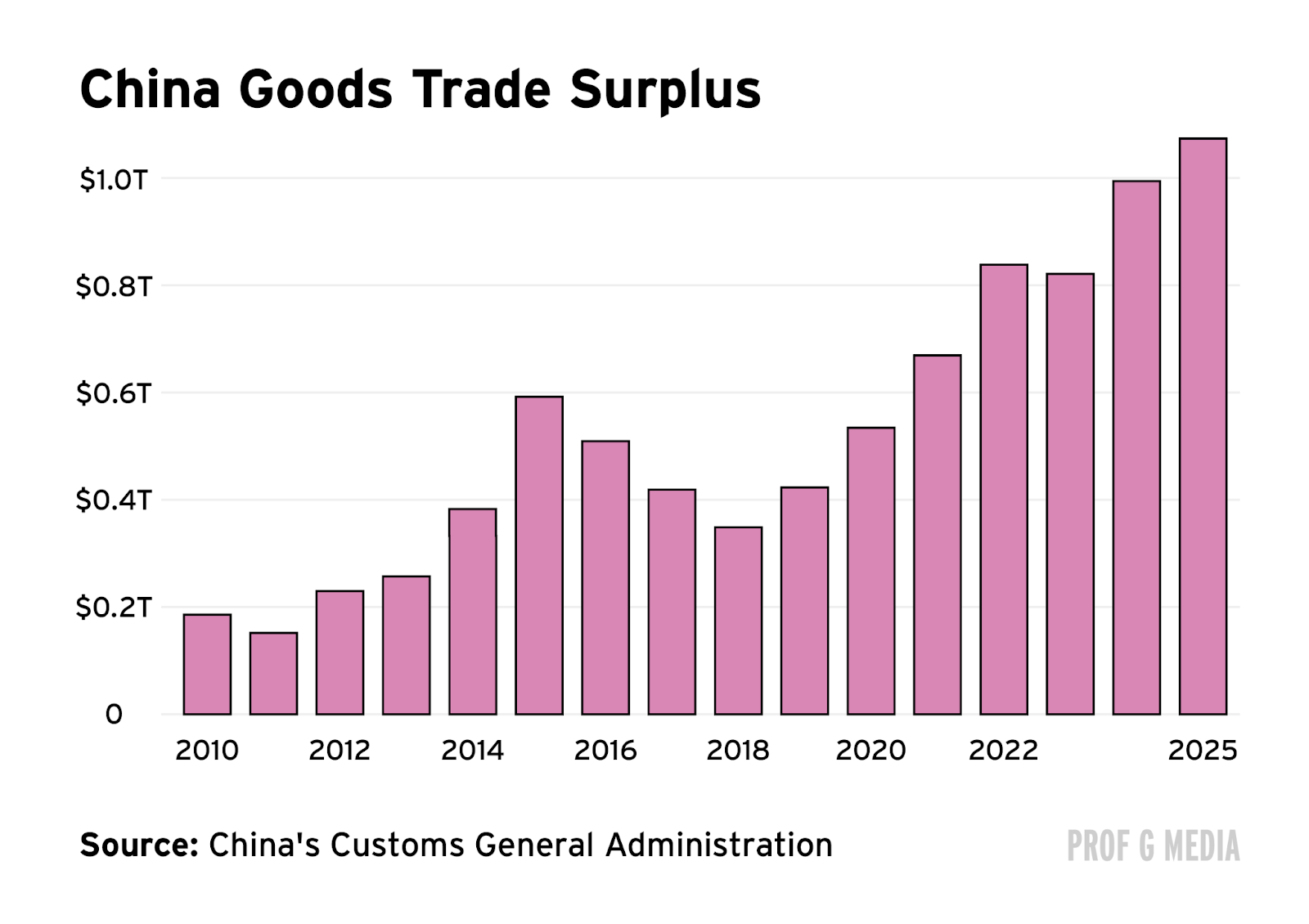
However, the pressure to do any of that got a lot lighter. The US Supreme Court ruled 6-3 last week that President Trump overstepped his authority in imposing sweeping global tariffs under emergency powers. For China specifically, the effective tariff rate has dropped by 7%. The ruling also weakens Trump’s negotiating hand ahead of his first meeting with Xi Jinping in Beijing, expected in early April and the first visit to China by a US leader since 2017.
Alice’s Take: The IMF’s advice won’t be followed. China is too committed to its current trajectory to reverse course. When the National People’s Congress convenes in early March, the government work report will almost certainly double down on China’s identity as a high-tech manufacturing superpower, not pivot dramatically toward domestic consumption.
Trump is actually giving China a modest assist. The Supreme Court ruling lowers the effective tariff rate, and Trump remains in a conciliatory mode toward Beijing in advance of his proposed trip to Beijing in April. He wants a strong photo-op with Xi in April and is actively working to ease tensions. Meanwhile, private Chinese companies facing headwinds at home are finding every available export route, whether to APAC, Europe, or through US subsidiaries. The direction of travel isn’t changing.
James’s Take: The IMF report is wishful thinking. China will not overhaul its economic model, will not meaningfully boost consumer spending, and will not walk back the record trade surplus of roughly $1.2 trillion it posted last year. The report reads less like a realistic policy prescription and more like a barometer of Western frustration.
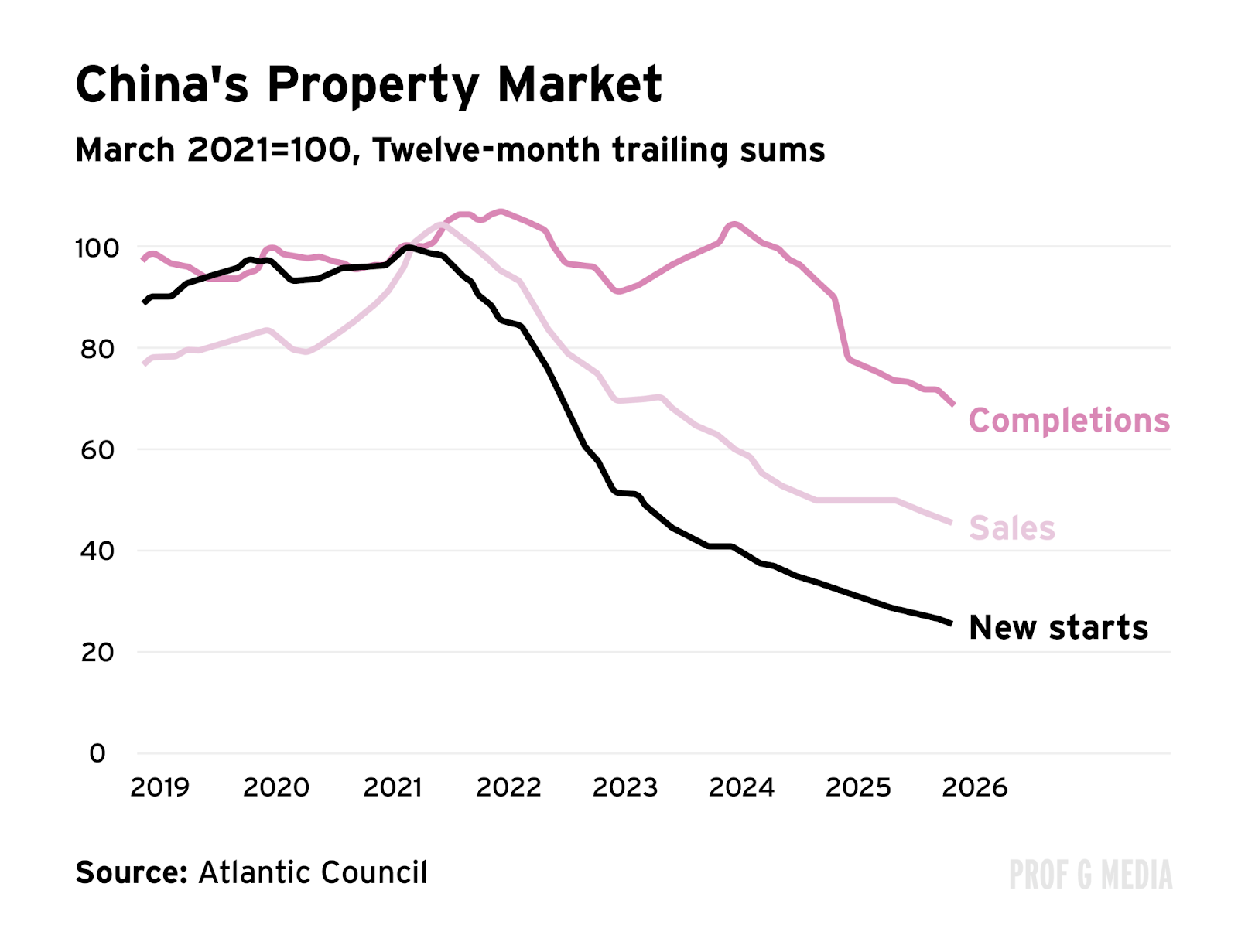
The real problem runs deeper: China’s property market. Around 60% of Chinese household wealth is tied up in real estate, prices are still falling, and property transactions are expected to drop another 10-14% this year. Until the property market finds a floor, which likely won’t happen before 2027, a genuine rebound in consumer spending is off the table.
Title: China’s Property Market
Subtitle: 2019 - 2026
Chinese Hospitals Are Becoming a Global Medical Tourism Hub
A video has gone viral of a British patient who flew to Beijing with stomach pain and walked away with a diagnosis, a treatment plan, and a total bill of around $400. That covered an endoscopy, blood tests, an electrocardiogram, a biopsy, and multiple consultations, all within 12 days. For context, a routine GP appointment with the NHS in the UK can take over a year to schedule — and going private can cost upwards of $3,800.
Last year, Chinese hospitals treated nearly 1.3 million foreign patients, a 75% jump from 2022. Under the government’s Healthy China 2030 initiative, Beijing is actively promoting a mix of modern and traditional Chinese medicine to attract both regional and Western visitors. Hainan Island has been designated a special medical zone by the State Council, giving international travelers easier access to cutting-edge foreign-approved treatments including stem cell therapies and cochlear implants.
The medical tourism market in China is projected to grow from $1.2 billion in 2025 to $3.4 billion by 2035.
Alice’s Take: This fits squarely into China’s broader push to develop its services sector, historically one of its weakest areas. Beyond the headline numbers, there’s a specific cultural angle worth watching: Yuezi, the traditional Chinese postnatal confinement practice. New mothers spend 30 - 40 days in a clinic receiving spa-level care, nutritious meals, and full infant support for roughly $1,000 to $2,000. Comparable offerings in the US cost ten times that. I can see this becoming a genuine lifestyle trend for women overseas seeking better affordable post-natal care.
If China can pair its cost advantage with consistent quality, it becomes a natural rival to Turkey and South Korea as a medical destination. I’d expect the next five-year plan to formalize that ambition.
James’s Take:This will happen and faster than people expect. That said, a word of caution from personal experience. About a decade ago, I was on a business trip in Beijing when a colleague’s lung collapsed. At the hospital, we were told he could either wait a couple of days for standard treatment, clearly not an option for someone gasping for breath, or pay 10x the price for immediate care. They could see I was from a foreign company and knew we were desperate. Things may have improved since then, but I would not assume those practices have disappeared entirely.
Seedance 2.0: ByteDance’s AI Video Model is Threatening Hollywood
ByteDance’s AI video model Seedance 2.0 is generating hyper-realistic, cinema-quality clips from a few written prompts. Tom Cruise and Brad Pitt brawling on a rooftop. Donald Trump fighting kung fu masters in a bamboo forest. Kanye West in Imperial Chinese attire performing a traditional music video. None of it is real, yet millions are watching it as if it is.
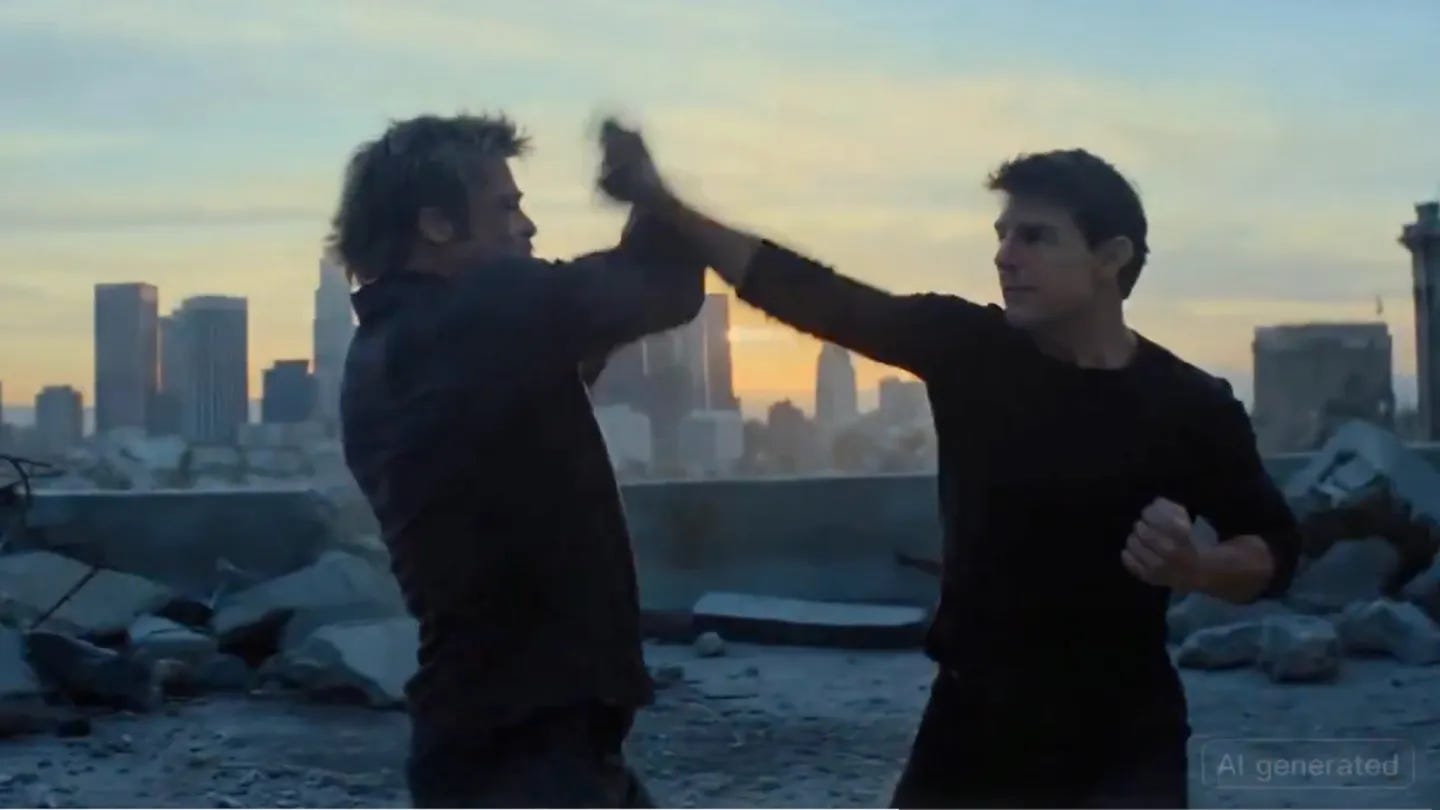
Hollywood is not taking it well. Paramount, Disney, Warner Bros., and Netflix have all sent cease and desist letters to ByteDance, accusing the company of systemic infringement and treating their intellectual property as “free public domain clip art.” SAG-AFTRA is pushing back, and critics warn the technology will accelerate deepfakes and fundamentally reshape the film industry.
Seedance 2.0 also charges roughly $0.60 for a 10-second video. Google’s comparable VO3 model costs $2.50 for the same output.
Alice’s Take: I’m genuinely worried about what’s been let out of Pandora’s box. The gap between what Seedance 2.0 produces and what I see on actual TV screens is shrinking fast. What’s striking is that China actually moved early on domestic regulation. The Cyberspace Administration penalized more than 13,000 accounts and removed hundreds of thousands of unlabeled AI-generated posts inside China. They saw this coming and built guardrails. America hasn’t and likely won’t anytime soon.
The result is that Chinese AI companies effectively have free rein outside their own borders, infringing on Hollywood IP with no real legal consequence. Studios can’t threaten market access because China largely pushed out American films around 2016, and you can’t compel a Chinese company through a US court. The only realistic path is government-level regulation. Right now, nobody is moving fast enough.
James’s Take: 2026 will be the year of mass Hollywood litigation against Chinese AI video apps, and those lawsuits will consistently fall behind the pace of the technology itself. It reminds me of the Chinese piracy DVD era of the early 2000s, when you could walk down any street in China and buy a bootleg film for one yuan, shot by someone sitting in a cinema with a camcorder. Hollywood was essentially powerless until China’s own government decided to crack down, and that’s probably the only realistic parallel here too.
The lawsuits will pile up, the apps will keep advancing, and the film industry will be disrupted in the meantime. The one slim hope is that Trump and Xi use their April summit to open a conversation about AI cooperation, but I wouldn’t hold my breath on anything substantive coming out of it.
Newsletter Exclusive: Why is Everyone Suddenly Wearing a Tang Jacket?
Adidas released a limited-edition “Tang-style” jacket at Shanghai Fashion Week in October. Available only in Greater China, it sold out immediately. Within weeks, there was even a version for pets.
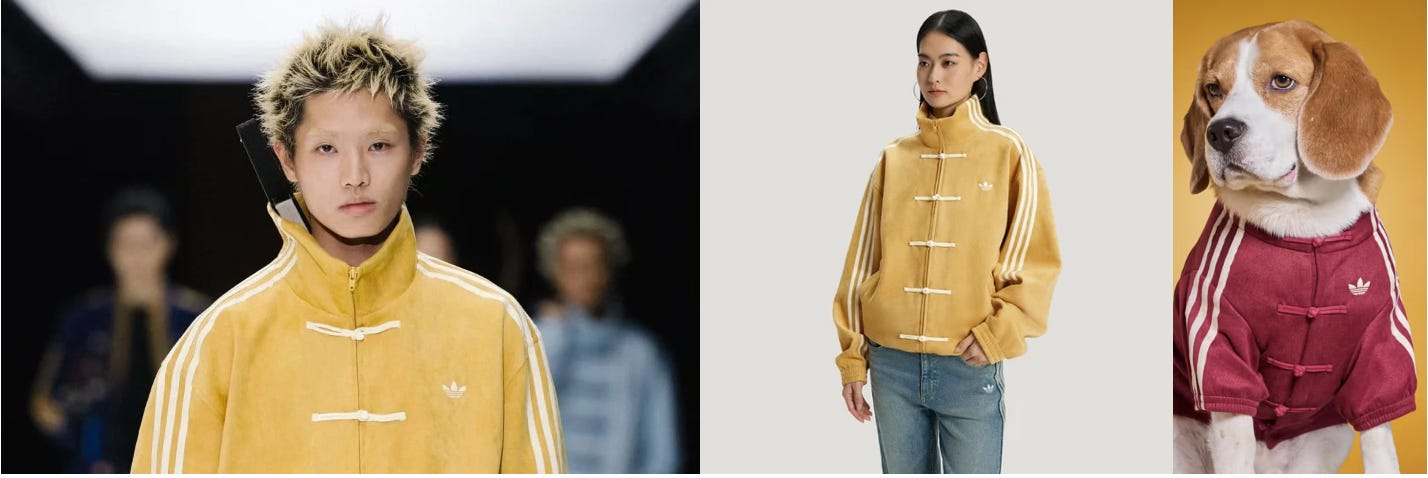
This month, Adidas brought the jacket to Paris.
Fashion influencers and Western brands are jumping onto this bandwagon with the Tang jacket being one of the key fashion trends for 2026.
Western retailers call this a “mandarin jacket,” after the standing collar. The actual name is Tangzhuang (唐装). Tangzhuang evolved from the Qing dynasty’s Manchu riding jackets, combining the collar with frog button closures. China revived it in 2001, presenting it as official attire at Shanghai’s APEC summit after decades of obscurity.
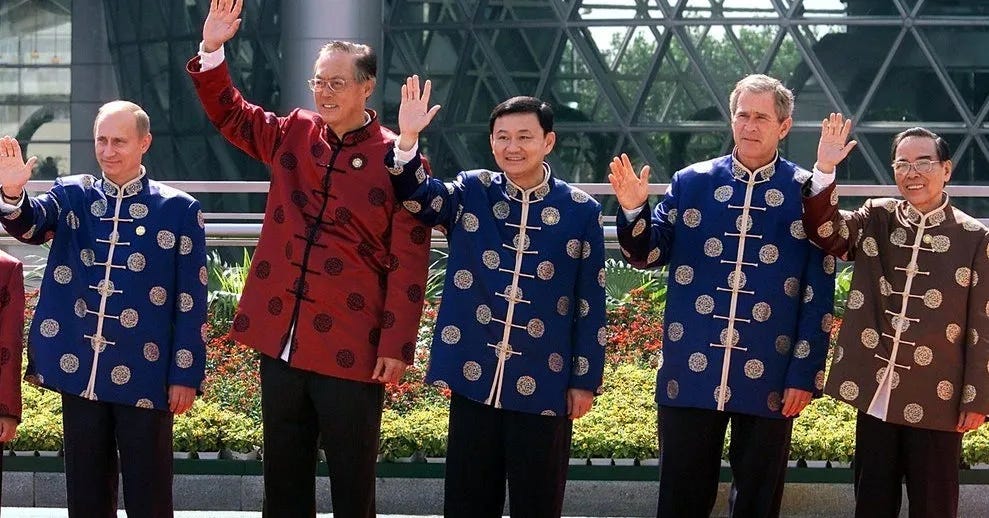
APEC 2001
The rise of the Tangzhuang has been driven by three converging forces.
First, domestic demand. What started several years ago as guochao (国潮, “national tide”), a surge in national pride among younger Chinese consumers, has become a powerful commercial force. Chinese Gen Z and millennials are rejecting Western luxury brands in favor of homegrown designs that celebrate Chinese heritage.
Second, a Western cultural backlash. Across TikTok and social media, younger Americans are proclaiming they’re at “a very Chinese time” in their lives. They’re wearing mandarin jackets, eating hot pot, buying Labubus, and celebrating Chinese products and technology. In the past year, search volume for Mandarin jackets has risen by 112%. The viral “Chinamaxxing” trend isn’t really about China. It’s a projection of American frustrations with their own country’s failures. China serves as a symbol, however selective or superficial, of what younger Americans believe their own country has lost.
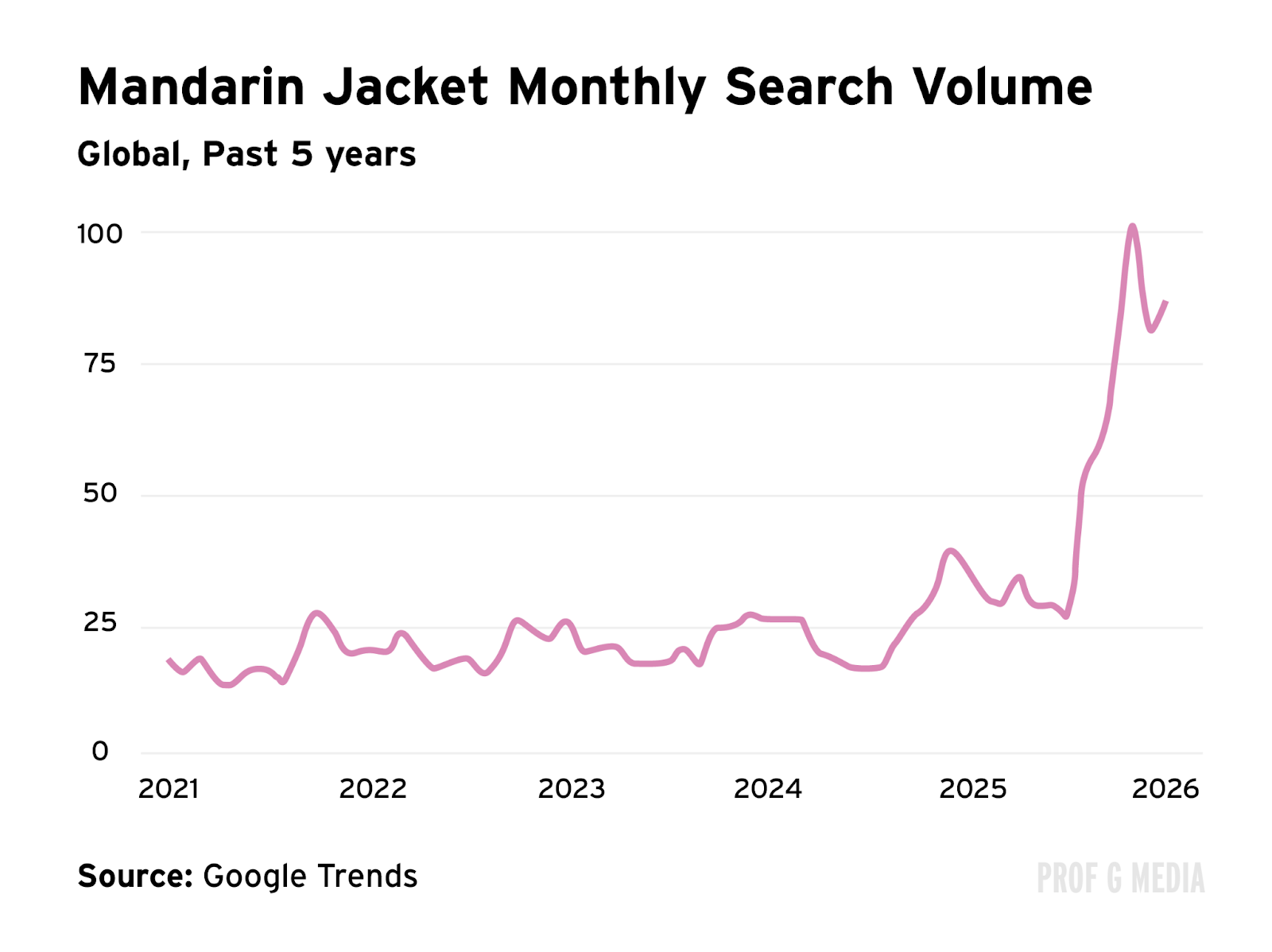
Third, manufacturing leverage is converting to cultural power. China accounts for about 30% of global apparel exports. For decades, that manufacturing was invisible, the final product branded as American or European. What’s changed is that Chinese companies now control the full value chain: design, production, branding, and increasingly, distribution. When Li-Ning, Anta, and other Chinese sportswear brands outperform Nike and Adidas in their home market, Western brands have to adapt. That domestic dominance has given Chinese companies the capital to acquire Western brands outright. Anta just bought 29% of Puma for $1.8 billion, adding the German brand to their portfolio that includes Salomon and Wilson.
Other Western brands are also capitalizing on this shift. In October, Moncler debuted its first Chinese collaboration with designer brand Qiuhao. Prada opened its first independent dining space in China. Amsterdam-based brand Rohe launched its own signature “Mandarin” jackets.
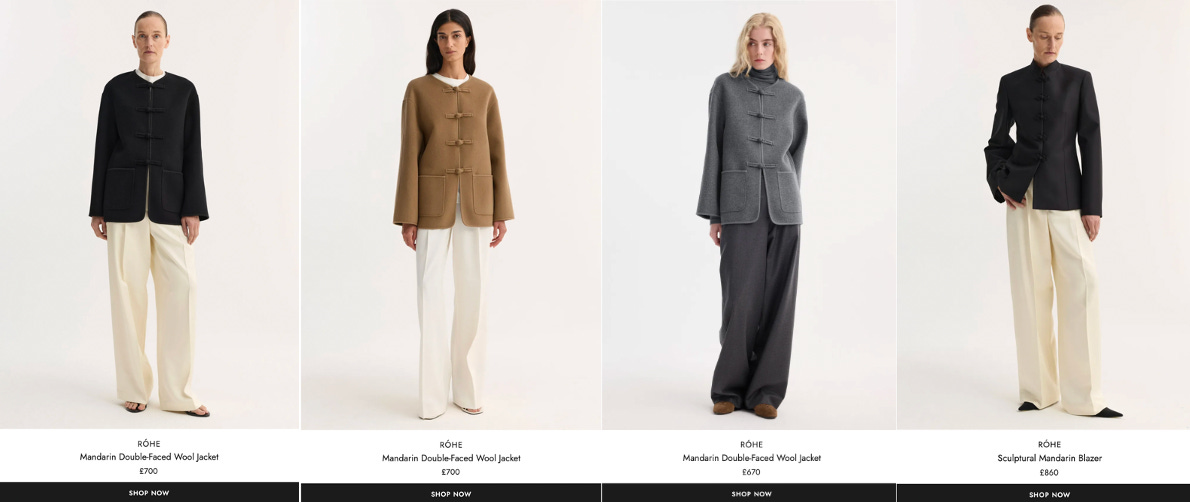
For decades, China manufactured most of the world’s clothing invisibly while Western brands claimed the credit. Now that dynamic is flipping. Western brands are the new cultural copycats, designing first to appeal to Chinese consumers, then bringing those aesthetics to global markets. When a German sportswear company markets traditional Chinese design elements under their Chinese names to Parisian audiences, its recognition that Chinese aesthetics now carry commercial value on their own terms.
Alice’s Prediction: Chinese mainland stocks will see positive momentum heading into the NPC meeting on March 4, driven by market anticipation around semiconductor hardware, upstream and downstream chip industry players, and AI-related policy announcements. Historically the lead-up to NPC meetings has been positive for markets, and I expect the same pattern here.
James’s Prediction: 2026 will be the year of mass Hollywood litigation against Chinese AI video apps, and the lawsuits will fall behind the pace of the technology. The apps will march ahead while the legal cases pile up, and the film industry will be thoroughly disrupted in their wake.
Medical tourism will most likely happen at private hospitals, not the (I assume) public hospital where your friend had his breathless shakedown. The standard of care here in Shanghai is excellent - with many public hospitals featuring more expensive wings and upgrade possibilities. Plastic surgery is also top level - competing with Korea.