


If you’re already a Prof G+ subscriber (thank you), join yours truly for weekly deep dives.
I think about masculinity a lot. I have two sons, and the market for good (public) male role models is experiencing a supply shock. In his new Netflix documentary Inside the Manosphere, filmmaker Louis Theroux chronicles influencers who cosplay as alpha males, displaying their fitness and wealth while vomiting misogynistic garbage re men dominating women. Spoiler alert: These guys will die alone and forgotten.
They’re also painfully boring. “The only way for them to maintain the attention of their audiences is to ramp up their behavior,” Jessica Grose wrote after watching the film. “They go beyond slurs and conspiracy theories to filming sex acts and beating strangers in the streets.” These influencers aren’t providing a template for a virtuous life, they are shills for an attention-economy grift.
Tragically, there’s never been anyone so adept at grifting the manosphere than Donald Trump. He claims to be concerned with the plight of young men (an admirable aim of the manosphere), but peddles a loud, crass, and ultimately bogus version of masculinity in service of his own enrichment, at the expense of his marks.

In my book Notes on Being a Man, I offer a vision of masculinity that emphasizes the roles men can play as providers, protectors, and procreators. Some people have pushed back, arguing that my framing overlooks men who don’t fit easily into those categories. Fair. Here’s a simpler framework: Men should add surplus value. Give more than they take. Leave rooms, relationships, and institutions better than they found them. That’s the whole shooting match. Try to absorb more complaints than they levy, de-escalate conflict, and notice people’s lives without needing to draw attention to their own.
Another takeaway from Theroux’s work: Calm and intellect trump physicality and aggression. The documentarian is slight, awkward … and owns the room. His honest, unafraid queries are never mean-spirited, and when his subjects turn on him, he just takes it (see above), as he knows he’s right. I wish I’d learned earlier in life that being a man means occasionally absorbing a blow without responding to restore some fucked-up sense of equilibrium to the universe.
Final takeaway. Ideology isn’t what’s driving the manosphere. The icons of this realm are grifters — there’s always a supplement, a crypto course, or a trading platform that drains boys (these are boys) economically in exchange for an illusory sense of self. Their followers engage because they have a desperate need for community. The manosphere, for all its flaws, is a community of men. The left should take notice: It celebrates and funds almost every special interest group — except the one that’s fallen faster than any other group in the last 50 years, young men.
Filter
If you’re a young man trying to figure out what surplus value looks like in practice, here’s a filter: Are you optimizing for attention, or service? Attention offers a dopa hit that evaporates into the ether, sending you chasing after things that will never merit mention in your best man’s wedding speech, the story your partner tells about why they chose you, or the eulogy your children give. Optimizing for service compounds value over a lifetime.
Captain Mueller
Last Friday, we lost a great American. Rather than sharing condolences, or reflecting on Robert Mueller’s decades of service, or simply demonstrating some grace, President Trump wrote, “Good, I’m glad he’s dead.” With just five words, Trump personified the antithesis of masculinity. In contrast, Mueller’s life was a case study in what it means to be a man. He optimized for service … as a Marine infantry officer, prosecutor, FBI director, and finally, special counsel. In addition to a Bronze Star and Purple Heart, he was awarded two invaluable titles: husband and father.
Sociologist Robert Merton coined the term “role model” in 1957 while studying the socialization of medical students. He found that we learn “scripts” from role models teaching us how to behave in a specific status (doctor, leader, parent, etc.). Mueller likely had dozens of great role models, but it was David Hackett, a classmate and lacrosse teammate at Princeton, who provided the leadership script.
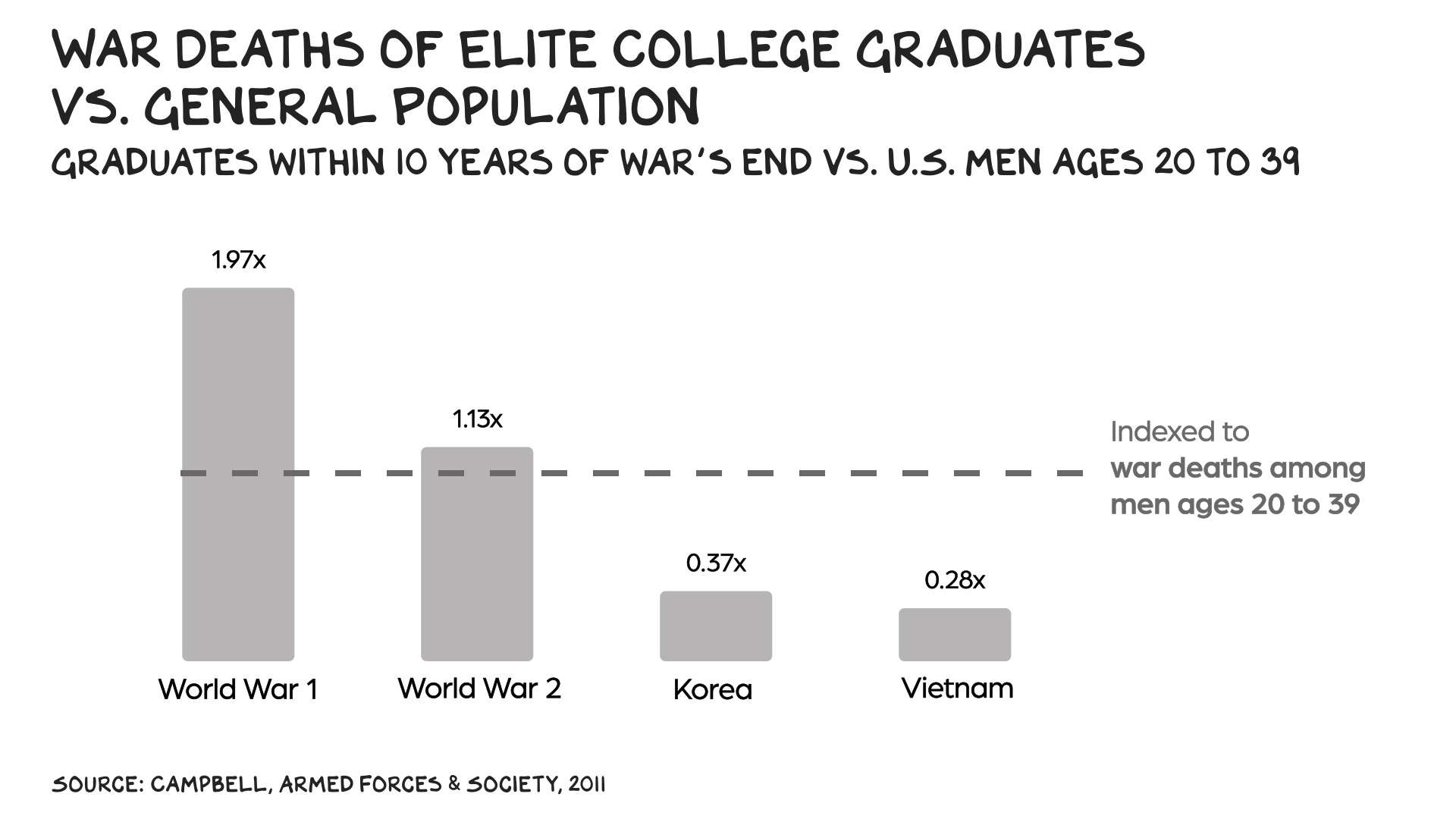
After learning that his friend had been killed in combat while serving in Vietnam, Mueller volunteered for the Marines. As a “Fortunate Son” — Mueller was reportedly a Creedence Clearwater Revival fan — he could’ve sought deferments (Bill Clinton), asked a doctor to write a note saying he had bone spurs (Trump), or had his family pull strings to secure a National Guard spot (George W. Bush). Sociologist Alec Campbell quantified an uncomfortable truth about the Vietnam war: Someone from the general population was 3x to 4x more likely to die in combat than an Ivy League graduate. Mueller’s decision to serve was out of step with his socioeconomic cohort, but very much in character.
“I had one of the finest role models I could have asked for in an upperclassman by the name of David Hackett,” Mueller recalled in a 2013 speech he gave as FBI director. “One would have thought that the life of a Marine, and David’s death in Vietnam, would argue strongly against following in his footsteps. But many of us saw in him the person we wanted to be, even before his death,” Mueller went on. “A number of his friends and teammates joined the Marine Corps because of him, as did I.”
Service
The Marines live by a code: Semper Fidelis, Latin for “always faithful,” to the Constitution and the country, to the Corps, to their fellow Marines, and to the mission. Mueller served three years on active duty before attending law school. After a brief stint in private practice, he joined the Department of Justice. Years later, reflecting on a lifetime of service, Mueller said, “I consider myself exceptionally lucky to have made it out of Vietnam. There were many who did not. And perhaps because I did survive Vietnam, I have always felt compelled to contribute.”
Mueller’s contributions read like a John Grisham novel. After rising through the ranks as a prosecutor, he oversaw cases against Panamanian strongman Manuel Noriega, Gambino crime family boss John Gotti, and the terrorists who bombed Pan Am Flight 103 over Lockerbie, Scotland. But it’s the work Mueller did outside the spotlight that reveals his character. In 1995, two years after leaving the DOJ for private practice, Mueller volunteered to return in a lesser role, as a line prosecutor. “One day he called me, out of the blue, and asked if I could use a homicide prosecutor in my office,” recalled the chief federal prosecutor in Washington at the time, Eric Holder Jr., later Barack Obama’s attorney general. “Our nation’s capital was a city in great distress — we were called the murder capital of the United States.” For the next three years, Mueller prosecuted murder cases, helping to bring down the city’s homicide rate.
His greatest contribution, however, was leading the FBI for 12 years in the aftermath of 9/11, restoring public trust while reforming the bureau to address the systemic failures that had allowed the worst terrorist attack in American history. Fealty to his mission sometimes put him at odds with the presidents he served. Mueller’s counterterrorism agents blew the whistle on abuses and torture at secret CIA interogation sites. Later, in 2004, Mueller, with his resignation letter in hand, confronted President George W. Bush about a secret NSA program to spy on Americans. In his memoir, Bush wrote, “I had to make a big decision, and fast. I thought about the Saturday Night Massacre. That was not a historical crisis I was eager to replicate.” Fearing others would follow Mueller’s lead, Bush backed down, agreeing to reforms that would narrow the spying program and place it on more solid legal ground. A year later, Mueller’s deputy, James Comey, told an NSA audience, “It takes far more than a sharp legal mind to say ‘no’ when it matters most. It takes moral character. It takes an ability to see the future. It takes an appreciation of the damage that will flow from an unjustified ‘yes.’”
Character
My sons are too young to remember when Trump didn’t dominate America’s politics. In their eyes, bragging about grabbing women by the pussy, using your office to enrich yourself, and calling your efforts to avoid STDs your own “personal Vietnam” aren’t disqualifying. The manosphere is teaching their generation that masculinity is performative. Mueller’s life proves the opposite. Masculinity is a lifetime practice. Vietnam wasn’t a punchline for Mueller, but a moral proving ground. As he later said, “You were scared to death of the unknown. More afraid in some ways of failure than death, more afraid of being found wanting. That kind of fear animates your unconscious.” I want my boys to know that kind of fear, to understand that men aren’t measured by social media stats, body counts, and bank statements, but by whether they do the right thing, even when it’s hard, and especially when nobody is looking. The grifters are busy counting their followers, but real influence comes from planting trees whose shade you’ll never sit under.
Should his family choose, Captain Robert Mueller will be laid to rest with full military honors: a three-rifle volley salute, folding of the flag, and taps. In attendance will be many of the 25 high school hockey players he captained, the 50 marines he commanded, the thousands of colleagues he served with, his two daughters, five grandchildren and one wife of 60 years.
Captain Robert Mueller, United States Marine Corps, was 81.
Life is so rich,

P.S. Storytelling is the most important skill you need to succeed in the modern economy. Join Prof G Media Research Lead Mia Silverio this Tuesday, March 31, at 1:30 pm ET for a subscriber-only masterclass on the Science of Storytelling. Sign up here.
Wow what an excellent piece. Thank you @ScottGalloway - again
It is such a relief to read such a thoughtful, well-expressed essay in a time when my mouth seems to continually open in shock and my mind numb at the crass, callous, ignorant and consistently vulgar expressions uttered by the Commander in Chief and those who serve with him.