



Minutes after a gunman attacked the White House Correspondents’ dinner last Saturday, millions of Americans, on the left and the right, theorized the attack was staged. This is only the latest example of our worst instincts running amok, leading us to ignore Lincoln’s urging to call on “the better angels of our nature.” So far, those calls have been sent to voicemail. I believe the U.S., after a decade of breaking laws and blowing past norms, is headed for a reckoning.
Crisis
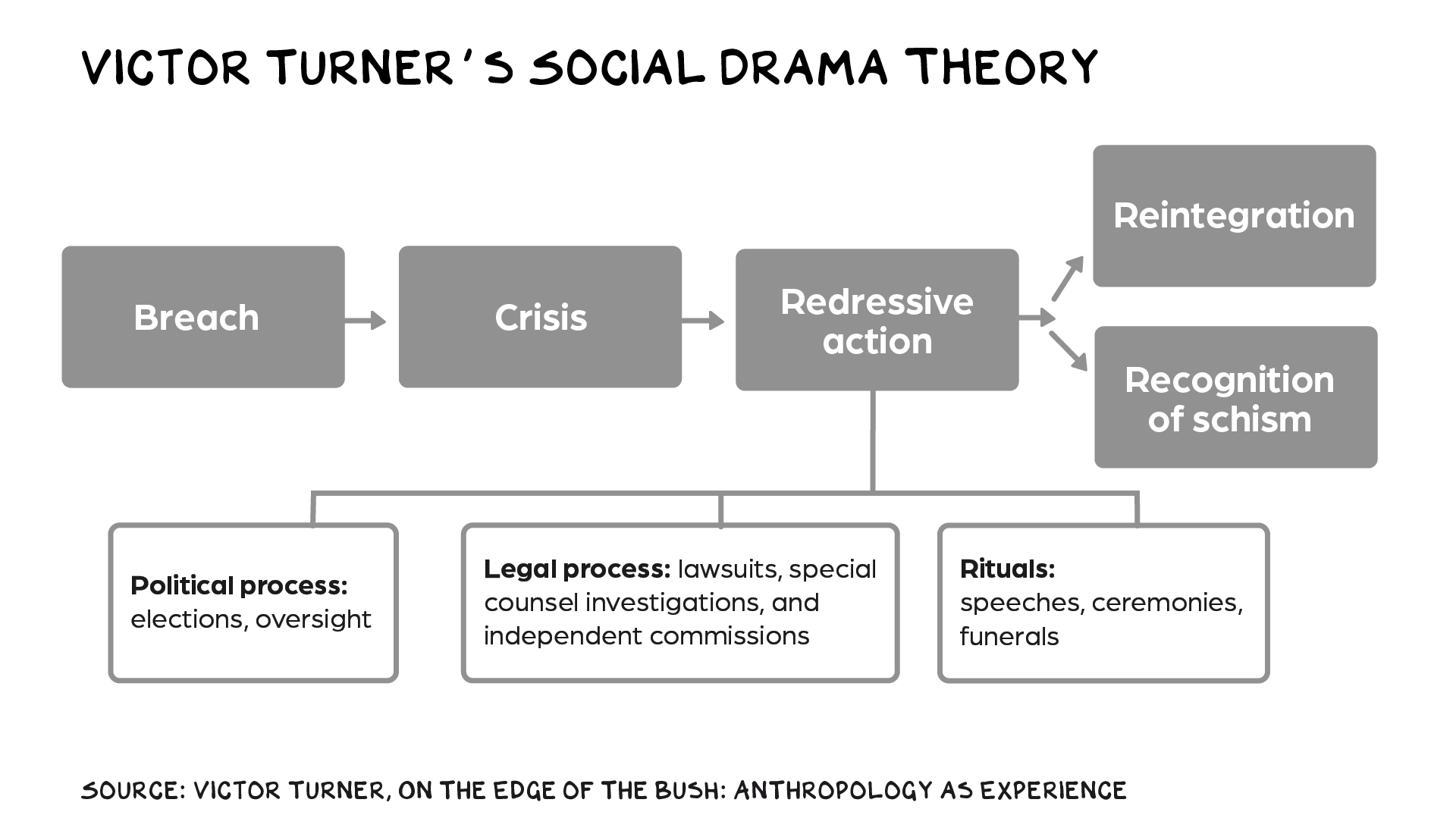
In my NYU Brand Strategy course, I teach a section on crisis management. The playbook: Acknowledge the issue, take responsibility, and overcorrect. As Anthropologist Victor Turner observed, leaders perform rituals to repair social breaches. In his 1957 book Schism and Continuity in an African Society, Turner laid out the four-act structure of his Social Drama Theory: breach, crisis, and redress, followed by either reintegration or recognition of a schism.
Observing the Ndembu people in what is now Zambia, Turner witnessed an ambitious young man trigger a social drama by publicly refusing to share meat from the hunt — a violation of tribal norms and a direct challenge to his uncle, the chief. The breach spiraled into a village-wide crisis, forcing everyone to take sides and exposing tensions in the group’s social structure. In the end, rituals meant to repair the breach failed, and the young man left the group to form his own village. Over the course of his career, Turner built on his Social Drama Theory, applying it to his understanding of political contests, legal disputes, and other social conflicts. According to Turner, every crisis pits our ties to the larger group against our deeper loyalties to individual leaders or factions. In other words, the most devastating fractures aren’t caused by outside enemies, they come from within.
Breaches
Future historians will debate where to locate Act One (the breach) of America’s current social drama. When the country elected a man who bragged about grabbing women by their genitals, or when we re-elected a convicted felon and insurrectionist? Or when masked federal agents started murdering and disappearing people? Maybe the breach occurred earlier, with atmospherics that made Trump’s election possible? The 2008 financial crisis blew up the housing market, sent unemployment above 10%, and reduced household wealth by 26%. The result wasn’t prison sentences, but bonuses (Obama). Two breaches occurred on George W. Bush’s watch. He responded to 9/11 by lying about weapons of mass destruction to justify invading Iraq — the biggest intelligence failure since Pearl Harbor — while losing momentum in the hunt for Osama Bin Laden. The bungled response to Hurricane Katrina in 2005 and Bush’s tone-deaf remarks crystallized the image of an indifferent and inept government. Bill Clinton lowered the Oval Office bar. Ronald Reagan’s Iran-Contra affair was a modern triangle trade that sent arms to Iran in exchange for hostages, funded a secret war in Central America, and, according to journalist Gary Webb’s reporting, inflicted the crack cocaine epidemic on American communities. Another Reagan breach: Turning his back on the tens of thousands of people who died of AIDS on his watch. The list of executive breaches goes on.
If the executive branch is the monster, Congress is Dr. Frankenstein. Since World War II, the legislative branch has slowly delegated its powers, acquiescing in the face of presidential expansion — washing its hands of wars, scaling back oversight, outsourcing rules and regulations, and weakening its authority to tax and spend. Meanwhile, a seat in Congress has become the ultimate get-rich-quick scheme, as lawmakers are effectively immune from insider trading prosecutions. In 2024, Republicans David Rouzer and Susan Collins registered returns on their investments of 149% and 77%, respectively; Democrats Debbie Wasserman Schultz and Nancy Pelosi performed slightly worse, at 142% and 71%. The S&P, a decent proxy for your retirement portfolio, returned 25% that year.
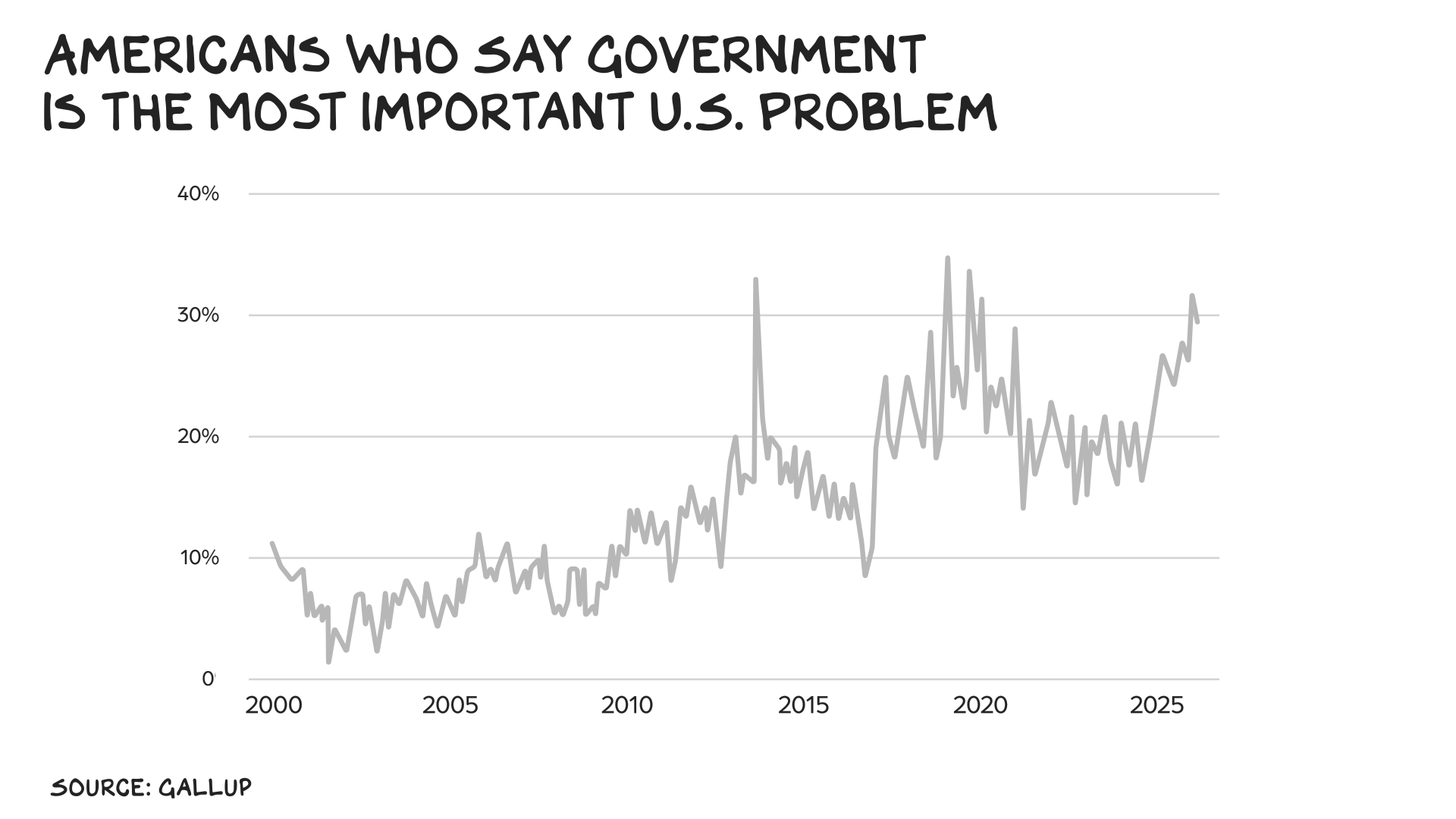
The question isn’t why Congress’ approval rating is so low, at 10%, but why it’s that high. Fourteen of the past 20 national election cycles have been “change elections,” with the out-party retaking the White House or at least one chamber of Congress. But the only real change since 2000 has been a 3x increase in the share of Americans who say the government is the most important problem facing … America. In a recent interview, former Senator Ben Sasse said government is a tool of the people. Imagine a power drill becoming sentient and coming for our eyes.
Healing
Healing from a breach requires what Turner called redressive action. Modern societies deploy legal and political processes (rituals) to balance competing forces — truth, justice, forgiveness — as they attempt to repair the rift. After apartheid, South Africa’s Truth and Reconciliation Commission provided a healing framework by giving citizens the opportunity to bear witness. “Whites can no longer deny what took place,” Afrikaner journalist Antjie Krog wrote. “The Commission revealed the extent to which apartheid dehumanised … and it introduced a moral language in which the past could be confronted.” After World War II, the allies secured justice via the Nuremberg trials. But the healing process continues through the concept of Vergangenheitsbewältigung — “the struggle of overcoming the past” — which shapes German political culture to this day. After reunification, Germany repeated the exercise, creating the Stasi Records Agency so citizens could read their secret police files, providing healing with relatively few prosecutions.
U.S. history provides examples of healing, but our record is schizophrenic. After the Civil War, federal troops occupied the South, providing a (very limited) umbrella of security for free Black people, and, with the help of three Constitutional amendments, the promise of a more just and democratic society. Three years into Reconstruction, however, President Andrew Johnson issued a blanket amnesty to former Confederates, including Jefferson Davis and Robert E. Lee, taking treason off the table. A few years later, to promote reconciliation, Congress restored voting rights for most former Confederates. After the contested 1876 election, former Confederates leveraged their restored political power to end Reconstruction. As historian Eric Foner noted, “Reconstruction in some ways is still alive because the issues of Reconstruction have never been fully resolved in American society.” Jim Crow, the Civil Rights Movement, and the recent fights over Confederate monuments illustrate how that unresolved breach marches on like a zombie, infecting today’s politics.
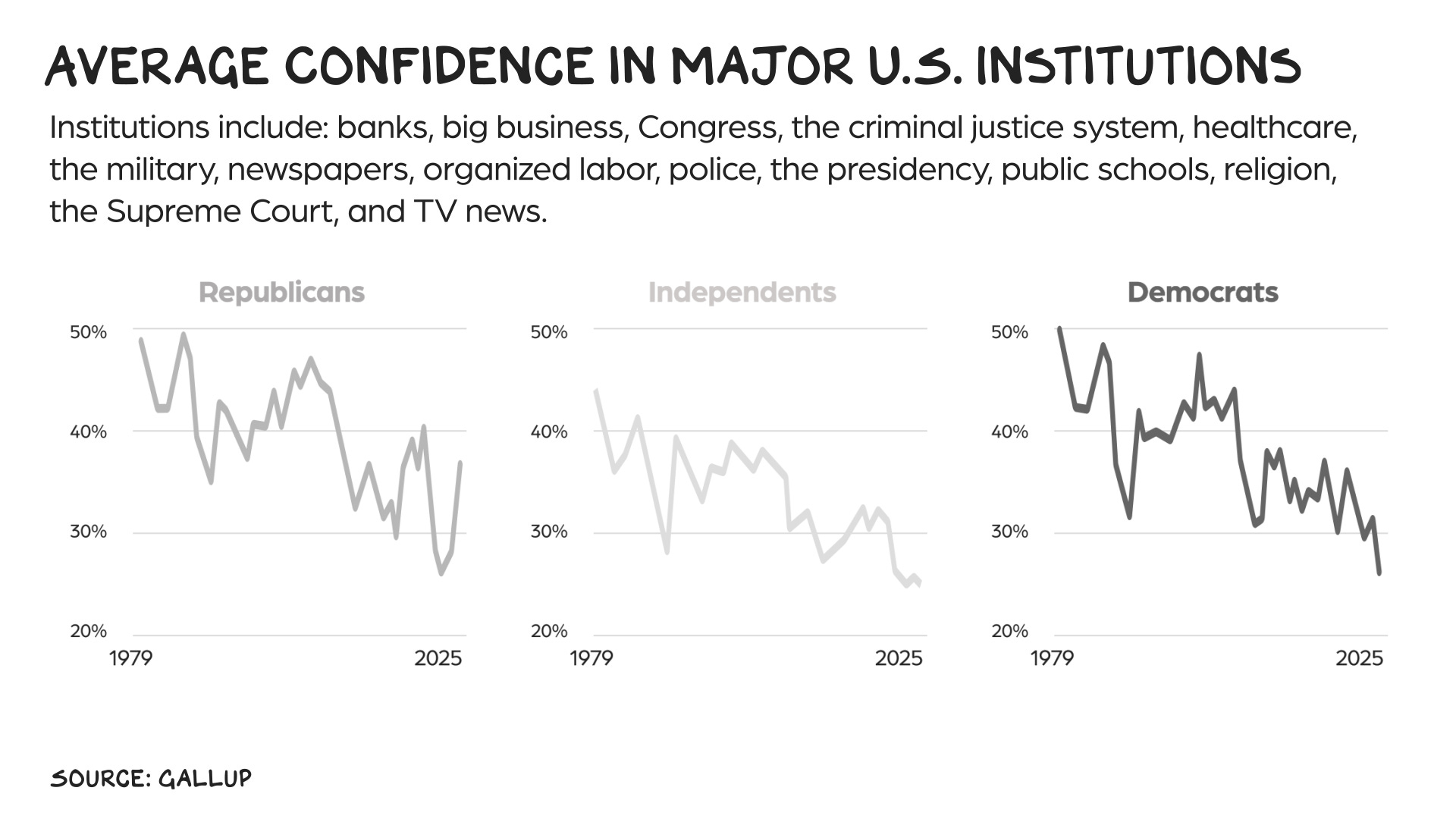
In the wake of Watergate and President Nixon’s subsequent resignation, Gerald Ford pardoned his predecessor. “My fellow Americans, our long national nightmare is over,” Ford said in his 1974 inaugural address. “Our Constitution works; our great republic is a government of laws and not of men.” In pardoning Nixon, Ford was performing a forgiveness ritual in the form of a legal process. It didn’t work. Two-thirds of Americans at the time disapproved of the decision, and Ford’s approval rating dropped 21 points within a month of taking office. The crisis caused by Nixon’s power grab endures, casting its long shadow over opportunities to hold Trump accountable, including the decision to prosecute him for attempting to overturn the 2020 election. Ultimately, voters rejected the legal process in favor of a political one and reelected Trump, who immediately sought retribution against his political opponents and pardoned his J6 insurrection gang. Zooming out, our failures to confront history have contributed to a half-century-long erosion of trust in our institutions. The periodic exceptions: Trust briefly recovers when your party wins, making every election feel existential … because it is.
American Renewal
The midterms may provide a reckoning, but it won’t be the one the U.S. needs. Our divisions run too deep. One example: Prosecuting the rampant corruption of Trump’s family and associates will deliver justice, but if we fail to also address congressional corruption (insider trading, Citizens United spending) we’re putting a Band-Aid over a wound that needs to be cauterized. Does our society have the courage to go deeper and the attention span to see it through? My Yoda on American history is historian Heather Cox Richardson. Last time we spoke, I was struck by her optimism. “We’ve renewed our democracy in the past,” she told me, “and we have the tools to do it again.” Her advice: Channel Lincoln, who navigated a period of political instability and violence and renewed our democracy by appealing to the values expressed in the Declaration of Independence. Although Lincoln didn’t just appeal to values — he presided over 600,000 deaths first.
The question isn’t whether the U.S. can renew itself. History says yes. Americans yearn for better leadership. But this misses the point — the people running the country aren’t stupid, they’ve been incentivized to continue to engage in corruption, demonization, and the trampling of institutions and norms. We don’t have a leadership crisis but a consequence deficit.
Life is so rich,

P.S.
Moderates looking to rage harder have a new forum — The Monday Rage, a companion newsletter to the Raging Moderates podcast. Subscribe here.
P.P.S.
The best way to read No Mercy / No Malice is to have George Hahn read it to you. Audio drops on Saturday wherever you listen to podcasts, but the ad-free version is available only on Substack with a Prof G+ paid subscription. Upgrade here.
Already upgraded? (Thank you.) Set up your private feed to skip the ads. Take your time back here.
I was working as a mason's assistant during the summer of the Watergate Investigating Committee hearings in 1973. We were replastering the Brown University chemistry labs. Like most teaching labs at the time, we had televisions everywhere. I tuned in to the hearings while I worked. The committee was headed by Constitutional scholar Sam Earvin. The Republican delegation was headed up by Howard Baker. Everyone, including the witnesses worked in good faith.
There was no partisan bickering or sloganeering. Once the oval office tapes came to light and the Supreme Court required that Nixon turn them over, it was curtains for Nixon. You may recall, that it was a Republican delegation headed by Barry Goldwater who eventually talked Nixon into taking his last trip on Marine One.
In 1979, on a postdoc, I found myself working on Senate Banking Committee staff. As a dyed in the wool Dem, I thought I could tell the bad guys from the good guys. Then, in my first conference committee meeting, with the doors closed and the press shut out, I saw true comradery and affection between the Democrat and Republican members. They could work the differences out of pending legislation with ease. Mostly by splitting the difference and moving on.
What ended all this, in my view, was one man: Grover Norquist. He perfected the practice of primarying Republican members of Congress who did not toe the hard right line. Gradually, even the most popular moderate Republican members were run out of office. Donald Trump has taken Norquist's techniques to the next level in order to rip the spine out of every Republican in Congress since John McCain died.
Job One is campaign finance reform starting with Citizen's United. Nothing is more important.
The argument that America’s current crisis of trust stems from unresolved breaches stretching back decades, 100 years or even 200 years misses the more immediate and powerful driver: modern media systems that curate and shape perception in real time.
Today’s breakdown in confidence doesn’t require reaching back to the Revolution, Reconstruction, Watergate, or the Iraq War. The breach is happening now, daily, through a media ecosystem that is no longer primarily in the business of informing—but incentivized to influence. Major media institutions operate within corporate and political frameworks where narrative alignment, audience capture, and revenue models often outweigh neutral truth-seeking.
This isn’t speculation—it’s structural. Advertising dependence, consolidation of media ownership, and algorithm-driven amplification have created an environment where emotionally charged, divisive content outperforms balanced reporting. The result is not just bias, but systematic steering of public perception, where the same event can be framed in entirely different ways depending on the outlet.
Trust erodes not because Americans failed to resolve the Civil War or Civil Rights properly, but because citizens no longer believe they are being told the truth in the present moment. When reality itself appears fragmented—when facts feel negotiable—confidence in institutions collapses quickly.
In short, the breach is not buried in history. It is engineered in the present, distributed at scale, and reinforced daily into your place of work, your home and on your phone. Any serious attempt at “reckoning” must start there—not in the past, but in the systems actively shaping public understanding right now.