If you checked out over the holidays, here’s what you missed.
US Stocks Finished the Year Behind Global Equities
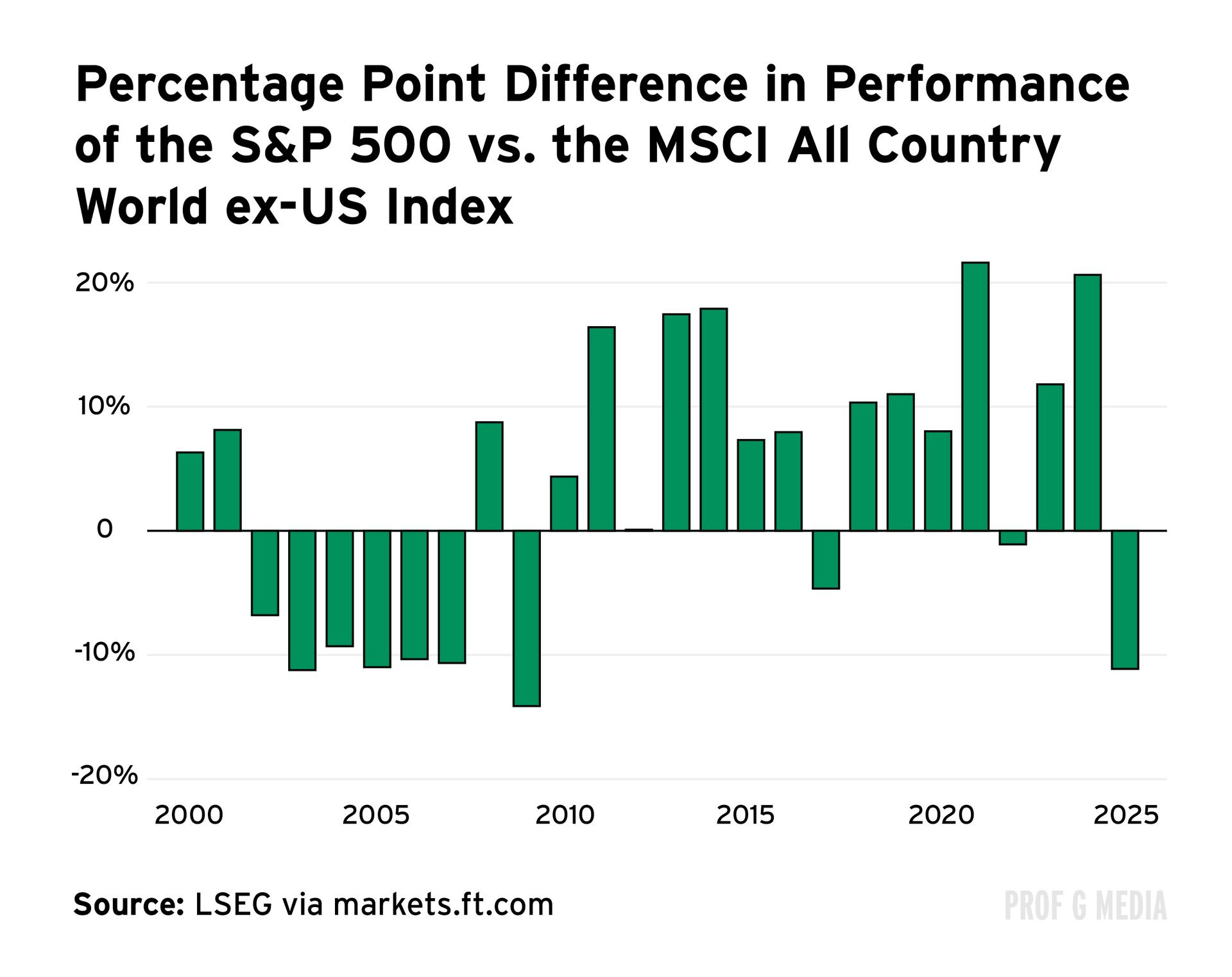
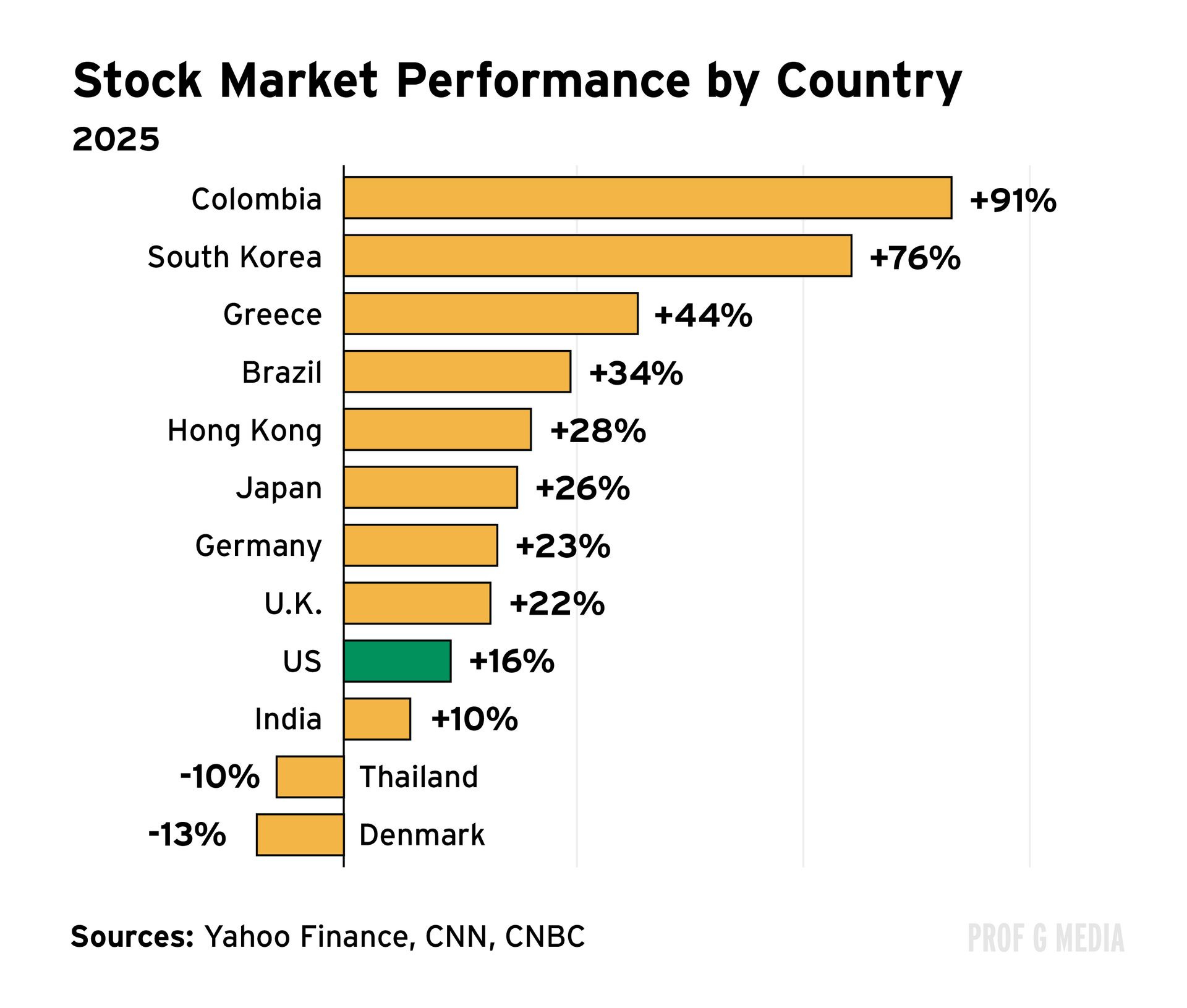
The S&P 500 increased 16% in 2025, trailing the MSCI All Country World ex-U.S. Index’s 29% gain. That’s the widest gap between U.S. and international stocks since 2009. But by historical standards, both markets had exceptional years — especially given the overhang of trade tensions and lingering uncertainty around President Trump’s tariffs.
Over the past four decades, the MSCI ex-U.S. Index has delivered an average annual return of about 6.9%.
Since 1957, the S&P 500 has posted average annual returns of about 10.6%. In its modern history, three consecutive years of gains above 15% have occurred just four times, with mixed outcomes: Half were followed by continued gains; the rest ended in a pullback.
Why did international markets perform so spectacularly? European stocks benefited from higher defense spending, China’s AI progress boosted confidence in its tech sector, and globally, AI spending started rewarding second-order beneficiaries — energy and industrial firms — rather than just the most obvious tech names.
Looking ahead to 2026, J.P. Morgan Global Research is also bullish on global equities, projecting double-digit returns supported by fiscal stimulus and continued AI-driven capex.
In the U.S., not a single one of the 21 strategists surveyed by Bloomberg expects a stock market decline. The average year-end forecast for the S&P 500 implies another 9% gain.
Nvidia and Meta Used the Holidays to Lock Up AI Talent
While most white-collar workers were enjoying the holidays, Big Tech went into acquisition mode.
Nvidia made its largest “acquisition” ever on Christmas Eve, paying $20 billion for the assets of AI chip startup Groq. The day before New Year’s Eve, Meta bought Chinese AI startup Manus for $2.5 billion.
Nvidia Acquires Groq’s Talent for $20 Billion
Nvidia isn’t technically acquiring Groq. The companies announced a “nonexclusive licensing agreement” valued at an estimated $20 billion. Groq will remain an independent company, but roughly 90% of its employees — along with its founder and CEO and its president — are joining Nvidia, making the deal functionally an acquisition.
This move signals a shift in Nvidia’s priorities from AI training toward AI inference, the process of running models.
Inference is set to be the next major profit pool; McKinsey estimates that it will make up more than half of AI workloads by 2030.
Groq specializes precisely in inference-focused chips, a market in which Nvidia has faced more intense competition. CEO Jensen Huang acknowledged the challenge last fall, telling analysts on the company’s Q3 earnings call that inference is “really, really hard.”
The deal eliminates Groq as a competitive threat in the next-biggest AI market but also gives Nvidia an edge in its intensifying rivalry with Google. Nvidia’s newest employee, Groq’s founder Jonathan Ross, invented Google’s AI chips, called Tensor Processing Units (TPUs).
Google fell 1% on Christmas Eve but recovered by the end of the day.
Neutralizing the competition didn’t come cheap. Based on Groq’s estimated revenues of $500 million in 2025, the $20 billion deal implies a 40x revenue multiple.
The average revenue multiple for AI M&A deals in 2025 was 26x.
It’s worth noting that several of Groq’s investors have close ties to President Trump, who recently allowed Nvidia to resume selling advanced chips into China. They include Social Capital, led by Trump donor Chamath Palihapitiya; BlackRock, which partnered with Trump last year on the Panama Canal deal; 1789 Capital, where Donald Trump Jr. is a partner; and Altimeter Capital, whose CEO, Brad Gerstner, is working with the Dell family on Trump-linked investment accounts.
This backdoor acquisition strategy has become a common way for Big Tech firms to neutralize competition while minimizing antitrust scrutiny.
In 2024, Microsoft licensed Inflection’s models and hired its CEO; Google struck similar deals with Character.AI and later Windsurf; and Amazon did the same with Adept. In 2025, Meta followed suit, paying $15 billion for a stake in Scale AI … and its CEO.
, prominent tech journalist and frequent guest on Prof G Markets, reported that on the day Google announced its Character.AI deal, Groq founder Jonathan Ross told him: “We have no intention of being fake acquired, or real acquired for that matter.” The learning: Everyone has principles; the only variable is the number of zeros required to suspend them.

It’s becoming comic how frequently this is happening in AI. This is the biggest technological revolution of the past 20 years and all of the value is accruing to a handful of multi-trillion-dollar companies.
We’re now devolving into an ecosystem where competition just doesn’t really exist. If you’re building a great AI company, the reality is that sooner or later you’re going to get a knock on the door and one of the Big Tech CEOs will show up with terms of your surrender and also the biggest bag of money you’ve ever seen. They’re going to say take the money, join us, and you will.
Meta Acquires Manus AI
At an estimated $2.5 billion, Meta’s acquisition of Chinese startup Manus AI is its third-largest deal ever. Manus was founded in 2022 and builds an AI agent capable of autonomously handling tasks like research, coding, trip planning, and website creation.
Manus has already demonstrated extraordinary growth and revenue potential: It reportedly went from zero to $100 million in annual recurring revenue (ARR) in just eight months, the fastest ramp on record. And, as recently as March 2025, fewer than 1% of users on its waiting list had access to the product.
Meta said it will keep Manus’ core products on the market while folding its technology into its own offerings, including the Meta AI chatbot. According to the Financial Times, Meta has been testing the idea of premium subscriptions for Meta AI.
Manus is now based in Singapore and plans to discontinue its operations in China.

The double-digit stock drop after Meta’s Q3 earnings — following its announcement of higher AI spending — clearly registered with Mark Zuckerberg. Investors are worried that AI could become to Meta what the metaverse division has been: a money sink. Integrating Manus AI’s agents into Meta’s AI assistant offers a more concrete path to monetization, potentially making Meta AI compelling enough to support a subscription model — and tangible evidence that Zuckerberg understands AI capex needs a clear path to ROI.
Gold and Silver Surge at Year-End
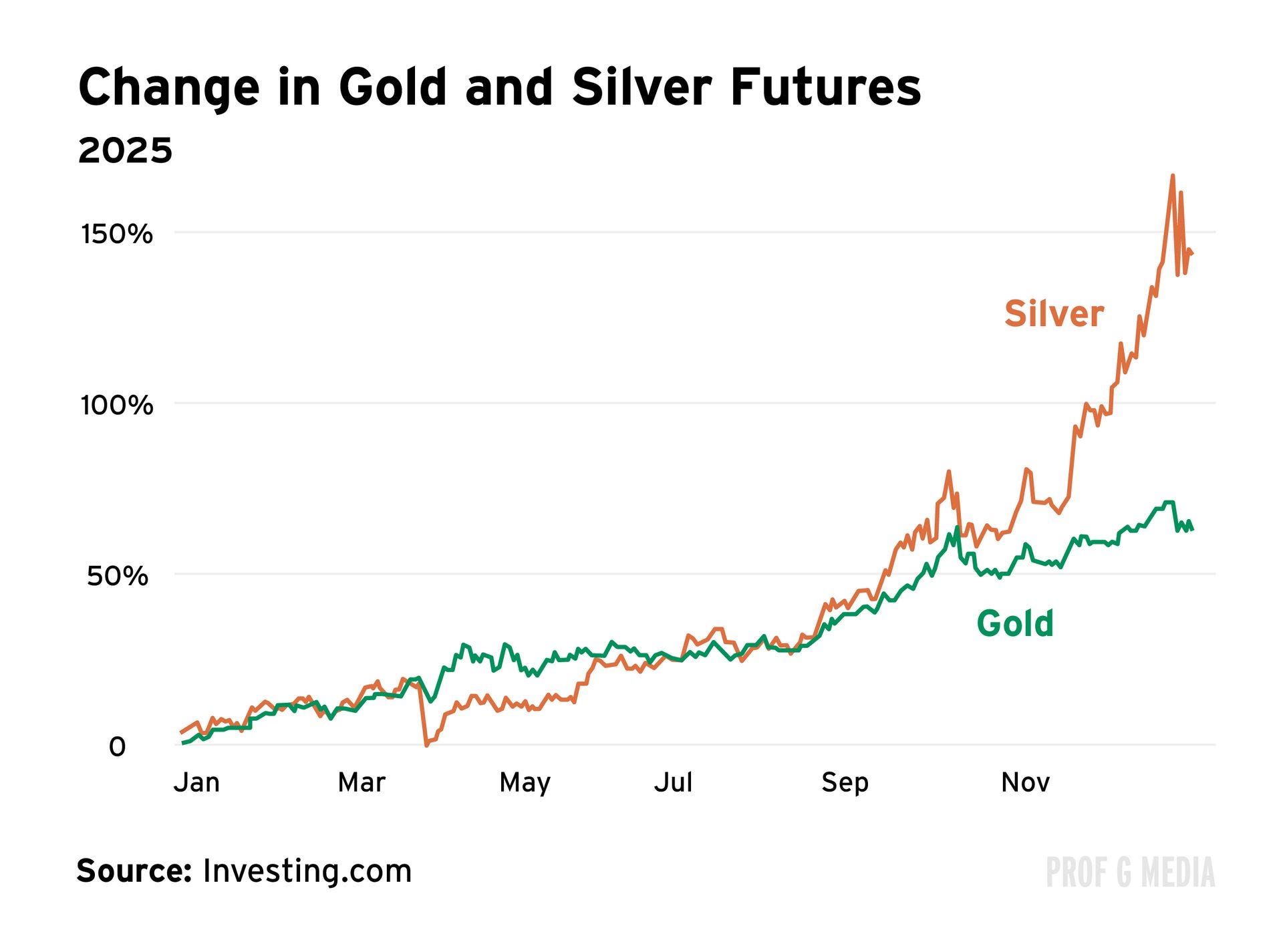
Gold and silver popped in December, capping off an unusually strong year for both metals.
Silver jumped 25% in December alone, while gold rose 3%.
Zooming out, silver finished 2025 up 147% and gold up 67% — both metals’ best annual performance since 1979.
Several forces drove the December surge. Rising geopolitical risk boosted demand for safe havens like gold and silver, and falling interest rates reduced the opportunity cost of holding nonyielding assets (investments that don’t pay regular income like dividends or interest), making precious metals more attractive.
Silver outpaced gold this year because, unlike the yellow metal, silver is an important industrial input. It’s a crucial part of semiconductors, batteries, and solar panels, making it a beneficiary of increased AI and clean-energy spending.
It looks like demand in both industries will continue growing this year, but investors should know that silver is historically volatile. While gold prices are primarily driven by steadier central-bank buying and investor hedging, silver’s smaller market and greater exposure to industrial demand amplify price swings.