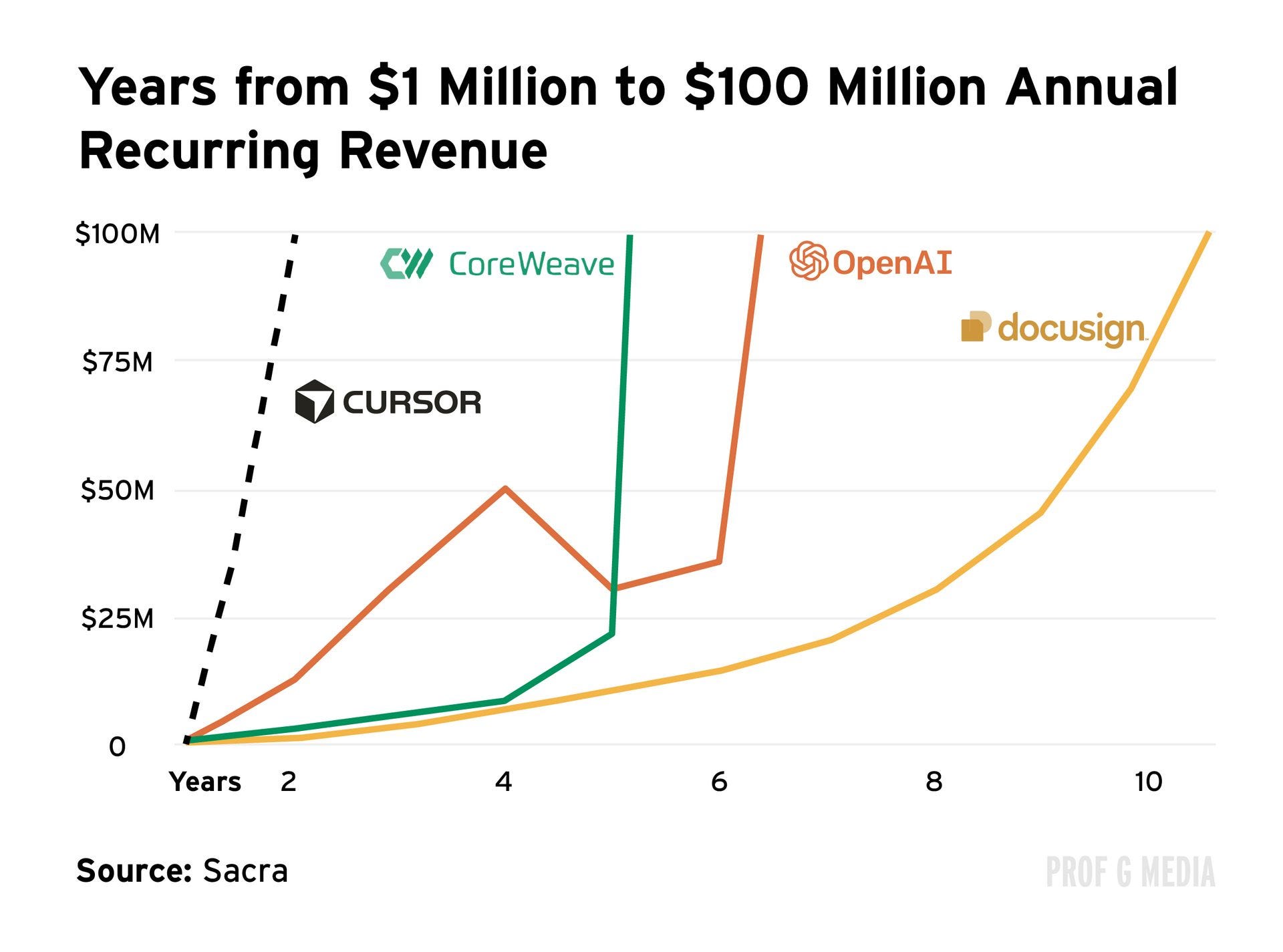
A small group of companies dominated AI headlines in 2025. If you relied on media coverage alone, you’d think the industry began and ended with OpenAI, Anthropic, Nvidia, Meta, Microsoft, and Google. In reality, there are more than 30,000 AI startups worldwide, roughly a quarter of them based in the U.S. Below are three lesser-known companies that caught our eye.
These three companies are what Prof G Media calls “time machines,” because their core value proposition is giving users the scarcest asset in the world: time.
Consider two critical bottlenecks in American professional services: healthcare and law.
The U.S. healthcare system faces a projected physician shortfall of nearly 100,000 by 2030.
Lawyers are misallocated nationally: Rural areas house roughly 14% of the American population, but only 2% of attorneys practice there. The consequence is that justice can be unfairly delayed.
Over the past 20 years, civil cases pending more than three years rose 346%.
The U.S. now ranks 107th out of 142 countries for civil justice accessibility, down 40 spots since 2015.
Vertical, highly specialized AI companies are emerging to fill the talent supply gap. These firms each serve a specific professional niche — lawyers, doctors, or developers. This creates three advantages:
Trust builds faster because the product demonstrates domain expertise immediately.
The tool gets better faster because its use cases are much more specific. It’s easier to make an AI excellent at one task than generally excellent at every possible task.
The product has pricing power because it becomes a critical part of how work gets done, not a nice-to-have productivity boost.
Harvey AI
Harvey is an AI legal assistant used by lawyers at 8 of the 10 highest-grossing law firms in the U.S. Built on ChatGPT, Claude, and Gemini but trained on legal documents and case law, Harvey helps lawyers analyze thousands of documents at once, conduct due diligence, and automate contract drafting.
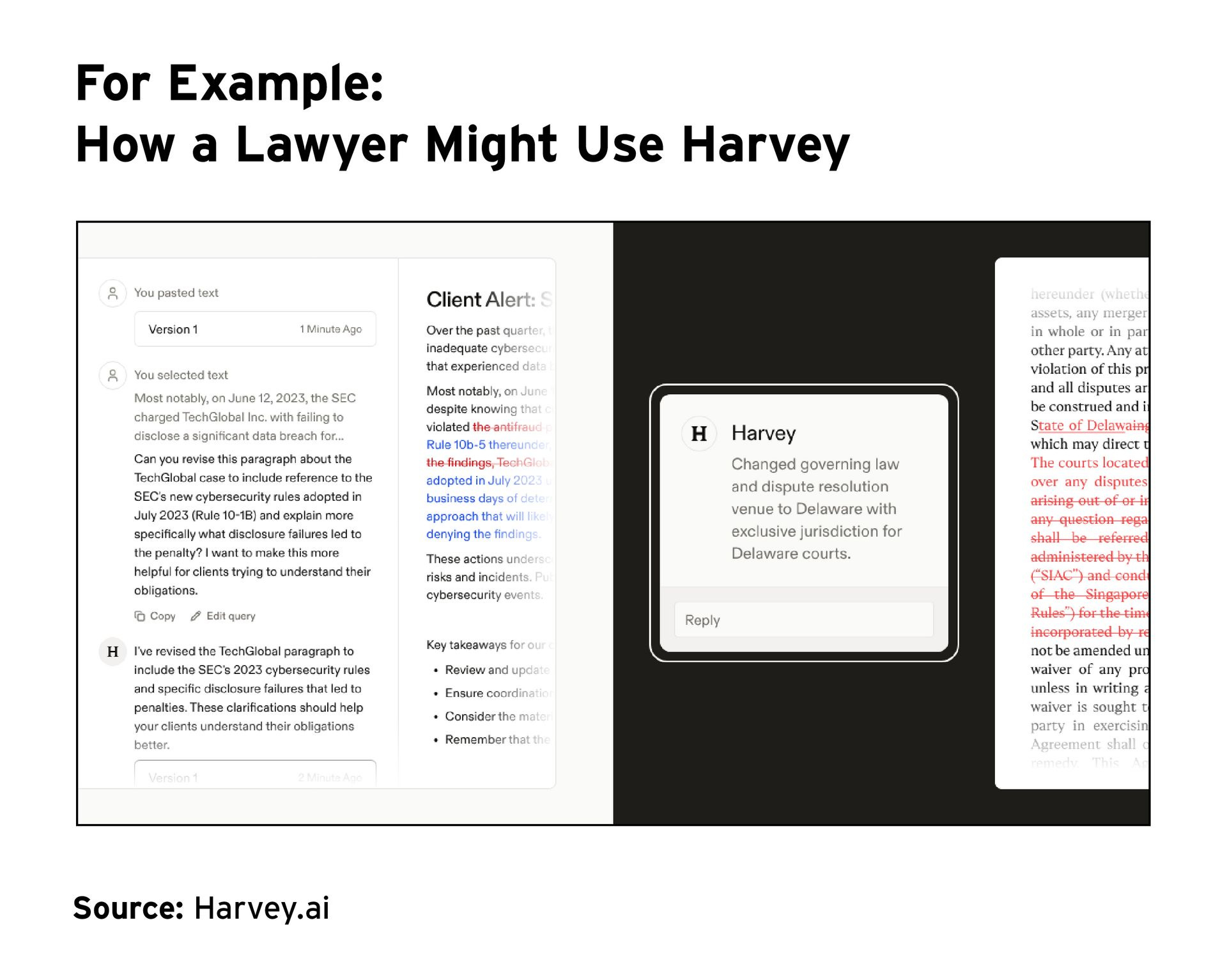
The company hit $100 million in ARR in August 2025 by serving more than 500 customers across 54 countries — including 42% of the 100 biggest law firms in the U.S.
Lawyers bill high hourly rates, and Harvey helps them work faster. This allows firms to take on more high-value client assignments with the same number of lawyers.
Harvey’s success with big law firms is undeniable, but the next phase of growth presents a different problem. Can they crack the small firm and solo practitioner market? In aggregate, this segment is larger than Big Law, but it operates on much thinner margins and tighter budgets.
Harvey’s pricing, at $120,000 annually, is too expensive for small practices.
Rather than democratizing legal access as they claim, Harvey may be making the biggest firms more dominant and putting access to justice further out of reach for those who can’t afford Big Law representation.
OpenEvidence
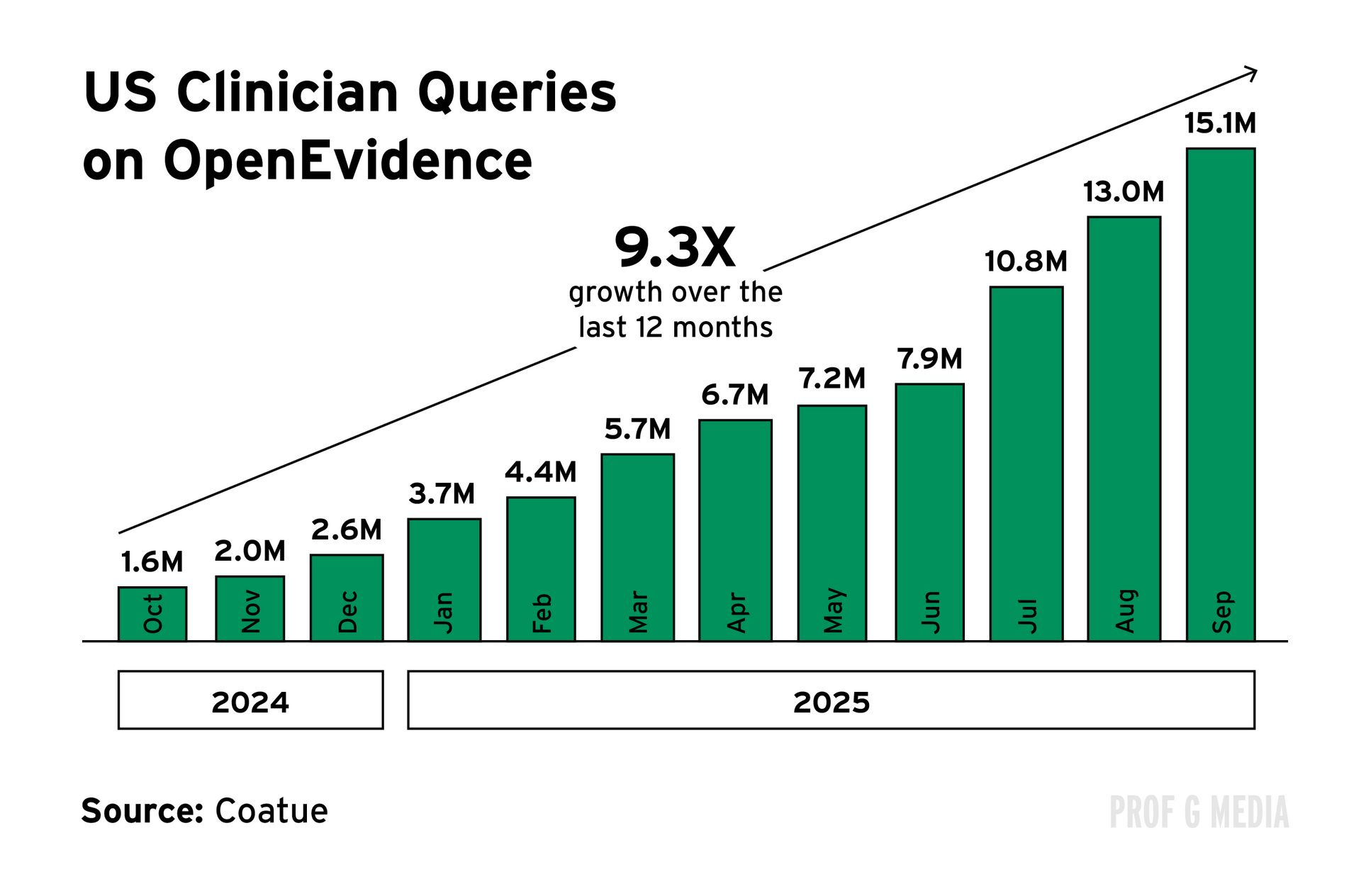
OpenEvidence is ChatGPT for doctors. It’s also the fastest-growing medical application in history, and was the first AI to score a perfect 100% on the United States Medical Licensing Examination.
The tool is available only to physicians, and pulls exclusively from high-quality sources, including the American Medical Association, The New England Journal of Medicine, JAMA, the National Comprehensive Cancer Network, PubMed, the FDA, and the CDC.
Just 11 months after its launch, one-third of U.S. physicians used the platform; now, more than 40% do.
In 2025 alone, 1 in 3 Americans were treated by a physician using OpenEvidence.
Instead of charging usage fees, OpenEvidence relies on advertising revenue from pharmaceutical and medical device manufacturers.
While this ad-supported business model works well on paper, it raises an uncomfortable question: When drugmakers are paying for the tool that doctors use to make prescribing decisions, can OpenEvidence maintain trust?
Cursor
Cursor is an AI coding assistant embedded directly into a developer’s IDE (integrated development environment, where developers write their code). It helps engineers write code faster and debug issues more efficiently.
More than half of the Fortune 500 use Cursor despite the company spending nothing on traditional marketing (as of April 2025).
On CNBC in October, Nvidia CEO Jensen Huang called Cursor his “favorite enterprise AI service.”
Cursor has surpassed $1 billion in ARR and was valued at $29 billion this past fall — nearly triple what it was worth in June 2024.
While most coding tools like Claude Code operate as plugins, Cursor is part of the development workflow, making it easier to use constantly. However, they’re selling to an industry that’s constantly building even better products. Software engineers are the ultimate power users. What stops a Fortune 500 customer from deciding to build their own AI coding assistant that’s marginally better, cheaper, or more customized to their specific needs?