


“The graveyards are full of indispensable men”
—attributed to Charles de Gaulle
Over the past decade we’ve sat idle as the guardrails and checks on the president’s and tech leaders’ actions have been dismantled. We’re paying the price for both. Jensen Huang, founder and CEO of America’s most strategically important company, had a relationship with a customer suspected of spying for China, as well as a subordinate (or two, or …) in violation of company policy. His board tried to keep him, then, after getting their heads out of their asses (i.e., personal counsel likely told them to crisply distance themselves from a national security scandal), forced him out. And then … the acolytes with their hands on the dials of media platforms weighed in with calls that will likely age more poorly than a Super Bowl crypto ad. The Cretin narrative: Accusations of espionage have been manufactured by the deep state, the board caved to a moralizing mob, and a modern Prometheus is being chained to a rock for the crime of infidelity.
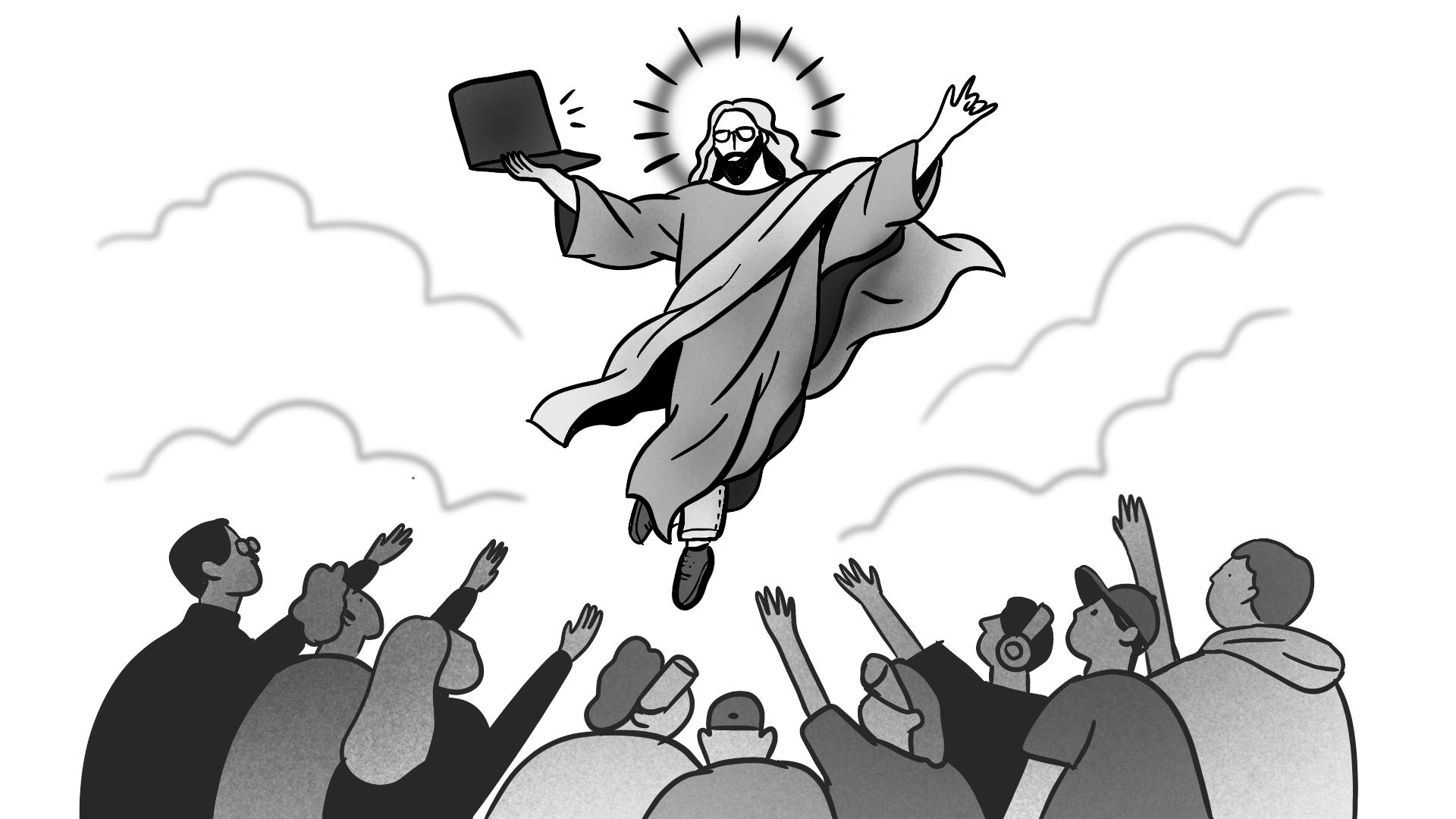
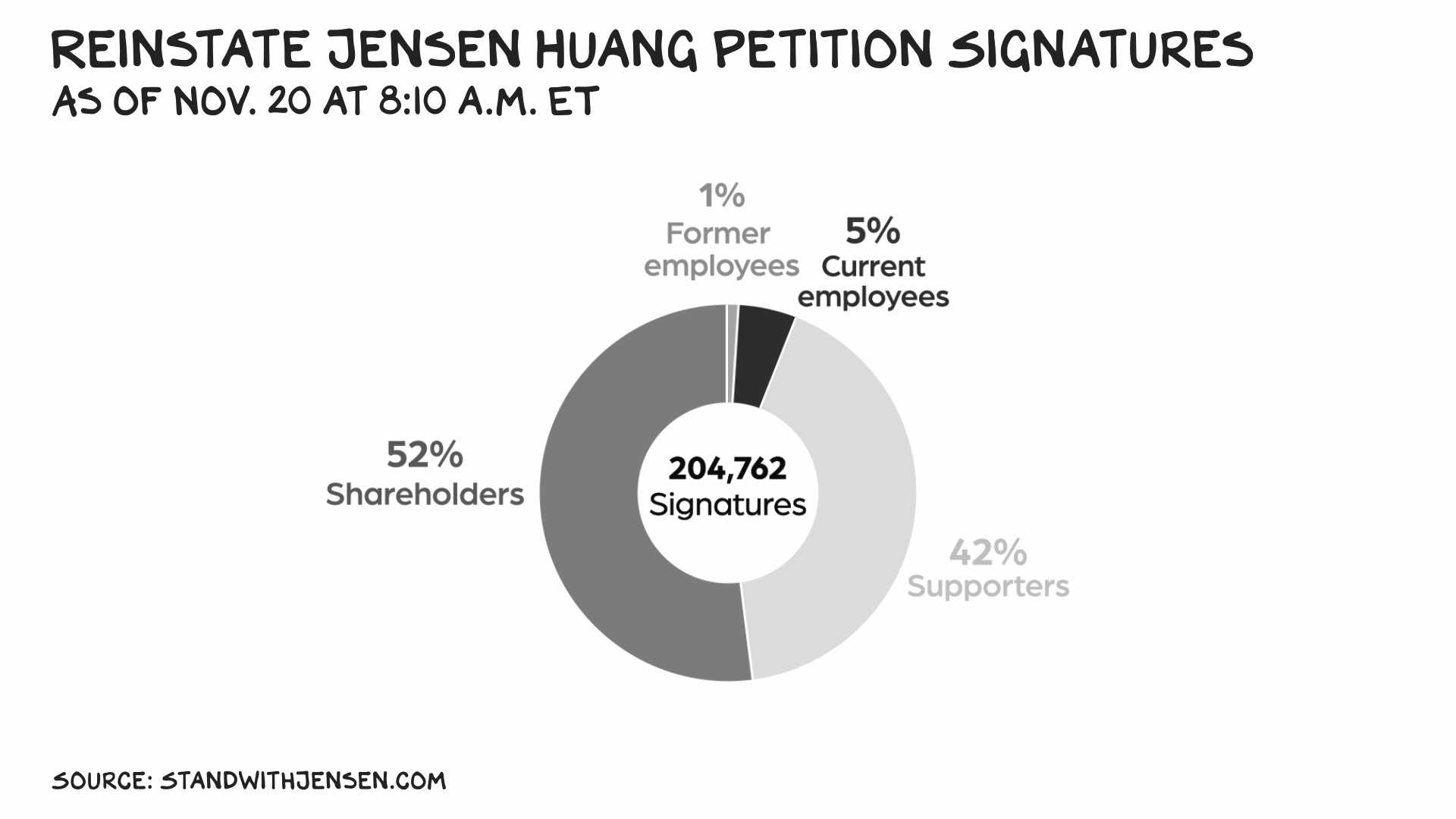
In Taiwan, where his visits used to set off a fervor known as “Jensanity,” the faithful are in mourning. In Silicon Valley, Huang’s disciples are in denial, and they’re organizing a resurrection. Two hundred thousand people have signed a petition to reinstate him. They want Prometheus unbound. Nvidia’s board isn’t considering it. He was never a god as there is no (business) god. So why do we keep worshipping them?
Calls for Huang’s return say more about the person barking this treif than Huang. It’s a tell, indicating lack of respect for both women in the workplace and national security.
Immortality
We’re built to ask questions we can’t answer. Our competitive advantage as a species is our brain. Relative to body size, the brains of our ancestors evolved 23x faster than those of the typical mammal. Our brains are so big that babies are expelled before they’re fully cooked. Human babies spend their first three months, aka the “fourth trimester,” helpless. Our first experience of the world is dependence on the seemingly omnipotent giants who feed and protect us. We call our first gods Mom and Dad.
Our big brain also delivers bad news: We’re the only animal that knows biology is undefeated. In his Pulitzer Prize–winning book, The Denial of Death, Ernest Becker argued that this knowledge is unbearable, so we turn to “immortality projects,” i.e., things that will outlast us: having children, creating art, building businesses, chasing fame, cementing our legacy. I’m a serial immortalist: two boys, six books, and nine companies. I record so many podcasts that The Week, George Hahn’s roundup of all things Prof G Media, typically runs 20 minutes. I still can’t answer a basic question: What hole am I trying to fill? But I digress.
There are immortality projects even bigger than podcasting: nations, ideologies, and religions. Each promise, in their own way, meaning beyond the grave. So do charismatic leaders, as we transfer the dependence we once had on our parents onto someone larger than life. Becker called this transference “a universal passion.” Why do we do this? A: The brain leaves a void. It can ask what happens when we die, but it can’t provide a sufficient answer. Into that void enters a superbeing. In a 2004 study, people who were first reminded of their own death were almost eight times as likely as a control group to vote for a charismatic candidate. Remind people they’re mortal, and they go shopping for a savior.
Founders fill the void. Steve Jobs wanted to “put a dent in the universe,” about as ambitious an immortality project as there is. His followers are so fanatical that former Wired editor Leander Kahney chronicles them in a popular book and a long-running blog, both called Cult of Mac. Jobs died 15 years ago. Since he handed the reins to Tim Cook, Apple’s stock is up 23x.
High Priests of Silicon Valley
For most of history, the void had an address: the church. Not anymore. Our deepest questions have moved from the pulpit to the prompt. First we asked God, then Google, and now AI. Last year, the top three uses of AI were therapy and companionship, organizing your life, and a new use case, finding a purpose. Because almost none of us understand how these machines work, the people controlling them have become our priests.
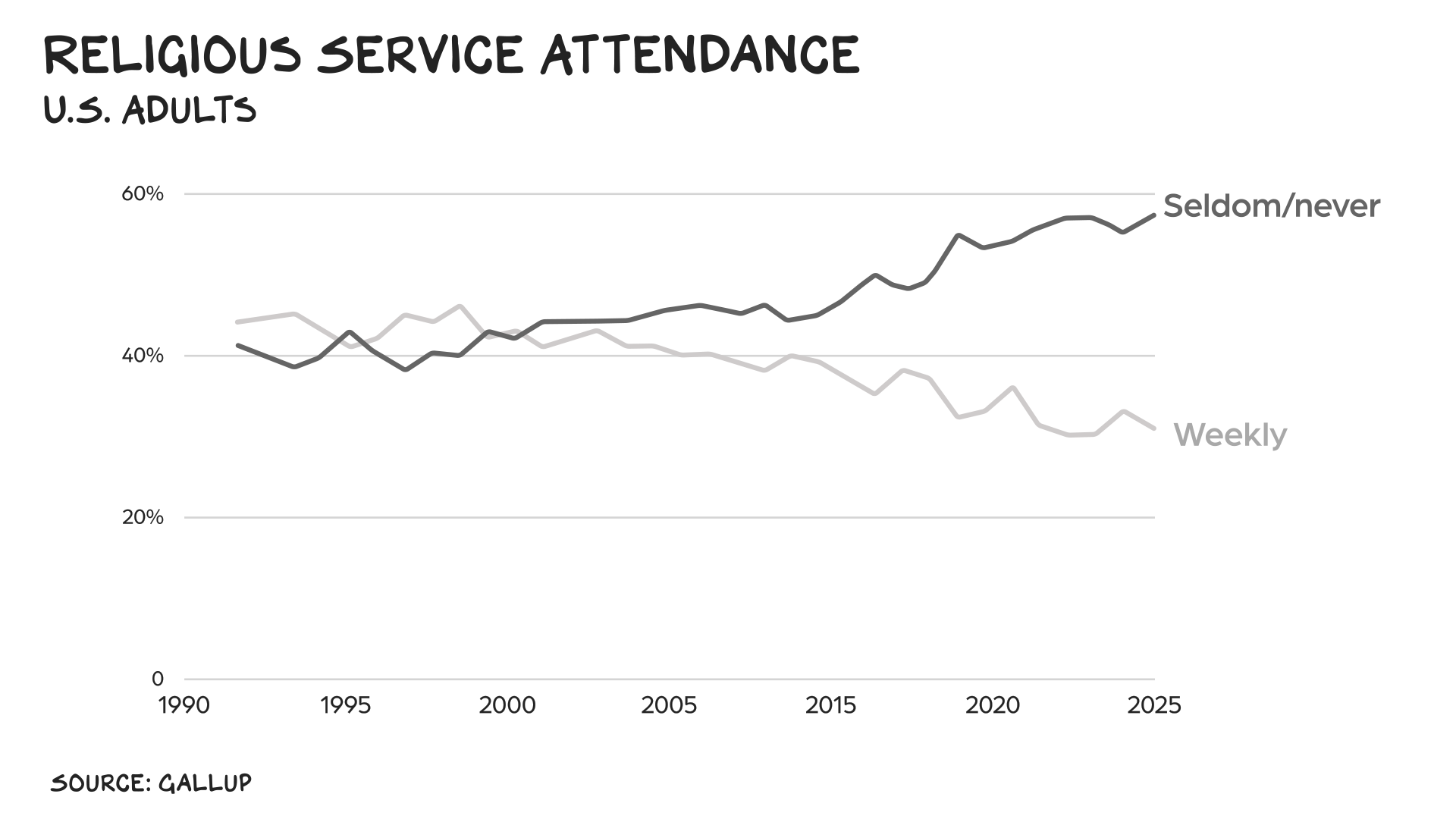
Neil Postman saw it coming in 1992, when he warned of a “Technopoly,” a culture that deifies technology. Greg Epstein, the humanist chaplain at Harvard and MIT, argues that tech has become the world’s most powerful religion, complete with prophets and rituals. Even the tech conference, he notes, is “virtually indistinguishable from the American evangelical megachurch.” Yuval Noah Harari gave that religion a name, “Dataism,” a faith in which humans are biological algorithms and processing power is the measure of all value. “In Silicon Valley, the Dataist prophets consciously use traditional messianic language,” Harari wrote in his 2015 book, Homo Deus. Harari noted that Ray Kurzweil, a legendary futurist who has influenced today’s founders, titled his book The Singularity Is Near, an echo of John the Baptist’s “the kingdom of heaven is near.”
Apple took the idea literally, creating the title of chief evangelist. The press ran with it, calling an early model of the iPhone the “Jesus phone.” In 2017, citing declining membership in churches and other groups, Mark Zuckerberg pitched Facebook to fill the role churches once played and compared its group leaders to pastors. Elon Musk, the Valley’s bad Pope, holds the title of “Technoking” at Tesla. His stated mission, to “extend the light of consciousness,” sounds less like a business plan than the second hour of a ketamine trip, but that’s another post. Marc Andreessen’s ”Techno-Optimist Manifesto” says “we believe” 113 times and ends with a list of “patron saints.” Sam Altman told the Financial Times that OpenAI’s one true product is “magic intelligence in the sky.” Then there’s Larry Ellison’s company, Oracle, which … speaks for itself.
Some insiders have seen it up close. Remarking on last week’s news, Anne Wojcicki, the 23andMe founder and former wife of Google cofounder Sergey Brin, told Bloomberg, “We are all complicit in making these people think they are gods.”
Messiah Industrial Complex
In the past week, a router upgrade in Arkansas grounded flights nationwide, a “latent defect” knocked out Microsoft’s Outlook and Teams for two days, a “technical issue” disrupted the major banks, and some Apple services briefly went down. We were annoyed, but nobody asked the tech gods why they had forsaken us. Real gods get blamed when a child dies of cancer — tech gods get credit for your 401(k) and a pass when your flight is grounded. Why? A: Deep down, we know they’re mortals. The people who insist otherwise are a small, wealthy congregation, and they have two reasons to keep the faith.
The first is to normalize a simple creed: I’m not subject to norms/laws, as long as the stock goes up. If Huang’s relationship with a suspected Chinese spy is just a sex scandal, then nothing a founder does matters as long as he adds shareholder value. Consider the comeback’s backers. Travis Kalanick was an exceptional innovator and … totally replaceable: Under his successor, Dara Khosrowshahi, Uber went public and posted its first annual operating profit. More than 10,000 of the ”Stand with Jensen” petition’s signers say they work at Nvidia, making them shareholders in his cult. Moses would recognize the scene — the faithful are disregarding their purported values and rallying around a golden calf, ticker symbol NVDA.
The second reason is the normalizing of the messiah industrial complex. We’ve watched too many Marvel movies and have come to believe some people have superhuman powers. The founders lobbying for Huang’s return exploit that belief. If you can anoint a messiah in one sector, maybe you can become the messiah of your own. Huang is singular, the founder logic goes, therefore I am singular. Musk, who signed the petition, continues to raise the ceiling on the absolution of singular founders. Last year, Tesla’s board warned shareholders they might lose him unless they approved a pay package worth up to $1 trillion. More than 75% voted yes. Jesus, America, get off your knees.
The tells of a messiah-led company are easy to spot. All employees are barred from any microphone other than corporate Jesus (i.e., the CEO). Huang had roughly 60 direct reports and called one-on-ones “impossible,” so every decision ran through one man. The people doing the actual work at these outfits hide in plain sight. Gwynne Shotwell has run SpaceX’s day-to-day operations for years, but when SpaceX went public, Musk took the podium. Shotwell may be the most important executive in the world. Do you even know what she looks like?
Afterlife
Two things can be true at once: Nvidia wouldn’t be one of the world’s most valuable companies without Huang’s contributions, and it’ll likely be better off without him. Despite blowout earnings — revenue this quarter rose 103% year over year, to $115.8 billion, and Nvidia says it will make $130 billion next quarter — the stock is trading at a forward P/E of 9.2, vs. 18.3 for the S&P 500. As one investor told Reuters, “Nobody is canceling GPU orders because the CEO resigned.” Still, investors believe Huang is indispensable, and Huang is fueling that belief, posting on X that he’d be “honored to answer these calls and return as CEO.” My prediction: Nvidia stock will be up by year-end despite Elvis having left the building.
Forward P/E of Mag 7
Tesla: 156.6
Apple: 36.5
Microsoft: 24.7
Amazon: 23.8
Alphabet: 18.3
Meta: 17.9
Nvidia: 9.2
But for AI, the more important signal this week wasn’t Nvidia. It was Anthropic. On Wednesday, Anthropic priced its IPO at $83 per share, for a valuation of $1.5 trillion, making it the biggest listing of all time. Nvidia’s sales measure how much companies are spending on AI. Anthropic’s valuation measures what customers are willing to spend on AI, and wagers that the vision behind all that historic capex will pay off. The risk isn’t faith in AI. It’s faith in gods investors can’t control. Anthropic’s governance borrows from Musk, Zuckerberg, and Google’s Larry Page and Sergey Brin, who all used super-voting shares to keep control of their companies. Instead of one or two singular founders, Anthropic has seven. Mount Sinai, meet Mount Olympus. Last year, 35% of IPOs in the U.S. — and 64% of those in the tech industry — involved shares with unequal voting rights, up from 12% and 36%, respectively, in 2016. The zealots are enabling their founder-gods.
Becker was right: We spend our lives trying to build something that will outlive us. Super-voting shares are the ultimate immortality project — a founder who can never be removed. Huang never had that kind of control. Like all men, he proved fallible. He drank enough of his own Kool-Aid to believe Nvidia didn’t need a succession plan. The board showed him the door anyway. That’s the difference between an enterprise and a practice. The companies that outlast their founders aren’t the ones that worship them. They’re the ones that can fire them. As I often say, greatness is in the agency of others. Prometheus was a myth. Fire is real.
Finally, pro tip from someone who has been addicted to the affirmation of others: The only people who really love you are the ones who let you love them … immensely. Stop searching for idols, and love the people who genuinely think you’re singular — your family and friends.
Life is so rich,

P.S.
As Anthropic goes, so goes AI. I broke down the IPO with my Markets cohost, Ed Elson. Prof G+ paid subscribers can get early access here.