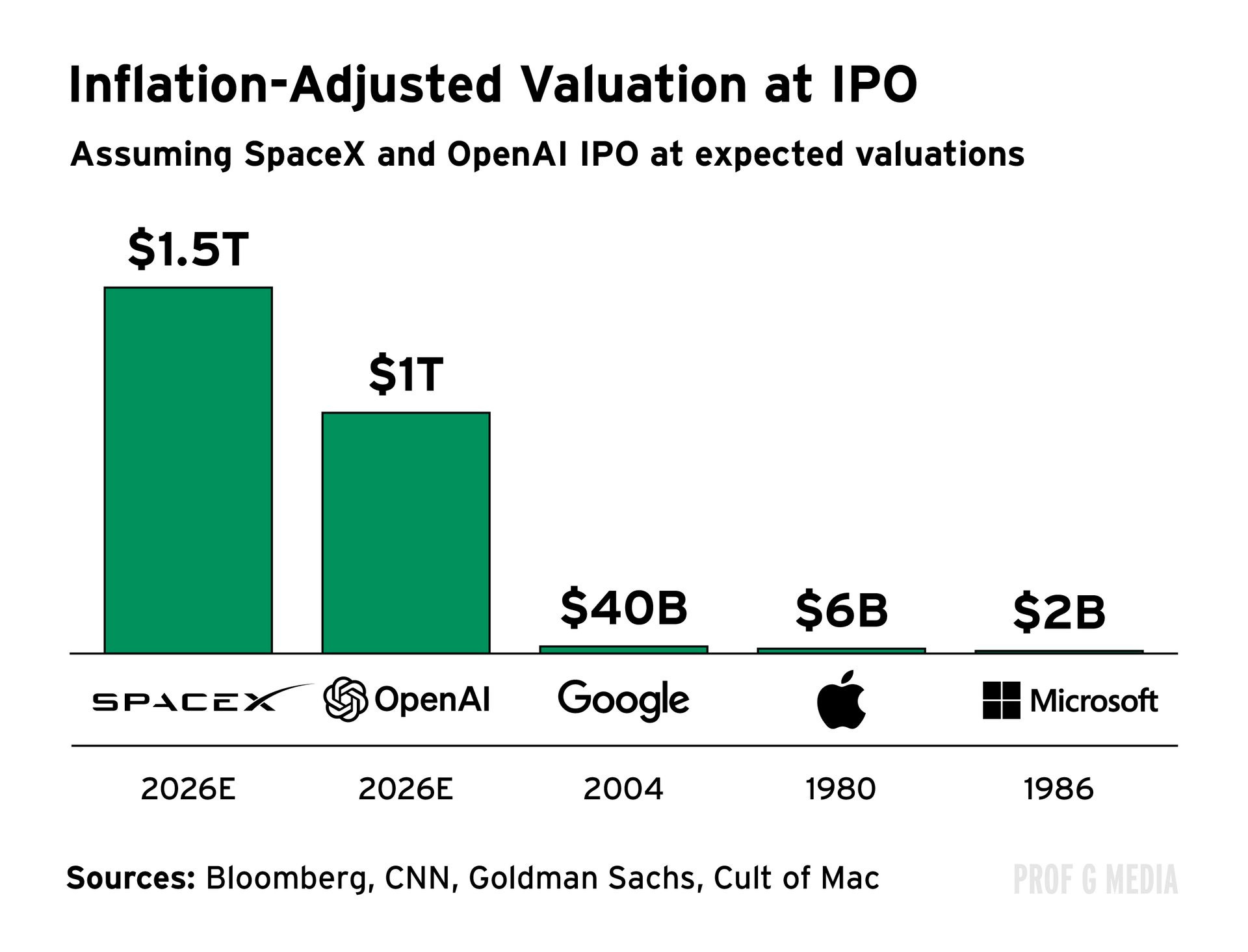
It could be a record-setting year for IPOs. In fact, Blackstone’s president said the company had lined up one of the largest IPO pipelines in their history. Two of the most important candidates are SpaceX and OpenAI.
SpaceX is reportedly targeting a mid-June listing and is seeking to raise up to $50 billion at an estimated $1.5 trillion valuation. That would make it the largest IPO in history.
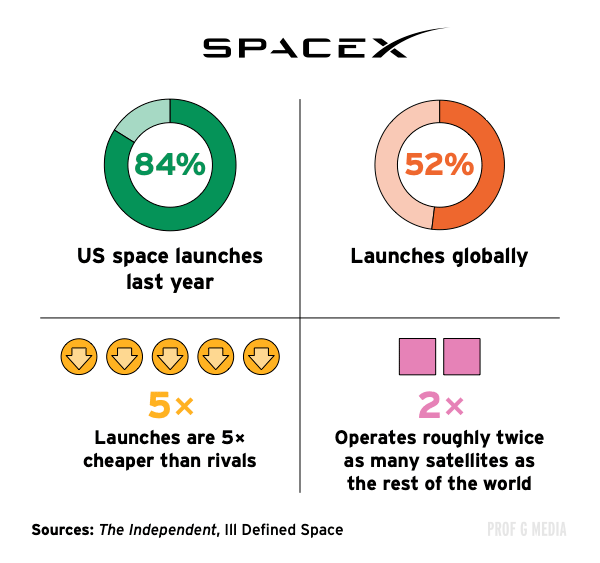
SpaceX earned $15.5 billion last year, which, assuming a $1.5 trillion valuation, implies a price-to-sales multiple of 97x. Among major tech companies, the only company valued similarly is Palantir. Meta and Alphabet trade at around 10x sales.
Or, maybe not.
Last Thursday, Tesla CEO and SpaceX founder Elon Musk said he’s considering merging SpaceX with xAI, his AI company, or Tesla, his struggling electric vehicle firm. Tesla shares jumped as much as 5% on the news.
Meanwhile, startup darling OpenAI is reportedly raising additional funding at a valuation between $750 billion and $830 billion, and discussions are underway about a potential IPO at a $1 trillion valuation in late 2026. OpenAI’s annual recurring revenue (ARR) hit $20 billion last year, and it recently announced plans to integrate advertising into its free and low-cost membership tiers.
An $830 billion valuation will make OpenAI roughly as valuable as: the second-biggest bank in the U.S. (Bank of America), the biggest streaming service in America (Netflix), and the biggest sports retailer in the world (Nike) … combined.
Last Wednesday, Sen. Elizabeth Warren penned a letter to OpenAI, citing a “$300 billion gap” between its $1.4 trillion spending commitments and its actual revenues” and asking for assurances that the company would not seek a government bailout.
Other potential 2026 IPO candidates include Anthropic, Databricks, Strava, Canva, Stripe, and Ledger.
Investing in IPOs: Should You, or Shouldn’t You?
Buying into an IPO as a retail investor is risky (and that’s because it’s kind of a rigged game).
Institutional investors get early access to better-priced IPO shares; retail investors usually have to buy in the open market after the initial IPO pop. According to the National Bureau of Economic Research, institutional investors earn about 3x more than retail investors on IPO investments.
* As Warren Buffett said, “You’re not gonna beat the investment banks at their own game.”
* And, as a recent Wall Street Journal article noted, “You’re more likely to be struck by lightning than you are to buy shares directly in most pre-IPO companies.”
You might not even want shares in the first place. Companies spend hundreds of thousands of dollars (sometimes even millions) on marketing leading up to their IPOs, generating hype and excitement that can overpower any real scrutiny of their fundamentals.
The result is that many get a first-day pop, but end up declining for years after. Between 1980 and 2022, the majority of IPOs lost money over a five-year period following their debut.

When Microsoft hit a trillion dollar valuation, it had $92 billion in revenue. Google had $183 billion. SpaceX has less than $16 billion in revenue.
If SpaceX does an IPO at $1.5 trillion, Bloomberg estimated that this will increase Elon’s net worth to $950 billion. According to Kalshi, the probability that he will become a trillionaire in the next year is 74%, making his net worth equal to 3% of America’s GDP.
At the peak of the Gilded Age, John D. Rockefeller’s wealth amounted to 2% of America’s GDP.