


With inflation at a three-year high 4.2%, we all had an expensive Fourth of July weekend.
But spare a thought for the new members down at Mar-a-Lago, whose initiation fee is double what it was before President Trump came back into office. It costs a record $1 million to join Trump’s Florida resort.
Of course, joining Trump’s club comes with unique perks. In addition to access to the 20-acre private estate and “award winning” tennis courts, you might also get dinner with the President.
We already knew Trump has attended several fundraisers at the venue since his inauguration, and reportedly offers one-on-one dinners for $5 million per plate.
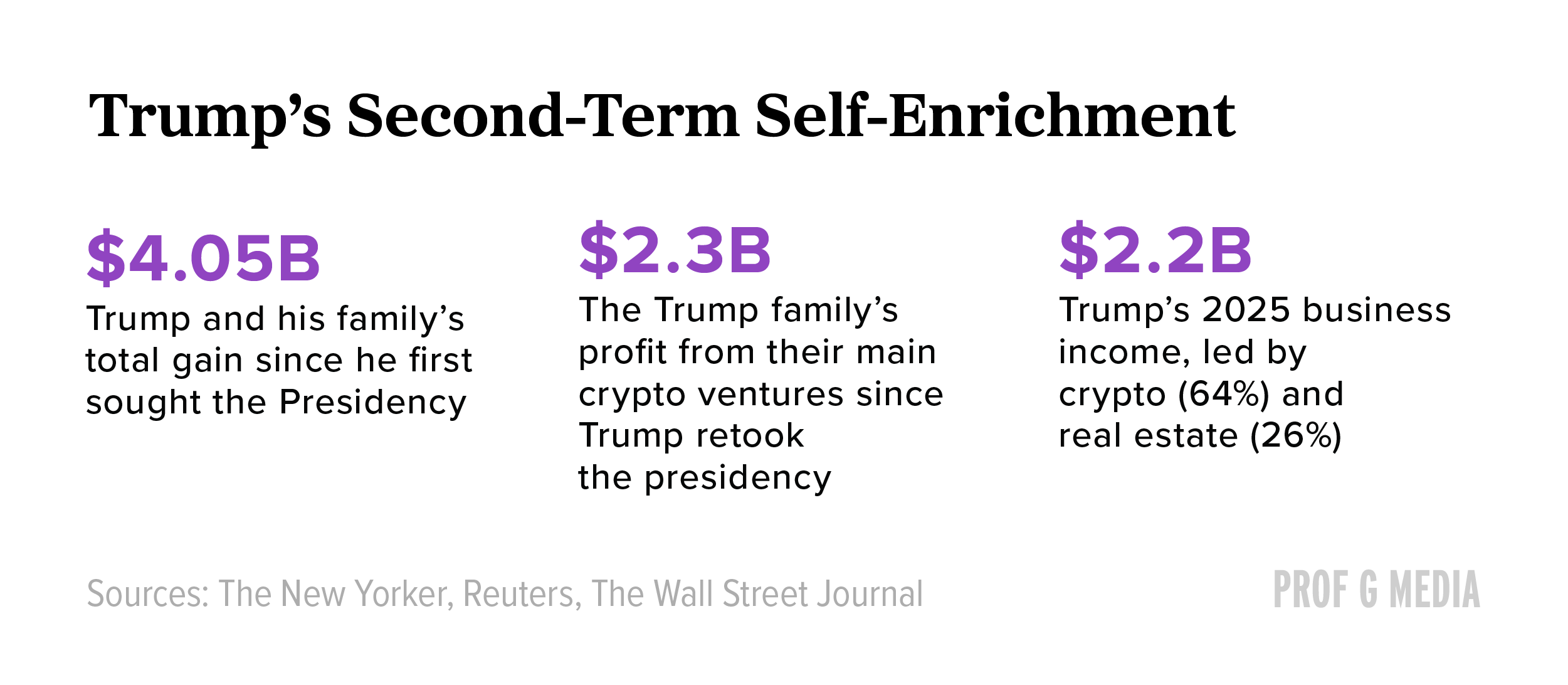
Now we know this: Trump earned a whopping $575 million from Mar-a-Lago and his other real estate investments last year. And that was just a fraction of his $2.2 billion in total business income, according to disclosures released this week.
It’s enough to make you feel like America is drowning in a big, murky swamp.
The good news is that voters have noticed and Democrats are acting on it. But as we’ve learned before, it’s not enough to complain about Trump. We have to show voters how we’re going to fix it as well. To win this issue, Democrats should follow our three C’s of corruption: call it out, use Congress, and be credible.
Trump’s unprecedented conflicts of interest
Where to even begin with Trump’s conflicts of interest? It’s an essay in and of itself, but here’s the top five:
1. Crypto
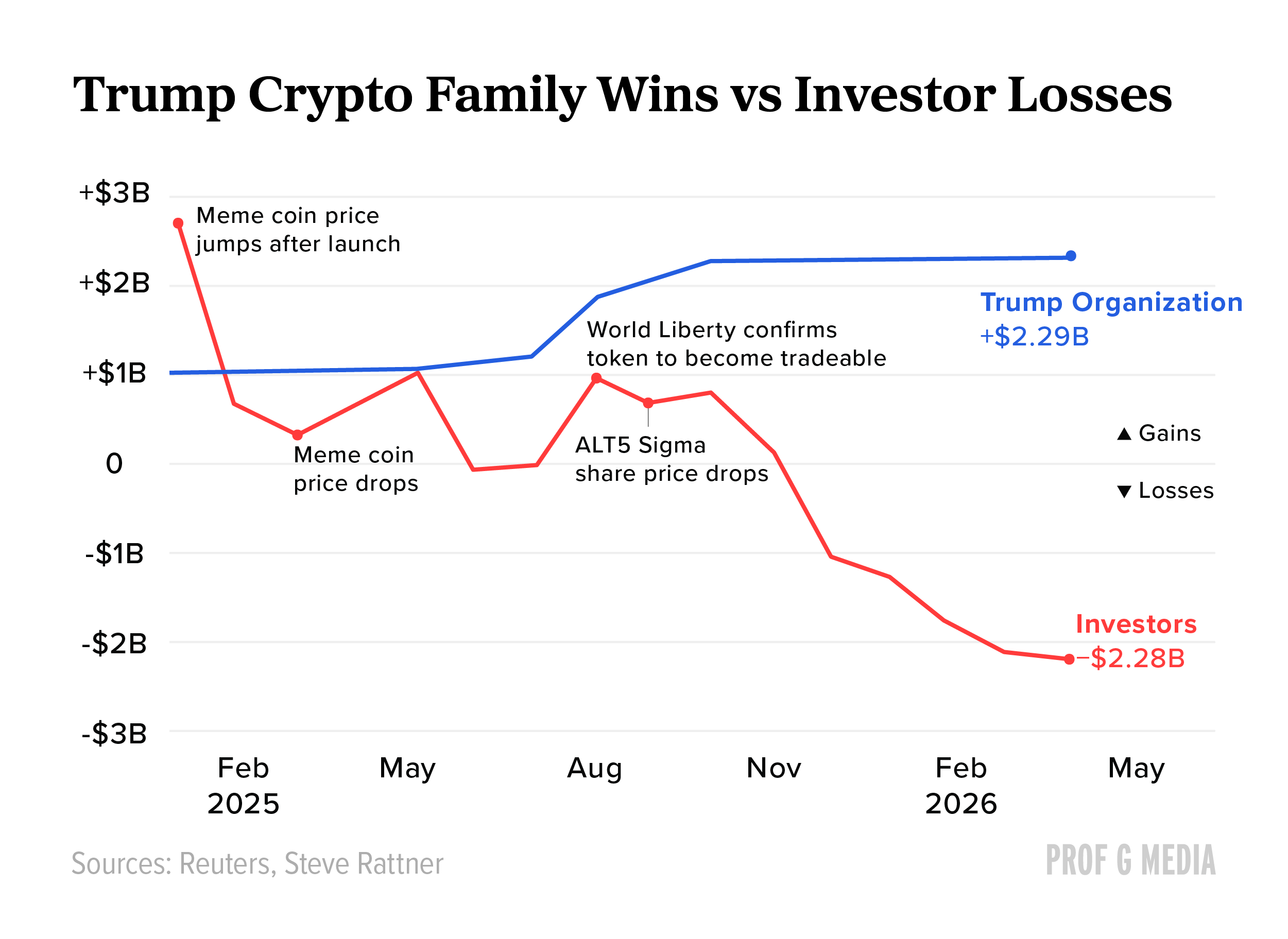
Trump has repeatedly used the presidency to enrich himself and his family through his crypto ventures. The chief culprit is World Liberty Financial, which the Trumps have heralded as a way to “democratize” finance but whose tokens ($WLFI) have crashed in value since launch. Add in $TRUMP, the infamous “memecoin” that has also collapsed in value, and Trump alone has pocketed $1.4 billion just in the last year.
2. Foreign money
You can attribute part of that $1.4 billion to Trump’s sale of equity in World Liberty. As the Wall Street Journal first reported in January, this week’s disclosure is the first acknowledgment of a secret $500 million deal between Eric Trump and an Abu Dhabi royal who has been knocking at the door for access to American AI chips.
That’s not the only foreign money flowing into Trumpworld. His real estate and licensing income has skyrocketed as the Trump Organization expands throughout nations in the Middle East and India; the same countries have been negotiating with the US over tariffs, military aid, and more.
3. The jet
Trump accepted a $400 million Boeing 747 from the Qatari government last year, shrugging off security and ethics concerns by promising to donate it to his presidential library. He took his first flight on it this week, calling it the “greatest commercial plane ever built.” Need we say more?
4. Pay-to-play
Major donors, corporations, and allies keep getting what they want from the Trump administration: lucrative contracts, favorable regulatory decisions, dropped lawsuits, or an appointment to the Cabinet. The Campaign Legal Center, who have been tracking Trump’s pay-to-play transactions, say it’s clear that this administration is “available for a price.”
5. Pardons
Then there’s the pardons. Changpeng Zhao, the founder of Binance who was jailed over his willful failure to maintain an anti-money laundering program. Imaad Zuberi, the Trump backer convicted on campaign finance charges. Trevor Milton, the electric vehicle founder jailed for defrauding investors. The list goes on.
Voters have noticed and they’re not happy
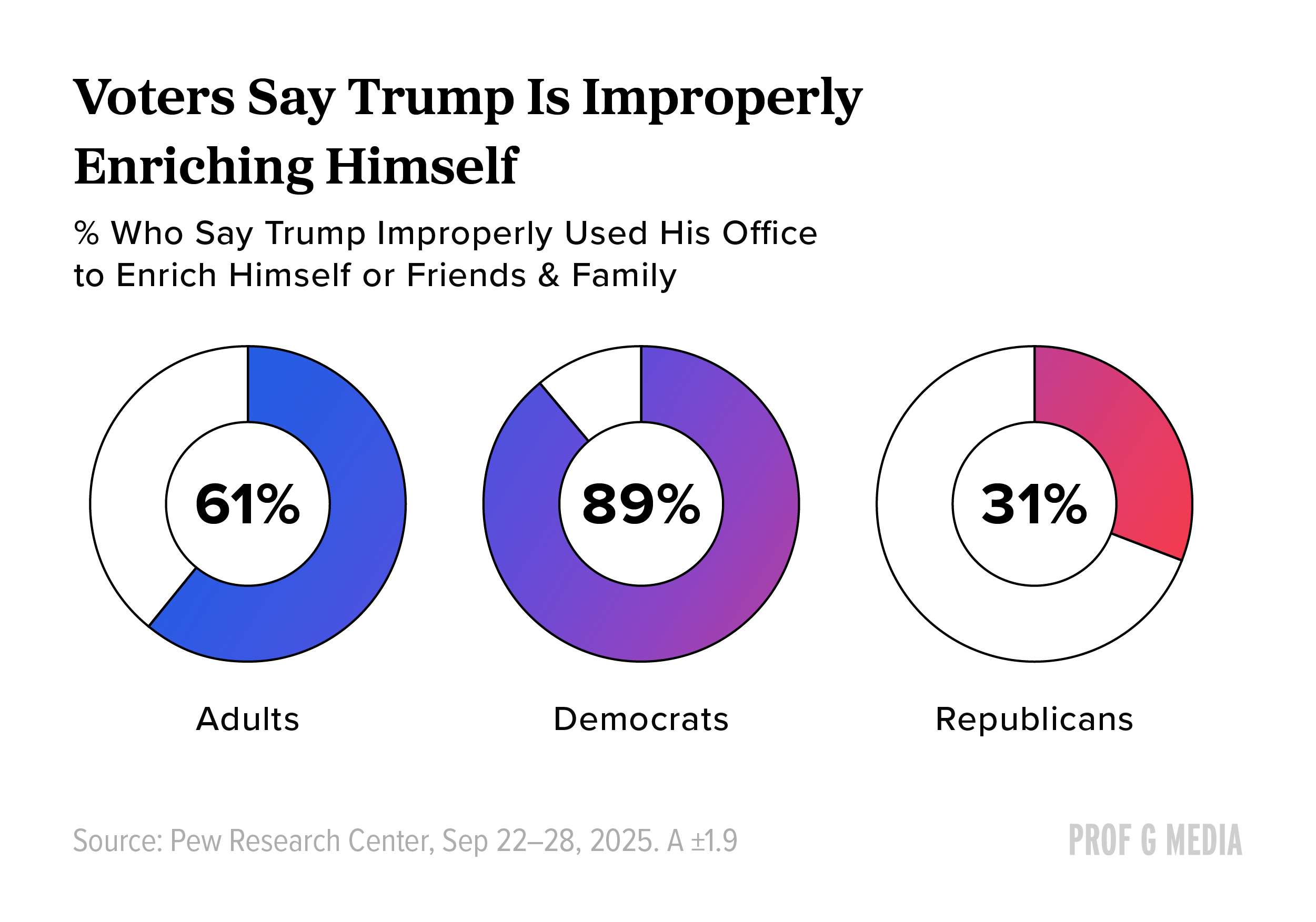
We have a surprising lack of high-quality polling that directly addresses voters’ feelings on the issue. But Pew surveyed Americans about it last year, and the results should send a shiver down White House spines: 61% of Americans say Trump has definitely or probably improperly used his office to enrich himself or his friends or family. Even 31% of Republicans agree with that statement.
In the same poll, Pew found Americans had broader misgivings about how Trump is running the government: 59% said he hasn’t improved the way the government works, 60% said it wasn’t open or transparent, and 64% said he hadn’t set a high moral standard for the presidency.
The real struggle for Republicans isn’t just from questions about Trump and corruption – it’s the wider perception that the economic system is stacked against them. In a June survey from Fox News, only 12% of voters said they thought they were getting ahead financially; while 54% believed Trump’s economic policies mostly benefited people with more money.
(Another 15% said his policies benefited “no one” at all.)
The stories about Trump’s conflicts of interest and the billions he has gained in personal wealth tie directly into results like that. When we’re talking about the “economy” these midterms, we should be talking about how – amid tariffs and a war – Trump is getting much, much richer.
Democrats are making it a core issue, but they must walk the walk
Step one of capitalizing on this issue is calling it out. Here, Democrats are succeeding.
The poster child for this is possible 2028 contender Sen. Jon Ossoff, who’s been calling out the “Mar-a-Lago mafia,” building on years of experience he’s had as a corruption watchdog (both in politics and journalism).
Other Dem hopefuls are also focusing on corruption in their own states. Rob Sand, the Iowa gubernatorial candidate, has been telling local news anchors that “everything going wrong in Iowa right now can be summed up in two words: costs and corruption.”
It’s a good start. But as we’ve said, the Democrats need to show how they’re going to act. It’s a midterm year, so talk about how Congress can address these issues.
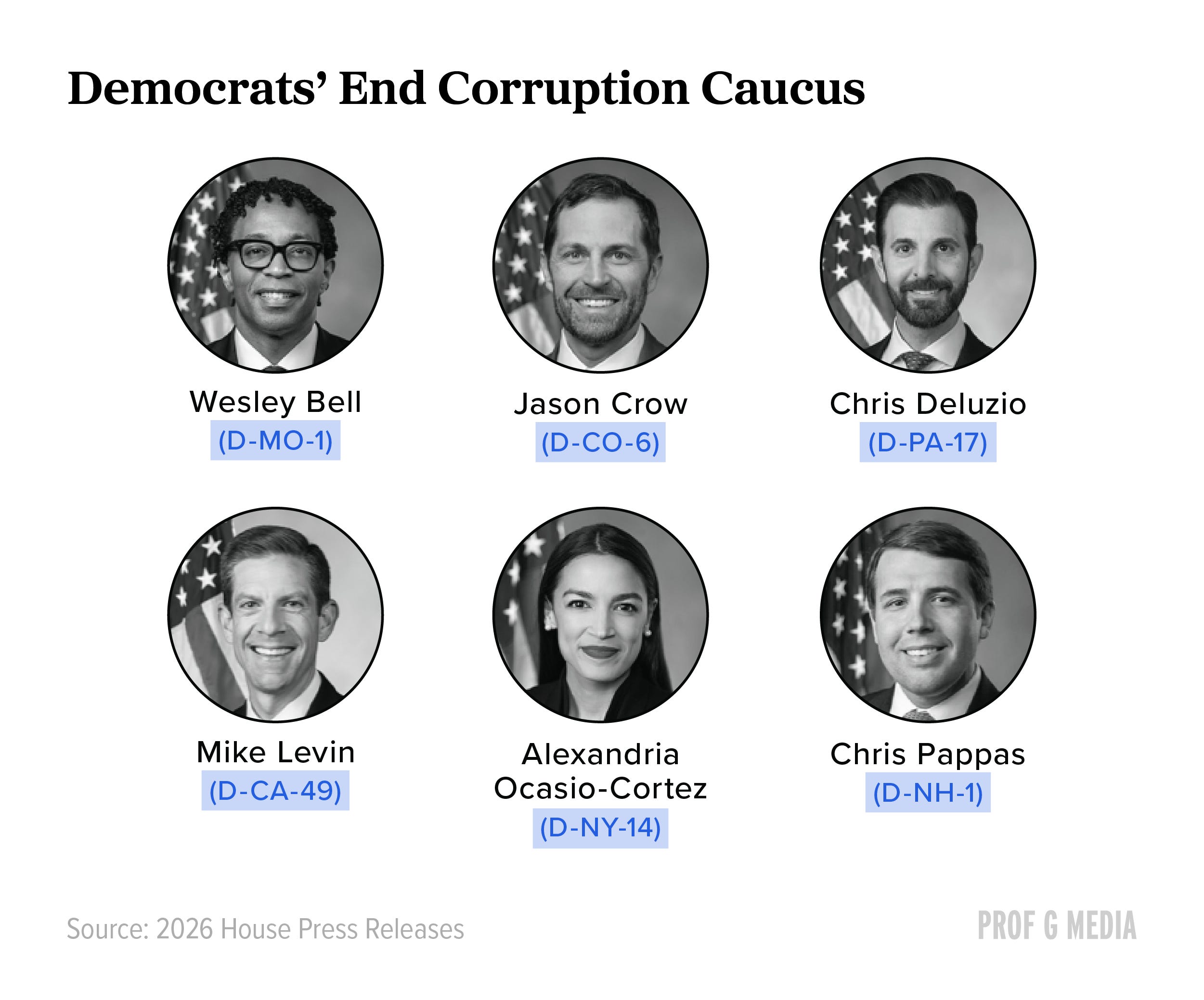
We’re encouraged by Rep. Alexandria Ocasio-Cortez, who launched the End Corruption Caucus with two moderate Dems, Reps. Jason Crow (CO-6) and Mike Levin (CA-49). Another three Congressmen are now on board.
They’ve already made clear in a resolution what Democrats must denounce:
insider trading, foreign licensing deals, gifts from foreign nations, and the sale of various cryptocurrencies
promising industries favorable policies, tax incentives, and an end to regulatory oversight in exchange for extensive campaign donations
providing pardons to individuals who have provided millions of dollars in donations to associated political action committees (PACs), special projects, and inauguration funds
Okay, good. We can all agree on that. But it brings us to the third C: be consistent.
Democrats have never engaged in the kind of brazen dealmaking that Trump has, but the party raked in $1.2 billion from dark money groups in 2024, they’re still not on the same page about stock trading bans, and rely on a small group of billionaires to get through election season. It muddies our message and – to be blunt – big money hasn’t even helped us win elections.
In 2020, the last time Democrats had an open field in a presidential election, Roll Call pointed out that between billionaires Michael Bloomberg and Tom Steyer, and multimillionaires John Delaney, Michael Bennet, Elizabeth Warren and Joe Biden, the field looked more like the “makings of one blockbuster hedge fund” than representatives of the working class.
These are the inconsistencies that make it hard for voters to enthusiastically vote for team blue. Stock trading, alone, should be a slam dunk for Democrats in Congress, and it’s past time for us to turn the page on the shadowy dark money groups that we used to criticize the right for running.
Everyone knows Democrats stand against Trump’s gross misuse of the White House. We have to show voters how we’ll do better.
A few other Cs come to mind…
I do wonder what the Catholic Vice President makes of all this, given his emphasis on Communion and Conscience. Does corruption ever make it into Confession? I do wonder.
I don’t expect anyone to share my Christian principles or beliefs.
But even atheists must recognise the reality that the same end befalls every human being eventually. Et in Arcadia Ego.
Atheists may well comfort themselves with the expectation that death simply brings annihilation. Christians will be mindful of the Biblical warnings.
Luke 16 relates the parable of the foolish barn builder and 19 that of Dives and Lazarus. It’s not for me to second guess the dispensation of God’s mercy but I would not be surprised if Trump’s behaviour in this life is rewarded in the next by the greatest comeuppance “that anyone has ever seen” and not by the accolade of “Good Jarb!”