



Redistricting used to be a once-a-decade fight. Thanks to President Trump, it’s now a permanent part of our politics.
It’s been true since last year, when legislators in states ranging from North Carolina to Texas took up his call to change their maps.
But it reached a breaking point last night, when he called on key state legislatures to redraw their maps so Republicans can “receive” another 20 seats in the midterms in a Truth Social post. Trump doesn’t care about voters or democracy (he literally said “if they have to vote twice, so be it”). He just wants to hold on to power at any cost.
If the last few weeks of headlines from Virginia, Florida, and now Louisiana have felt exhausting, you’re not alone. Even after poring over maps, analysis, and lawsuits, there’s still a lot up in the air. With new challenges being filed every day, the final boundaries could come down to the wire.
Still, we’re not convinced that these fights will define the midterms. The math on redistricting matters, but the outcome really depends on how much voters have tired of Trump and trust the Democrats. And that will also be the story of 2028.
The redistricting state of play
What’s already in place
This war began in July 2025, when Texas Governor Greg Abbott announced the agenda for a special session that included redistricting. It was a highly unusual move and reportedly one that Abbott and GOP legislators were reluctant to make until Trump’s team pushed the idea.
A month later, Abbott signed a new map into law netting the GOP three to five more seats, and the tit-for-tat began. California Gov. Gavin Newsom gave voters the power to approve a new map in November that gives the Democrats the same three to five seats in return, and North Carolina Republicans redrew their map in October to help Trump take one more seat in the midterms.
Ohio and Utah also underwent redistricting this cycle, but their plans were unrelated to Trump. Ohio’s map was already temporary and expiring, and Utah’s redraw came after a court struck down a previous version for gerrymandering.
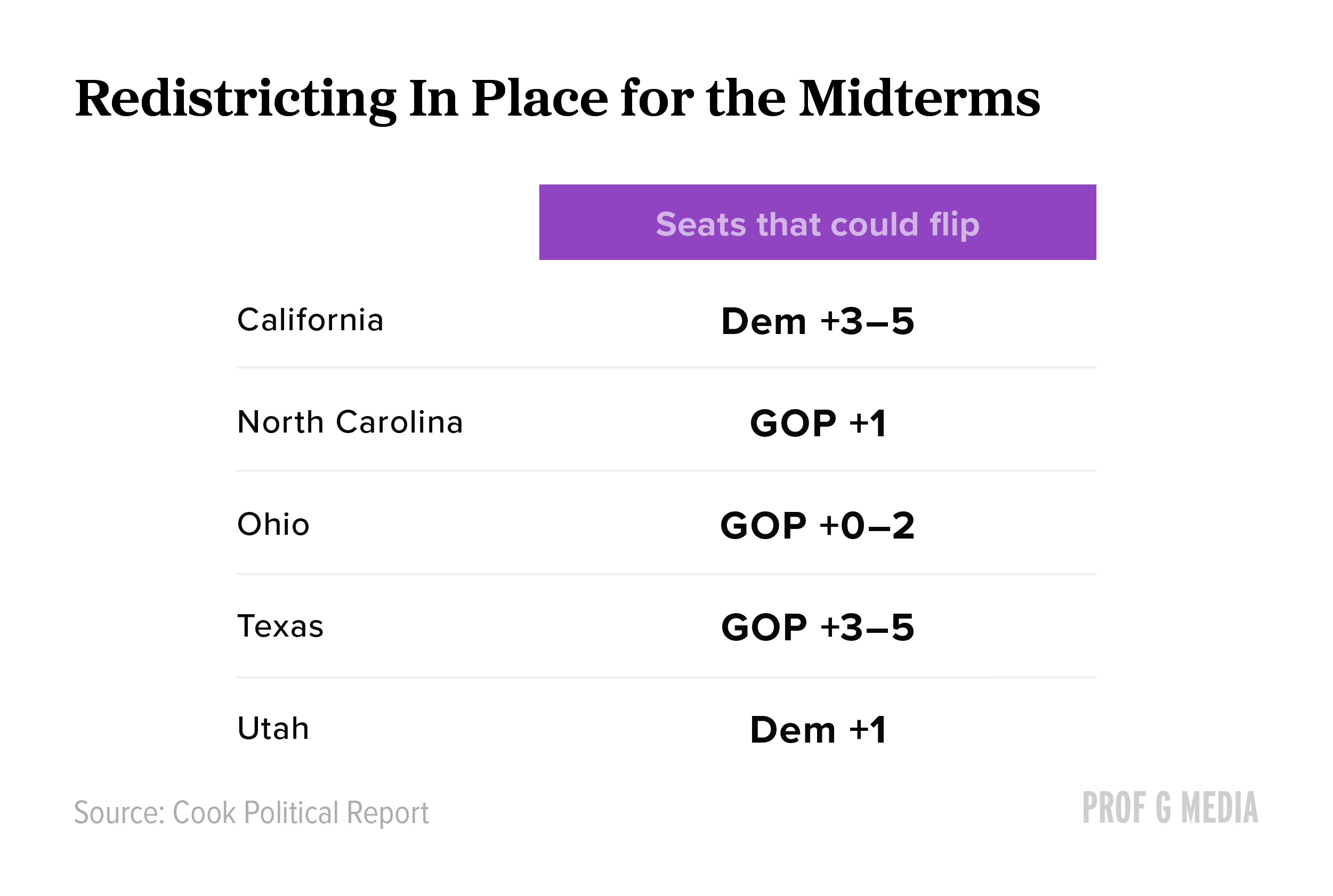
Together, the changes we know will be in place this year give Democrats another four to six seats, while Republicans would take another four to eight.
What’s pending for the midterms
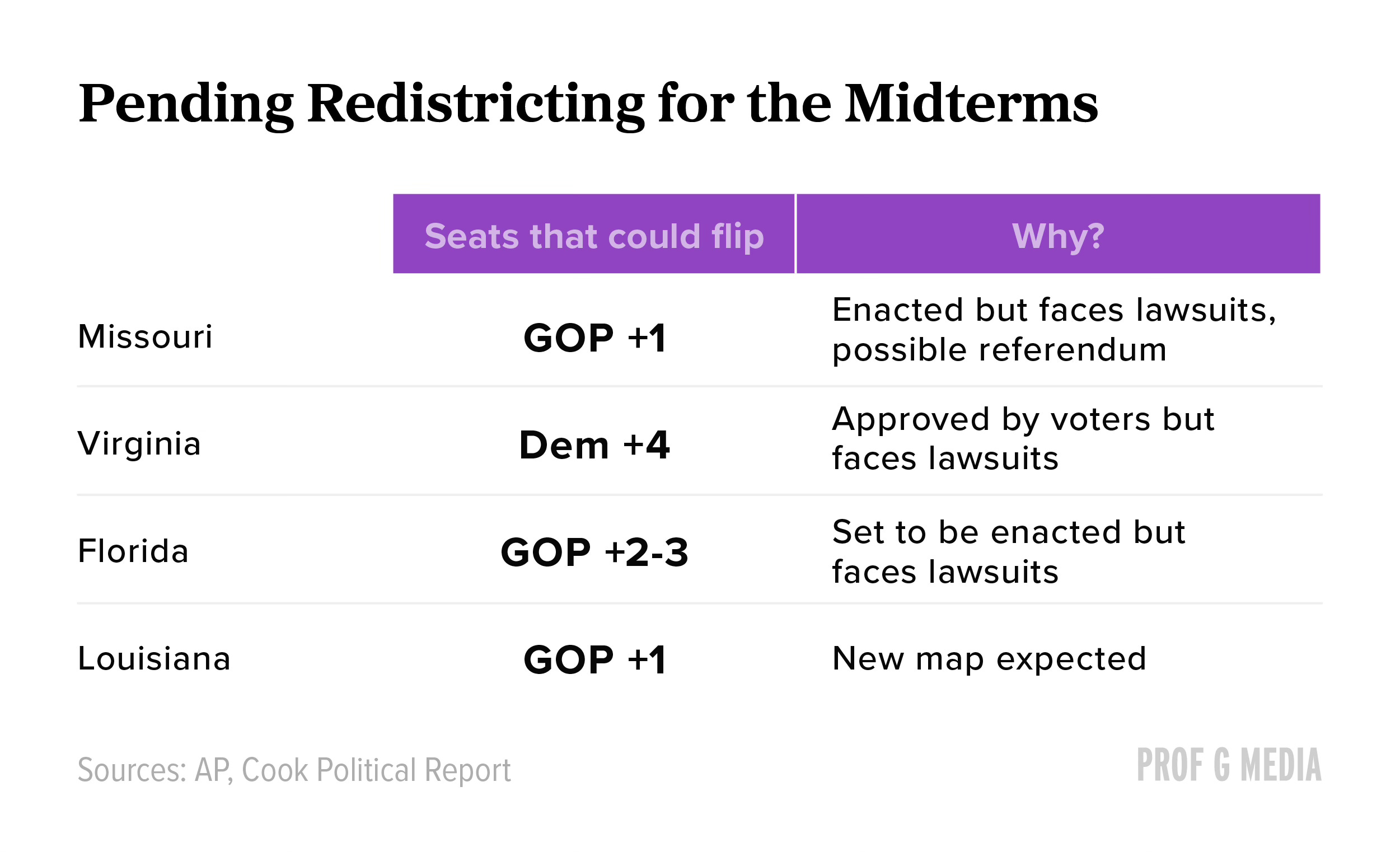
You’ll notice that neither Virginia nor Florida are on the list above. That’s because their redistricting efforts are facing multiple lawsuits.
Like in California, Virginia Gov. Abigail Spanberger put the power to redistrict in the hands of voters in a referendum that won with 52% of the vote in April. But that effort was blocked by Virginia’s top court last week in a ruling that came in one of three lawsuits GOP groups have filed challenging the ballot measure.
Florida Republicans rushed a Gov. DeSantis-led redistricting measure through their legislature last week, and he’s expected to sign it shortly. Democratic-aligned lawyers are preparing to fight that effort on the grounds that it violates Florida’s Fair Districts Amendments.
There’s also Missouri, where the legislature’s attempt to eke out an extra seat is subject to its own lawsuits and a potential referendum.
And lastly, Louisiana, which heads back to the drawing board after the Supreme Court’s Voting Rights Act ruling. While that ruling didn’t invalidate the Civil Rights-era law, which helped protect majority-minority seats like Louisiana’s sixth district, it did weaken it enough to deem that district unconstitutional, and possibly several others in the southeast.
That’s why Trump is pushing those state legislatures to redraw their maps now. Political analysts suggested last week that it’s already too late in most of the affected states, and Georgia Gov. Brian Kemp shut the door on redistricting last week along those lines.
Other states are more willing to accede to Trump’s demands. Governors in Alabama and Tennessee have announced special sessions next week in an attempt to create new maps, despite the significant legal hurdles in their way.
For now, if the four states that are best placed to survive their legal challenges implement their maps in time, then together, Democrats would gain 8-10 seats, while the GOP gains anywhere between 8-15.
A good environment for Democrats
We’d obviously prefer that the Democrats have the higher potential upside from redistricting, and five seats is meaningful given the margin of victory in the House has been an average of eight seats this decade.
But remember: these are all hypothetical gains depending on the political environment in November, and right now, the environment looks pretty grim for the GOP.
We talked last week about two good polling signs for the Democrats: they’re averaging in the high 40s on the generic ballot with a four-point lead on their opponents, and Trump’s polling is miserable on the issues, with a net -32 approval in the latest Fox poll.
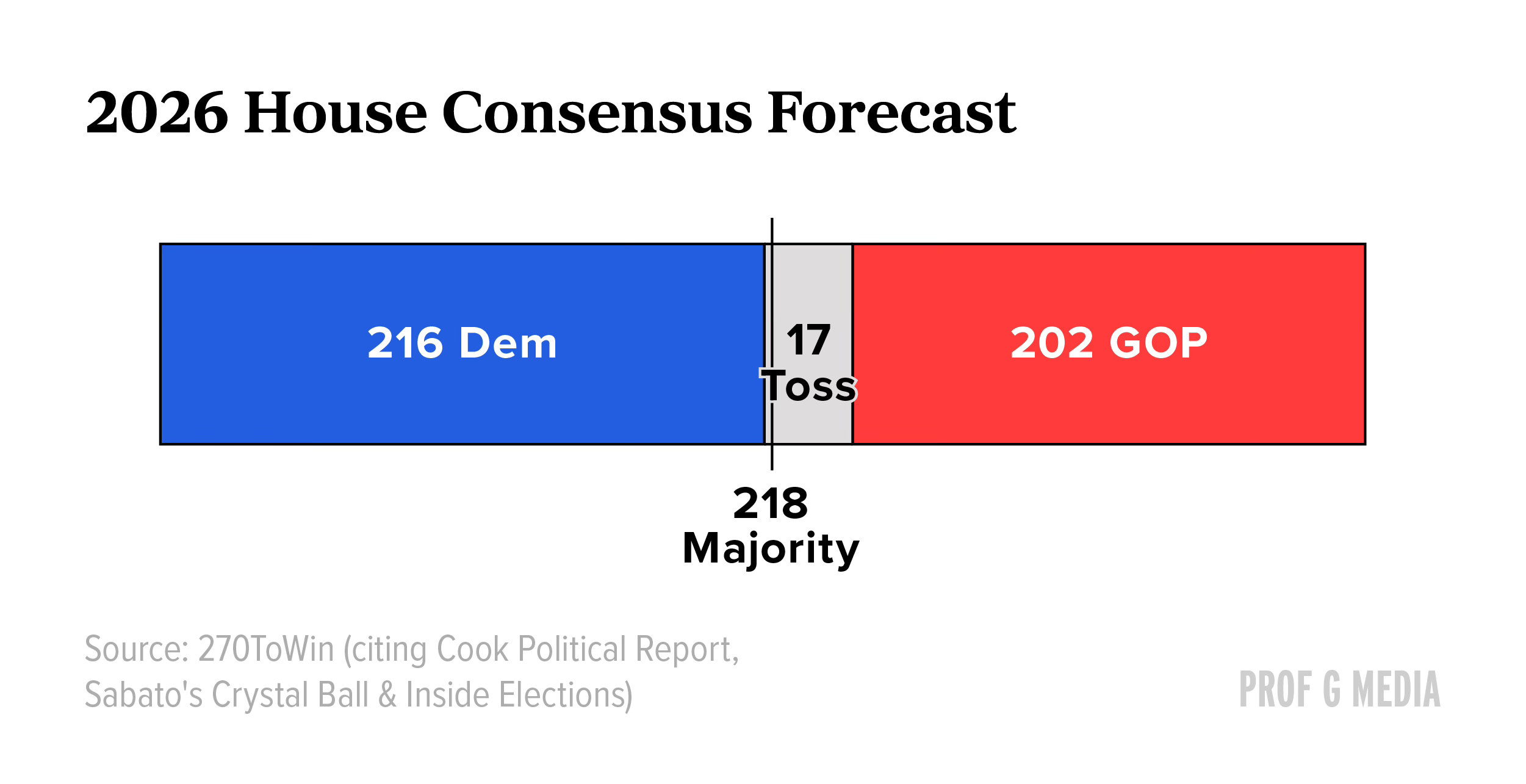
Election handicappers have noticed. That’s why, even in a hyper-partisan and hyper-gerrymandered era, the consensus forecast for the midterms puts 216 seats in the Democratic column, or two seats short of a majority. Wins in the toss-up seats would give them up to 15 seats of wiggle room.
It’s about as strong a position as the Democrats could ask to be in, notwithstanding the “known unknowns” before November on the economy, Iran, and other foreign policy misadventures.
In other words, on a good election night, Democrats will take home more seats from redistricting alone (up to 10) than Republicans will (as low as 8).
Florida: a step too far?
Florida legislators agree that redistricting isn’t a silver bullet on a rough election night. Amid all the reporting on DeSantis’ redistricting win, some local Republicans had warned that new boundaries could backfire.
“Don’t do it. I’ve said it from the beginning,” Rep. Daniel Webster, whose seat includes The Villages, told Punchbowl News in March. “I’ve been around enough reapportionments to know it’s a slippery slope.”
The problem is in the mechanics. To take more seats, you have to put more of your party’s voters in the districts currently held by your opponent. In this case, that means more Republicans in Democratic-held seats, which notionally turns them red. But by putting those voters elsewhere, you also make your own seats more competitive. On a wave night, that could jeopardize several GOP incumbents.
The same will be true for states with more Democratic districts: it benefits the party this year, but it might come back to haunt us in future cycles.
What really matters in 2028
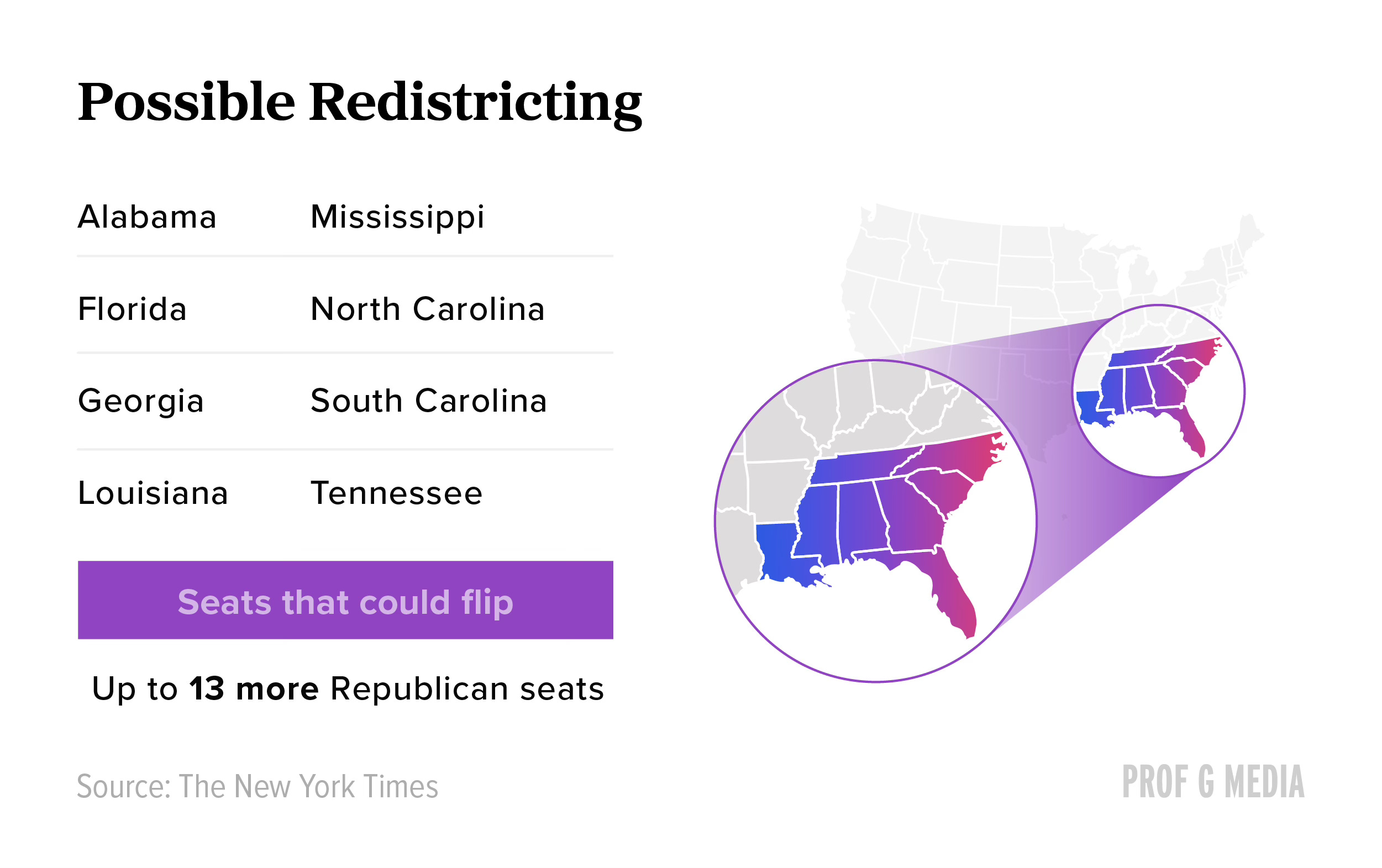
Speaking of future elections, the Supreme Court’s decision will have a larger impact on 2028. While it’s likely too late for most states to redraw their districts before the midterms, The New York Times’ Nate Cohn identified eight southeastern states that could implement new maps because of the ruling, including Alabama, Georgia, Mississippi, and South Carolina. Together, that could flip up to 13 more Republican seats.
We can spend the next two years worrying about that, or realize that the pathway to winning elections is to persuade voters you can govern for them. A strong midterms result gives us a chance to show Americans that Democrats can be trusted to execute (and will hopefully lift our spirits), but it doesn’t mean voters are going to give us the keys to the White House.
To win in 2028, we need to develop a vision and communicate to everyone. Then we can win on any boundary.
Who will the leading figures on the democrates side? Who will be the presidential candidates? No one? All of them should show up very early, this time. All of them should be positioned with a strong agenda by now, and go to work.
People will vote for a better life for themselves, and a country they can feel proud to call their own.
https://digitaljbg.substack.com/p/a-declaration-for-america-2028?utm_source=share&utm_medium=android&r=dzcsv