



TL;DR
How China brokered the Iran ceasefire
The Trump-Xi Summit Is Coming. The Relationship Isn't Fixed
China's AI Agent Takeover
China’s Peace Plan for the Iran War Has More Behind It Than Posturing
A ceasefire has paused the Iran war. Trump declared a two-week halt to US bombing, Iran agreed to reopen the Strait of Hormuz, and talks are set to begin in Islamabad. Trump told AFP he believed China had persuaded Iran to negotiate. According to the New York Times, three Iranian officials confirmed that a last-minute intervention by Beijing asking Iran to show flexibility was what secured their acceptance. To what extent the White House and China were actively coordinating remains unclear, but that public acknowledgment was a key moment. The US was more willing to work alongside Chinese efforts than seemed likely just days ago.
The ceasefire is fragile. JD Vance called it a fragile truce. Israel and Iran have already traded accusations of violations in Lebanon. As of April 9th, the Hormuz blockade had not been lifted, and Iran’s 10-point proposal and the US 15-point framework remain far apart.
China and Pakistan’s five-point plan, which set this in motion, called for an immediate ceasefire, diplomatic talks, protection of civilian infrastructure, safe passage through the strait, and a comprehensive peace framework. Pakistan was the public face of the initiative. China was pulling the strings. The plan was always more than posturing. Multiple rounds of talks between Beijing and Islamabad, meetings between their foreign ministers, and credible reports of a four-way consultation involving Pakistan, Turkey, Saudi Arabia, and Egypt suggest serious work was done behind the scenes.
China had a material stake in seeing this resolved. It sources roughly 50% of its seaborne oil imports from the region, and while strategic reserves and rerouted Russian supply had provided a buffer, that window was closing within two months.
A Shanghai-based firm called Mitsa Vision had been publishing real-time satellite imagery of American military movements in the region on X, including footage posted ahead of the US operation that began February 28th. Whether China was actively sharing this data with Iran is not clear, but it was publicly accessible, and that alone raised serious questions about US force exposure in the region.
Alice’s Take: China’s goal here is a familiar one: claim the moral high ground. By positioning itself as a peacemaker while the US reserves the right to escalate militarily, Beijing reinforces the narrative it has been building for years. That said, China has a genuine material interest in seeing the strait reopen. The longer this drags on, the more acute the energy crunch becomes. I expect Beijing to continue to push harder bilaterally, working through its leverage with Iran to secure preferential access to oil shipments, regardless of what happens with the formal peace process. As for Trump, I think he ultimately needs China more than he’s letting on. It may be that come May he’ll want to claim a quick victory in the form of “good” relations with Beijing. If Operation Epic Fury stalls or becomes a quagmire, a positive China relationship may be his best available diplomatic off-ramp. We may look at the situation in a month’s time and find that Operation Epic Fury was a botched effort at regime change in Tehran that simply paved the way for “Operation Tollbooth,” whereby Iran calls the shots on tolling oil flows and China succeeds in pressuring the Gulf states to accept more yuan, not dollars.
James’s Take: The peace plan matters, but China’s fundamental credibility problem as a mediator is that it cannot and will not act as a security guarantor. Mediation can take you only so far. If a ceasefire breaks down, someone has to be willing to step in and hold the line, and China has made clear it will not use its military to keep peace on behalf of Iran, let alone risk a confrontation with the US and Israel. That is a structural hole in the initiative that no amount of diplomatic groundwork can fill. What the plan does accomplish is keeping China at the table, building its profile as a responsible power, and leaving the US looking like the party blocking peace. That’s a significant soft power gain, even if the hard security outcome remains out of reach.
Trade Probes and a Major Hack Put The Trump-Xi Summit on Shaky Ground
China launched two trade investigations into US practices this week, retaliating against Section 301 probes the Trump administration initiated after IEEPA was struck down by the Supreme Court. The targets: American policies Beijing says are choking global supply chains and shutting out Chinese green tech. The timing is pointed. A Trump-Xi summit is reportedly being planned for May, though Beijing has yet to confirm it.
The same week, the FBI declared a suspected Chinese hack of a US surveillance system a “major cyber incident,” with indications that sensitive data across agency networks was compromised. It echoes the 2015 OPM breach, when Chinese actors accessed records on millions of federal employees. The pattern holds: two countries trying to choreograph a diplomatic reset while their security establishments operate in deep mutual distrust. Whatever mood music a summit produces, the underlying dynamic does not change.
The economic picture is harder to spin. US exports to China fell 26% in nominal terms in 2025. By some estimates, bilateral trade was roughly $90 billion lower than it would have been absent the trade war. The administration has talked extensively about closing the deficit, but the actual mechanism for doing so, rigorous rules-of-origin enforcement to catch Chinese goods rerouted through Vietnam, Mexico, and elsewhere, has not materialized. The rhetoric has outpaced enforcement.
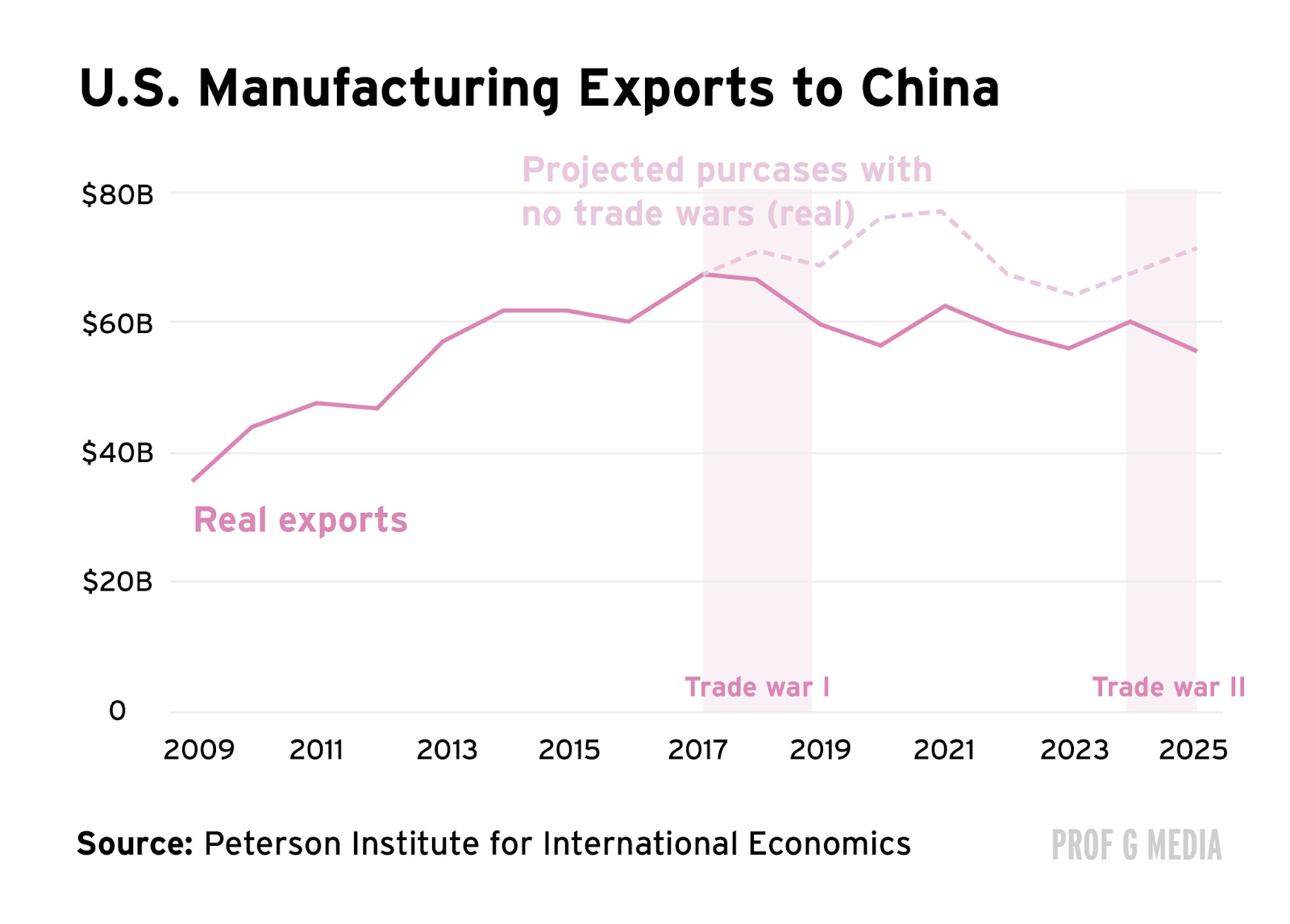
Alice’s Take: I’ve watched these cycles repeat long enough to be skeptical of the framing. The FBI hack will almost certainly be deployed politically, as these incidents usually are, to apply pressure ahead of talks rather than to reflect genuine outrage. My concern is more structural. Even setting aside the surveillance story, the underlying conditions for a meaningful summit aren’t there. The trade numbers are moving in the wrong direction. Yes, the bilateral trade deficit between the U.S. and China is at a two-decade low but the U.S.’s overall trade deficit has grown and simply shifted to Vietnam and Mexico, which are clearly used as re-routing hubs for Chinese goods. The security states are at each other’s throats, and the US approach to reducing the deficit remains more rhetorical than operational. If Washington were serious about curbing the deficit, they would go after “rules of origin” but they haven’t. The worse things get in Iran, the more Trump needs China, particularly if Iran becomes a sustained military commitment. That shifts the negotiating dynamic considerably.
James’s Take: What strikes me about this moment is how much it illustrates the chasm between the diplomatic track and everything happening beneath it. Summits, even when they go well, are fundamentally about managing the surface. But the security relationship between the US and China operates on a completely different plane, one defined by surveillance, cyber operations, and proxy conflicts where trust is essentially zero. The FBI hack is not an anomaly. These incidents are a permanent feature of the relationship. Every time the two governments try to build something at the diplomatic level, the security track erodes it. I don’t see that changing regardless of what happens in May.
China’s OpenClaw Moment
A free, open-source AI agent built by Austrian programmer Peter Steinberger has become one of the fastest-growing open-source projects in GitHub history since its release in November 2025.
OpenClaw is not a chatbot. It executes tasks: connecting to large language models, integrating with messaging apps, managing calendars, writing code, handling bookings. In China, it has taken on a life of its own. The local term for the frenzy, “Yang Longxia,” or lobster farming, is now ubiquitous. Chinese users are forking it, building new applications on top of it, and folding it into existing platforms. One developer built a version called QClaw that deploys the agent directly inside WeChat.
Alice’s Take: I’m calling it “Lobster Mania.” Token consumption, the key measure of AI usage in China, jumped from 100 trillion in December to 140 trillion in March, a 40% surge in three months. A KPMG survey found 93% of Chinese respondents already use AI for work. In the US, only 35% of people believe the benefits of AI outweigh the risks. In China, that figure is 69%.
Title: % of People Who Trust AI
Subtitle: 2025
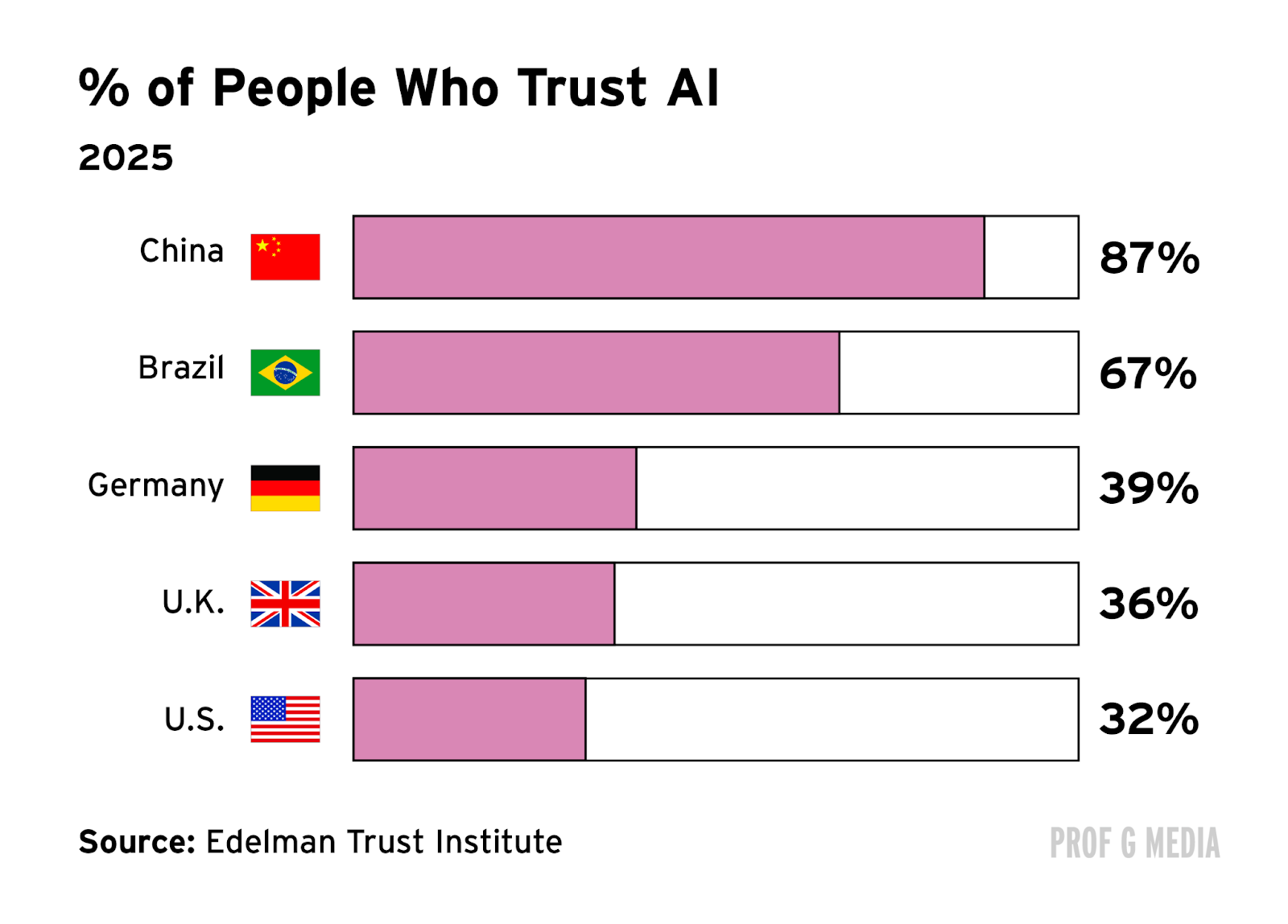
What the numbers reflect is something deeper than enthusiasm for a new tool. China did this with super apps a decade ago. WeChat and Alipay built ecosystems so embedded in daily life that the West still has not replicated them. OpenClaw looks like the same instinct playing out in agentic AI, so in a way, I foresee the era of “super apps” being replaced by “super agents” in China. The government’s posture right now is permissive but that can’t be sustainable over the long-term. AI dominance is a national priority and regulators do not want to slow the momentum. But the Cyberspace Administration issued quiet guidance in December on anthropomorphic AI services, flagging concerns about systems that simulate family relationships for elderly users and calling for restrictions to protect minors. That is not a crackdown. It is just a signal that the let-it-rip phase has a shelf life, as has often been the case in China’s history of technological innovation.
James’s Take: I spent just over two weeks in China researching this topic, and OpenClaw was the dominant conversation everywhere I went in tech circles. What matters is not just the scale of adoption but what kind of tool people are actually adopting. A chatbot answers your questions. An agent executes tasks for you. That distinction has enormous implications for employment. Roughly 67% of Chinese industrial firms have already deployed AI agents in production, compared to about 34% in the US. But outside the tech sector, the mood I encountered was anxious. Almost everyone I spoke to who does not work in AI was worried about their job, or watching peers struggle to find one and drawing the obvious conclusion. Youth unemployment among urban 18-to-24-year-olds hit 18.9% last year. I think it exceeds 20% this year. The government can hold the let-it-rip line for now, but if that number keeps climbing, the political pressure to respond will be very hard to ignore.
Alice’s Prediction: China’s Cyberspace Administration may try to kill or delay Meta’s acquisition of Manus, a Chinese agentic AI company. Regulators are already looking into whether the deal violates tech transfer laws. While Manus isn’t directly national security related, AI is getting increasingly charged as a topic in China. My suspicion? Regulators will throw up obstacles mainly because it’ll make Mark Zuckerberg’s life a little bit worse.
James’s Prediction: I think 2026 will be a landmark year for the EU strengthening resilience against foreign cyber threats, especially Chinese technology. We’re going to see the European Commission expand restrictions to Chinese cars, cellular modules, wind farms, and other sectors where Chinese companies collect data throughout Europe.