



What do you call it when you’re scrolling through social media and all you see is good news? Joyscrolling? Whatever it is, it’s all we’ve been doing all week.
Last week’s midterms keep generating more and more good news. We’re on the cusp of victory in Mississippi, look set for another key gubernatorial win, and longtime incumbent Republicans keep falling.
(Next on our wishlist is Virginia Foxx, who you might remember from a certain letter she wrote to a 10-year-old who advocated for electric vehicle rebates. She trails by 99 votes.)
It can be hard to keep track of everything that finally went right last week, but hold on to these extraordinary statistics whenever times get tough:
In the House, Democrats are on track to post the largest victory by either party in half a century.
Trump won the six red state Senate seats that Democrats flipped by an average of 13 points. It will be 14 points if Scott Colom wins.
Three in four Americans will have a Democratic governor next year.
7% of Republican voters switched to the Democrats this year, and the party won 6 in 10 independents.
There are 22 Democratic state government trifectas, including Michigan, Wisconsin, Pennsylvania, Nevada, Arizona, and Alaska.
You don’t need us to tell you who last week’s biggest loser was. To President Trump’s credit, he is at least aware of the reasons he lost. He admitted last night on 60 Minutes that the Iran War and ICE were major reasons why Republicans lost this year.
There is one other big loser this week: money in politics. This election was the most expensive ever, with $11.87 billion in spending, according to AdImpact. Republicans spent more than Democrats in hundreds of races and still came up short.
We think that’s not getting enough attention, so this week, we’re presenting a few stories – big and small – that show while small-dollar donations helped, giant piles of money from billionaires didn’t.
Programming note: Join Jessica and Aaron Parnas for Raging Perspective again this Wednesday. We’re live at 12PM with an unscripted, unfiltered, unedited conversation about the issues defining this era. As always, we’re also taking your questions! Ask away in the comments section below.
Republicans outspent Democrats in most of the key races and still lost
Let’s start with the battleground states. Across ten highly competitive Senate races this year, Republicans outspent their Democratic opponents in nine of them. In three of those states (Texas, Ohio, and Georgia), the GOP had a spending gap of $100 million or more.
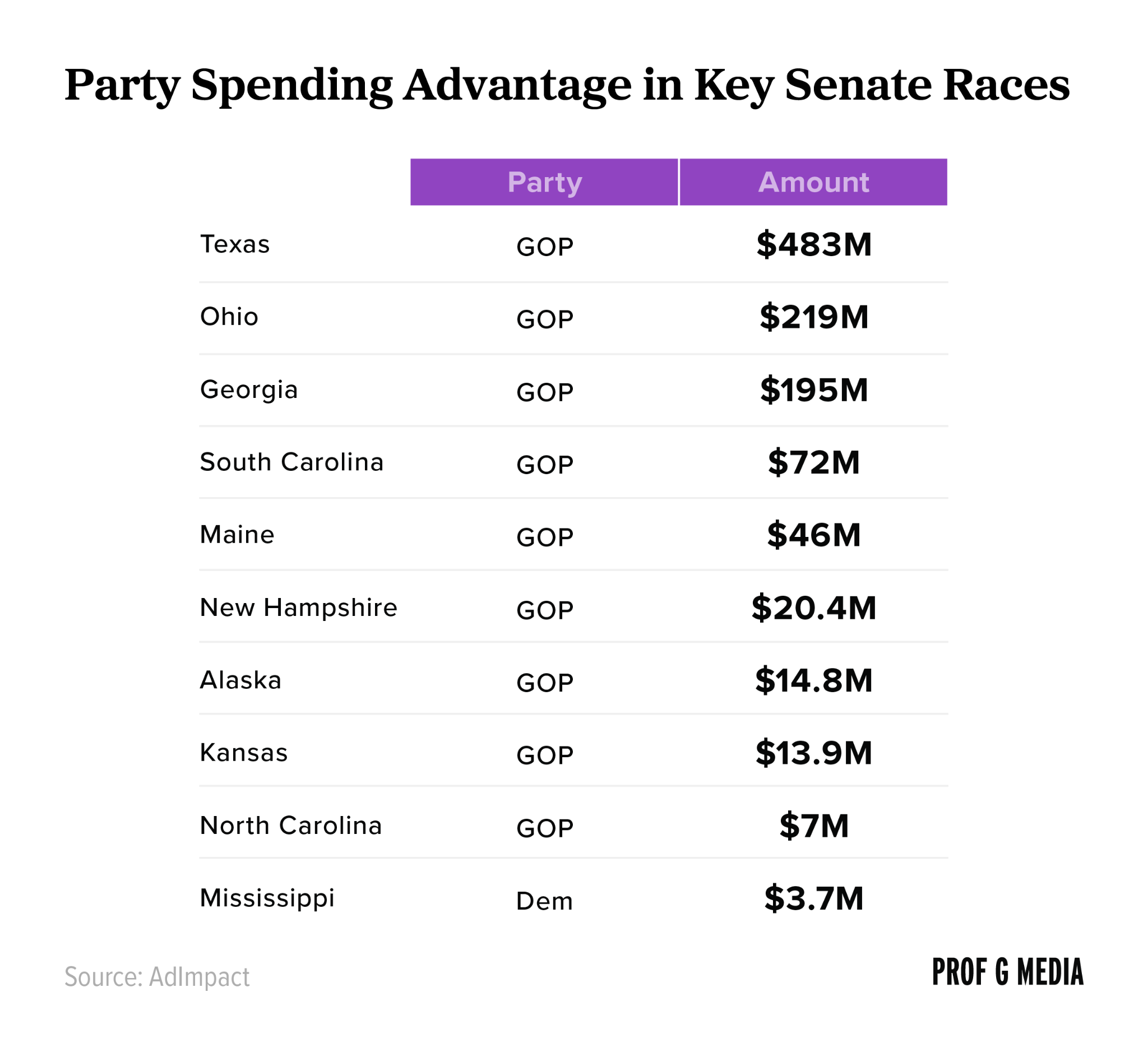
In Texas, the GOP spent nearly half a billion-dollars more than the Dems, thanks largely to Elon Musk, who personally dumped $224 million into the race. It made for the GOP’s biggest spending gap of any state, and also two of the party’s most humiliating losses: a Senate flip to James Talarico, who won by 12 points, and a bonus gubernatorial flip, with Gina Hinojosa winning by 7.
Billionaires who self-funded their campaigns didn’t fare much better. Vivek Ramaswamy, who loaned $41 million to his own campaign, ended up losing by 8 points last week. Rick Jackson, the billionaire businessman in Georgia, blew $220 million to lose by the same amount.
Wherever the money came from, Republicans who thought they could save themselves by pouring more dollars into their states came up short across the board.
Big spenders in the House couldn’t save themselves
We saw the same thing in the House.
Take New York’s 17th district. That race was always destined to be a big spender because advertising here means buying air time in the New York City media market.
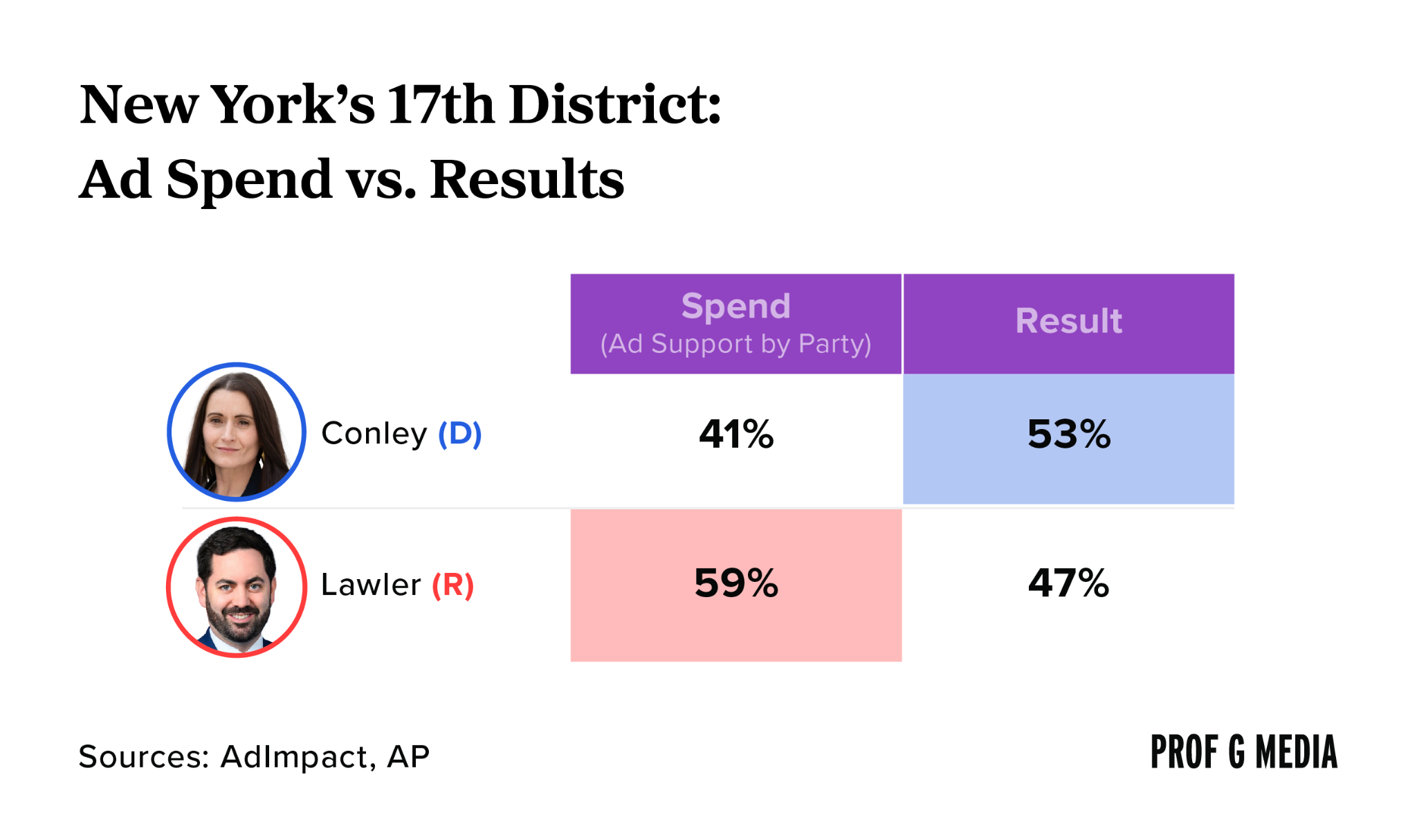
Still, ad spending reached new heights there this year: a total of $60 million for one House district, making it the second most expensive House general election ever.
Republican Rep. Mike Lawler, the incumbent, often bragged about his fundraising prowess. He said his fundraising totals were “historic,” “monster,” and showed his “dominance” in the race. He even teased his opponent, Cait Conley, for having a fifth of the resources that he did.
With 95% of the vote in, Conley has defeated Lawler, and currently leads him by 6 points.
Don’t get us wrong: Democrats were competitive on ad spending in many House races. But the party still won many races where they fell short on money.
Some House Dems got massively outspent and still won
For an extreme example, look no further than North Carolina’s 14th district.
You have already read about this race: the winner, LaKesha Womack, still faces felony charges for allegedly not returning a rental car in 2019.
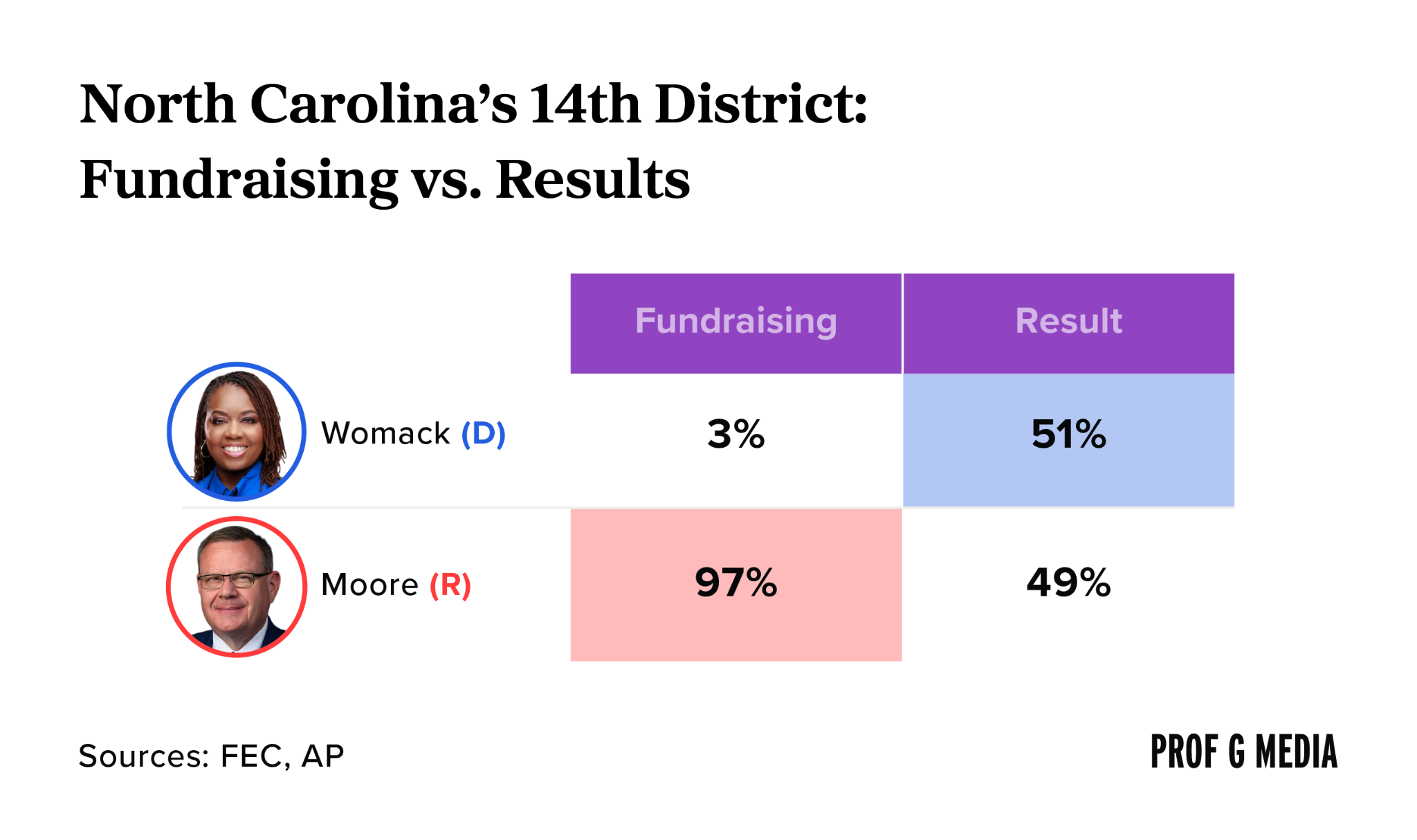
What you haven’t read about is the extraordinary fundraising gap between her and her Republican incumbent rival, Rep. Tim Moore.
Moore raised $2.1 million these midterms, compared to just $59k for Womack. She didn’t get a single donation over $1,000. No support from the federal party, nor any PACs or famous donors.
She still got it done: a 6,415 vote victory at time of publication, or 51%-49%.
Poorly-funded Democrats won all the way down to the local level
Even when you get down to state districts, you can find examples of Democrats who raised almost no money picking off much better-funded rivals.
Our favorite example is Florida’s 94th district, which until now, was home to “MAGA Meg,” or Meg Weinberger, a Florida state House representative whose “signature accomplishment” was a bill that renamed Palm Beach International Airport and part of a local boulevard for Trump.
Yes, you can thank her for your “DJT” boarding pass.
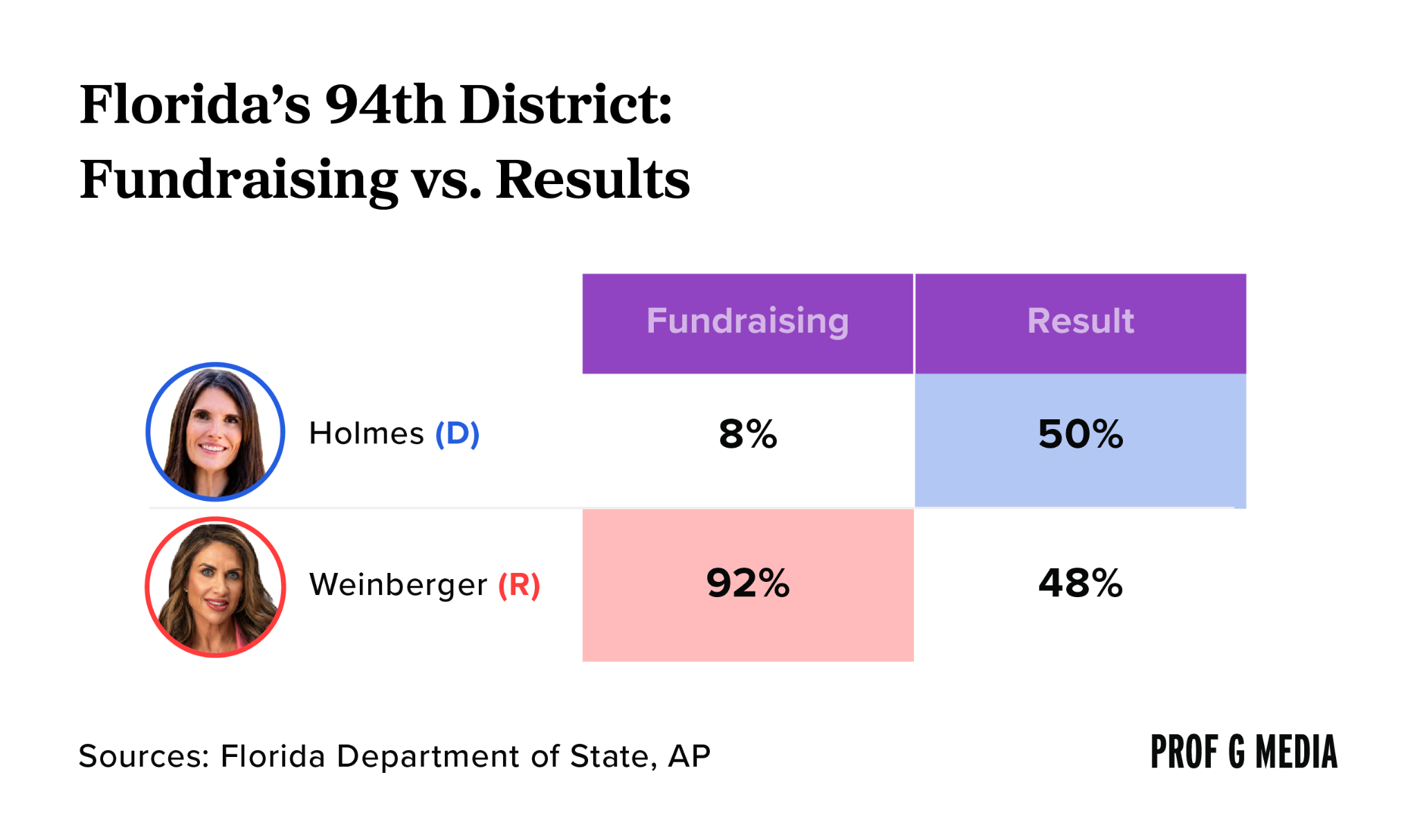
Believe it or not, she lost her race last week to a local Democrat named Elizabeth Holmes (no relation).
Holmes had campaigned on opposing, in the Wall Street Journal’s words, “hate and corruption and the wealthy few over the struggling many.”
She lived by those values, raising just $53,000 to Weinberger’s more than $600,000.
We’ve said all year that money matters in elections, and we still believe that. Small-dollar fundraising from individual donors is a sign of enthusiasm for a campaign, and it helps fund not just advertising but turnout operations too.
But as we’ve seen, trying to buy an election – or hoping that a mere fundraising advantage will get you over the line – just doesn’t work. It doesn’t matter whether you’re running in Texas’ Senate race or a Florida House district.
Like so much of the last week, that’s a good thing for Democracy, and for the future of the country.