


President Trump gave new meaning to the phrase “start the year out strong” by announcing U.S. troops’ removal of Venezuela’s president, Nicolás Maduro. Just a few days later, he revived his push to acquire Greenland, an independent territory of Denmark, a NATO ally.
According to the White House, acquisition by military force is an option.
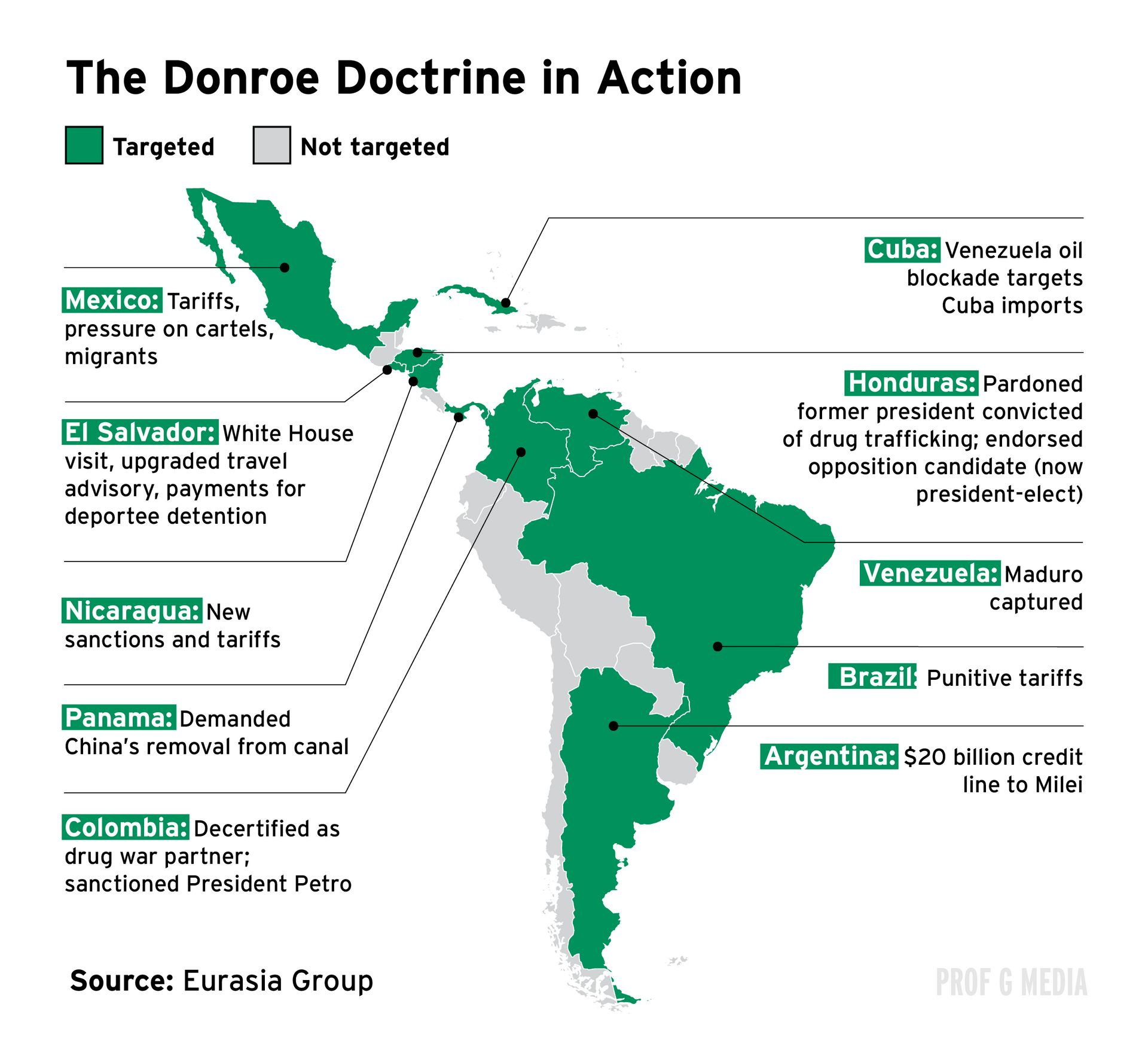
Trump framed these moves as part of a broader vision of American power, which he is calling the “Donroe Doctrine.” It’s a reference to the Monroe Doctrine, which was first articulated in 1823, when President James Monroe declared the Western Hemisphere was America’s sphere of influence.
Trump also threatened action against Cuba, Colombia, and Mexico.
Wall Street’s reaction has been surprisingly muted. The S&P 500 and oil prices finished the week up 1% and 3%, respectively.
The standout gains were in rare earth miners operating in Greenland. Shares of Critical Metals Corp. and Energy Transition Minerals finished the week up more than 72% and 145%, respectively.
The economic implications of exerting control over Venezuela and Greenland hinge primarily on both countries’ natural resources. But in both cases, extraction will be more complex than the president has implied.
Venezuela has the largest oil reserves in the world but produces less than 1% of global supply. Oil infrastructure in the country has collapsed, and much of its heavy crude requires extensive refining.
By most estimates, rebuilding would take years and more than $100 billion.
The end result would be extraordinary. The U.S., Canada, Venezuela, and the rest of Latin America account for nearly 40% of global oil output. If the U.S. were to exert de facto control over the Americas, it would preside over an oil empire without historical precedent.
Greenland’s resources are also access-constrained. Experts believe that Greenland could possess up to 18% of the world’s rare earth elements, crucial for manufacturing electronics, energy, and defense systems.
For context, the U.S. possesses only 2% of global reserves, while China has 48%.
However, roughly 80% of Greenland is covered by ice, infrastructure is minimal, and skilled labor is scarce: The island’s total population is smaller than that of Albany, New York.
Geologists estimate it would take at least a decade before commercial production could begin.
There’s no free lunch — even for imperialists. Paul Krugman, Nobel Prize-–winning American economist, journalist, and professor, noted that removing Maduro likely cost U.S. taxpayers more than a billion dollars.
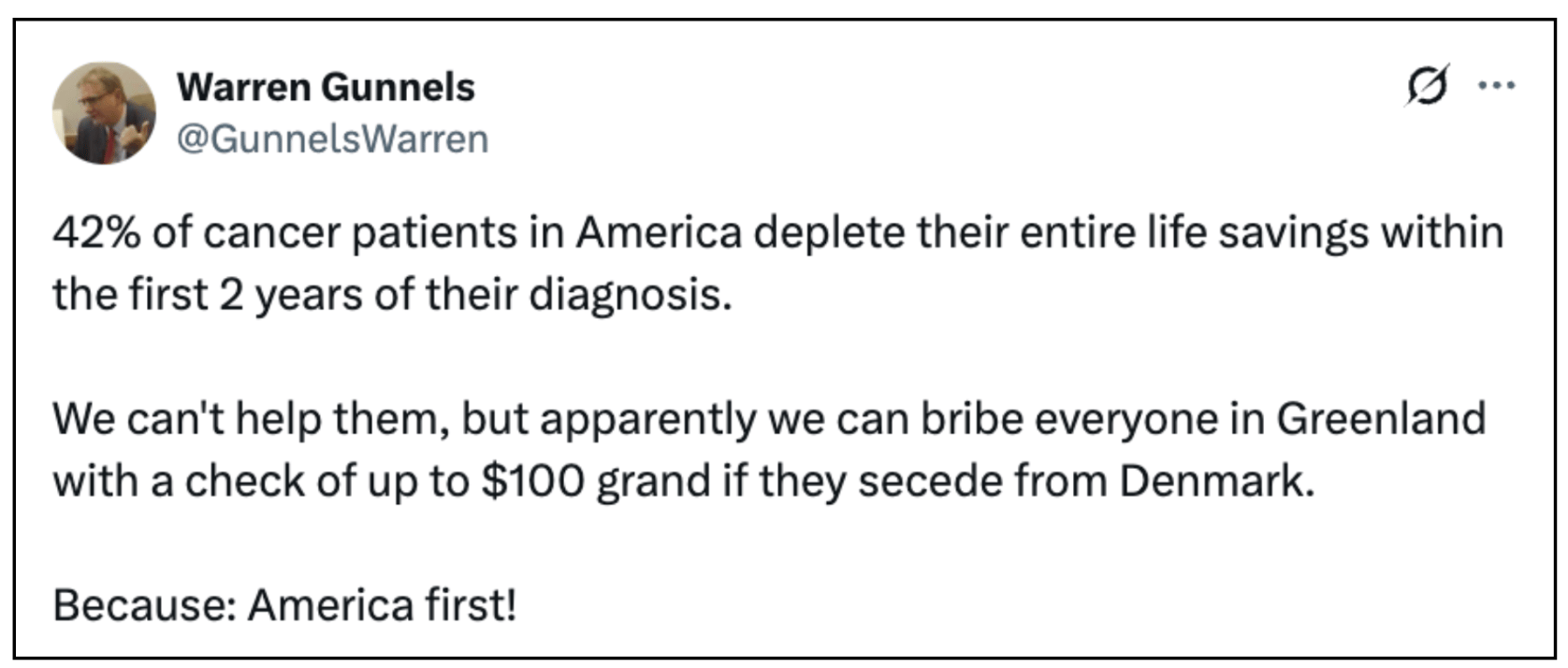
And last Thursday, White House officials discussed sending lump sum payments to Greenlanders to convince them to join the United States. According to Reuters, the potential payments range from $10,000 to $100,000 per person.
The last foreign territory the U.S. purchased was the Virgin Islands in 1917 from Denmark for $25 million in gold (equal to over $630 million today). The move required Senate approval.
Warren Gunnels, staff director for Sen. Bernie Sanders, responded to the proposal on X:

If your only goal is making money, should you just invade other nations and take their stuff?
The MAGA view is that America has always operated through force; we were just hypocrites about it before. There’s a plausible reading of history where that’s true.
But here’s the counter: We had a good thing going. America is the richest country in the world by a mile, and things have been relatively peaceful since World War II. Are we sure we want to gamble that away?

Robert Armstrong is the U.S. financial commentator at the Financial Times and writer of the Unhedged newsletter
We want markets to punish bad ideas, but that’s not how it works. Stocks discount future cash flows. Bonds bet on national solvency. History is full of empires that were solvent enough to make their bonds worth owning. Markets can’t solve political and moral problems.
But here’s the contradiction: Markets flourish long term only where there’s rule of law. You haven’t made consistent money in Russian stocks. Despite massive economic growth, Chinese stocks haven’t delivered either. Investors didn’t grow with China’s economy because rule of law is questionable there.
If America’s imperial attitude undermines rule of law at home, markets will eventually have a problem. But they’re not discounting that now.