


Over the past few weeks the AI craze has accelerated into a frenzy.
Two trillion dollars in market value has been erased. AI researchers have issued public resignations, warning of “world peril”. A blog post comparing AI to Covid racked up nearly 100 million views. AI search interest is going parabolic.
The arms race continues. Big Tech plans to spend $660 billion on AI this year. That’s five times more than America spent on the interstate highway system as a percentage of GDP. It’s also ten times what we spent on the Apollo Moon Program and the International Space Station combined. AI is fast on its way to becoming the largest project in the history of capitalism.
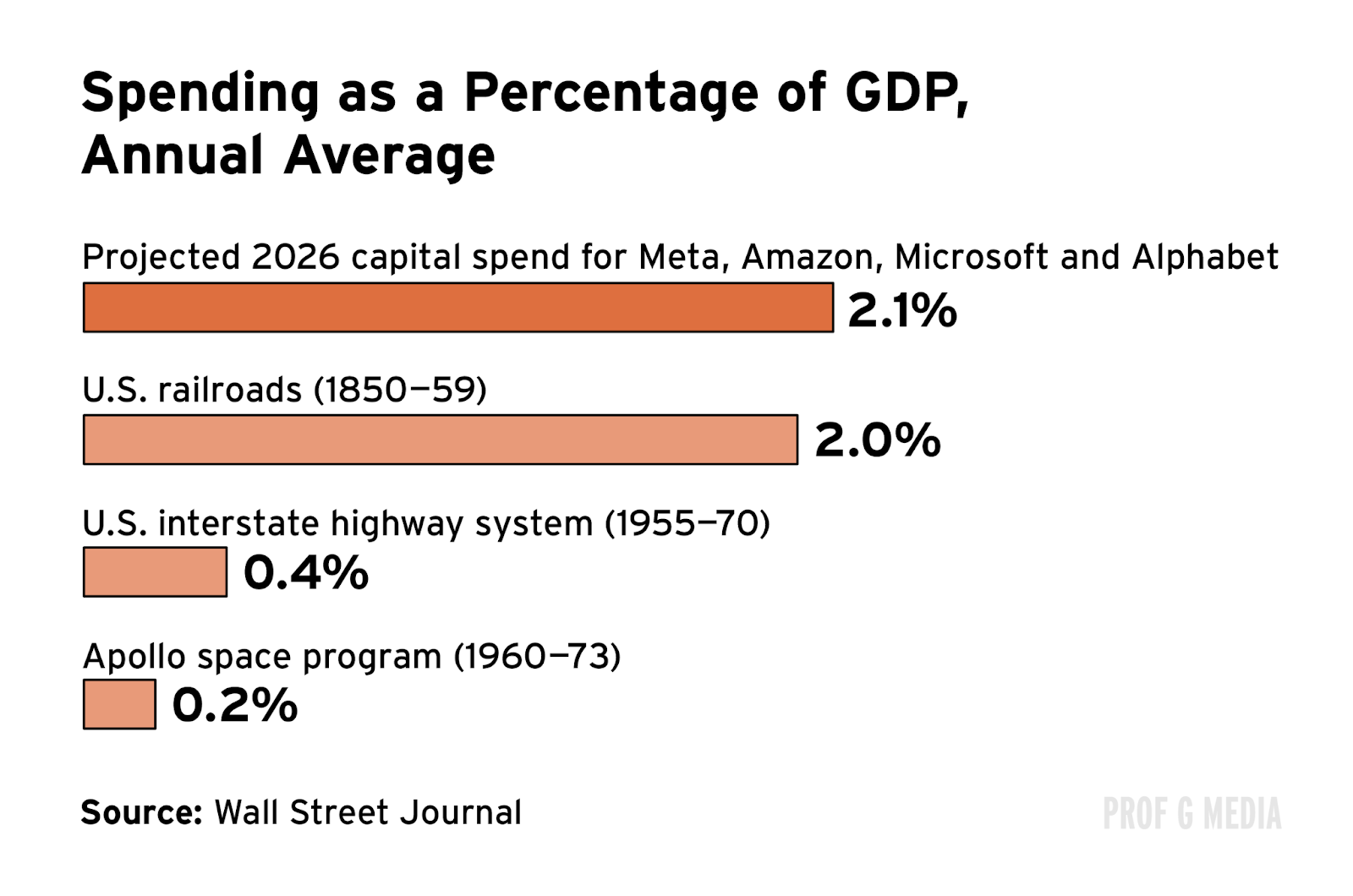
As AI outgrows our initial optimism, the era of tough questions has begun. How will it be financed? What will it do to the energy supply? How will chip production keep up? Who will be the winners? Who will be the losers? These are all relevant. But there is one far more important question that no one seems to be asking — a question that could fundamentally transform the trajectory of this technology:
How many people actually want it?
Dumb Questions, Big Answers
I understand this is kind of a dumb question. In my experience, however, I’ve found the dumbest questions often lead to the most significant answers.
Here’s the data. Less than a third of Americans trust AI. Less than half of Americans have a favorable view of AI. Half of Americans say they’re more concerned about AI than excited (the highest in the world). Less than a quarter say they enjoy using AI (one of the lowest in the world). Three quarters of Americans think AI is going to reduce the overall number of jobs. More than half think it’s going to negatively affect our ability to do things on our own. 77% think it poses a “threat to humanity.”
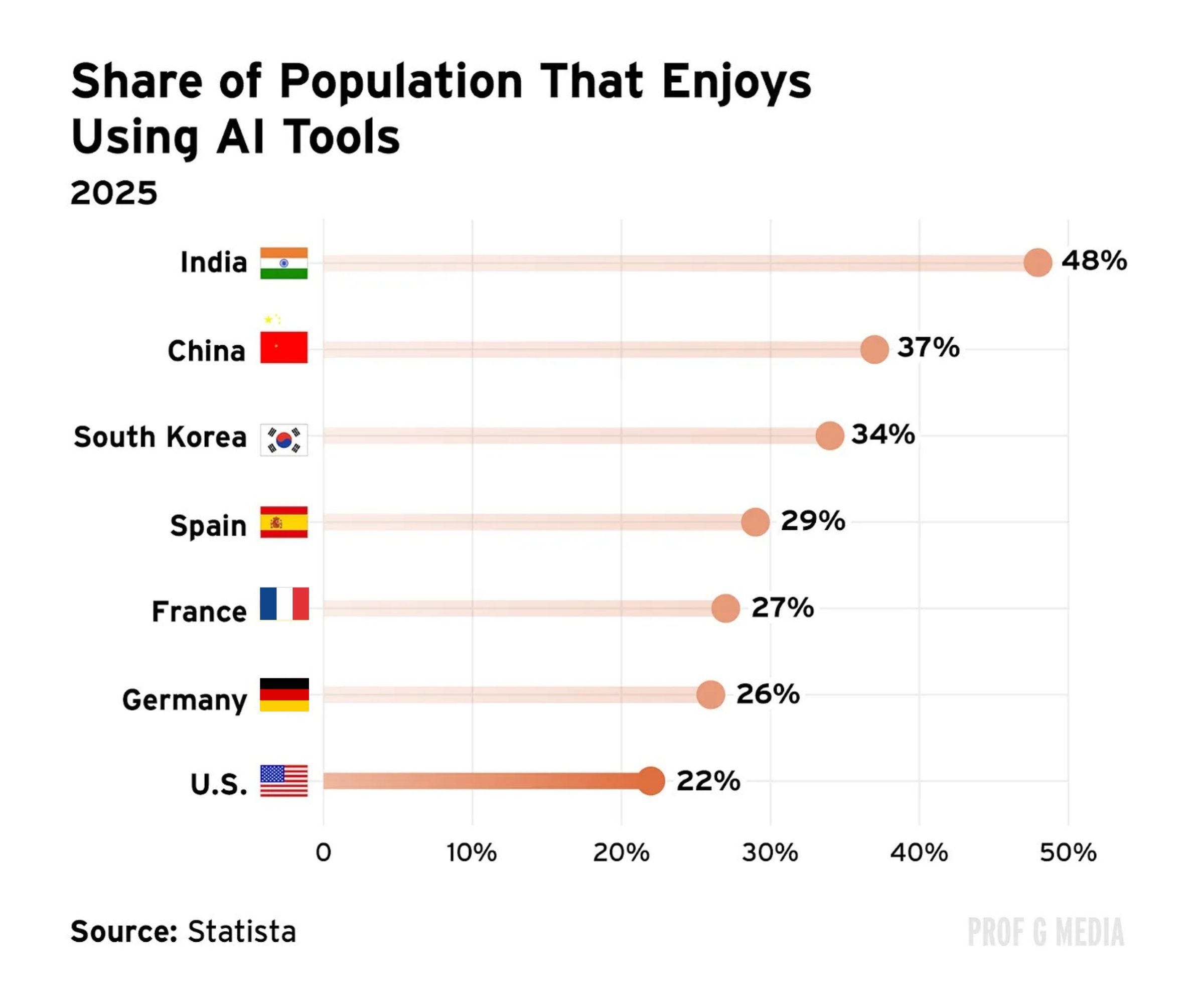
The data isn’t telling us no one wants AI — rather, it’s far more unpopular than most people assume. More Americans dislike AI than like it. This is substantially different from, say, the internet revolution, which was broadly popular. In 1999, nearly two thirds of Americans said they liked the technology, and among internet users, that number was nearly 80%.
This is the part where you tell me that doesn’t matter: So what if people don’t want AI? That won’t do anything to stop it. This is where we disagree. There are multiple roadblocks ahead for AI — financial and technological constraints among them — but none greater than its own lack of popularity.
Ground Zero
To build AI you need data centers, the engine of large language models. More than 3,000 data center construction projects are currently underway in America.
Every data center requires lots of physical stuff: GPU chips, CPU chips, memory chips, copper wires, cooling units, etc. The prices of all of these items are soaring right now. But they also need lots of nonphysical stuff. Things like permits, licenses, and local government approvals. These elements are just as critical as chips. More importantly, they’re getting scarcer.
Across 24 states, 142 activist groups have organized to block the construction and expansion of data centers. This is happening everywhere, from Arizona to Michigan to Virginia. In just two years, grassroots protestors have blocked $64 billion worth of data centers.
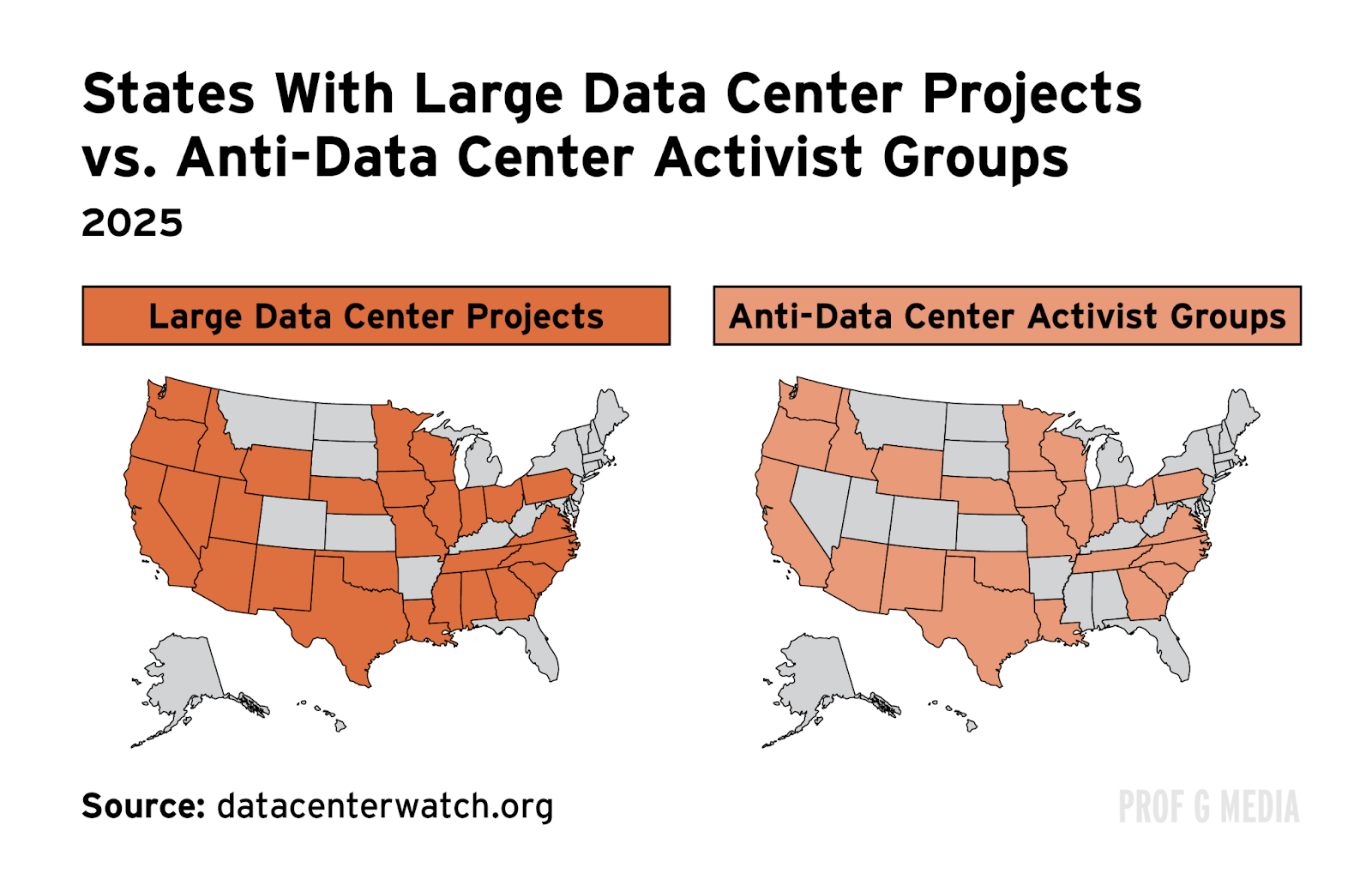
The reasoning is simple: Data centers take more than they provide. A typical data center employs only a hundred people, which is roughly a third of the number of people that work at an average Walmart. Meanwhile, they consume vast amounts of energy and water, which sends local electric and utility bills through the roof. For residents, a data center is basically a giant robot that makes locals poorer and Californians richer.
As local communities realize they don’t like AI and the data centers that power it, local governments are following suit. More than fifty bills have been proposed in Virginia to crack down on data centers. In Georgia, lawmakers have suggested banning data centers altogether. It doesn’t stop there.
The Next Political Firestorm
A sea change is happening in Washington right now. Not on ICE, or tariffs, or Bad Bunny, but AI. Elected leaders across both sides of the aisle are starting to speak up — not in support of AI, but in spite of it.
My aha-moment occurred a couple weeks ago, when Governor Ron DeSantis delivered a powerful attack on the burgeoning AI ecosystem. “I don’t think there’s very many people that want to have higher energy bills,” he said, “just so some chatbot can corrupt some 13-year-old kid online.” More importantly, his comments echoed those of a quite different politician: Bernie Sanders, who recently called for a nationwide moratorium on all data center construction (not dissimilar to what’s happening in Georgia).
I later read an article in The Atlantic that featured an AI discussion with MAGA mastermind Steve Bannon. “Let’s just be blunt,” he said. “We’re in a situation where people on the spectrum that are not, quite frankly, total adults … are making decisions for the species. Once we hit this inflection point, there’s no coming back. That’s why it’s got to be stopped, and we may have to take extreme measures.” After that I watched a congressional address from AOC, who had similar complaints.
There are now few issues more bipartisan than AI. In fact, of the elected officials who’ve taken positions against AI data centers, 55% are Republicans and 45% are Democrats — a near-even split. The implication is quite obvious. AI is fast becoming the number-one political issue in America. Leaders must now choose where they’ll stand, and if they’re looking for votes, they’ll stand in its way.
Subhuman
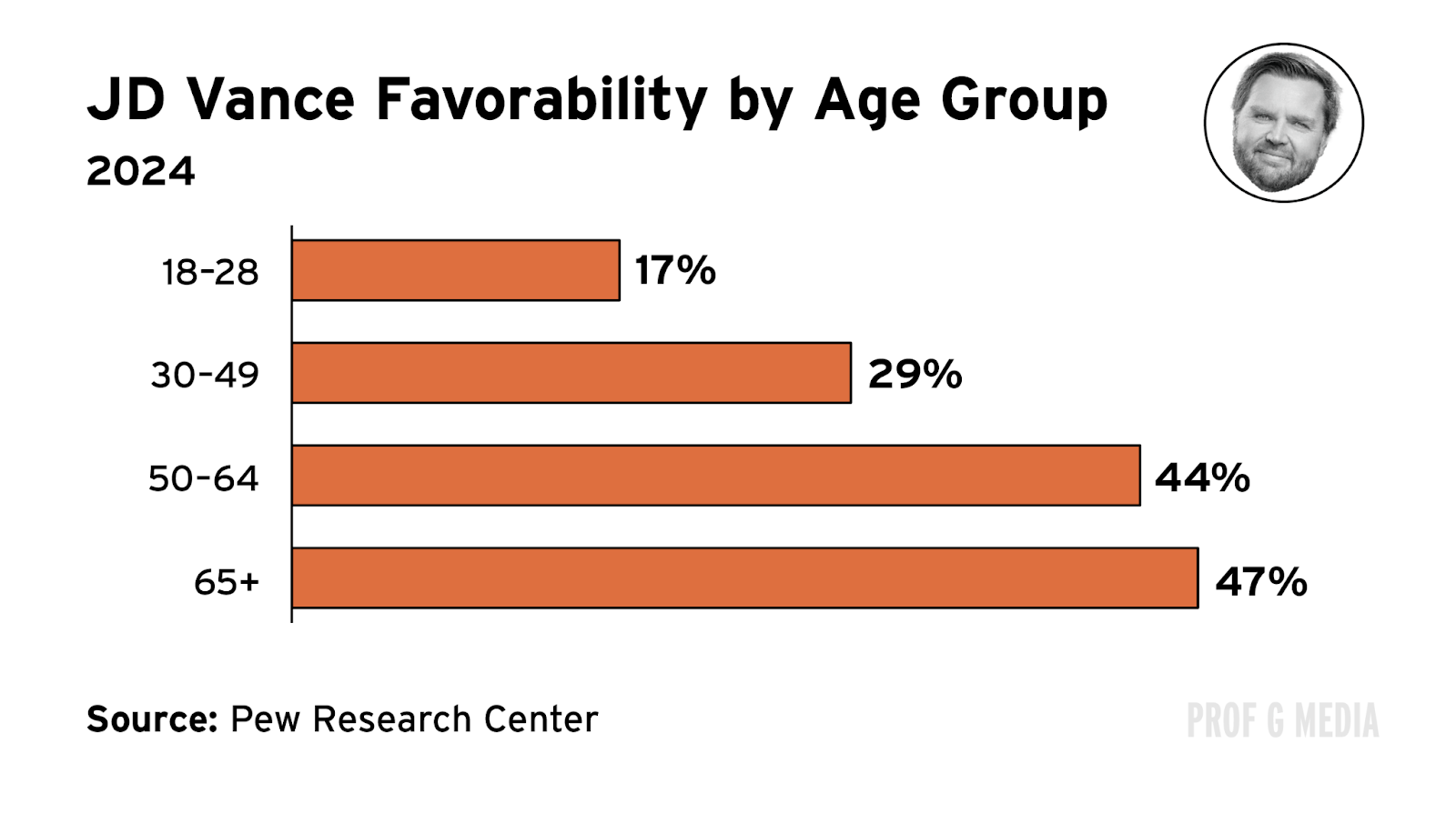
There might be no funnier instantiation of AI acrimony, however, than JD Vance, whose poll numbers are tanking, especially among young people. There are many reasons for this, but the most interesting reason is his close association with Big Tech and AI.
Don’t take it from me — take it from Nick Fuentes, the far-right white-nationalist streamer who’s become the de facto leader of Gen Z Republicans across America. His view (oft repeated to his hundreds of thousands of fans) is that Vance is a puppet of Peter Thiel, that he was installed by Silicon Valley to do Big Tech’s bidding and execute the AI agenda from inside Washington. It’s hard to call this position wrong: Vance’s Senate campaign was largely funded by Thiel, and so far, he’s been the glue between Silicon Valley and the administration.
Vance’s AI connections are beginning to discolor his reputation. His likability among young people is roughly three times lower than that of people over 65. A recent poll found most young men (the same young men who swung to Trump) now prefer Newsom over Vance. POLITICO ran a focus group of young men, which also confirmed this. A few weeks ago, The Daily Wire’s Michael Knowles was visibly shaken when Gen-Z’s viral “looksmaxxing” star, Clavicular, explained why he prefers Newsom to Vance. His view: “Because JD Vance is subhuman, and Gavin Newsom mogs.”
All About Popular
Popularity is one of those things most tech and finance people don’t fully understand. They tend to view it as an afterthought — either because it seems dumb, or because they never cracked it themselves. But the reality is that popularity is one of the most powerful forces on our planet. You could have the most advanced product in the world — it means nothing if it isn’t popular.
According to estimates, AI’s total addressable market will reach $3.5 trillion by 2033. This is a financial projection based on things like model capability, compute capacity, training speed, etc. What’s missing in that analysis, however, is the softer, high-school stuff: the question of how popular AI actually is, and how many people actually like it. This is the kind of thing Wall Street neglects to build into their financial models, a grave error.
Let’s say the trend continues, and AI gets even more unpopular. Let’s say the anti-data center movement grows even larger. Political backlash becomes even fiercer. The share of Americans who like AI goes from less than half to, say … a fifth. What will that do to the total addressable market? What will it do to future cash flows? Might it eliminate billions of dollars in revenue? Hundreds of billions? Trillions?
These are the questions Wall Street needs to answer. I don’t know what the number is, but I do know it’s higher than you think it is.
V-Day
I’m writing this on Valentine’s Day. For most of my life I’ve had a boyish dislike for Valentine’s Day. Then my girlfriend and I got together and I came to love it. Tonight we’re going out for our favorite food (sushi) at an omakase restaurant (Noz 17).
When we sit down I’ll be thinking of Same Same, the new Hell’s Kitchen wine bar that bills itself as the world’s first “AI companion” cafe. Designed for people in virtual relationships, each table is fitted with a single seat and a phone stand. The idea is to give people in AI relationships another outlet: Instead of chatting with your AI girlfriend at home, you get to take her out to drinks.
I’ve never visited but I can picture it. A row of sad and empty men, chatting deliriously with a small box of electrical wire posing as a woman. With each lifeless AI compliment, another spark of electricity in a distant data center in Wisconsin. With each prompt, another dollar in the pocket of a guy in California. Misery incarnate. Hell in a wine bar. As I think about it, I will ask myself the same question many others around the nation are asking:
Does anyone want this?
See you next week,
Ed