



Elon Musk has broken four wealth records in the past four months. Specifically, he is the first person to be worth more than $500 billion, $600 billion, $700 billion, and now $800 billion.
Though his fortune is mostly illiquid, if he could convert it to cash, his current net worth would be enough to
End world hunger;
End homelessness in the U.S;
Make public college free in the U.S. for four years;
Cover three years of universal pre-K.
Yet, if his tweets are to be believed, he’s miserable.
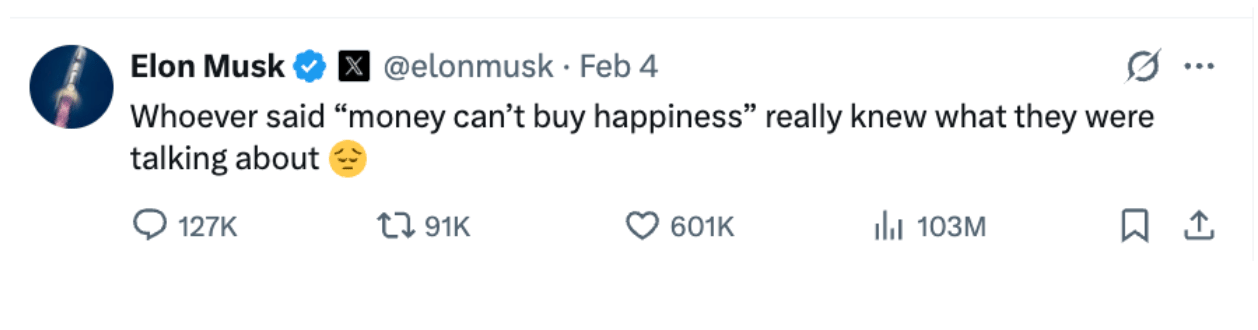
Is Elon right? Is it true that money can’t buy happiness? A much-cited study from Daniel Kahneman and Angus Deaton in 2010 found that happiness increased up to a point — $75,000 per year — and then leveled off. Then, a study in 2021 found that more money did increase happiness with no plateau.
But the most recent research, a collaboration between both studies’ authors, found that the reality is more complicated.
Money increases happiness for everyone up to $100,000 per year.
But past the $100,000 threshold, the effect changes. For people who are persistently unhappy, earning more money doesn’t make them happier. In the words of the paper’s authors: “The suffering of the unhappy group diminishes as income increases up to 100k but very little beyond that.”
However, among people who already experience a lot of positive emotion, additional income continues to increase happiness, even past $100,000, and it does so faster than it did at lower income levels.
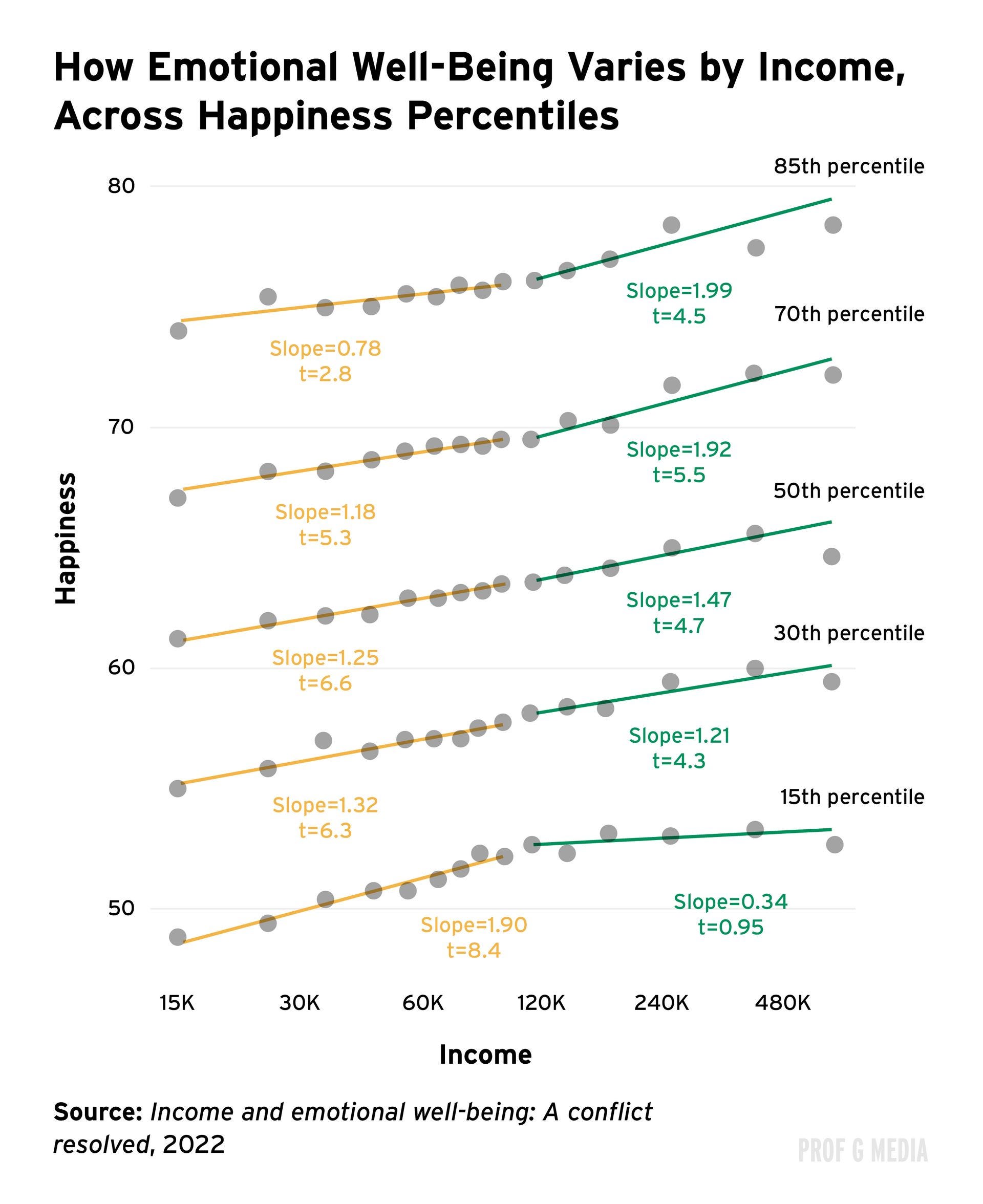
The chart below helps clarify.
The different lines represent people grouped by their average happiness level. The people in the 85th percentile are more consistently happy than those in the 15th percentile.
The slope of the lines represents change in happiness. The yellow lines from 0 to $100,000 show that for all groups, happiness increases until $100,000.
The green lines show the change in happiness for incomes higher than $100,000. For the folks in the least-happy group, the 15th percentile, the rate of increase in happiness (green line) is basically flat — meaning their increase in happiness is statistically insignificant past $100,000.
Small Influences and Big Influences
Money impacts happiness and even increases it substantially for some people. However, as the authors of the study noted, “The relationship is weak, even if statistically robust.” Not even $850 billion will buy happiness for someone who is persistently unhappy.
If money can’t reliably buy happiness, what can? The longest scientific study of happiness ever conducted tells us the answer: relationships. All relationships matter: friends, acquaintances, family, coworkers, and neighbors. The stronger our relationships are with others, the happier we are, and the longer we live.
At the End
Musk’s tweet about happiness was seen by over 100 million people and received over 100,000 comments in 48 hours.
There’s something ironic and deeply sad about the most well-resourced man in the world confessing his unhappiness to 100 million IP addresses, when we know that the key to happiness is real relationships. If only he would get off his phone.