



TL;DR
Apple Under Fire in China as Beijing Demands More from Tim Cook
Trump’s Beijing Summit Delay Exposes the Limits of China’s Global Leverage
Insides China’s Museum Boom
Newsletter Exclusive: Inside China’s Mental Health Crisis
Apple Under Fire in China as Beijing Demands More from Tim Cook
Tim Cook was in Chengdu last week for a splashy Apple Store event marking the company’s 50th anniversary. The optics were unmistakable: America’s most valuable company, worth roughly $3.7 trillion on public markets, flying its CEO to China to open a retail location and make nice with regulators. iPhone sales in the mainland are up 23% so far in 2026, outperforming a shrinking broader smartphone market. But the trip was as much damage control as celebration.
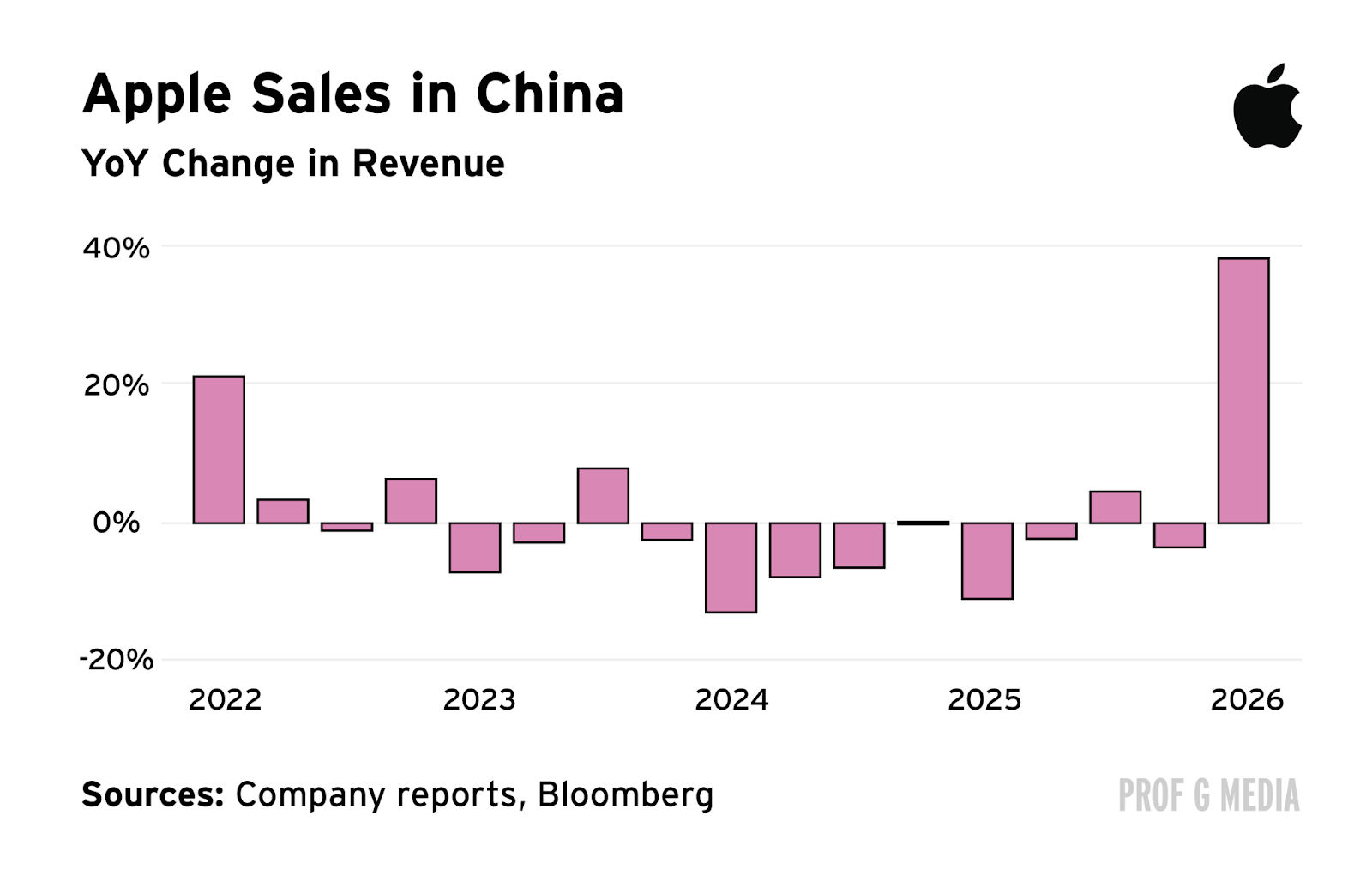
The pressure started earlier this month when the People’s Daily, the official mouthpiece of the Chinese Communist Party, ran an editorial calling Apple’s App Store practices monopolistic. This came just days after Apple announced it would cut its App Store commission for Chinese users from 30% to 25%, dropping below what US users pay. Beijing said it was not enough. Cook’s response at the China Development Forum was carefully worded: a commitment to “collaborating with partners across China,” conspicuously short on specifics.
Apple is not alone. Qualcomm, Texas Instruments, Micron, Broadcom, Tesla, ASML, Volkswagen, BMW, BASF, Siemens, Richemont, and Rio Tinto all derive a significant share of global revenues from China. When Beijing issues an instruction, these companies face the same calculation Apple does: comply, or risk a market that in many cases accounts for 20% or more of total revenue. China still manufactures roughly 80% of Apple’s iPhones, 80% of its iPads, and 55% of its MacBooks.
The deeper problem for Apple is AI. Apple Intelligence, its generative AI product, is not yet available in China, held up by regulatory approval that was delayed further by last summer’s trade disputes. Meanwhile, Chinese competitors like Huawei and Xiaomi are shipping phones with on-device AI already embedded. The iPhone 17’s orange colorway went viral on Chinese social media partly because the word for orange in Mandarin sounds like the word for success, but virality alone will not close the AI gap.
Alice’s Take: The 23% growth number is impressive, but I think it reflects a market that is becoming more stratified. Two years ago I would have said the writing was on the wall for Apple in China. Chinese phones have caught up on hardware, cameras, and now AI. But there still seems to be a segment, probably upper income, for whom an iPhone is a status object, not just a device. The orange phone going viral for its lucky connotation is a great example of how Apple benefits from cultural dynamics it did not engineer. The real risk is what happens when Apple Intelligence finally launches in China and has to compete with Tencent’s and Alibaba’s agentic AI offerings on their home turf. That is the test that will actually tell us whether Apple has a durable future in this market.
James’s Take: The key framing here is not Apple in China, it is China capturing Apple. Beijing has figured out that companies that derive a substantial share of global revenues from China become leverage, and it is using that leverage systematically. The App Store commission cut is a concession. The Tim Cook visit is a concession. The mollifying language at Davos-for-China is a concession. China wants more, and the pattern suggests it will get more. The same dynamic plays out across every major Western company with a big China book. The commercial logic of staying is so strong that each individual concession looks rational, even as the cumulative pattern amounts to a significant loss of corporate sovereignty.
Trump’s Beijing Summit Delay Exposes the Limits of China’s Global Leverage
Trump’s postponement of the Beijing summit with Xi Jinping, which had been expected around April 1, sent a clear signal: Washington still holds the scheduling leverage in the relationship, no matter how much Beijing tries to position itself as a peer superpower. Chinese officials are frustrated. State media, including the Global Times, has been mocking the delay, framing the Iran war as an American-made catastrophe and arguing that the US is now asking the world to help put out a fire it lit.
China’s public stance on Iran has been notably restrained. There has been little vocal criticism of the US campaign in Chinese media, and Beijing has not moved to actively obstruct American military operations. Instead it has sent a special envoy to the Gulf region and signaled interest in a longer-term diplomatic role. Premier Li Qiang used the China Development Forum, China’s version of Davos, to position Beijing as a “harbor of stability” in a world of rising protectionism and “upheavals in the rules-based international order.” He did not mention the United States by name.
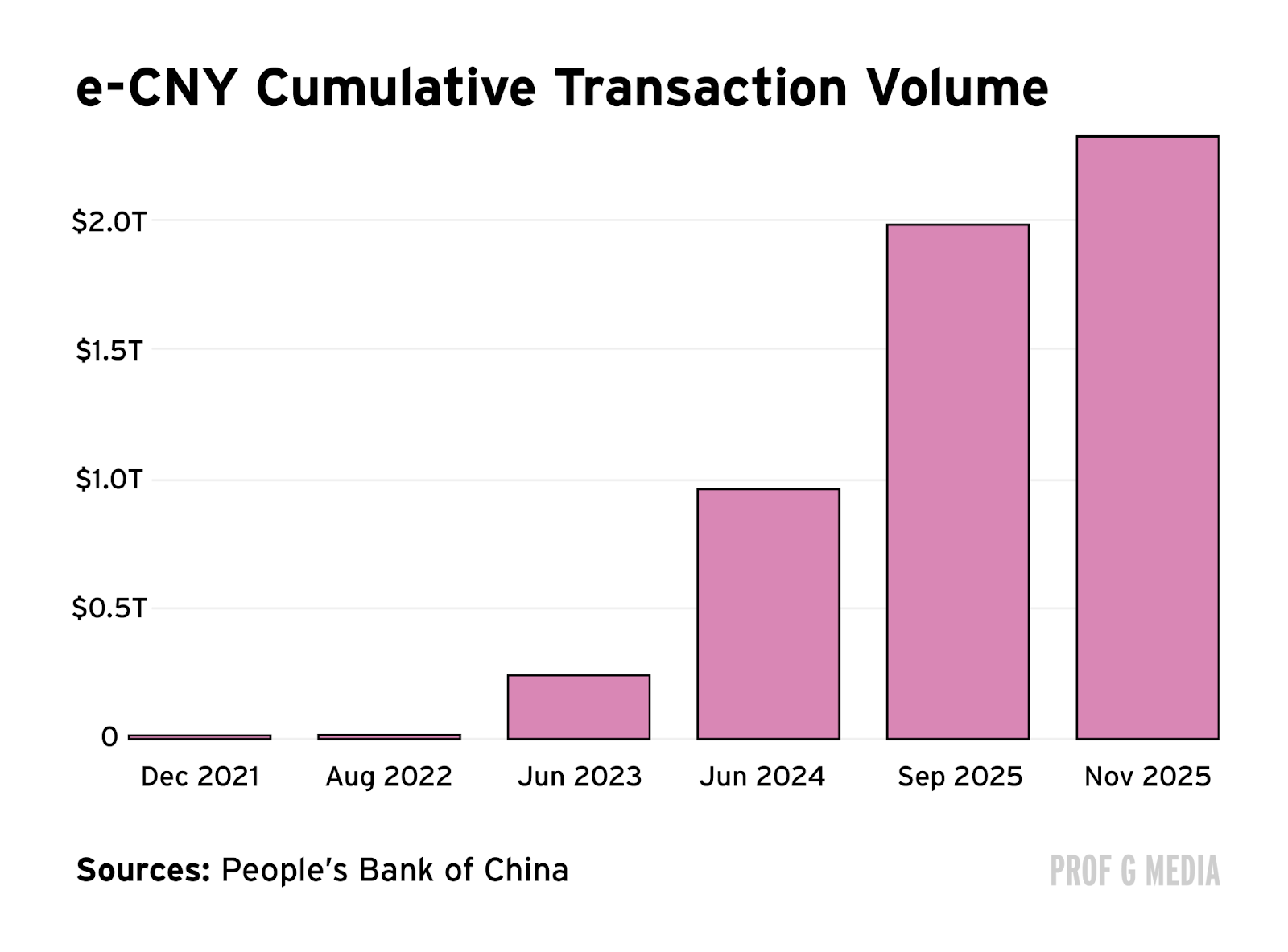
The People's Bank of China governor Pan Gongsheng was less oblique. Speaking at the China Development Forum in Beijing in March 2026, an annual gathering of senior Chinese officials and global business leaders that included Trump administration officials in the audience, he criticized countries whose persistent trade deficits he attributed to an international monetary system "dominated by a single sovereign currency." The context was unmistakable: China wants to accelerate de-dollarization, and the Iran crisis is giving it cover to move faster. Since 2022, China has facilitated a 2,500-fold increase in cross-border digital yuan settlements through central bank bridges with Hong Kong, Thailand, the UAE, and Saudi Arabia, totaling roughly $55 billion, with around 95% denominated in renminbi. CNY currently accounts for about 8% of global trade settlement through SWIFT, and that number is likely to continue to rise.
The geopolitical logic is clear. If oil prices stay north of $100 WTI and the Strait of Hormuz remains disrupted, China pays a real economic price as a major oil importer. But every week the US is bogged down in the Middle East is a week it is not pressing on Taiwan, not tightening technology export controls, and not building coalition pressure on Beijing. The war may be bad for China’s energy balance sheet. It may be good for almost everything else.
Alice’s Take: I want to make one historical comparison that I think captures the moment. What is happening now rhymes with Suez in 1956. Britain and France moved on the Suez Canal without American backing. Eisenhower refused to support them, backed Egypt’s Nasser, and the old imperial order took a decisive blow to its credibility. China today is playing the Eisenhower role: declining to help police a conflict it did not sanction, positioning itself as the neutral party, and waiting to step in as a mediator once the shooting stops. The 2023 Saudi-Iran rapprochement that Beijing brokered gives them real diplomatic credibility to do this. If that is the play, it is a patient and sophisticated one.
James’s Take: China is making propaganda capital from the Iran war, but I would caution against assuming that capital is permanent. If the US manages to restore shipping through the Strait of Hormuz, bring oil prices down, and achieve something that looks like a stable outcome, the pendulum of international opinion could swing back. Trump would get to play statesman. The narrative that the US is a global wrecking ball would weaken. The more interesting long-term question is the one Alice raised on de-dollarization. These are tectonic shifts that move slowly, but when they move, they do not reverse easily. The Gulf states becoming more like Russia in their use of the yuan for trade settlement would be a structural change to the global financial architecture, not a news cycle story.
Inside China’s Museum Boom
China had a handful of museums in 1949. It now has more than 7,000, with roughly 1.5 billion annual visits as of late 2025. A new museum opens approximately every two days. The range is striking: from the Zigong Dinosaur Museum, built directly over the excavation pit where its fossils were found, to a Black Museum dedicated to immersive experiences of mental illness, to a sex museum that relocated from Shanghai to the smaller city of Tongli in Jiangsu province after becoming politically sensitive. There is also a paper airplane museum in Wuhan and a Chinese meme museum for the digital age.
The boom is not accidental. The Chinese state has been deliberate about linking museum expansion to heritage, urban development, tourism, and soft power. State-backed cultural districts now dominate the landscape. Even private and contemporary art spaces operate within a structured ecosystem that shapes which histories get told and how China projects itself abroad. Xi Jinping’s installation of a museum dedicated to his father in Shaanxi, the family’s ancestral village, is the clearest example of how museum-building is also history-making: a curated account of the CCP’s past, including the rehabilitation of figures whose legacies were complicated by the Cultural Revolution.
But the deeper cultural thread is older than the party. China has a millennia-long tradition of collecting. Grave goods, the terracotta army at Xi’an, the imperial collections now split between the Palace Museum in Beijing and the National Palace Museum in Taipei, all reflect a civilization that has long understood physical objects as carriers of history and legitimacy. China’s top collecting power couple, Liu Yichen and Wang Wei, have spent $36 million on a Ming dynasty chicken cup and $45 million on a Tibetan tapestry. There is now even a secondary market for Mao-era badges from the Cultural Revolution, a period many Chinese would rather forget but some are choosing to collect.
Alice’s Take: What strikes me is how deeply this collecting instinct runs in Chinese political culture, not just among private collectors. Wang Qishan famously instructed top Chinese leadership to read history books, including Tocqueville’s Democracy in America. Xi’s own obsession with historical legitimacy runs through everything from the museum dedicated to his father to the rhetoric around China’s “century of humiliation” and its reversal. The museums being built now are not neutral archives. They are arguments. The question of what gets included, what gets airbrushed, and who controls the framing matters enormously for how the next generation of Chinese understand their country’s place in the world.
James’s Take: There is a George Orwell line from 1984 that applies here: he who controls the past controls the future. That sits alongside the traditional Chinese expression, examine the past to understand the present. Both are valid simultaneously, which is what makes this topic so rich. The collecting culture is genuine and deep. The state’s use of that culture for ideological purposes is also real. They are not in contradiction. The money side is also worth noting. This is a massive and growing art market. The secondary market for Chinese antiques, contemporary Chinese art, and even Cultural Revolution memorabilia is significant and not well understood in the West.
Newsletter Exclusive: China Wants You To Go To Therapy. Just Don’t Talk About It
China has a mental health crisis it is trying to treat with one hand and censor with the other.. A 2024 meta-analysis of nearly 1.5 million Chinese children and adolescents found that 1 in 4 showed symptoms of depression. That is higher than the US, where about 1 in 5 teenagers reported a major depressive episode the same year.
Among high school students preparing for the gaokao, the national college entrance exam, depression and anxiety rates are significantly higher than in younger students. Students in gaokao-track schools average 11.2 hours of study per day. Suicide rates for children between the ages of five and 14 have increased more than 5x since 2010.
The structural causes are well understood. The gaokao remains the single most consequential event in a young Chinese person’s life, routing them into a tier of university that largely determines their economic trajectory. Youth unemployment hit 18.8% in August 2025, the highest since records began, with other estimates placing the real figure above 25%. Young people who fought through the gaokao grind and graduated into a contracting job market have a phrase for what they feel: neijuan, or involution, the sensation of being trapped in an unwinnable competition. The counter-culture responses have their own vocabulary: tang ping, lying flat; bai lan, letting it rot; and runxue, the study of how to emigrate.
The government’s official response to all of this has been to invest in mental health infrastructure. In January 2025, China’s National Health Commission designated 2025 to 2027 the “Years of Pediatric and Mental Health Services,” committing to expand the professional workforce, improve standards, and build more specialized centers. A nationwide 12356 mental health hotline has been rolled out across 18 provinces. The therapy app market has grown significantly, with platforms like Jiandan Xinli and Know Yourself attracting millions of users and substantial venture capital. Private psychiatric hospitals now outnumber government-run facilities.
But in September 2025, the Cyberspace Administration of China issued new guidelines ordering platforms including Weibo, Douyin, Xiaohongshu, Bilibili, and WeChat to detect and remove content that “deliberately amplifies pessimistic, depressed, or anxious moods.” Platforms must deploy AI filters and human reviewers around the clock. First-time violators face account suspension; repeat offenders face permanent bans or fines of up to 100,000 yuan. Within a week of the crackdown, four prominent influencers with tens of millions of followers combined were banned and their archives wiped. Hashtags like #LyingFlat and #CantAffordToHaveKids, which had accumulated billions of views, disappeared overnight. The censorship went further than topics: phrases like “the economy is bad” or “I am tired” began triggering shadow-bans. In February 2026, the CAC went further still, mandating that platforms remove content deemed to spread “fear of marriage” or “anxiety about childbirth.”
Therapy is politically useful to the Chinese state precisely because it individualizes problems that are structurally caused. A young person in therapy is working on themselves. A young person on Xiaohongshu telling millions of followers they cannot afford to get married or have children is doing something else entirely. The government wants citizens to process their despair quietly and privately, not to aggregate it publicly into a legible critique of economic policy, the education system, or the housing market.
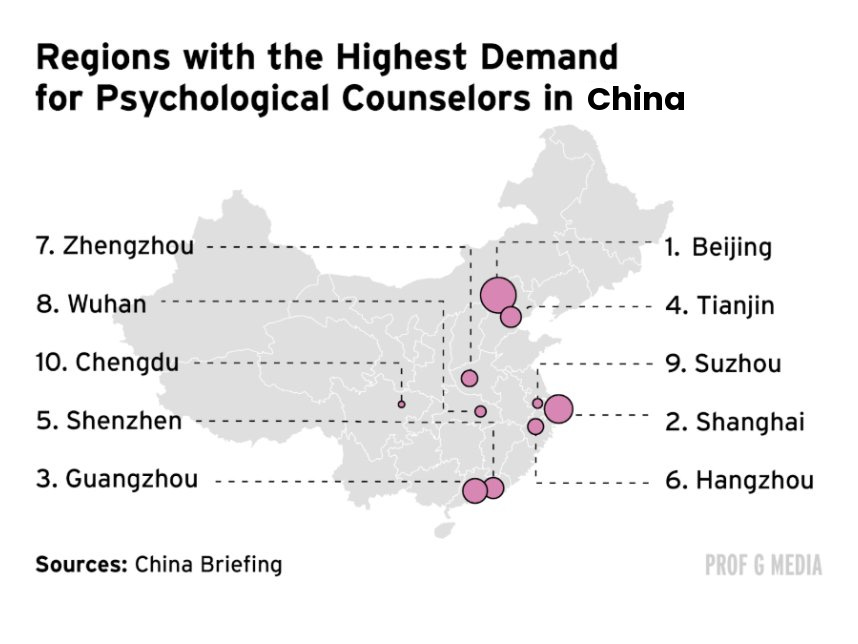
The therapy boom and the censorship crackdown are not in tension. They are two sides of the same governing strategy.
James’s Prediction: China will eventually step out from behind the scenes on both the Iran and Ukraine conflicts and take a visible mediating role. It will position itself as the peacemaker, and it will use that positioning to secure infrastructure and reconstruction investment opportunities in both countries once the fighting stops. The after-game is already being planned in Beijing.
Alice’s Prediction: China will be the first country to achieve mass adoption of agentic AI in everyday life. Not because of any single breakthrough, but because Alibaba and Tencent’s super app ecosystems already have the infrastructure for an AI personal assistant embedded in daily routines: booking travel, managing schedules, texting, dating advice, financial planning. The Tencent agentic AI announcement was disappointing, but the direction is clear. Within two years, China will be ahead of the West on how deeply AI agents are woven into ordinary life.
This newsletter is also very interesting. I would only add that the formatting could be more similar to that of the Prof G Markets Newsletter (with colors, photos, etc.). That would make it more visually compelling