



TL;DR
China’s Geopolitical Gains and Economic Losses
What’s Next for Taiwan After Rare Talks in Beijing
China is Back in President Trump’s Firing Line
China reportedly played a key role in pushing Iran to accept a ceasefire with the U.S., scoring diplomatic points and strengthening its status as a regional mediator and peacemaker. Even President Trump gave China credit for nudging Iran to the negotiating table. But after talks aimed at permanently ending the war failed to reach a resolution, the situation for China is far more complex. The U.S. military earlier this week started a blockade of Iranian ports in an effort to force Tehran to open the Strait of Hormuz and accept a deal to end the conflict, and Iran threatened to retaliate, casting doubt on the fragile ceasefire.
Following reports Beijing is preparing to deliver new air defense systems to Iran, Trump threatened to impose a 50% tariff on countries supplying Iran with weapons. Further inflaming tensions, an investigation by the FT found that Iran secretly acquired a Chinese spy satellite that allowed the Islamic republic to target American military bases across the Middle East. China has denied claims by U.S. intelligence that it might have shipped arms to Iran and criticized the U.S. blockade as a “dangerous and irresponsible act.” This comes as Trump and Chinese leader Xi Jinping prepare to meet in Beijing next month for a high-stakes summit.
James’s Take: The main takeaway is that China is moving back into America’s crosshairs. We’ve discussed in recent days how China can emerge as a winner from the Iran turmoil, but it’s increasingly clear what China also stands to lose. As the primary importer of Iranian oil, China is hit harder than any other country by the U.S. effort to cut off those supplies. Even though China is well-positioned to withstand the economic pain — only 6% of its energy consumption depends on imports from the Gulf — it still stings.
What’s more important is China’s military relationship with Iran amid reports citing U.S. intelligence that China is getting ready to deliver new air defense systems to Iran within the next few weeks. A spokesman for China’s embassy to the U.S. strongly denied that his government had shipped missiles to Iran during the war. Other reports suggested a Chinese company’s publication of AI-enhanced satellite images of U.S. bases in the Middle East is helping Iranian forces identify targets. It’s no secret that China has sold arms to Iran in the past, with support in recent years flowing to its ally in the form of components that could be used in both civilian technologies as well as missiles and drones. The critical question is whether military aid has arrived since the war in Iran erupted at the end of February.
Given the twists and turns in this conflict over the past several weeks, don’t be surprised if China returns to its important diplomatic role behind the scenes in a bid to ease the friction. The U.S. and Iran may arrange a second round of peace talks in the coming days. But with Trump warning that imports from countries supplying Iran with military weapons will face immediate 50% tariffs — with no exemptions — the temperature is rising.
Alice’s Take: Hopes for a summit in Beijing between Trump and Xi Jinping next month and improved U.S.-China relations are dimming. The latest developments surrounding the conflict in Iran and the questions over China’s potential military support for its closest strategic partner in the Middle East deal a blow to trade discussions, putting China back in Washington’s firing line and threatening to destabilize an emerging detente.
I’d point to a recent Atlantic Council report, which explored how China enables both Iran and Russia by importing their sanctioned oil and selling them sophisticated dual-use technology. The research institute describes a network of U.S. adversaries, or an “Axis of Evasion,” that bypasses Western sanctions through supply chains, allowing Iran to develop drones, navigation systems and other military capabilities. The authors argued that Trump will need to confront Xi and Putin about their support for the Iranian regime to end the war.
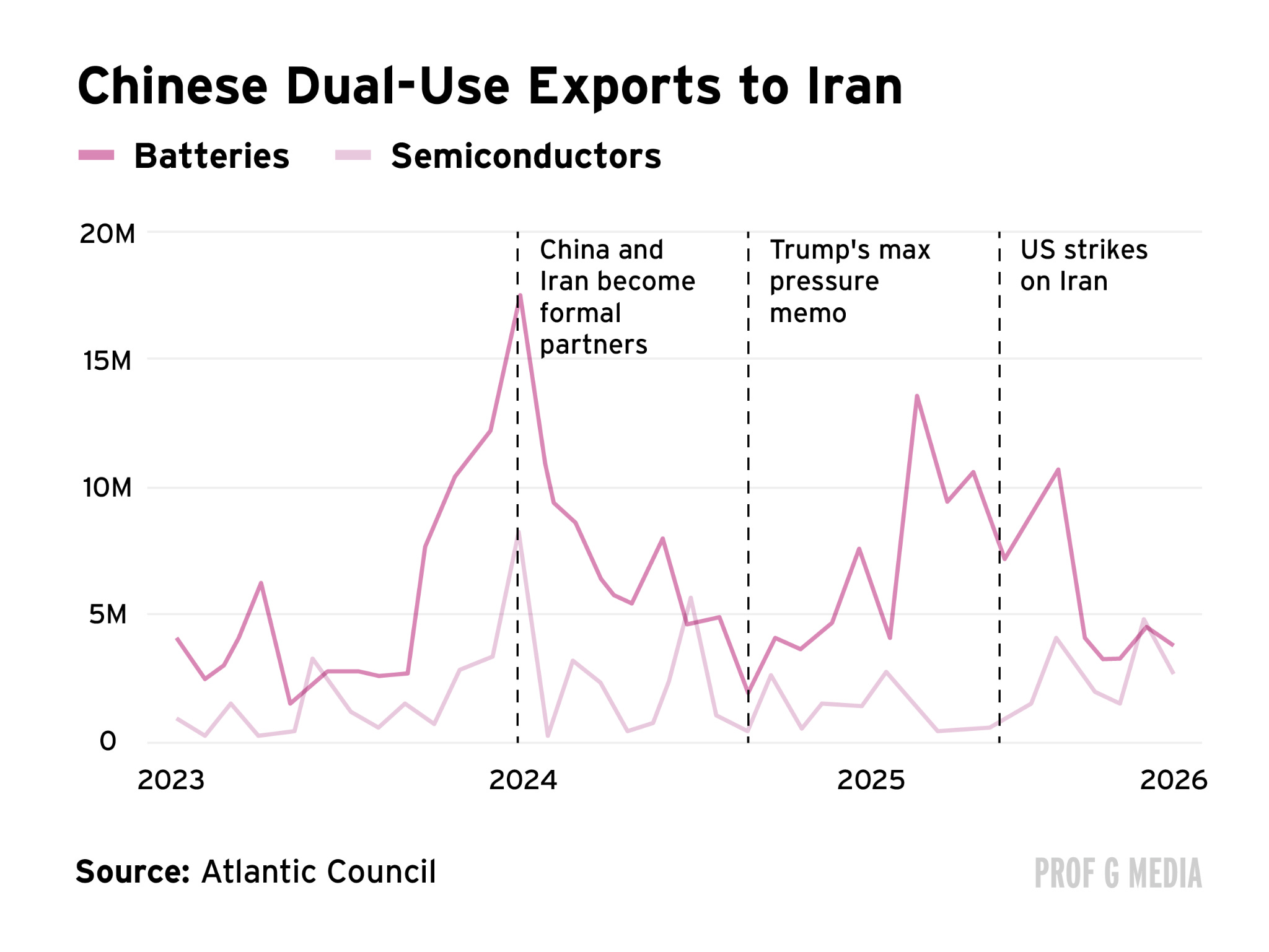
If Trump is worried about China being in the same camp as Iran and Russia, it doesn’t bode well for his ties with Xi. Still, it’s in China’s interests for the Strait of Hormuz to be opened as soon as possible. While China may gain geopolitically from the upheaval Trump has triggered, it will suffer at home economically if the war in the Middle East drags on.
Are Talks With Taiwan Opposition Leader a Sideshow or Significant Moment?
A meeting in Beijing between the leader of Taiwan’s main opposition leader, Cheng Li-wun, and China’s Xi Jinping — the first such visit in a decade — raises intriguing questions. We turned to Eyck Freymann for answers. The Hoover Fellow at Stanford University and author of a new book, Defending Taiwan, A Strategy to Prevent War With China, told us Xi sees it as a prime opportunity to drive a wedge between the U.S. and Taiwan and encourage a more friendly Kuomintang (KMT) political party in the lead-up to Taiwan’s 2028 presidential election.
First, what happens if the KMT wins? According to Freymann, Xi would be happy to negotiate, but this time he’d do so with more leverage. China still lacks confidence that an invasion of Taiwan would succeed, despite building up its military capabilities and America shifting its focus to the Middle East, he says. As a result, diplomacy remains the preferred way to achieve what Xi calls reunification. China’s leader doesn’t care if it’s democratically acceptable. He wants to put Taiwan in a position where it has no choice. What he will likely offer is akin to what was presented to Hong Kong: one country, two systems. If Taiwan accepts, they can maintain self-government and control over economic affairs and perhaps gain subsidized energy and other benefits. But Taiwan also knows what this means: If it steps out of line, China will seize the opportunity to bring the hammer down. Taiwan will capitulate only if it has nowhere to turn.
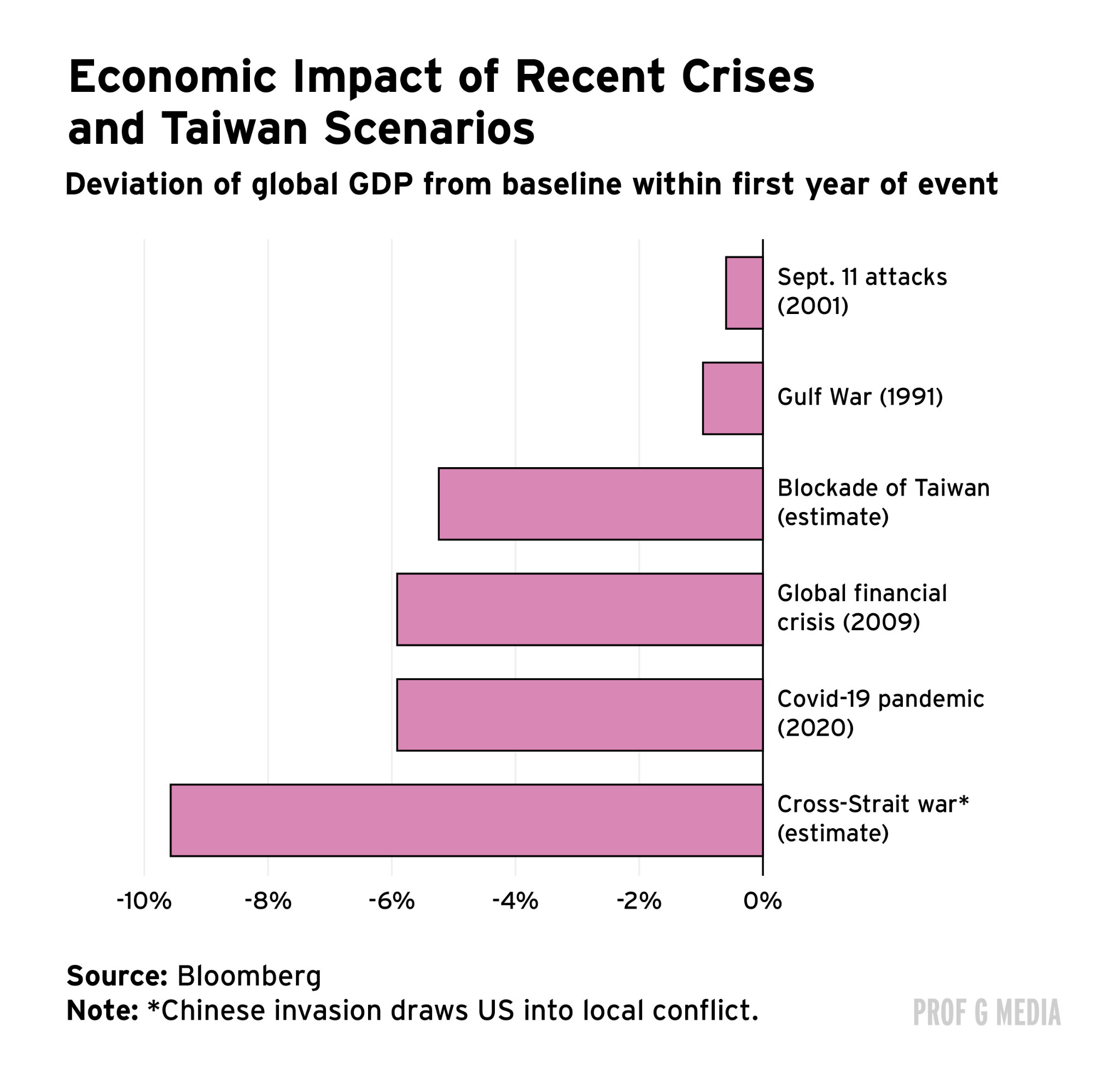
One of the main questions we’re asked is whether China will invade Taiwan. Freymann walked us through the different paths that China could take. Xi has a menu of options the country could implement, either simultaneously or sequentially. An amphibious invasion is plausible given the overwhelming size of China’s military, he says, but China recognizes that many things could go wrong. Other possibilities include launching missile, drone, cyber or false-flag attacks, squeezing Taiwan economically, or taking gradual steps to erode Taiwan’s morale.
The stakes are immense. Bloomberg Economics analyzed five potential scenarios for how tensions in the Taiwan Strait could play out, from war to rapprochement. In the most extreme case, a U.S.-China conflict over Taiwan would cost the global economy $10.6 trillion, about 9.6% of global GDP, in the first year alone, surpassing the impact of the Covid-19 pandemic.
Freymann argues that the U.S. should deter a crisis, not just a war. That means showing China it can respond proportionately to Xi’s steps along the road to war, while also showing restraint, “a delicate” balancing act. If China invades Taiwan and stops its chip exports to U.S. companies, it would be devastating for the American economy, with China potentially seizing leadership in AI. That would lead not only to a recession but a Lehman Brothers-like moment, he says. With Taiwan making about 90% of the world’s high-end computer chips, the economic shock could occur before any bullets and missiles fly. That means we need to prepare now.
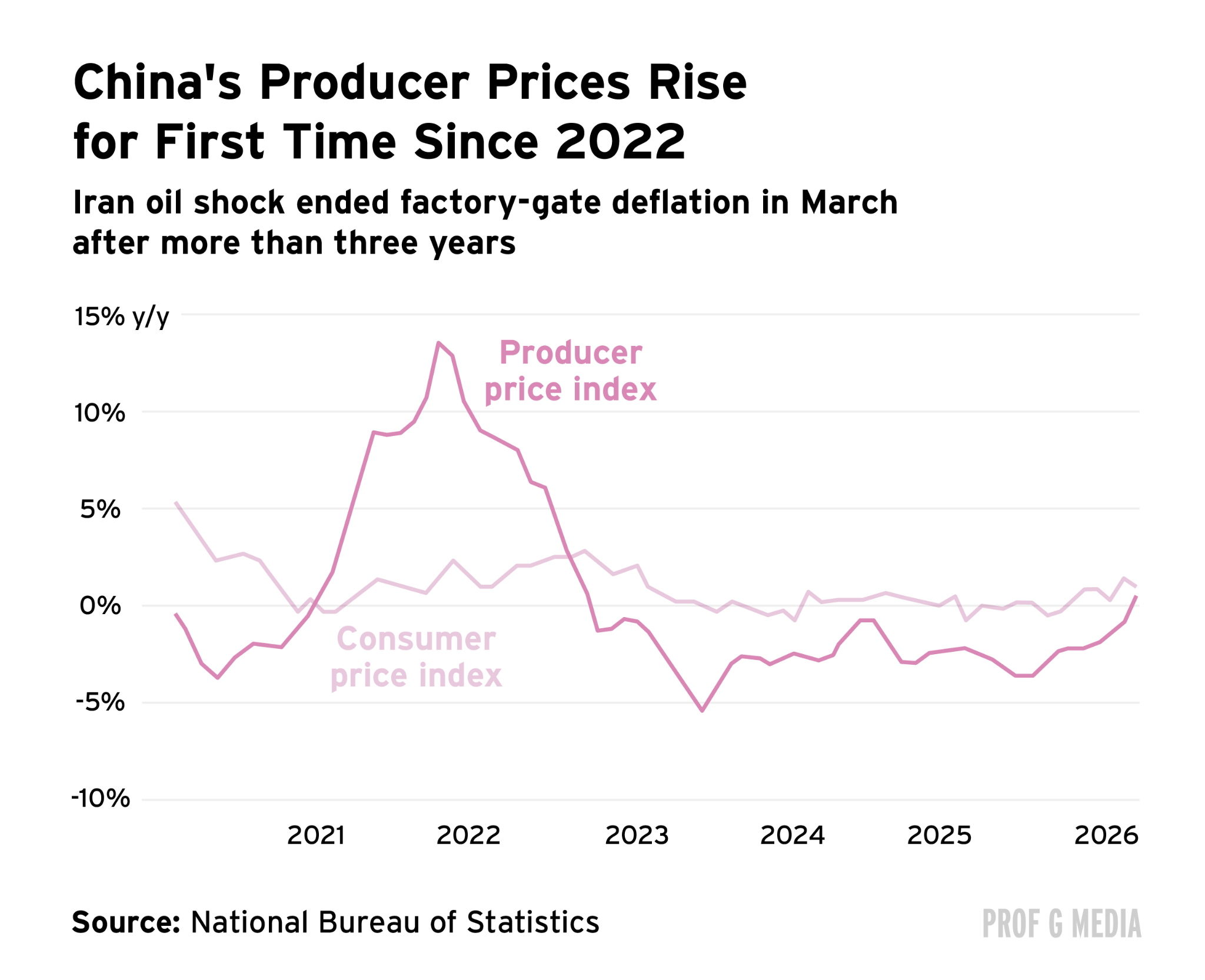
Alice’s Prediction: China’s producer price index last month rose for the first time since 2022 as the war in Iran boosted energy costs. While China’s consumer inflation slowed in March, more than three years of factory deflation came to an end. Producer prices rose 0.5% from a year earlier after a decline of 0.9% in the prior month. If this trend persists, it will eat into the profitability of Chinese manufacturers, some of which won’t be able to pass on the costs. Inflation driven by higher oil prices rather than strengthening demand is not what China wants.
China, meanwhile, has effectively banned exports of diesel, jet fuel, and fertilizers as it tries to preserve energy and food reserves. If the conflict in the Middle East continues and the blockade is sustained, China will probably expand the list to plastics, additional petrochemicals and other goods, doubling down on controlling supply chains and protecting the domestic market.
James’s Prediction: Japan’s automotive industry is on the brink of survival. That’s the stark warning issued by Honda Motor’s Chief Executive Officer Toshihiro Mibe at a recent industry event. Mibe, whose company has warned of its first annual loss since going public in the 1950s, walked into a car part supplier in Shanghai keen to check out the highly automated facility and walked out with an unsettling assessment: The Japanese company has “no chance” to compete due to the cost, speed, and quality advantages of Chinese EV makers. My first thought: What took you so long? We’ve been talking about China’s EV edge for months. I have a forecast of my own: This year at least one Japanese auto maker will experience a major shock — a collapse in its share price, a sale at a fire-sale price, or another shakeup.