



TL;DR
Why China Is Caught in the Middle at the Strait of Hormuz
Beijing’s Cautious New Five-Year Plan
Newsletter Exclusive: China’s Baby Problem, and the Billionaire Trying to Fix It
China is Caught in the Middle at the Strait of Hormuz
The war in Iran is squeezing the world’s most critical energy chokepoint. Tanker traffic through the Strait of Hormuz has plunged as attacks on ships and energy infrastructure escalate, leaving hundreds of vessels stranded and oil prices surging. Roughly 20 million barrels pass through the strait every single day, nearly three times Russia’s total export volume. When global oil markets panicked at the start of the Ukraine war, that was a problem a third the size of what we are looking at now.
China gets roughly 40% of its oil through the strait, and is pressing Tehran to allow safe passage for its ships. For now it appears to be working: Iranian forces don’t dare fire on Chinese vessels. But that’s a fragile arrangement, not a structural fix. There are simply no viable alternatives to Hormuz. Pipelines and other routes cannot replace the volume moving through that narrow waterway, leaving the global economy entirely dependent on a single corridor that is currently in the middle of a war.
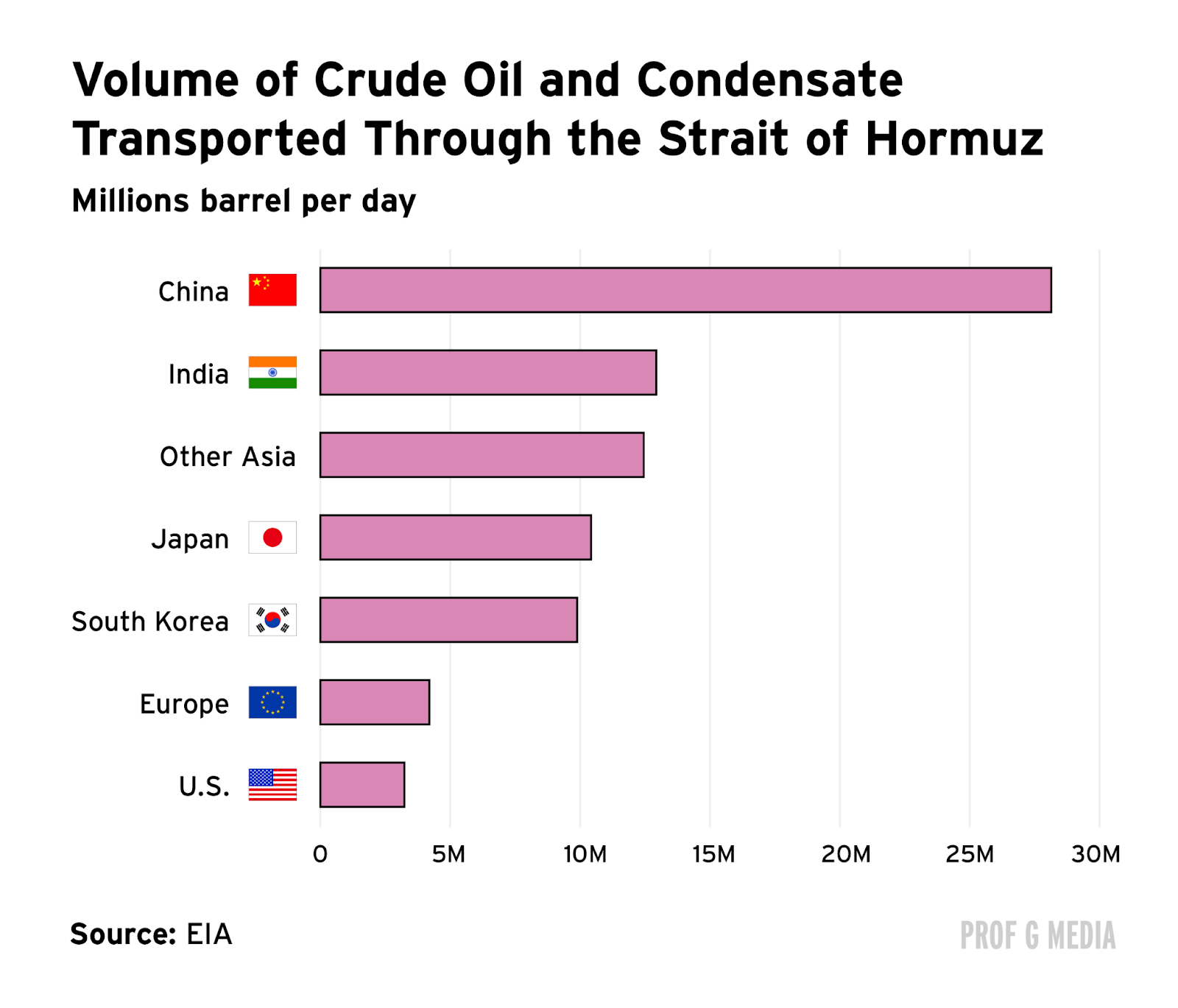
Markets are already registering the shock. Brent and WTI crude both surged more than 20% before pulling back. Chinese energy majors like CNOOC and China Shenhua closed up over 3%, while property companies sold off on fears that inflation could delay rate cuts. Some analysts are warning that Brent could climb from $100 toward $150 in short order, which would make this one of the largest collapses in affordable global oil supply in recorded history, worse than either of the 1970s shocks.
Alice’s Take: What makes this moment so interesting geopolitically is that China is simultaneously a victim of the Hormuz disruption and one of the few countries with real leverage over it. Beijing has been notably quiet in its criticism of the US and Israel, and for good reason: it wants to position itself as the stable actor in an increasingly chaotic situation of America’s own making. It has roughly three to four months of strategic oil reserves, which gives it runway to watch and wait.
But here is the question I keep coming back to: could we see the US quietly ask China for convoy assistance? It happened before. In 1987, during the Iran-Iraq war, the US and Soviet navies cooperated to escort oil tankers safely through this same strait. Secretary Bessent is meeting Vice Premier He Lifeng in Paris in the coming days, and Trump’s trip to China is expected in early April. History says that kind of cooperation is possible, but asking Xi for help after the tariff standoff and the Supreme Court striking down some of those measures is a very different dynamic. China holds more leverage in this negotiation than it did at the start of the year, and I don’t think Washington has fully reckoned with that yet.
James’s Take: This disruption is three times the scale of what triggered the oil market panic at the start of the Ukraine war, and the knock-on effects are compounding. Rising oil prices feed inflation. Inflation threatens higher interest rates. Higher rates hammer debt servicing costs. China carries a debt-to-GDP ratio of around 340%, so there is no clean escape from this crisis regardless of its diplomatic positioning.
The core question is whether US military action produces regime change quickly and restores stability. If it does, Washington wins. If it doesn’t, which is where things appear to be heading, China emerges by comparison as the more dependable superpower, even as it absorbs real economic pain. The West’s deeper problem is that we are making calculations about a war zone we barely understand, with no meaningful influence over the country at the center of it, while Beijing holds the one relationship that actually matters in Tehran.
Beijing’s Cautious New Five-Year Plan
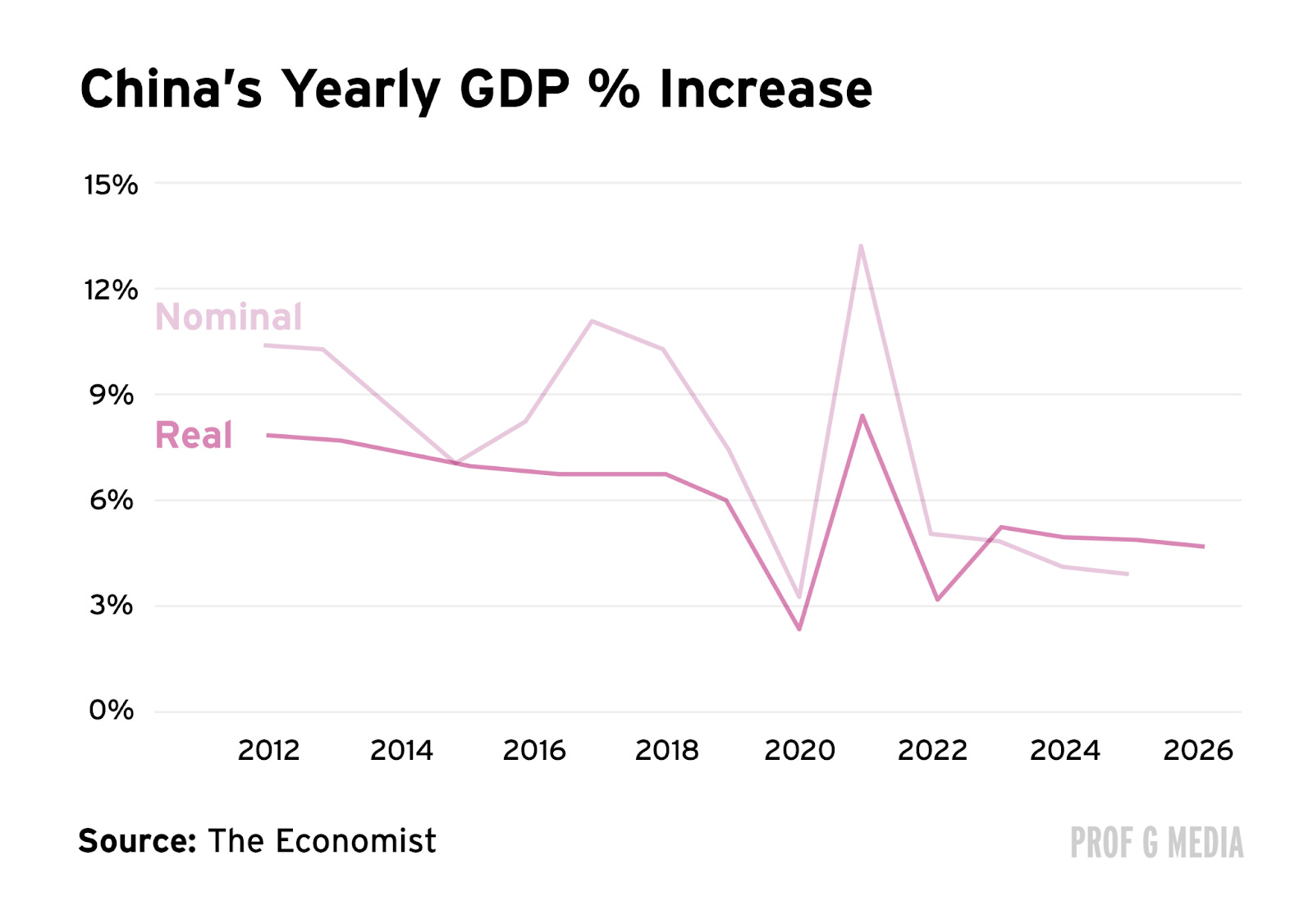
Beijing quietly laid out its economic roadmap for the next five years this week. Premier Li Qiang delivered the government work report setting a growth target of 4.5 to 5% for 2026, the lowest since 1991. That number is a deliberate signal: Beijing is not trying to overheat a fragile economy. It is preparing for slower, more uncertain global conditions and betting that targeted investment beats the blunt instrument of infrastructure-led stimulus.
Two new financing instruments define the approach. The national venture capital guidance fund, formally approved last December, is designed to act as a public-private angel investor for early-stage tech companies, pairing state-backed capital with private VCs to direct money toward genuine innovation rather than prestige projects. Alongside it, an additional 800 billion yuan financing instrument was introduced specifically to stimulate private investment in AI, the digital economy, and consumption.
The broader ambition of the 15th Five-Year Plan is hard to miss: AI was mentioned 373% more than in the previous plan, the single largest increase of any word in the entire document, with a stated goal of deploying AI across 90% of the Chinese economy by 2030.
Running through every section of the plan is one word: self-reliance. Technological self-reliance. Energy self-reliance. Supply chain resilience across semiconductors, advanced materials, software, and biotech. Beijing is explicit that it wants to ease China off every chokehold the West holds over it, while simultaneously asserting its own chokepoints over the rest of the world.
Alice’s Take: My biggest takeaway is that there was more seriousness around consumption than I expected. A larger share of the special treasury bond issuance was directed toward consumption-boosting programs, which is a genuine shift from the infrastructure-heavy playbook of the past decade. Whether the fiscal multiplier is strong enough to move the needle on growth remains to be seen, but the intent is real.
One thing worth flagging: a little inflation from Hormuz-driven energy prices might actually be welcome in Beijing right now. China has been fighting deflationary pressure for the better part of two years, and energy prices nudging CPI toward 1.5% would not alarm the PBOC. It might even give the economy some warmth it badly needs. That connection between the two stories this week matters. China is structurally vulnerable on energy, and this plan is a serious attempt to do something about that over the next five years.
James’s Take: I have been describing China as a techno-authoritarian superpower for about a decade. After reading the 15th Five-Year Plan, I think that descriptor needs updating: China is now an AI-animated, techno-authoritarian superpower. The plan is not just about building more technology. It is about using AI to enforce the authoritarian model more effectively, accelerate productivity to offset a rapidly aging population, and achieve the kind of self-sufficiency that makes Western pressure progressively less relevant. Five years from now, if this plan works, China wants to be in a position where a crisis like the Hormuz disruption barely registers domestically because it no longer depends on anyone else for what it needs. That is the ambition. Whether execution matches it is another question entirely, and China’s track record on translating plans into outcomes is genuinely mixed. But the direction is unmistakable, and I don’t think the West has begun to seriously grapple with what it means.
Newsletter Exclusive: Can China Buy Its Way Out of a Baby Crisis?
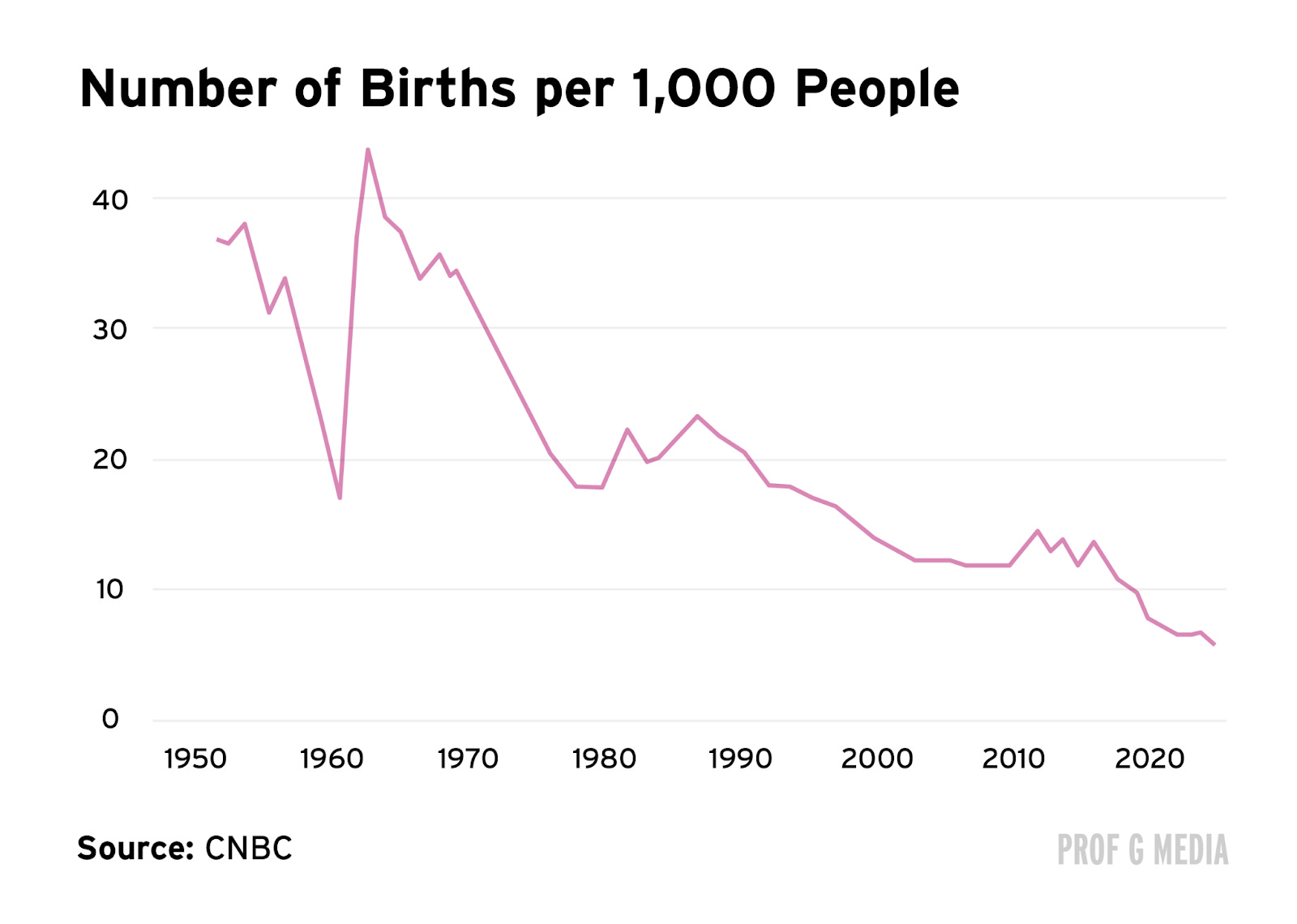
China just recorded its lowest birth rate since the founding of the People’s Republic. In 2025, only 8 million babies were born, down 17% from the year before, erasing the brief Dragon Year bounce of 2024 entirely. The population shrank for the fourth year in a row. There are now 323 million people over 60, 23% of the total population, and that share keeps rising as the working-age population shrinks. The UN projects China could lose 786 million people by the end of the century.
James Liang, co-founder of Trip.com, Stanford PhD, and Peking University economics professor, has spent a decade as China’s most prominent public intellectual on demography. His core argument is that population decline is not just a pension problem, it is a creativity problem. Aging societies become gerontocracies: hierarchical, risk-averse, and culturally stagnant. In 2023, he committed 1 billion yuan to a childcare subsidy fund for Trip.com’s 32,000 employees. Last November he went further, launching the HK$500 million Genovation Foundation in Hong Kong, with grants for PhD students who have children and an annual global forum on declining birth rates.
The Chinese government has also finally stepped in directly. In 2025 it introduced a national childcare subsidy of 3,600 yuan per year for every child under three, started taxing contraception, and added daycares and matchmaking services to the tax exemption list. Some cities have gone much further, with Hohhot offering families up to 100,000 yuan for a second or third child.
None of it is working, and the evidence from comparable countries suggests it probably won’t. South Korea has spent decades on generous subsidies and extended parental leave. Its birth rate remains the lowest in the world. The deeper issue is structural, and it falls disproportionately on women. In China, women face a genuine career penalty for having children: demotion, wage cuts, and in some cases dismissal. Housing costs are prohibitive, education competition is ferocious, and a generation raised under the one-child policy has internalized small families as the cultural norm. There is also a darker irony not lost on China’s millennials and Gen Z: the government spent 35 years fining and coercing people for having too many children. Trust, once destroyed at that scale, is not rebuilt with an annual subsidy.
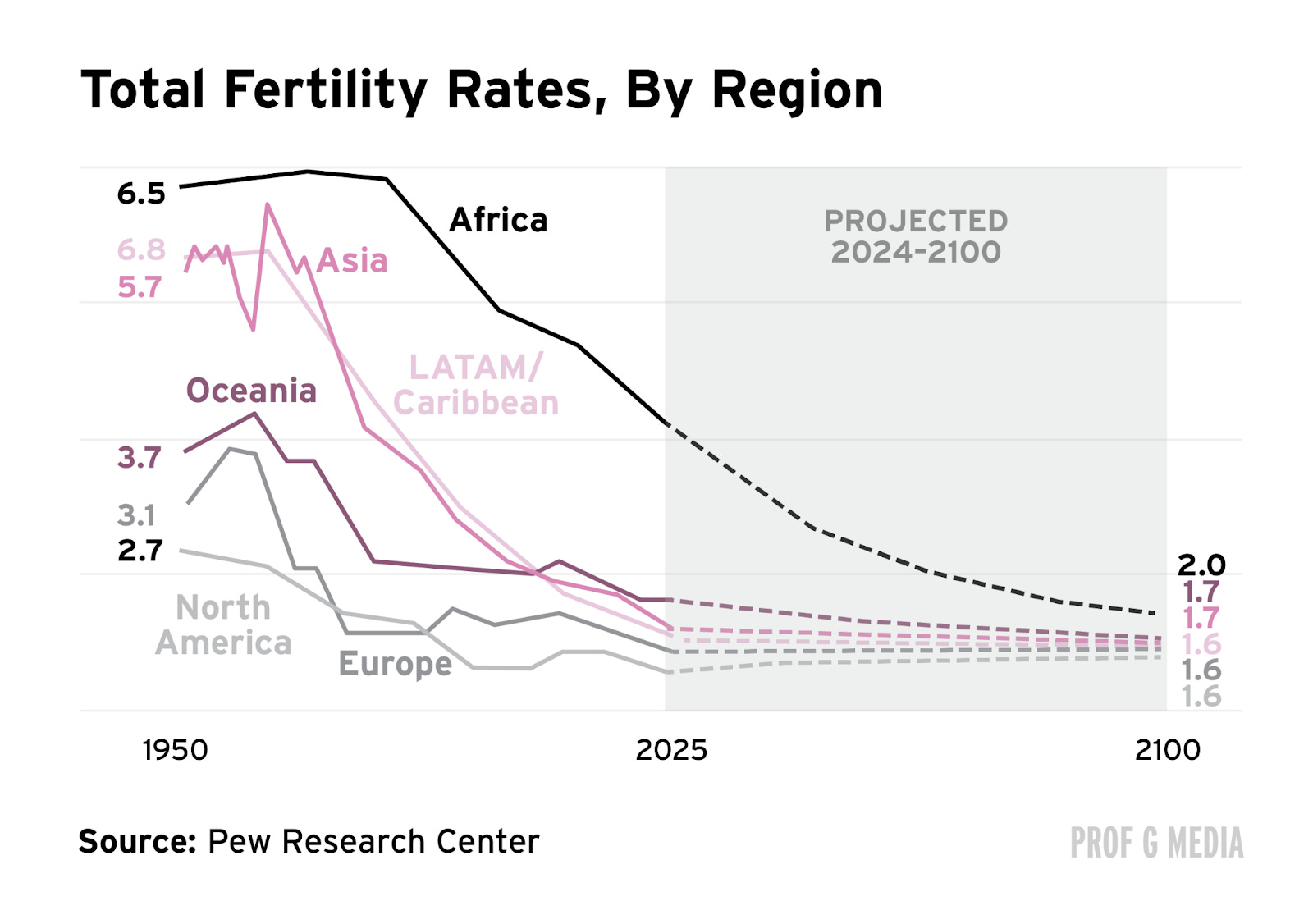
America would do well to pay attention. The US fertility rate has fallen to around 1.6, well below the replacement level of 2.1, and the same structural forces are at work: unaffordable housing, a labor market that penalizes women, and a generation deeply skeptical about the future. The difference is that America still has immigration as a pressure valve, something China does not. But if Washington closes that valve while failing to fix the conditions that make raising a family feel impossible, it will find itself staring at the same chart Beijing is staring at now, just a decade behind.
Predictions:
Alice’s Prediction: Watch the Besant-He Lifeng meeting in Paris closely. The trade talks have been moving quietly in the background, but the Hormuz crisis has handed China new leverage and Washington is not negotiating from a position of strength heading into Trump’s Beijing trip. If anything substantive comes out of Paris, it will set the tone for everything that follows in April.
James’s Prediction: 2026 will be a landmark year for the EU toughening its posture on Chinese technology. We are going to see the European Commission expand restrictions to Chinese cars, cellular modules, wind farms, and other sectors where Chinese companies are collecting data across Europe. Brussels has been watching Washington’s approach and concluded it needs its own framework, one that is not built around billionaire deal-making.