



China-Russia Ties Are Strong, Even if Gas Link Remains Elusive
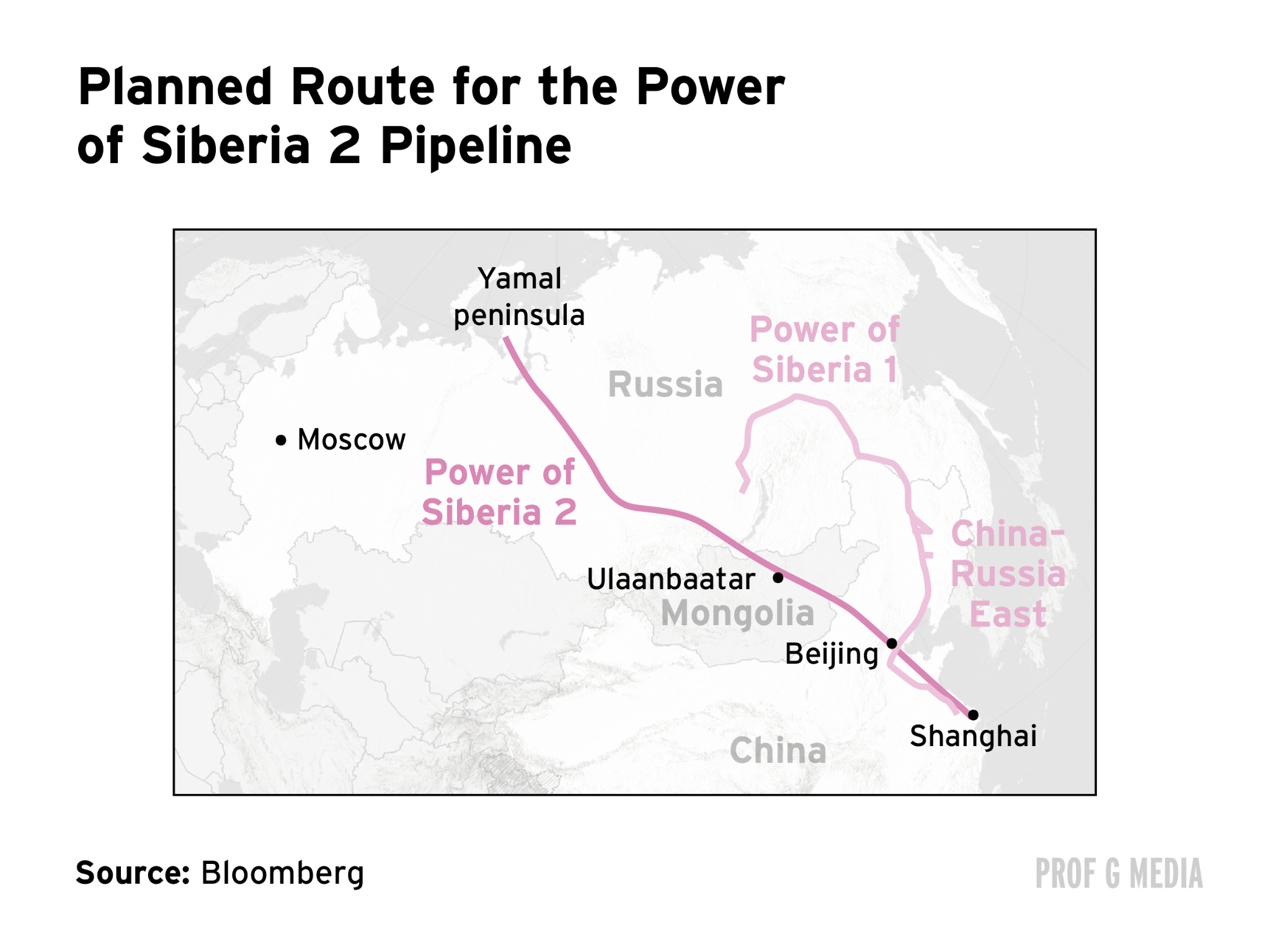
Just days after hosting Donald Trump, China’s leader, Xi Jinping, rolled out the red carpet again, this time for his Russian counterpart, Vladimir Putin. The meeting — Putin’s 25th visit to Beijing — focused on the Power of Siberia 2 pipeline, a long-stalled project that would more than double Russia’s gas exports to China.
The countries failed to clinch a deal on the 2,600-kilometer (1,616-mile) link between the gas fields of western Siberia and China’s industrial heartland — the Kremlin said they had reached a “general understanding.” But the bond between the two powers continues to deepen. Xi emphasized the importance of collaborating on energy and technology, including AI, declaring that bilateral relations are at “their highest level in history.”
While Russia’s economy remains heavily reliant on China, with gas sales to Europe largely cut off due to the war in Ukraine, the oil shortage triggered by the conflict in Iran has improved Russia’s hand as an energy supplier to China.
James’ Take: This is the axis of authoritarianism in action. Since Russia’s invasion of Ukraine in 2022, the country has moved closer to China diplomatically, economically — and militarily. This is the most consequential geopolitical shift we’ve seen over the last decade.
China was a U.S. rival before Russia invaded Ukraine. When you combine China and Russia, the second- and ninth-biggest economies in the world and two nuclear powers, you get a much more formidable adversary. Xi and Putin have issued increasingly explicit joint communiques in opposition to U.S. foreign policy, and they didn’t hold back in their latest statement. The two leaders condemned the “irresponsible” policies of the U.S. and warned of a return to “the law of the jungle,” clear references to American military action in Iran and Venezuela.
Turning to the pipeline, it would be a monster if it’s built. China would be the buyer of up to 50% of Russia’s exports of natural gas, equivalent to what Russia was sending to Europe before the war. And Western sanctions haven’t stopped the flow of Chinese goods into Russia.
Alice’s Take: The two leaders clearly have genuine respect for each other. While their bond has strengthened, so have the economic ties between their countries. Trade between China and Russia roughly doubled between 2020 and 2024, mainly driven by oil and gas. China has increased its imports of Russian oil by 35%, making Russia its largest single-country source of crude. Meanwhile, Chinese exports of semiconductors, vehicles, and “dual-use” components and materials are flowing into Russia. This is Kissinger’s nightmare: Russia and China moving toward each other rather than the U.S. getting closer to Russia and China individually.
The leaders may deeply admire each other. But the main factor stalling the project — which complements the existing Power of Siberia 1 project — is a disagreement over price. Reports suggest China is pushing for prices roughly half of what Russia was expecting. And China has the upper hand. Ultimately, there are limits to Xi and Putin’s “no limits partnership.”
China Cuts US Treasuries to Lowest Level Since 2008
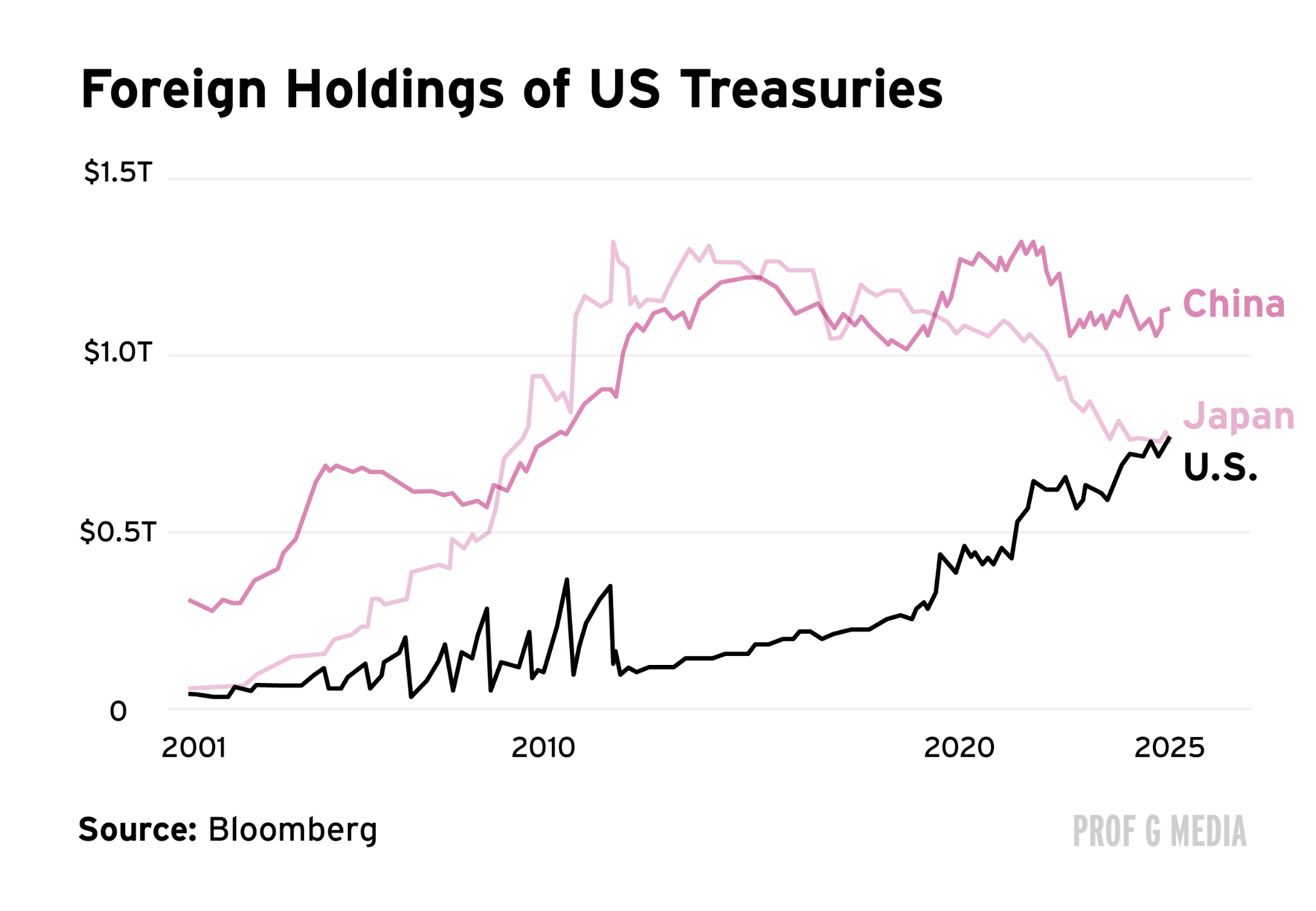
The war in Iran has sparked a sell-off in U.S. Treasuries, with China and Japan leading the retreat as countries defend against the energy shock. China, which has gradually lowered its exposure to Treasuries in recent years, cut its holdings in March to the lowest level since 2008.
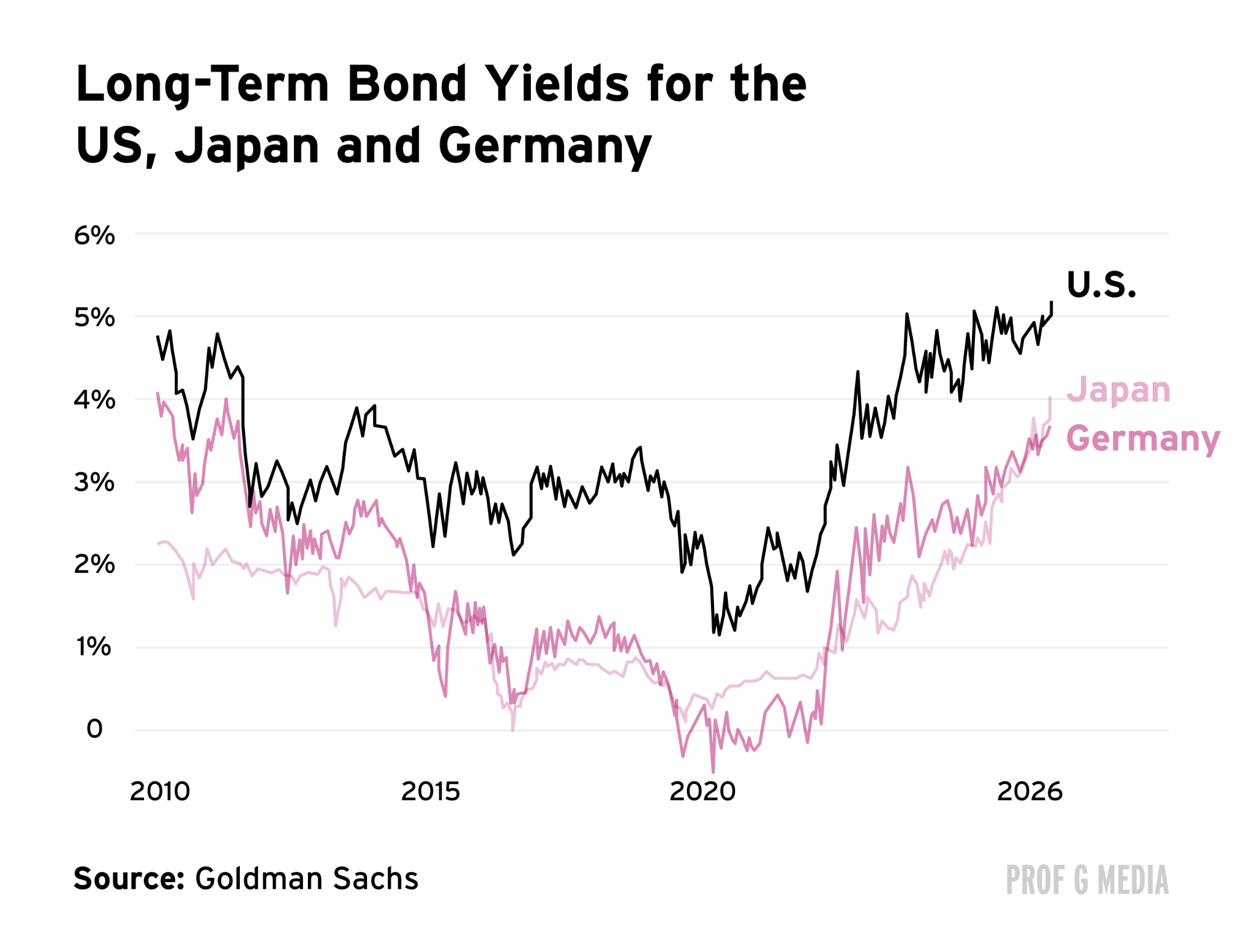
At the same time, the 30-year U.S. Treasury yield reached 5.2%, its highest level since 2007.
In addition to providing signals about the direction of the economy and inflation, these long-term yields are critical because they influence borrowing costs for mortgages and other loans. Yields of similar maturity bonds in Germany, Japan and other markets range between 3.5% and 6%. Goldman Sachs and other market watchers see a growing risk that rising bond yields, along with inflationary pressures and a slowing economy, could lead to a correction in stocks.
James’ Take: With a huge trade surplus, China has faced the challenge of figuring out where to invest dollar-denominated assets. The answer in the past was buying U.S. Treasuries. Now we’re seeing a sell-down that raises questions about the long-term dominance of the dollar. However, there are important caveats. Official figures may underestimate its actual footprint in U.S. debt markets, with centers such as Belgium seen as conduits for Chinese investment.
As for the renminbi, I believe it is likely to appreciate gradually over the coming years. China faces heat from Europe and the U.S. over its enormous trade surplus — which surged to a record of nearly $1.2 trillion last year — and it needs the currency to appreciate to buy more from abroad and address concerns about a growth model that’s increasingly hard to sustain.
Alice’s Take: You can’t overstate the importance of the 30-year yield. For those who have been screaming about a recession, this strengthens their case. As for the bond market, it matters more than the stock market. James Carville, the Democratic strategist, once famously said he’d like to be reincarnated as the bond market. “You can intimidate everybody,” he said. And don’t forget Trump cited the bond market in backing down from punishing tariffs.
For the first time since the 1990s, meanwhile, foreign central banks’ holdings of gold late last year surpassed holdings of Treasuries in their reserves amid questions about U.S. debt levels and America’s continuing role as the global hegemon.
In the past, China built up a foreign currency war chest, devaluing its own currency. Now we’re seeing a shift — a willingness to let the Chinese currency rise against the dollar. With the People’s Bank of China allowing a gradual appreciation, the currency at the end of last year crossed the level of Rmb7 to the dollar for the first time since 2023.
China Makes History With First Brain Implant for Commercial Use
In a world first, China in March approved a brain chip for commercial use in adults with spinal cord injuries. The green light for Neuracle’s brain-computer interface is an important step in the country’s bid to challenge American rivals such as Elon Musk’s Neuralink.
BCIs link a person’s brain to an external device or computer using sensors placed around or inside the head. In trials, Neuracle’s product helped patients improve their ability to hold and grab objects with their hands. The company is among startups developing technologies to allow people to control computers or other devices using only their minds. Neuralink is the most advanced in the U.S. after the FDA in 2022 initially rejected the company’s bid to test the technology in a clinical trial. A trial was eventually approved, and as of January the company had 21 participants enrolled in a study, according to a Scientific American report.
James’ Take: This sounds like science fiction. My mind immediately turns to Hollywood movies like the 1995 film Johnny Mnemonic, in which Keanu Reeves plays a data courier with an overloaded brain implant designed to store confidential information. But this is reality, and it’s amazing. We’re talking about a coin-sized brain implant, called Neo, that effectively reads the thoughts of a patient and sends the signals to a robotic glove that will grasp an object.
What’s also remarkable is how seriously the Chinese government is treating this technology. Not as fringe science. But as a strategic priority, backed by a 17-step government roadmap and $1.7 billion in funding. Another company, NeuroXess, which develops brain chips that enable communication between people and machines, reported that a paralyzed patient was able to control a computer cursor within five days of implantation, according to the Financial Times.
Alice’s Take: What strikes me is how the approval processes of the U.S. and China diverge. The FDA’s caution on Neuralink is understandable, but China has pulled ahead and moved into commercial terrain faster as the country seeks to build an ecosystem encompassing research, talent, and data. Elon Musk’s company is still in clinical trials.
The gap in timelines is not a fluke. China has identified brain-computer interface technology as a national strategic priority, published a 17-step roadmap to establish global leadership in the sector by 2030, and allocated $1.7 billion to fund breakthroughs.The next question is whether this emerging industry can export the technology to global markets in five to 10 years time.
James’ Prediction: Watch for multiple new licenses for technology linked to the brain in China within two to three years. NeuroXess will likely be among them, possibly this year or next.
Alice’s Prediction: The world’s second-largest economy faces headwinds in the second quarter following April data showing industrial output is slowing. GDP could grow by just 4.5% amid rising energy costs and cooling demand. In addition, trillions of five-year, fixed-term deposits opened during the Covid-19 pandemic unwind this year, and with yields on those accounts languishing at around 2%, compared with 5% in 2022, Chinese households will no doubt want to pursue better returns. That money will likely flow into the stock market and wealth management products, a catalyst that isn’t getting as much attention as it deserves.
“This is the axis of authoritarianism in action”??
WTF is ‘authoritarianism’?
“Axis of authoritarianism” is a slogan, not an analytical concept.
It sounds powerful because it compresses Russia, China, Iran, North Korea, and sometimes any non-Western challenger into one moral category. But its explanatory value is weak. It replaces structural analysis with regime-labeling.
The deeper reality is that Russia-China alignment is not primarily produced by a shared love of “authoritarianism.” It is produced by the external pressure structure of the U.S.-led order: NATO expansion, sanctions weaponization, dollar-based financial power, technology controls, energy-security competition, and the narrowing space for great powers outside the Western alliance system.
That does not mean Russia and China are identical, equal, or naturally allied. They are not. Russia is a resource, military, and territorial power under severe sanctions pressure. China is an industrial, technological, financial, and market-scale power trying to preserve strategic autonomy. Their relationship is asymmetric, transactional, and shaped by necessity. China has far more economic optionality than Russia. Russia needs China more than China needs Russia.
Calling this an “authoritarian axis” obscures the most important mechanism: the U.S.-led system is creating incentives for sanctioned, pressured, or excluded states to build alternative circuits of trade, finance, energy, technology, and security. The more Washington uses control over finance, chips, shipping insurance, payment systems, reserves, platforms, and alliances as instruments of coercion, the more it encourages the formation of parallel systems.
This is why the concept is politically useful but analytically lazy. It tells Western audiences that the world is dividing because “bad regimes cooperate.” It avoids the harder question: how much of this alignment is a reaction to the structure of American power itself?
A better framework is not “democracy versus authoritarianism.” It is system versus system: who controls energy corridors, financial rails, industrial capacity, military logistics, technology standards, payment networks, supply chains, and strategic resources.
The Russia-China relationship should be studied seriously because it is one of the central facts of global power reordering. But serious analysis begins by asking what material pressures, institutional incentives, and strategic dependencies are pushing these states together. Moral branding may be useful for speeches. It is a poor substitute for understanding.